

 Freedom Index
Listen to the article
This week, we’re going to be talking about the cost of affirmative action. And by cost, I mean the literal economic cost—using as our case study, a federal Canadian program that subsidizes the salaries of university professors, providing that the university in question hits certain so-called equity targets in regard to female, LGBT, Indigenous and “racialized” academics.
This program, known as Canada Research Chairs, was the subject of a recent study by my guest this week, Eric Kaufmann, a Canadian academic who’s spent most of his career in the UK—most recently as a professor of politics at the University of Buckingham.
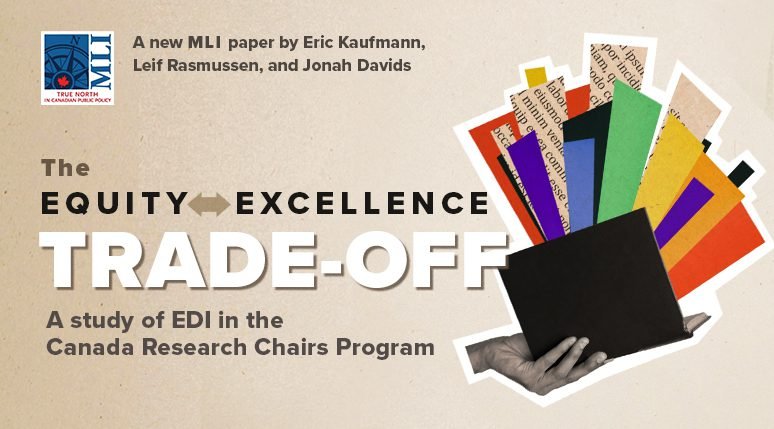
In a newly published report for a Canadian think thank called the Macdonald-Laurier Institute, Eric and two co-authors looked at the demographic data for hundreds of Canada Research Chair professors, going back a quarter century—and cross-indexed each scholar’s identity-based characteristics against his or her h-Index, which is a measure of scholarly influence and prominence.
The equity excellence trade-off: A study of EDI in the Canada Research Chairs Program | Macdonald-Laurier Institute
The analysis reveals that EDI has actively weakened Canadian research and reduced overall academic performance at Canadian universities.
By use of a multivariate analysis that controlled for a wide range of potentially confounding factors, the researchers found that the average h-indices for scholars from so-called “equity groups” were, in many cases, significantly below those associated with the lone non-equity group—which is to say white men who don’t claim a disability or LGBT status.
Eric’s data also showed that in recent years, Canada Research Chair appointees tended to skew their academic focus toward trendy but often obscure social-justice based topics.
Using h-Index as a proxy for value, Eric concludes that overall, the overriding focus on affirmative action within the Canada Research Chairs selection process is equivalent to a tax in the neighbourhood of 12% to 15% on the value that Canadian taxpayers receive from this $300-million per year program.
In the grand scheme of public policy, that’s not a lot of money. But the argument here is that the data set associated with this one self-contained Canadian program can give us a rough estimate of what preferential hiring and admissions programs cost society more generally.
On the other hand, it’s worth asking whether any of this economic analysis will make a difference politically. Survey data show that something like two thirds of Canadians oppose racial preferences and other forms of affirmative action. But among Canadian university administrators, who tend to use upbeat euphemisms such as “inclusive excellence” and “inclusive flourishing,” opposition to aggressive DEI measures is seen as taboo.
Measuring the Economic Cost of Affirmative Action in Academia
A new report on the Canada Research Chairs program analyses the reduced standards applied to scholars belonging to ‘equity groups.’

Indeed, as you’ll hear us discuss, one member of the Canadian academic establishment, a fellow by the name of Alex Usher, became so enraged at Eric’s analysis that, even before reading his paper, he publicly accused Eric of peddling “racist tripe.” Mr. Usher also invited Eric to have a debate about the issue, during which, Mr. Usher boasted, he would “jam this argument so far up your rectal cavity that you’ll gain a new nostril.”
1/ TRIGGERED: The Progressive Activists who police elite institutions just tried to force a retraction of my recent @MLInstitute report on EDI in Canada Research Chairs. This higher ed consultant’s frothing conniption exemplifies how emotional blackmail has replaced reason: pic.twitter.com/64ucSKPcLt
— Eric Kaufmann (@epkaufm) September 4, 2026
On that graphic note, please enjoy my interview with Anglo-Canadian scholar Eric Kaufmann, lead author of a new report from the Macdonald-Laurier Institute entitled, The Equity-Excellence Trade-Off: A Study of EDI in the Canada Research Chairs Program.
Transcript
Read the full article here
Fact Checker
Verify the accuracy of this article using AI-powered analysis and real-time sources.