Close Menu
FSNN | Free Speech News NetworkFSNN | Free Speech News Network
  • Home
  • News
    • Politics
    • Legal & Courts
    • Tech & Big Tech
    • Campus & Education
    • Media & Culture
    • Global Free Speech
  • Opinions
    • Debates
  • Video/Live
  • Community
  • Freedom Index
  • About
    • Mission
    • Contact
    • Support
Trending

Appeals Court Hands Roy Moore Another Loss In Yet Another Bogus Libel Lawsuit

9 minutes ago

The Self-Driving Car Fight in Congress Isn’t Really About Safety at All

12 minutes ago

AI Agent gets EIN from IRS, bank account, crypto wallet in first autonomous company filing

34 minutes ago
Facebook X (Twitter) Instagram
Facebook X (Twitter) Discord Telegram
FSNN | Free Speech News NetworkFSNN | Free Speech News Network
Market Data Newsletter
Friday, May 1
  • Home
  • News
    • Politics
    • Legal & Courts
    • Tech & Big Tech
    • Campus & Education
    • Media & Culture
    • Global Free Speech
  • Opinions
    • Debates
  • Video/Live
  • Community
  • Freedom Index
  • About
    • Mission
    • Contact
    • Support
FSNN | Free Speech News NetworkFSNN | Free Speech News Network
Home»Cryptocurrency & Free Speech Finance»DeFi’s Lose-Lose Problem on Freezing Stolen Funds
Cryptocurrency & Free Speech Finance

DeFi’s Lose-Lose Problem on Freezing Stolen Funds

News RoomBy News Room2 hours agoNo Comments5 Mins Read740 Views
Share Facebook Twitter Pinterest Copy Link LinkedIn Tumblr Email VKontakte Telegram
DeFi’s Lose-Lose Problem on Freezing Stolen Funds
Share
Facebook Twitter Pinterest Email Copy Link

Listen to the article

0:00
0:00

Key Takeaways

Playback Speed

Select a Voice

Decentralized finance (DeFi) protocols are stepping in to freeze stolen funds while centralized issuers face criticism for holding back.

A recent intervention on Arbitrum saw attacker-linked assets frozen after a major exploit, while some stablecoin issuers, including Circle, have faced public backlash for slower or more limited responses in similar situations.

Connor Howe, CEO and co-founder of cross-chain infrastructure project Enso, said that crypto protocols are not that different from centralized platforms or banks if a small group of people can freeze funds.

“The differentiation from a bank compliance officer is less than DeFi idealists will ever admit,” Howe told Cointelegraph.

The debate isn’t the usual kerfuffle between decentralization and centralization, but about who gets to intervene and how quickly they can act. In practice, it can determine whether stolen funds are stopped or slip through.

Crypto community divided on Arbitrum’s decision to freeze stolen funds. Source: Joe Hall

The limits of decentralization in DeFi

To put it simply, the industry is split on whether protocols that call themselves decentralized should be able to freeze funds during exploits.

Protocols like THORChain said they cannot freeze funds by design, even during exploits. Security researchers have questioned that claim, pointing to past cases where intervention did happen.
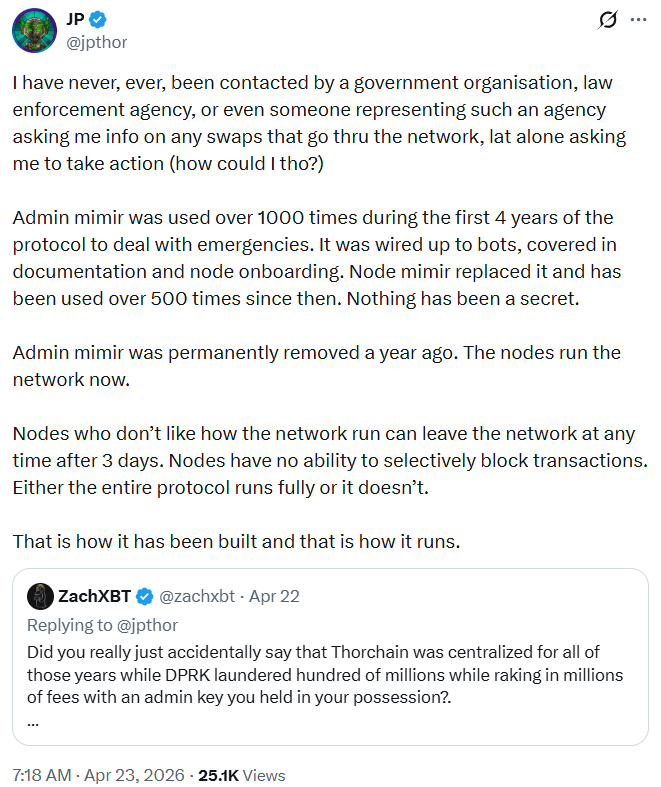
THORChain founder’s defense against the security community. Source: JP Thorbjornsen

Related: Crypto projects shut down as token models fail under pressure

Bernardo Bilotta, CEO of stablecoin infrastructure platform Stables, said the function is necessary but must operate within clear constraints.

“Freeze capabilities need to be narrowly scoped, time-limited and governed by transparent criteria that existed before the breach occurred,” Bilotta told Cointelegraph. “A protocol shouldn’t be making up the rules while the house is on fire.”

Bilotta characterized choosing “philosophical purity” over user protection as “negligence.”

The recent $293 million Kelp DAO exploit brought those discussions back into the spotlight as Arbitrum froze some of the stolen funds linked to suspected North Korean hackers. Some in the industry said the decision cut against DeFi’s grain.

The Ethereum layer-2 network has a 12-member security council with the ability to carry out certain changes to the protocol. In emergency situations, it can do so through nine of the 12 in its multisig wallet.
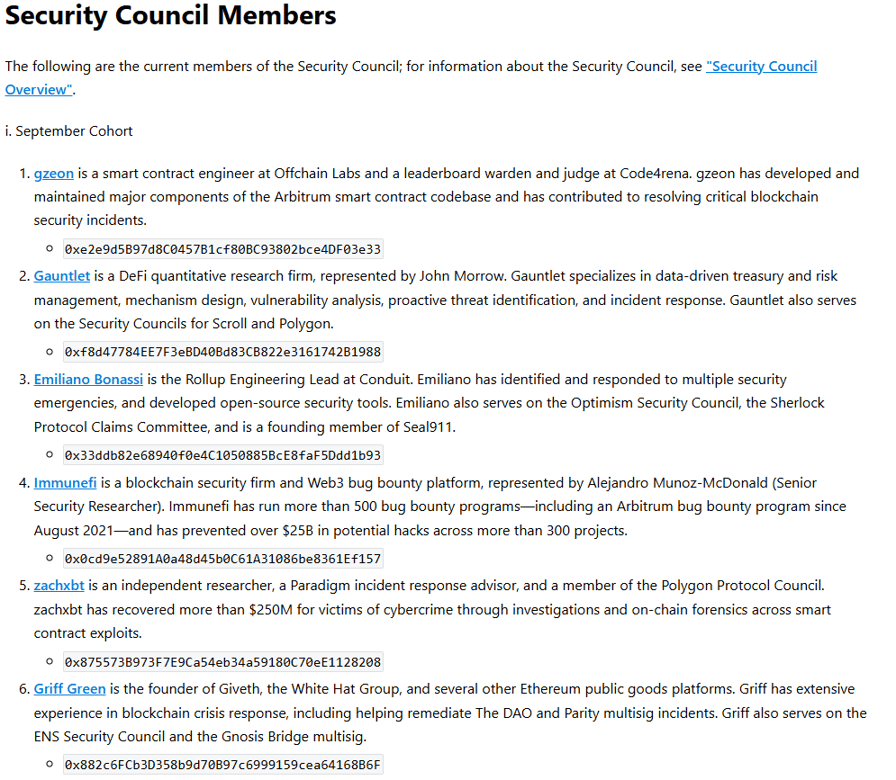
Arbitrum security council members are voted on by the network’s decentralized autonomous organization. Source: Arbitrum

Howe said that transparency in how such security councils operate can still separate DeFi platforms from traditional finance or their centralized counterparts.

“That’s notably different from a TradFi institution that invokes discretionary powers buried in their terms of service and guarded by their legal team,” Howe said.

“There should be transparency in every protocol around who holds the keys, and the safeguards in place to prevent them from going rogue. If there’s no clear distinction, then it’s a vague claim of decentralization.”

Centralized issuers face different constraints

Centralized stablecoins are among the most-traded cryptocurrencies in the world. Tether’s USDt and Circle’s USDC are the largest, accounting for more than $266 billion in combined market capitalization.

Both issuers have the ability to freeze their stablecoins, but they approach that function differently.

While Tether freezes funds more quickly in most security breaches, Circle emphasizes legal process and jurisdiction before intervening, 

“Let me be clear about something that is frequently misunderstood: when Circle freezes USDC, it is not because we have decided, unilaterally or arbitrarily, that someone’s assets should be taken from them,” Dante Disparte, the company’s head of global policy, wrote in a recent blog post.

“Our ability to freeze funds is a compliance obligation — exercised only when we are legally compelled by an appropriate authority, through lawful process,” he continued.

Circle was pushed to explain its stance after the recent $280 million exploit on Solana-based Drift protocol, also attributed to North Korea.

Circle’s explanation did not cut it for security experts demanding answers. Source: ZachXBT

Related: Ethereum’s EEZ could pull other blockchains into its orbit

Bilotta said waiting for formal legal orders in cases with clear, onchain evidence of an exploit is a “failure of responsibility.”

Who decides what counts as “extreme”

Large-scale exploits, including those linked to North Korean actors, have pushed the industry into situations most would consider extreme, where hundreds of millions can be drained and laundered in real time.

Such cases raise the question of who defines what qualifies as “extreme” and when intervention is justified.

“This is the question the industry has been ducking the longest,” said Wish Wu, CEO of institution-focused layer-1 Pharos.

“In practice, ‘extreme’ is too often defined after the fact by whoever holds the keys, which is exactly the failure mode decentralization was meant to avoid,” he added.

Wu said the more credible approach is to define those conditions in advance and encode them into governance, even if that means accepting that some edge cases fall outside those rules.

“Can a small, identifiable group move user funds before users have a fair chance to exit?” Wu asked.

“If the answer is yes, then whatever the marketing says, the system is custodial in substance. If the answer is no, only then are we in an honest conversation about which governance and safety tradeoffs make sense for different use cases.”

Below that line, decentralization loses its substantive meaning, he added.

Magazine: AI-driven hacks could kill DeFi — unless projects act now

Cointelegraph is committed to independent, transparent journalism. This news article is produced in accordance with Cointelegraph’s Editorial Policy and aims to provide accurate and timely information. Readers are encouraged to verify information independently.

Read the full article here

Fact Checker

Verify the accuracy of this article using AI-powered analysis and real-time sources.

Get Your Fact Check Report

Enter your email to receive detailed fact-checking analysis

5 free reports remaining

Continue with Full Access

You've used your 5 free reports. Sign up for unlimited access!

Already have an account? Sign in here

Share. Facebook Twitter Pinterest LinkedIn Tumblr Email Telegram Copy Link
News Room
  • Website
  • Facebook
  • X (Twitter)
  • Instagram
  • LinkedIn

The FSNN News Room is the voice of our in-house journalists, editors, and researchers. We deliver timely, unbiased reporting at the crossroads of finance, cryptocurrency, and global politics, providing clear, fact-driven analysis free from agendas.

Related Articles

Cryptocurrency & Free Speech Finance

AI Agent gets EIN from IRS, bank account, crypto wallet in first autonomous company filing

34 minutes ago
Cryptocurrency & Free Speech Finance

Crypto VC Funding Plunges to $659M in April, Hits 2024 Lows

36 minutes ago
Cryptocurrency & Free Speech Finance

Ethereum ETFs Shed $184M Over 4-Day Negative Streak

40 minutes ago
Cryptocurrency & Free Speech Finance

Bitcoin (BTC) takes another aim at $80,000 as stocks rise, oil drops on Iran optimism

2 hours ago
Cryptocurrency & Free Speech Finance

Dogecoin Hits 2-Month High as DOGE Mining Firm Plans to Go Public via Merger

2 hours ago
Cryptocurrency & Free Speech Finance

Bitcoin (BTC) market cap to hit $16 trillion by 2030, driven by institutional demand: Ark Invest

3 hours ago
Add A Comment
Leave A Reply Cancel Reply

Editors Picks

The Self-Driving Car Fight in Congress Isn’t Really About Safety at All

12 minutes ago

AI Agent gets EIN from IRS, bank account, crypto wallet in first autonomous company filing

34 minutes ago

Crypto VC Funding Plunges to $659M in April, Hits 2024 Lows

36 minutes ago

Ethereum ETFs Shed $184M Over 4-Day Negative Streak

40 minutes ago
Latest Posts

A Bridge to Somewhere: How to Link Your Mastodon, Bluesky, or Other Federated Accounts

1 hour ago

Zimmerman on “The President and the Universities”

1 hour ago

Bitcoin (BTC) takes another aim at $80,000 as stocks rise, oil drops on Iran optimism

2 hours ago

Subscribe to News

Get the latest news and updates directly to your inbox.

At FSNN – Free Speech News Network, we deliver unfiltered reporting and in-depth analysis on the stories that matter most. From breaking headlines to global perspectives, our mission is to keep you informed, empowered, and connected.

FSNN.net is owned and operated by GlobalBoost Media
, an independent media organization dedicated to advancing transparency, free expression, and factual journalism across the digital landscape.

Facebook X (Twitter) Discord Telegram
Latest News

Appeals Court Hands Roy Moore Another Loss In Yet Another Bogus Libel Lawsuit

9 minutes ago

The Self-Driving Car Fight in Congress Isn’t Really About Safety at All

12 minutes ago

AI Agent gets EIN from IRS, bank account, crypto wallet in first autonomous company filing

34 minutes ago

Subscribe to Updates

Get the latest news and updates directly to your inbox.

© 2026 GlobalBoost Media. All Rights Reserved.
  • Privacy Policy
  • Terms of Service
  • Our Authors
  • Contact

Type above and press Enter to search. Press Esc to cancel.

🍪

Cookies

We and our selected partners wish to use cookies to collect information about you for functional purposes and statistical marketing. You may not give us your consent for certain purposes by selecting an option and you can withdraw your consent at any time via the cookie icon.

Cookie Preferences

Manage Cookies

Cookies are small text that can be used by websites to make the user experience more efficient. The law states that we may store cookies on your device if they are strictly necessary for the operation of this site. For all other types of cookies, we need your permission. This site uses various types of cookies. Some cookies are placed by third party services that appear on our pages.

Your permission applies to the following domains:

  • https://fsnn.net
Necessary
Necessary cookies help make a website usable by enabling basic functions like page navigation and access to secure areas of the website. The website cannot function properly without these cookies.
Statistic
Statistic cookies help website owners to understand how visitors interact with websites by collecting and reporting information anonymously.
Preferences
Preference cookies enable a website to remember information that changes the way the website behaves or looks, like your preferred language or the region that you are in.
Marketing
Marketing cookies are used to track visitors across websites. The intention is to display ads that are relevant and engaging for the individual user and thereby more valuable for publishers and third party advertisers.