Close Menu
FSNN | Free Speech News NetworkFSNN | Free Speech News Network
  • Home
  • News
    • Politics
    • Legal & Courts
    • Tech & Big Tech
    • Campus & Education
    • Media & Culture
    • Global Free Speech
  • Opinions
    • Debates
  • Video/Live
  • Community
  • Freedom Index
  • About
    • Mission
    • Contact
    • Support
Trending

Review: The D.C. Museum Where Everything Is for Sale

15 minutes ago

Crypto exchange BitMEX sued for 623 bitcoin as it prepares to shut down

41 minutes ago

Bitcoin Profitability Boost In Doubt As Metric Stays Below Key Breakeven Line

44 minutes ago
Facebook X (Twitter) Instagram
Facebook X (Twitter) Discord Telegram
FSNN | Free Speech News NetworkFSNN | Free Speech News Network
Market Data Newsletter
Friday, July 24
  • Home
  • News
    • Politics
    • Legal & Courts
    • Tech & Big Tech
    • Campus & Education
    • Media & Culture
    • Global Free Speech
  • Opinions
    • Debates
  • Video/Live
  • Community
  • Freedom Index
  • About
    • Mission
    • Contact
    • Support
FSNN | Free Speech News NetworkFSNN | Free Speech News Network
Home»News»Global Free Speech»Cockroach Janta Party protestors holding posters of Bhagat Singh at Jantar Mantar, July 2026. Photo: Pelph Hoters/CC0 1.0 Towards the end of last year, when I was editing our magazine about Gen Z revolts around the world, I asked around about India. Was a Gen Z revolt likely there? After all, young people had toppled governments in neighbouring Bangladesh, Sri Lanka and Nepal. The consensus was that despite the increasing authoritarianism of Prime Minister Narendra Modi and his government, India was on a different trajectory to its much smaller neighbours. The young middle class were largely apolitical. Earlier protests had simply “petered out” because the country was so diverse no one could agree with one another. Eight months later, it turns out there is something which unites young people – the understanding that they are despised by the political elites. The Cockroach Janta Party was formed after a satirical call on social media by student Abhijeet Dipke, a recent graduate from a US university who heard the chief justice of India comparing young unemployed people to “parasites” and “cockroaches”. What would happen, he wrote on Instagram, if all cockroaches came together? It was a call that resonated. Within days of being formed the party’s Instagram account had 22 million followers – far more than the nine million following Modi’s BJP. The authorities tried to strangle the movement at birth, and the Cockroach Janta Party‘s X account was closed down pretty quickly by Elon Musk’s platform after anonymous complaints. But that didn’t stop the momentum and soon the anger was focused on the leak of medical exam questions, meaning millions would have to do expensive retakes. The issue was emblematic of wider problems of graduate unemployment reported to be at 40% for under 25s. In the last week we have seen thousands of Gen Z demonstrators taking to the streets calling for the resignation of Union Education Minister Dharmendra Pradhan. Even the India opposition leader Rahul Gandhi (who has not been popular with young people) has tried to get in on the act and was briefly arrested after joining a sit-in in Delhi. Other disturbing responses have included violence used against some protesters, the prohibition of protests near the parliament building in Delhi and the use of internet shutdowns being deployed in areas where demonstrations were planned to start on Monday. Internet freedom campaigners in India, including the Software Freedom Law Centre (SFLC), have condemned the targeting of the protest with an internet shutdown as setting “a dangerous precedent” as it “strikes at the heart of the fundamental right to freedom of speech and expression”. They also are demanding to know why no order was issued to authorise the blackout, seemingly in violation of the law and not in accordance with the Supreme Court’s ruling on this issue. India has long turned to internet shutdowns for the flimsiest of excuses. According to Access Now India was the world leader for shutting down the internet for six years in a row ending in 2023 (ahead of places like Iran, Russia and Myanmar). The SFLC warn that together with reports of social media content about the protest being “shadow banned”, as well as the closure of roads and metro stations, the government seems to be trying to disrupt protest rather than guarantee public safety. None of this is deterring Cockroach Janta Party supporters. If anything, it seems to be encouraging protesters to turn out. And the party’s popularity carries with it a message; globally connected young people are coming together and they are forces to be reckoned with. READ MORE
Global Free Speech

Cockroach Janta Party protestors holding posters of Bhagat Singh at Jantar Mantar, July 2026. Photo: Pelph Hoters/CC0 1.0 Towards the end of last year, when I was editing our magazine about Gen Z revolts around the world, I asked around about India. Was a Gen Z revolt likely there? After all, young people had toppled governments in neighbouring Bangladesh, Sri Lanka and Nepal. The consensus was that despite the increasing authoritarianism of Prime Minister Narendra Modi and his government, India was on a different trajectory to its much smaller neighbours. The young middle class were largely apolitical. Earlier protests had simply “petered out” because the country was so diverse no one could agree with one another. Eight months later, it turns out there is something which unites young people – the understanding that they are despised by the political elites. The Cockroach Janta Party was formed after a satirical call on social media by student Abhijeet Dipke, a recent graduate from a US university who heard the chief justice of India comparing young unemployed people to “parasites” and “cockroaches”. What would happen, he wrote on Instagram, if all cockroaches came together? It was a call that resonated. Within days of being formed the party’s Instagram account had 22 million followers – far more than the nine million following Modi’s BJP. The authorities tried to strangle the movement at birth, and the Cockroach Janta Party‘s X account was closed down pretty quickly by Elon Musk’s platform after anonymous complaints. But that didn’t stop the momentum and soon the anger was focused on the leak of medical exam questions, meaning millions would have to do expensive retakes. The issue was emblematic of wider problems of graduate unemployment reported to be at 40% for under 25s. In the last week we have seen thousands of Gen Z demonstrators taking to the streets calling for the resignation of Union Education Minister Dharmendra Pradhan. Even the India opposition leader Rahul Gandhi (who has not been popular with young people) has tried to get in on the act and was briefly arrested after joining a sit-in in Delhi. Other disturbing responses have included violence used against some protesters, the prohibition of protests near the parliament building in Delhi and the use of internet shutdowns being deployed in areas where demonstrations were planned to start on Monday. Internet freedom campaigners in India, including the Software Freedom Law Centre (SFLC), have condemned the targeting of the protest with an internet shutdown as setting “a dangerous precedent” as it “strikes at the heart of the fundamental right to freedom of speech and expression”. They also are demanding to know why no order was issued to authorise the blackout, seemingly in violation of the law and not in accordance with the Supreme Court’s ruling on this issue. India has long turned to internet shutdowns for the flimsiest of excuses. According to Access Now India was the world leader for shutting down the internet for six years in a row ending in 2023 (ahead of places like Iran, Russia and Myanmar). The SFLC warn that together with reports of social media content about the protest being “shadow banned”, as well as the closure of roads and metro stations, the government seems to be trying to disrupt protest rather than guarantee public safety. None of this is deterring Cockroach Janta Party supporters. If anything, it seems to be encouraging protesters to turn out. And the party’s popularity carries with it a message; globally connected young people are coming together and they are forces to be reckoned with. READ MORE

News RoomBy News Room2 hours agoNo Comments3 Mins Read342 Views
Share Facebook Twitter Pinterest Copy Link LinkedIn Tumblr Email VKontakte Telegram
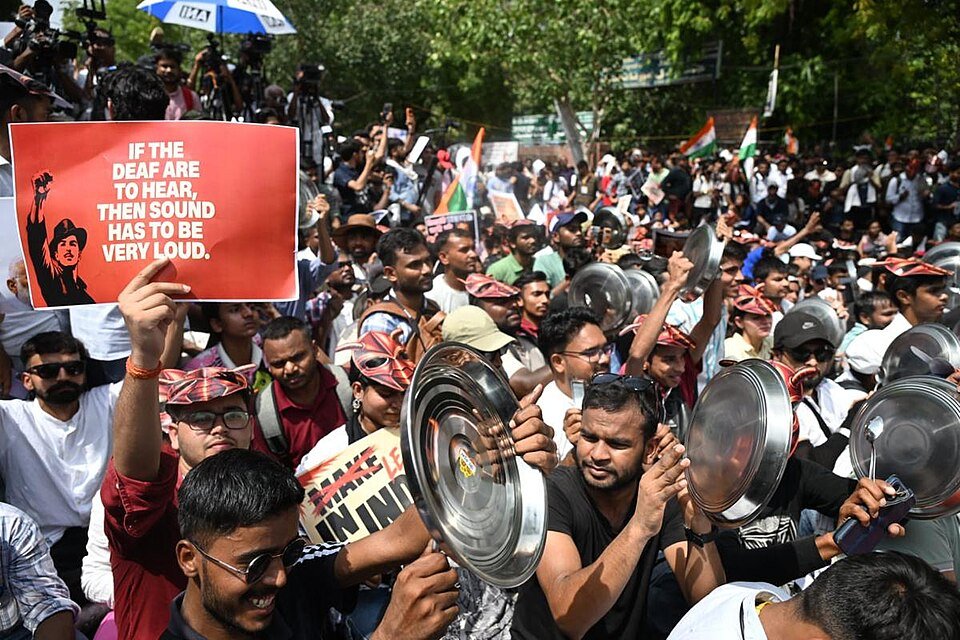
Cockroach Janta Party protestors holding posters of Bhagat Singh at Jantar Mantar, July 2026. Photo: Pelph Hoters/CC0 1.0


				Towards the end of last year, when I was editing our magazine about Gen Z revolts around the world, I asked around about India. Was a Gen Z revolt likely there? After all, young people had toppled governments in neighbouring Bangladesh, Sri Lanka and Nepal. The consensus was that despite the increasing authoritarianism of Prime Minister Narendra Modi and his government, India was on a different trajectory to its much smaller neighbours. The young middle class were largely apolitical. Earlier protests had simply “petered out” because the country was so diverse no one could agree with one another.
Eight months later, it turns out there is something which unites young people – the understanding that they are despised by the political elites. The Cockroach Janta Party was formed after a satirical call on social media by student Abhijeet Dipke, a recent graduate from a US university who heard the chief justice of India comparing young unemployed people to “parasites” and “cockroaches”. What would happen, he wrote on Instagram, if all cockroaches came together?
It was a call that resonated. Within days of being formed the party’s Instagram account had 22 million followers – far more than the nine million following Modi’s BJP.
The authorities tried to strangle the movement at birth, and the Cockroach Janta Party‘s X account was closed down pretty quickly by Elon Musk’s platform after anonymous complaints. But that didn’t stop the momentum and soon the anger was focused on the leak of medical exam questions, meaning millions would have to do expensive retakes. The issue was emblematic of wider problems of graduate unemployment reported to be at 40% for under 25s. In the last week we have seen thousands of Gen Z demonstrators taking to the streets calling for the resignation of Union Education Minister Dharmendra Pradhan. Even the India opposition leader Rahul Gandhi (who has not been popular with young people) has tried to get in on the act and was briefly arrested after joining a sit-in in Delhi.
Other disturbing responses have included violence used against some protesters, the prohibition of protests near the parliament building in Delhi and the use of internet shutdowns being deployed in areas where demonstrations were planned to start on Monday.
Internet freedom campaigners in India, including the Software Freedom Law Centre (SFLC), have condemned the targeting of the protest with an internet shutdown as setting “a dangerous precedent” as it “strikes at the heart of the fundamental right to freedom of speech and expression”. They also are demanding to know why no order was issued to authorise the blackout, seemingly in violation of the law and not in accordance with the Supreme Court’s ruling on this issue. India has long turned to internet shutdowns for the flimsiest of excuses. According to Access Now India was the world leader for shutting down the internet for six years in a row ending in 2023 (ahead of places like Iran, Russia and Myanmar). The SFLC warn that together with reports of social media content about the protest being “shadow banned”, as well as the closure of roads and metro stations, the government seems to be trying to disrupt protest rather than guarantee public safety.
None of this is deterring Cockroach Janta Party supporters. If anything, it seems to be encouraging protesters to turn out. And the party’s popularity carries with it a message; globally connected young people are coming together and they are forces to be reckoned with.


				READ MORE
Share
Facebook Twitter Pinterest Email Copy Link

Listen to the article

0:00
0:00

Key Takeaways

Playback Speed

Select a Voice

Towards the end of last year, when I was editing our magazine about Gen Z revolts around the world, I asked around about India. Was a Gen Z revolt likely there? After all, young people had toppled governments in neighbouring Bangladesh, Sri Lanka and Nepal. The consensus was that despite the increasing authoritarianism of Prime Minister Narendra Modi and his government, India was on a different trajectory to its much smaller neighbours. The young middle class were largely apolitical. Earlier protests had simply “petered out” because the country was so diverse no one could agree with one another.

Eight months later, it turns out there is something which unites young people – the understanding that they are despised by the political elites. The Cockroach Janta Party was formed after a satirical call on social media by student Abhijeet Dipke, a recent graduate from a US university who heard the chief justice of India comparing young unemployed people to “parasites” and “cockroaches”. What would happen, he wrote on Instagram, if all cockroaches came together?

It was a call that resonated. Within days of being formed the party’s Instagram account had 22 million followers – far more than the nine million following Modi’s BJP.

The authorities tried to strangle the movement at birth, and the Cockroach Janta Party‘s X account was closed down pretty quickly by Elon Musk’s platform after anonymous complaints. But that didn’t stop the momentum and soon the anger was focused on the leak of medical exam questions, meaning millions would have to do expensive retakes. The issue was emblematic of wider problems of graduate unemployment reported to be at 40% for under 25s. In the last week we have seen thousands of Gen Z demonstrators taking to the streets calling for the resignation of Union Education Minister Dharmendra Pradhan. Even the India opposition leader Rahul Gandhi (who has not been popular with young people) has tried to get in on the act and was briefly arrested after joining a sit-in in Delhi.

Other disturbing responses have included violence used against some protesters, the prohibition of protests near the parliament building in Delhi and the use of internet shutdowns being deployed in areas where demonstrations were planned to start on Monday.

Internet freedom campaigners in India, including the Software Freedom Law Centre (SFLC), have condemned the targeting of the protest with an internet shutdown as setting “a dangerous precedent” as it “strikes at the heart of the fundamental right to freedom of speech and expression”. They also are demanding to know why no order was issued to authorise the blackout, seemingly in violation of the law and not in accordance with the Supreme Court’s ruling on this issue. India has long turned to internet shutdowns for the flimsiest of excuses. According to Access Now India was the world leader for shutting down the internet for six years in a row ending in 2023 (ahead of places like Iran, Russia and Myanmar). The SFLC warn that together with reports of social media content about the protest being “shadow banned”, as well as the closure of roads and metro stations, the government seems to be trying to disrupt protest rather than guarantee public safety.

None of this is deterring Cockroach Janta Party supporters. If anything, it seems to be encouraging protesters to turn out. And the party’s popularity carries with it a message; globally connected young people are coming together and they are forces to be reckoned with.

Read the full article here

Fact Checker

Verify the accuracy of this article using AI-powered analysis and real-time sources.

Get Your Fact Check Report

Enter your email to receive detailed fact-checking analysis

5 free reports remaining

Continue with Full Access

You've used your 5 free reports. Sign up for unlimited access!

Already have an account? Sign in here

Share. Facebook Twitter Pinterest LinkedIn Tumblr Email Telegram Copy Link
News Room
  • Website
  • Facebook
  • X (Twitter)
  • Instagram
  • LinkedIn

The FSNN News Room is the voice of our in-house journalists, editors, and researchers. We deliver timely, unbiased reporting at the crossroads of finance, cryptocurrency, and global politics, providing clear, fact-driven analysis free from agendas.

Related Articles

Global Free Speech

Philippine journalist Marchel Espina charged with unjust vexation over opinion article

4 hours ago
Global Free Speech

The Royal Courts of Justice. Photo: StevovoB/NeedPix Years ago when still a baby defence barrister, a brief landed on my desk. The defendant, we shall call him Mohammad, was from Somalia. He was a PhD student travelling for his studies to Germany when civil war broke out. Mohammad’s sister was raped by soldiers; his father murdered. Newly married with a baby, he used all his money to pay for passage to the UK. This meant using forged travel documents. The family were eventually granted asylum. But Mohammad kept the forged passport; a symbol of his past life, perhaps. On a trip to visit German friends, the forged passport was discovered. He was charged with an offence to which he had no defence in law. The first trial saw running battles between me and the judge. At every opportunity he angrily reminded the court  of the defendant’s guilt. His summing up consisted of countering the arguments I had advanced in Mohammad’s defence. After two days deliberating, the jury were discharged, unable to reach a decision. The second trial was before a different judge. No angry exchanges. Just a measured, even-tempered stewardship of proceedings. A unanimous acquittal followed. Absent a bullying judge, this jury felt free to deliver a verdict according to their conscience; a principle called jury equity. I did not explicitly reference this principle in my closing speech. Nonetheless, it has often featured, in cases like Mohammad’s, when attempting to appeal to a jury’s sense of compassion. It was clear when Mohammad walked tearfully from the dock, that every right-minded person in that courtroom knew his prosecution, though lawful, was wrong. And so to the Filton trial and the unprecedented prosecution of my friend, Rajiv Menon KC, due to stand trial on 28 July for alleged contempt of court. Rajiv was lead counsel representing the first of six Palestine Action defendants charged with offences arising out of an incident in 2024 at an arms factory in Filton, Bristol, owned by Israeli-based Elbit Systems. During the incident, the defendents smashed equipment and one injured a police officer.  At the trial the judge made orders prohibiting defence barristers from mentioning jury equity in their closing speeches. That effectively meant forbidding them from telling the jury that they (the jury) were free to act on their conscience despite the law. The trial judge alleges that Rajiv disobeyed the order and has asked another judge to try him for contempt. The Filton trial was, in many ways, different from Mohammad’s. However, the principles at stake are the same. You may not agree with the Filton defendants’ cause or their methods. And, we can all sympathise with the police officer injured whilst doing her job, but we must all surely agree that every defendant deserves a fair trial. By severely limiting some defences, removing other defences altogether, and making orders disallowing defence counsel from referring to long-established basic principles like jury equity, a trial judge is at risk of reducing the jury’s role to a ceremonial one. That is why everyone should care about what happened in the Filton trial and what is happening now to Rajiv Menon. This is not just about a closing speech made by one defence barrister. Most defence barristers have, at some point, relied on the constitutional right of a jury to acquit even when a judge thinks that guilt is a forgone conclusion. It is a principle considered so important that it is enshrined on a plaque in the Central Criminal Court. And yet, today the very mention of it is being prohibited in protest trials, with the accompanying threat of contempt proceedings. This is about the essence of why the jury equity principle is necessary and has survived so long. It is recognised as a useful long-stop against state oppression. I would add, as a Black person who has observed first-hand the oppressive way in which our people are policed, the collective wisdom of twelve strangers along with jury equity, is sometimes our only chance of justice. Let’s be clear, this attack on jury equity and the heavy-handed attempt to gag defence counsel, is an attack upon basic freedoms. It will have a chilling effect on all defence barristers in politically sensitive cases as well as on the right to protest. Other important safeguards will be caught in the dragnet. Defence counsel’s obligation to fight fearlessly and the very concept of jury trial itself, are all up for grabs. In the 1980’s, during a wave of far-right attacks on Black communities in Bradford, twelve men were charged with offences linked to stockpiling 38 petrol bombs. One of the twelve, Tarlochan Gata Aura, admitted making and storing the bombs to protect his community. The late Sibghat Kadri QC, head of the chambers where I trained, was one of the defence barristers in that trial which ended with acquittals despite overwhelming evidence against them. Constantly interrupted by a hostile judge, the defence were warned against making the trial political. Kadri, a barrister who believed it was every lawyer’s duty to fight inside and outside the court, must be turning in his grave. READ MORE

23 hours ago
Global Free Speech

CPJ,  partners demand release of Egyptian cartoonist Ashraf Omar on arrest anniversary

2 days ago
Global Free Speech

Hungary’s initial media reforms are promising but lasting safeguards still needed

2 days ago
Global Free Speech

Cuban journalist threatened, interrogated by state security over newsletter

3 days ago
Global Free Speech

CPJ, partners call for investigation into the killing of Yemeni journalist Mohammed Aydah

3 days ago
Add A Comment
Leave A Reply Cancel Reply

Editors Picks

Crypto exchange BitMEX sued for 623 bitcoin as it prepares to shut down

41 minutes ago

Bitcoin Profitability Boost In Doubt As Metric Stays Below Key Breakeven Line

44 minutes ago

Polymarket Account in Farage Backer’s Name Took $9M in Crypto From Unknown Sources: FT

48 minutes ago

This Bipartisan Senate Bill Would Make Your Google Search Results Less Useful

1 hour ago
Latest Posts

Cockroach Janta Party protestors holding posters of Bhagat Singh at Jantar Mantar, July 2026. Photo: Pelph Hoters/CC0 1.0 Towards the end of last year, when I was editing our magazine about Gen Z revolts around the world, I asked around about India. Was a Gen Z revolt likely there? After all, young people had toppled governments in neighbouring Bangladesh, Sri Lanka and Nepal. The consensus was that despite the increasing authoritarianism of Prime Minister Narendra Modi and his government, India was on a different trajectory to its much smaller neighbours. The young middle class were largely apolitical. Earlier protests had simply “petered out” because the country was so diverse no one could agree with one another. Eight months later, it turns out there is something which unites young people – the understanding that they are despised by the political elites. The Cockroach Janta Party was formed after a satirical call on social media by student Abhijeet Dipke, a recent graduate from a US university who heard the chief justice of India comparing young unemployed people to “parasites” and “cockroaches”. What would happen, he wrote on Instagram, if all cockroaches came together? It was a call that resonated. Within days of being formed the party’s Instagram account had 22 million followers – far more than the nine million following Modi’s BJP. The authorities tried to strangle the movement at birth, and the Cockroach Janta Party‘s X account was closed down pretty quickly by Elon Musk’s platform after anonymous complaints. But that didn’t stop the momentum and soon the anger was focused on the leak of medical exam questions, meaning millions would have to do expensive retakes. The issue was emblematic of wider problems of graduate unemployment reported to be at 40% for under 25s. In the last week we have seen thousands of Gen Z demonstrators taking to the streets calling for the resignation of Union Education Minister Dharmendra Pradhan. Even the India opposition leader Rahul Gandhi (who has not been popular with young people) has tried to get in on the act and was briefly arrested after joining a sit-in in Delhi. Other disturbing responses have included violence used against some protesters, the prohibition of protests near the parliament building in Delhi and the use of internet shutdowns being deployed in areas where demonstrations were planned to start on Monday. Internet freedom campaigners in India, including the Software Freedom Law Centre (SFLC), have condemned the targeting of the protest with an internet shutdown as setting “a dangerous precedent” as it “strikes at the heart of the fundamental right to freedom of speech and expression”. They also are demanding to know why no order was issued to authorise the blackout, seemingly in violation of the law and not in accordance with the Supreme Court’s ruling on this issue. India has long turned to internet shutdowns for the flimsiest of excuses. According to Access Now India was the world leader for shutting down the internet for six years in a row ending in 2023 (ahead of places like Iran, Russia and Myanmar). The SFLC warn that together with reports of social media content about the protest being “shadow banned”, as well as the closure of roads and metro stations, the government seems to be trying to disrupt protest rather than guarantee public safety. None of this is deterring Cockroach Janta Party supporters. If anything, it seems to be encouraging protesters to turn out. And the party’s popularity carries with it a message; globally connected young people are coming together and they are forces to be reckoned with. READ MORE

2 hours ago

Mirae plans to turn crypto exchange Korbit into something Korea hasn’t seen before

2 hours ago

South Korea’s Korbit to rebrand as Digital X under Mirae: Report

2 hours ago

Subscribe to News

Get the latest news and updates directly to your inbox.

At FSNN – Free Speech News Network, we deliver unfiltered reporting and in-depth analysis on the stories that matter most. From breaking headlines to global perspectives, our mission is to keep you informed, empowered, and connected.

FSNN.net is owned and operated by GlobalBoost Media
, an independent media organization dedicated to advancing transparency, free expression, and factual journalism across the digital landscape.

Facebook X (Twitter) Discord Telegram
Latest News

Review: The D.C. Museum Where Everything Is for Sale

15 minutes ago

Crypto exchange BitMEX sued for 623 bitcoin as it prepares to shut down

41 minutes ago

Bitcoin Profitability Boost In Doubt As Metric Stays Below Key Breakeven Line

44 minutes ago

Subscribe to Updates

Get the latest news and updates directly to your inbox.

© 2026 GlobalBoost Media. All Rights Reserved.
  • Privacy Policy
  • Terms of Service
  • Our Authors
  • Contact

Type above and press Enter to search. Press Esc to cancel.

🍪

Cookies

We and our selected partners wish to use cookies to collect information about you for functional purposes and statistical marketing. You may not give us your consent for certain purposes by selecting an option and you can withdraw your consent at any time via the cookie icon.

Cookie Preferences

Manage Cookies

Cookies are small text that can be used by websites to make the user experience more efficient. The law states that we may store cookies on your device if they are strictly necessary for the operation of this site. For all other types of cookies, we need your permission. This site uses various types of cookies. Some cookies are placed by third party services that appear on our pages.

Your permission applies to the following domains:

  • https://fsnn.net
Necessary
Necessary cookies help make a website usable by enabling basic functions like page navigation and access to secure areas of the website. The website cannot function properly without these cookies.
Statistic
Statistic cookies help website owners to understand how visitors interact with websites by collecting and reporting information anonymously.
Preferences
Preference cookies enable a website to remember information that changes the way the website behaves or looks, like your preferred language or the region that you are in.
Marketing
Marketing cookies are used to track visitors across websites. The intention is to display ads that are relevant and engaging for the individual user and thereby more valuable for publishers and third party advertisers.