Close Menu
FSNN | Free Speech News NetworkFSNN | Free Speech News Network
  • Home
  • News
    • Politics
    • Legal & Courts
    • Tech & Big Tech
    • Campus & Education
    • Media & Culture
    • Global Free Speech
  • Opinions
    • Debates
  • Video/Live
  • Community
  • Freedom Index
  • About
    • Mission
    • Contact
    • Support
Trending

DOGE Shut Down This Agency. Now Its Employees Are Back on the Payroll With Nothing To Do.

9 minutes ago

Bitcoin ETFs bleed nearly $500 million in one day: Crypto Daily

18 minutes ago

US government moves $770M of seized Bitcoin to Coinbase Prime

28 minutes ago
Facebook X (Twitter) Instagram
Facebook X (Twitter) Discord Telegram
FSNN | Free Speech News NetworkFSNN | Free Speech News Network
Market Data Newsletter
Thursday, October 8
  • Home
  • News
    • Politics
    • Legal & Courts
    • Tech & Big Tech
    • Campus & Education
    • Media & Culture
    • Global Free Speech
  • Opinions
    • Debates
  • Video/Live
  • Community
  • Freedom Index
  • About
    • Mission
    • Contact
    • Support
FSNN | Free Speech News NetworkFSNN | Free Speech News Network
Home»Cryptocurrency & Free Speech Finance»Bitcoin Short Liquidations Eye Monthly High After Squeeze to $64,500
Cryptocurrency & Free Speech Finance

Bitcoin Short Liquidations Eye Monthly High After Squeeze to $64,500

News RoomBy News Room2 months agoNo Comments3 Mins Read5 Views
Share Facebook Twitter Pinterest Copy Link LinkedIn Tumblr Email VKontakte Telegram
Bitcoin Short Liquidations Eye Monthly High After Squeeze to ,500
Share
Facebook Twitter Pinterest Email Copy Link

Listen to the article

0:00
0:00

Key Takeaways

Playback Speed

Select a Voice

Bitcoin (BTC) short liquidations hit their highest in almost one month as it hit $64,500 on Monday, new data reveals.

Key points:

  • Bitcoin passed $64,000 thanks to a short squeeze on derivatives markets, CryptoQuant says.
  • An ongoing downward funding-rate reset from 0.006% to 0.003% over 24 hours could mean further short squeezes.
  • The absence of spot demand raises doubts whether the upside is sustainable after a week of $267.2 million in net ETF outflows.

Bitcoin short liquidations near one-month high 

BTC/USD rallied after Sunday’s weekly close, gaining up to 3% on Monday to top out at one-week highs of $64,550 on Bitstamp. 

BTC/USD one-hour chart. Source: Cointelegraph/TradingView

Examining the impetus behind the latest BTC price gains, onchain analytics platform CryptoQuant pointed to illiquid markets and funding-rate imbalances among exchanges.

Before rebounding on Monday, BTC circled near $62,750. Around this level, funding rates between exchanges began to diverge. Shorts were dominant on major platforms such as Binance, Bybit, OKX and Deribit, while the funding rate on HTX briefly spiked to 0.05%.

Funding rates refer to periodic payments exchanged by long and short traders on Bitcoin derivatives markets in order to maintain their positions. Positive aggregate funding rates show that long traders are actively paying shorts, with the reverse true for negative funding rates.

“This crowded short positioning served as the primary catalyst, fueling a short squeeze that drove prices higher,” CryptoQuant continued.
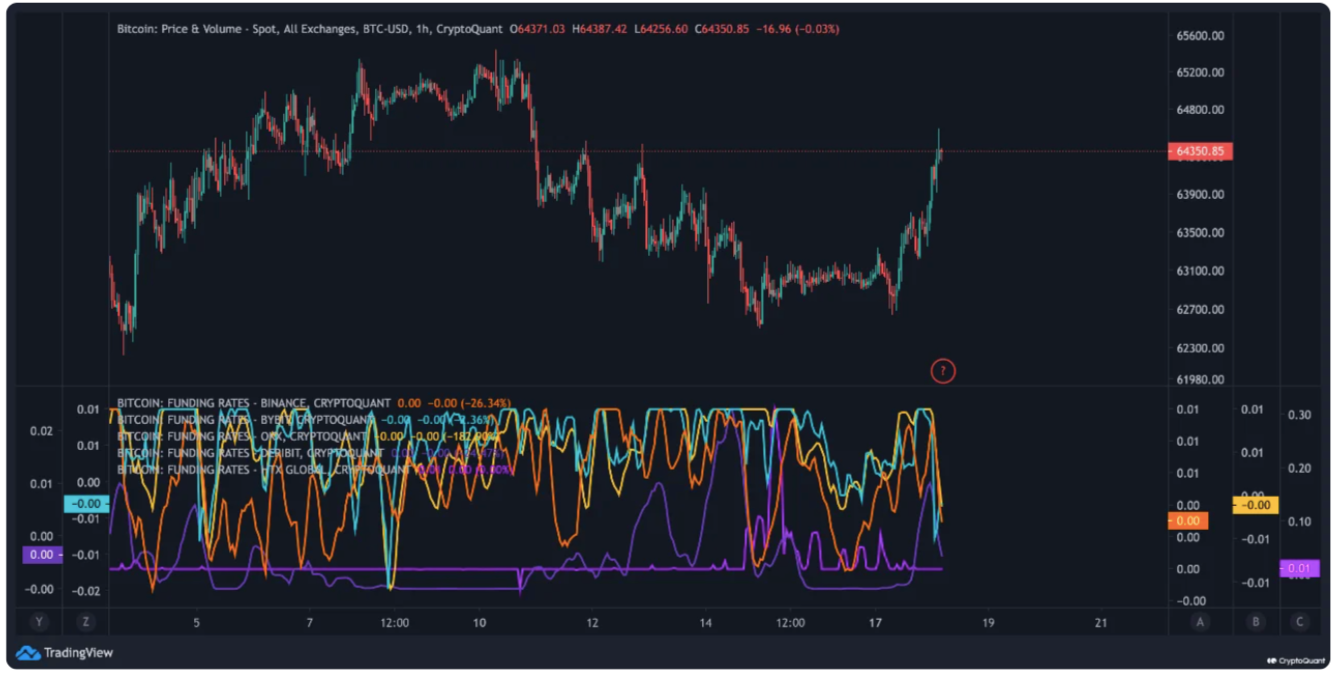
BTC/USD one-hour chart with exchange funding-rate data (screenshot). Source: CryptoQuant

Data puts total Bitcoin short liquidations at 637 BTC for Monday, the largest single-day tally since July 21.

Describing the event as a “low-volume liquidity trap,” CryptoQuant nonetheless suggested that the market could see more short squeezes next, with funding rates already declining again as traders increase short exposure.
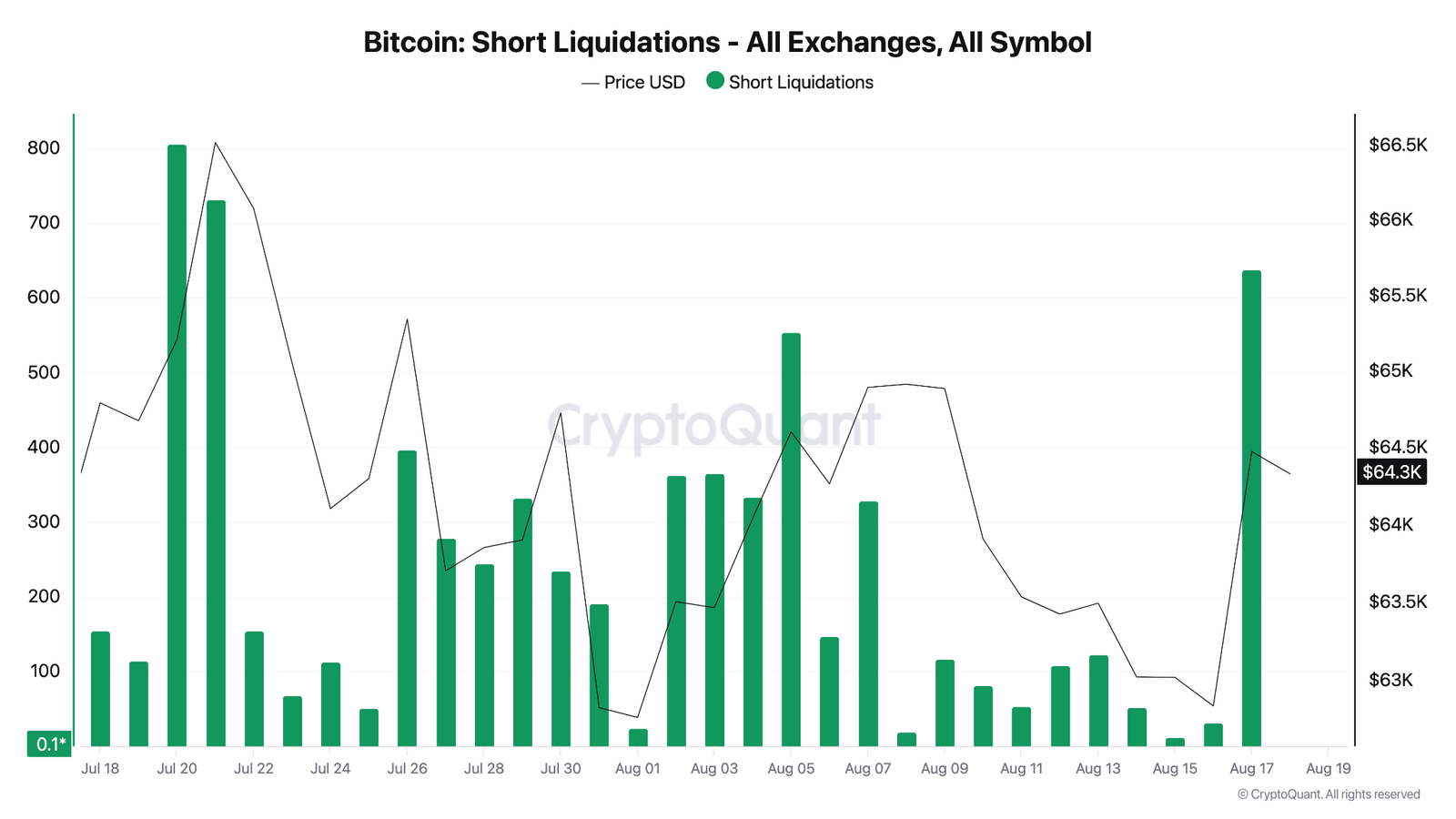
Bitcoin short liquidations. Source: CryptoQuant

Crucial spot demand remains absent

Previously, Cointelegraph reported that Bitcoin futures markets accounted for the majority of trading volume in the current range, with spot traders broadly uninterested. 

Related: BTC price loses 200-week trend line as 2022 repeats: Five things to know in Bitcoin this week

In further analysis on Monday, CryptoQuant called the lack of spot demand the primary hurdle to sustained upside, alongside the lack of inflows to the US spot Bitcoin exchange-traded funds (ETFs).

“A break below $60K alongside rising exchange inflows would weaken the structure and increase downside risk toward $50K. Selling pressure is cooling, but demand still needs to return,” it commented.

Recent buyers who remain underwater on their BTC allocation have helped cement the current trading range. Short-term holders — wallets holding a UTXO for less than 155 days — have their cost basis at around $68,700, reinforcing that level as resistance.

Read the full article here

Fact Checker

Verify the accuracy of this article using AI-powered analysis and real-time sources.

Get Your Fact Check Report

Enter your email to receive detailed fact-checking analysis

5 free reports remaining

Continue with Full Access

You've used your 5 free reports. Sign up for unlimited access!

Already have an account? Sign in here

Share. Facebook Twitter Pinterest LinkedIn Tumblr Email Telegram Copy Link
News Room
  • Website
  • Facebook
  • X (Twitter)
  • Instagram
  • LinkedIn

The FSNN News Room is the voice of our in-house journalists, editors, and researchers. We deliver timely, unbiased reporting at the crossroads of finance, cryptocurrency, and global politics, providing clear, fact-driven analysis free from agendas.

Related Articles

Cryptocurrency & Free Speech Finance

Bitcoin ETFs bleed nearly $500 million in one day: Crypto Daily

18 minutes ago
Cryptocurrency & Free Speech Finance

US government moves $770M of seized Bitcoin to Coinbase Prime

28 minutes ago
Cryptocurrency & Free Speech Finance

Former PlayStation Exec Slams Sony’s Move to Kill Discs: ‘What Are You Buying?’

30 minutes ago
Cryptocurrency & Free Speech Finance

Ethereum researcher’s AI security warning stirs debate as bitcoin extends slide: Crypto Markets Today

1 hour ago
Cryptocurrency & Free Speech Finance

Bitcoin Realized Cap Growth of $12.8 Billion Relied on Existing Holders: Glassnode

1 hour ago
Cryptocurrency & Free Speech Finance

Greece prepares 10% capital gains tax on cryptocurrency

2 hours ago
Add A Comment

Comments are closed.

Editors Picks

Bitcoin ETFs bleed nearly $500 million in one day: Crypto Daily

18 minutes ago

US government moves $770M of seized Bitcoin to Coinbase Prime

28 minutes ago

Former PlayStation Exec Slams Sony’s Move to Kill Discs: ‘What Are You Buying?’

30 minutes ago

The Democrats’ Socialist Moment

1 hour ago
Latest Posts

Criminal defamation threat hangs over dozens of Angolan journalists ahead of 2027 vote

1 hour ago

Painting of trader Elihu Yale One bright spring day in early April 2026, I visited Leeds Castle in Kent to see its dog collar museum. Of the 130 “rare and valuable collars” in the museum, about 60 had been collected by John Hunt, a historian and antiquarian, and later gifted to the castle by his wife Gertrude in 1977. A further 70 had been acquired by “purchase and donation”. According to the Leeds Castle website, its collection of historic collars, many dating back to the 17th and 18th centuries “was the largest of its kind on public display anywhere in the world”. Perhaps – if the exhibits were actually dog collars. But as an historian of slavery, my suspicion was that at least some of the items that I had seen on the website were not dog collars at all, but rather collars once worn by enslaved Black and Indian people in Britain as a mark of their servitude. Photographs of exhibits at the museum revealed large collars which match depictions of these slave collars in paintings dating to the late 17th and early 18th century, and I was keen to compare the two first-hand. But I was thwarted. Despite the website’s pronouncement that “Leeds Castle’s Dog Collar Museum is open daily,” the museum had been closed. It seems that at some point the curatorial team at Leeds Castle discovered that their exhibits were not all dog collars, and quietly shut the museum. So quietly they forgot to update the castle’s website. There were good intentions behind this, no doubt. But it was also an act of historical censorship, even if inadvertent – part of a pattern of rewriting Britain’s role in the slave trade, a tendency that has become more pronounced over the past few years. Between 1675 and 1807 Britain was the main importer of slaves to the New World from Africa. After 1807, when Parliament passed the Abolition of the Slave Trade Act, Britain not only ended its involvement in the international slave trade but actively worked to combat it. Nevertheless, its participation in the slave trade is part of British history. How best to engage with this distasteful part of the story is a complex issue, one that British museums and National Trust sites have a duty to consider carefully. My suspicion was that at least some of the items that I had seen on the website were not dog collars at all As historians undertake deeper research into the topic, the extent of Britain’s investment in slavery, both cultural and material, is becoming evident. Suppressing artefacts, which provide evidence distorts history. Silver slave collars are crucial artefacts which speak to that difficult legacy. The Yale Center for British Art in New Haven, Connecticut owns four portraits of Elihu Yale, dating to between 1710 and 1720. Yale, a wealthy merchant and British colonial administrator, was an early donor to the university now named after him. One of these, painted by the Briton James Worsdale and an imposing 2.3 metres tall, is described as Elihu Yale with his Servant. The portrait, clearly intended to depict Yale as a man of substance, shows him being attended to by a Black slave wearing a silver collar around his neck. Until 2007, it hung in the Yale Corporation Room in the university’s Woodbridge Hall, where the Yale Board of Trustees met to decide campus policy, until a student pointed out the incongruity of the painting on social media: not because it existed, but because of how it existed, benignly watching over meetings of the university’s trustees. John Marciari, a curator for the Yale Center for British Art at the time, acknowledged to the local newspaper, the Hartford Courant, that he knew of many other similar paintings, but that these were normally kept off display. Curators at some museums, he continued, “have since painted over the collars to make the art more palatable.” The paintings of Elihu Yale date to when he was part of the circle of courtiers surrounding Queen Anne. They can be viewed on the Center’s website, along with a discussion of the paintings’ historical provenance and context. Slave collars were a real thing at the time and archival evidence testifies to their ubiquity in England itself. Take, for example, an advertisement in popular newspaper The London Postman, from 17 September 1706: “Runaway from his Master about a fortnight since, a lusty Negro Boy about 18 years of age… Had about his neck a silver collar engraved Captain Thomas Mitchel’s Negro, Living Curators at some museums, he continued in Griffin Street in Shadwell.” An exhibit showing collars at Leeds Castle (Steve Vidler/Alamy) Leeds Castle, to be fair, is an unlikely location for a historical reckoning. On the Easter weekend of my visit to the “dog collar museum”, I was greeted on the path towards the castle by a carved wooden dragon, pretend mermaids and other magical creatures for children to discover. A day at the castle is clearly intended to be a fun day out for children and adults alike. Why force happy families to engage with such disturbing things? But this question underscores an important point: careful thought is a basic prerequisite for the display of such artefacts. For some time, the National Trust (NT) has been engulfed in controversy about the best way to display – or not – such artefacts forming part of the collections in many of its houses. The NT’s collection at Dyrham Park near Bristol, for example, includes a pair of stands that display Black men wearing gold collars holding scallops that serve as side tables. These were given to William Blathwayt in 1700 by his uncle, Thomas Povey. Both had been administrators for empire, with Blathwayt serving six kings and queens over almost 50 years. Leeds Castle, to be fair, is an unlikely location for a historical reckoning The curators at Dyrham Park have approached the issue thoughtfully. In a series of introductory exhibits that visitors encounter before entering the house, they frame Blathwayt’s involvement in empire and in slavery carefully, inviting the observer to acknowledge complicity in a deeply problematic and exploitative system. Then before entering the room with the side tables, visitors find a warning sign providing context for what awaits them. By way of contrast, the same stands also appear on the NT’s website along with the rest of the Dyrham Park collection. The item was once listed as “Nubian Slaves” and “Blackamoor Stands” and is now blandly described as “a pair of giltwood and polychrome stands”; here, there is no discussion of the wider context that the stools are a part of. Dyrham Park stands out for the willingness of its curators to confront this difficult past. Elsewhere, censorship by omission is far more commonplace. Indeed, sometimes this is done in the name of anti-racial history. Some Dutch museums, for instance, seem uncomfortable with any racially descriptive words such as “negro”. In 2015, a painting on the website of the RKD Nederlands Institute for Art History by Herman van der Mijn was entitled Portrait of a Lady with a Negro Servant; now it is just Portrait of an Unknown Woman, with a Servant. Dated about 1720, the Black “servant” was wearing a silver collar, marking him as a slave. Like painting over the silver collars in other works, the renaming of this painting to exclude racial signifiers, which makes it more difficult to be found and to be seen, is again a way of censoring an uncomfortable past. Rather than conceal the existence of these silver collars, museums and other repositories of history have a duty to reckon with the past in meaningful ways. We must see the evidence in order to fully understand the battles fought and costs paid to get rid of such a system. To comprehend how the past continues to shape the present – not only for the descendants of those enslaved in Britain’s empire but for all of us – we cannot and should not censor these historical memories. Museums need to explain to the visitor why it is necessary to engage with such material and why it still disturbs. Perhaps it all comes down to the purpose of museums. Are they supposed to be places that are just a fun day out for families, warming the blood with patriotic ardour? Or can they also be places that help us learn and make us think, that educate us about the past in order for us to make better decisions about the future? Here in the USA, as recently as 30 years ago one could go to Charleston in South Carolina and have little idea that slavery was once pervasive there. The one place that did promise some evidence, the site of the former slave market, was closed to the public. While there and elsewhere across the US, prominent museums have opened to address this history, their interpretations are now directly threatened by the Trump administration. These silver collars and their history, are a part of British history too. Morgan Godwyn, an English minister who had served in Virginia and Barbados wrote in 1682 that “Tho but a few were concerned in this horrid Fact” of slavery in Barbados “yet our whole Nation are guilty”. Perhaps he put it too strongly. But slavery did not just stay safely in the colonies. The NT’s 2020 interim report, Connections between Colonialism and Properties, now in the Care of the National Trust, stating that slavery needs to be more carefully acknowledged at Britain’s historic sites, was exactly right. These silver collars and their history, are a part of British history In response to an email query I sent after my visit, Jo Wiltcher, heritage and engagement director at Leeds Castle, confirmed that the dog collar exhibits were completely closed “following a leak in one of the rooms” in December 2022. When the exhibition was partially reopened, the new display only included a few of the collars. In response to my specific query stating that, “I’ve been working on slave collars for more than a decade (part of a much bigger book) and the online pictures indicated to me that some of the collars might actually have once been used for that purpose,” Wiltcher said: “We are aware of, and are actively working on, [a presentation strategy] behind the scenes.” She further stated that researchers could access the collars by special permission. I suspect that their awareness about the problematic provenance of the collars was sparked by the Guardian’s 2021 coverage of an exhibit at Amsterdam’s Rijksmuseum. As Valika Smeulders, the curator for an exhibit in 2021 put it, with regard to a Dutch silver collar dated 1689: “For the longest time people have not wanted to come to terms with the meaning of those collars … they were always described as being dog collars, but if you look at the paintings, the ones wearing those collars are never the dogs, they are the men.” My best guess is that when Leeds Castle realised what they actually possessed, their solution was to quietly, without fanfare, close the dog collar museum, leaving only a dozen collars behind in two small glass display cases in an otherwise empty room. Ironically, this work of erasure is incomplete. Leeds Castle’s website still has a page dedicated to the dog collar museum, enthusiastically describing its collection of “130 rare and valuable collars … which date from the 15th, 16th and 17th centuries”. Affording researchers access is welcome. But it does not fully address the larger issue of setting out the context that led to the existence of these disturbing collars. If Leeds Castle choose not to display them, they should loan them to another museum. Honest curation is certainly possible to do: to frame these artefacts around the complex issues at stake, to show the real bonds and chains, and the structural legal and social system that was racial slavery. Censoring history is not the answer. More generally, the fact that a dog collar museum was open for 50 years with artefacts that were in many cases likely not meant for dogs – that, in fact, likely intended for humans – raises profound questions about how censorship can work as much by omission as by commission. Because of this omission, a difficult history has been hiding all this time in plain sight. READ MORE

1 hour ago

Ethereum researcher’s AI security warning stirs debate as bitcoin extends slide: Crypto Markets Today

1 hour ago

Subscribe to News

Get the latest news and updates directly to your inbox.

At FSNN – Free Speech News Network, we deliver unfiltered reporting and in-depth analysis on the stories that matter most. From breaking headlines to global perspectives, our mission is to keep you informed, empowered, and connected.

FSNN.net is owned and operated by GlobalBoost Media
, an independent media organization dedicated to advancing transparency, free expression, and factual journalism across the digital landscape.

Facebook X (Twitter) Discord Telegram
Latest News

DOGE Shut Down This Agency. Now Its Employees Are Back on the Payroll With Nothing To Do.

9 minutes ago

Bitcoin ETFs bleed nearly $500 million in one day: Crypto Daily

18 minutes ago

US government moves $770M of seized Bitcoin to Coinbase Prime

28 minutes ago

Subscribe to Updates

Get the latest news and updates directly to your inbox.

© 2026 GlobalBoost Media. All Rights Reserved.
  • Privacy Policy
  • Terms of Service
  • Our Authors
  • Contact

Type above and press Enter to search. Press Esc to cancel.

🍪

Cookies

We and our selected partners wish to use cookies to collect information about you for functional purposes and statistical marketing. You may not give us your consent for certain purposes by selecting an option and you can withdraw your consent at any time via the cookie icon.

Cookie Preferences

Manage Cookies

Cookies are small text that can be used by websites to make the user experience more efficient. The law states that we may store cookies on your device if they are strictly necessary for the operation of this site. For all other types of cookies, we need your permission. This site uses various types of cookies. Some cookies are placed by third party services that appear on our pages.

Your permission applies to the following domains:

  • https://fsnn.net
Necessary
Necessary cookies help make a website usable by enabling basic functions like page navigation and access to secure areas of the website. The website cannot function properly without these cookies.
Statistic
Statistic cookies help website owners to understand how visitors interact with websites by collecting and reporting information anonymously.
Preferences
Preference cookies enable a website to remember information that changes the way the website behaves or looks, like your preferred language or the region that you are in.
Marketing
Marketing cookies are used to track visitors across websites. The intention is to display ads that are relevant and engaging for the individual user and thereby more valuable for publishers and third party advertisers.