Close Menu
FSNN | Free Speech News NetworkFSNN | Free Speech News Network
  • Home
  • News
    • Politics
    • Legal & Courts
    • Tech & Big Tech
    • Campus & Education
    • Media & Culture
    • Global Free Speech
  • Opinions
    • Debates
  • Video/Live
  • Community
  • Freedom Index
  • About
    • Mission
    • Contact
    • Support
Trending

DOGE Shut Down This Agency. Now Its Employees Are Back on the Payroll With Nothing To Do.

7 minutes ago

Bitcoin ETFs bleed nearly $500 million in one day: Crypto Daily

16 minutes ago

US government moves $770M of seized Bitcoin to Coinbase Prime

25 minutes ago
Facebook X (Twitter) Instagram
Facebook X (Twitter) Discord Telegram
FSNN | Free Speech News NetworkFSNN | Free Speech News Network
Market Data Newsletter
Thursday, October 8
  • Home
  • News
    • Politics
    • Legal & Courts
    • Tech & Big Tech
    • Campus & Education
    • Media & Culture
    • Global Free Speech
  • Opinions
    • Debates
  • Video/Live
  • Community
  • Freedom Index
  • About
    • Mission
    • Contact
    • Support
FSNN | Free Speech News NetworkFSNN | Free Speech News Network
Home»News»Media & Culture»The Democrats’ Socialist Moment
Media & Culture

The Democrats’ Socialist Moment

News RoomBy News Room1 hour agoNo Comments7 Mins Read1 Views
Share Facebook Twitter Pinterest Copy Link LinkedIn Tumblr Email VKontakte Telegram
The Democrats’ Socialist Moment
Share
Facebook Twitter Pinterest Email Copy Link

Listen to the article

0:00
0:00

Key Takeaways

Playback Speed

Select a Voice

Ever since Bernie Sanders and Donald Trump crashed through the gates of American politics in 2015, the professional moderates of both major political parties have twisted their ears toward the dreaded sound of oncoming hooves.

For Republicans, the stampede is an ever-present threat, awaiting irritated instruction from the Oval Office. Even in his waning final-midterm season, Trump in 2026 managed to oust in primaries two sitting United States senators, further cementing his decadelong teardown and reconstruction of the GOP.

For Democrats, the mob has been more sporadic and unpredictable, as in the bolt-out-of-the-blue 2018 New York primary defeat of House Democratic Caucus Chair Joe Crowley by the then-unknown Sanders organizer Alexandria Ocasio-Cortez. AOC is one of just two sitting members of Congress to hail from the Democratic Socialists of America (DSA), a fringe caucus that few paid much heed back then. No longer.

When DSA heartthrob Zohran Mamdani topped a desultory field for New York City mayor in November 2025, it was still possible to shrug off the over-the-top reaction—NYC politics gadfly and Sex and the City veteran Cynthia Nixon calling him a “miracle of nature,” Jon Stewart comparing the son of a movie producer and academic to Jackie Robinson—as a localized virus in a deep-blue city with too much media on its hands. But Mamdani this spring took things national, successfully endorsing in House of Representatives primaries three challengers (two DSA and one former DSA), including one inexperienced, nonsense-spewing candidate who toppled the chair of the Congressional Hispanic Caucus.

AOC’s DSA caucus in the House could conceivably triple in size, with the NYC shoo-ins potentially joined by candidates from Philadelphia, Denver, and Detroit. But the real test of the socialists’ mettle will come in the Senate.

Insurgent blocs within major political parties reveal themselves by showing when they’re willing to lose. The Tea Party during its productive heyday of 2009–13 backed some pretty out-there primary candidates who went on to squander some winnable general elections, such as anti–sharia law crusader Sharron Angle, who face-planted in her attempt to unseat a vulnerable Sen. Harry Reid (D–Nev.). Trump, too, has enforced loyalty by jeopardizing seats, as he did earlier this year by bouncing longtime Sen. John Cornyn (R–Texas) with the abjectly corrupt Texas Attorney General Ken Paxton.

Nothing matters more this year for Democrats—and, arguably, the national electorate—than wresting control of the closely divided Senate, which at press time was almost universally forecast as a 50–50 toss-up. Trump’s final two years in office will look a lot different should the opposition party hold the whip hand on the legislative branch’s oversight and investigatory functions. And yet such is the antipathy of younger Democratic voters toward the perceived crusts of the party’s establishment that the DSA and DSA-adjacent cheerleaders fought viciously to elevate three very flawed candidates to contested statewide Senate elections.
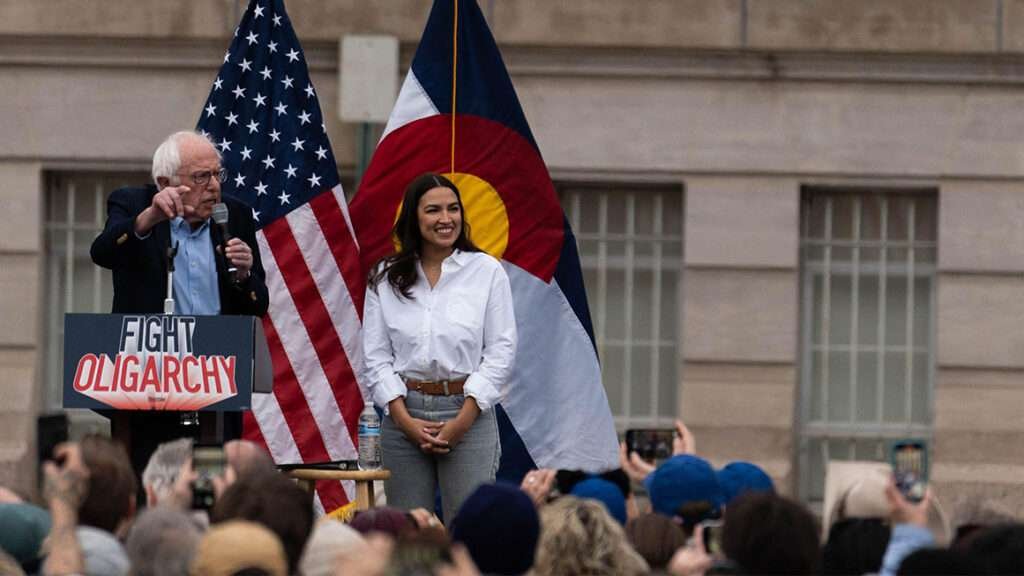
Photo: Sen. Bernie Sanders (I–Vt.), flanked by Rep. Alexandria Ocasio-Cortez (D–N.Y.), speaks in Denver on March 21, 2025; Jesse Paul/The Colorado Sun/Alamy

The first, Maine’s rough-hewn Graham Platner, generated a bewildering-to-outsiders enthusiasm with his billionaire bashing and vituperations against Israel, before eventually withdrawing under a cloud of sexual assault allegations and residual stink over a Nazi tattoo. A second, Florida’s Angie Nixon, won an upset victory over Trump 1.0 resistance hero Alex Vindman by stressing Medicare for All and peace in Gaza, then immediately began distancing herself from the DSA (which she had only recently joined, and which never endorsed her). Regardless of the Democratic primary, incumbent Republican Sen. Ashley Moody is considered the strong favorite.

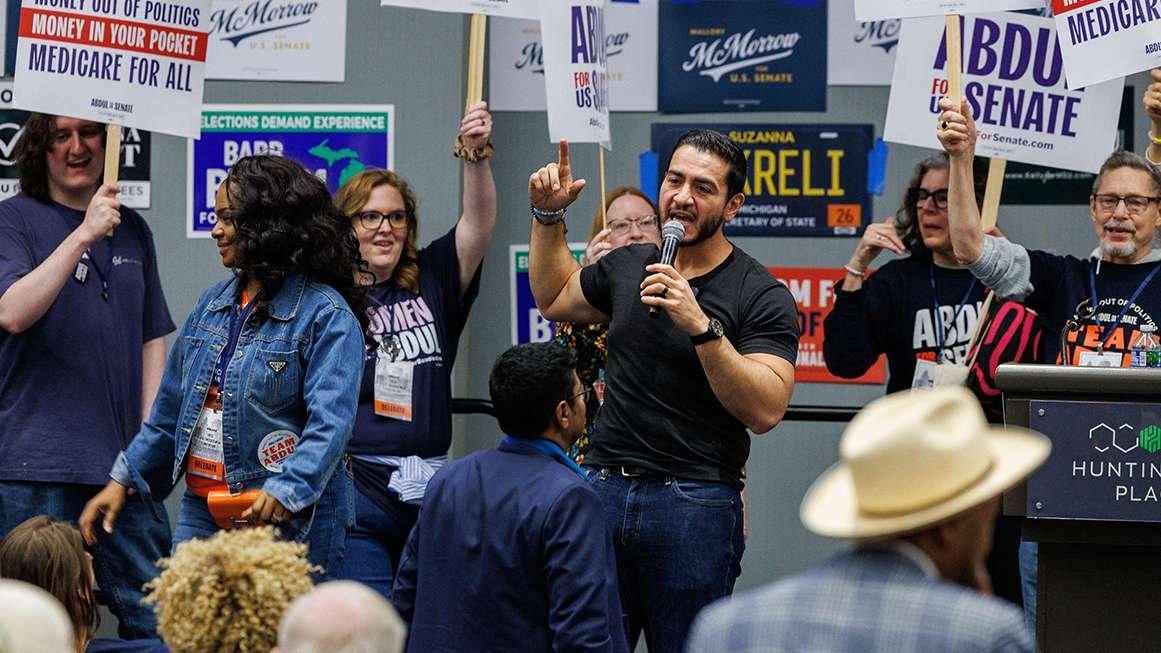
The real center of DSA enthusiasm—and risk—is the third candidate, Michigan’s Abdul El-Sayed, who won a razor-thin primary and is facing a razor-thin general election that could determine the razor-thin control of the Senate. El-Sayed, who combines some of Mamdani’s telegenic charisma with the masculine anger of Platner, is not technically a DSA member (hell hath no fury like the nomenclatural hair splitting of far-left blocs!), but is nonetheless the poster child for the socialistic left in the run-up to November.

What does El-Sayed want? Medicare for All, to bury data centers in a blizzard of burdens and regulations, and above all, to sever America’s tether with Israel, a country he cannot bring himself to affirm should exist. “Every definition of a Jewish state ends up in some articulation of illiberal values,” he told CNN this summer. “Every single one.”

That latter preoccupation has given an opening in this swing state to El-Sayed’s opponent, Mike Rogers, a longtime national security and surveillance hawk–turned Trump toady. Democratic control over the Senate could come down to the perceived antisemitism accompanying the lefty table stakes of decrying Israel as a genocide-committing apartheid state.

Can a mere two handfuls of congressional DSA candidates, including some who are bound to lose, justify the round-the-clock handwringing over the “sexy socialist summer”? Perhaps, yes.

Think back now toward those nervous moderates. How will they modify their behavior so as to keep the populist wolves at bay? House Minority Leader Hakeem Jeffries (D–N.Y.) is facing widespread DSA calls to step aside after saying on Meet the Press that he does not support Medicare for All (a proposal that would be ruinously expensive while criminalizing private insurance plans, among other demerits). Pennsylvania Democratic Gov. Josh Shapiro, a leading party centrist, signed an executive order in August severely restricting data centers, just 14 months after welcoming them with open arms. I had the opportunity recently to ask Sen. Chris Murphy (D–Conn.) the seemingly easy question of whether it’s a good idea for the government to run grocery stores (as it soon will in Mamdani’s New York), and he stammered like a middle schooler who didn’t do the reading.

Numerically minor as it may be, the DSA insurgency is jerking the much larger party leftward on taxing billionaires (including California’s disastrous wealth tax ballot initiative this November), blocking data centers, drastically expanding the already unaffordable entitlement state, and condemning Israel. This remains true even if El-Sayed loses: If you are more likely to lose your job in a primary election than the general, then what matters more is the passion of the grassroots mob, even if that proves to be normie poison.

Hillary Clinton staved off the Sanders challenge in 2016, but then capitulated to his followers on swaths of the Democratic Party platform, particularly on the hoary economic policies the old socialist holds dear. Joe Biden fended off a maniacally woke 2020 Democratic field, and campaigned in the general as a moderate, but then ceded much of his own economic policy to Sen. Elizabeth Warren (D–Mass.) while engaging in whole-of-government initiatives promoting diversity, equity, and inclusion. If the young professional talent in a major political party tilts heavily in a certain direction, then even the graybeards are going to get spun, either as a conscious attempt to fend off an intramural challenge or as mere staffing math.

There is hope yet that prolonged exposure to the Castro-loving, Hamas-apologizing, economically illiterate young fools of the DSA will curdle their electoral fortunes after 10 years (and especially the last 10 months) of growth. But as long as there are out-and-proud socialists winning elections, there’s plenty of work to be done by the anti-socialists of both parties.

This article originally appeared in print under the headline “The Democrats’ Summer of Socialism.”

Read the full article here

Fact Checker

Verify the accuracy of this article using AI-powered analysis and real-time sources.

Get Your Fact Check Report

Enter your email to receive detailed fact-checking analysis

5 free reports remaining

Continue with Full Access

You've used your 5 free reports. Sign up for unlimited access!

Already have an account? Sign in here

#Journalism #MediaBias #NewsAnalysis #OpenDebate #PoliticalNews
Share. Facebook Twitter Pinterest LinkedIn Tumblr Email Telegram Copy Link
News Room
  • Website
  • Facebook
  • X (Twitter)
  • Instagram
  • LinkedIn

The FSNN News Room is the voice of our in-house journalists, editors, and researchers. We deliver timely, unbiased reporting at the crossroads of finance, cryptocurrency, and global politics, providing clear, fact-driven analysis free from agendas.

Related Articles

Media & Culture

DOGE Shut Down This Agency. Now Its Employees Are Back on the Payroll With Nothing To Do.

7 minutes ago
Cryptocurrency & Free Speech Finance

Former PlayStation Exec Slams Sony’s Move to Kill Discs: ‘What Are You Buying?’

28 minutes ago
Media & Culture

Brickbat: Wrong Door

2 hours ago
Cryptocurrency & Free Speech Finance

Samsung Wallet Taps Solana for USDC Transfers on 82M US Galaxy Devices

2 hours ago
Media & Culture

Brickbat: Bumper to Bumper

3 hours ago
Media & Culture

FTX Is Gone, but Its Memory Still Drives Federal Crypto Policy

4 hours ago
Add A Comment
Leave A Reply Cancel Reply

Editors Picks

Bitcoin ETFs bleed nearly $500 million in one day: Crypto Daily

16 minutes ago

US government moves $770M of seized Bitcoin to Coinbase Prime

25 minutes ago

Former PlayStation Exec Slams Sony’s Move to Kill Discs: ‘What Are You Buying?’

28 minutes ago

The Democrats’ Socialist Moment

1 hour ago
Latest Posts

Criminal defamation threat hangs over dozens of Angolan journalists ahead of 2027 vote

1 hour ago

Painting of trader Elihu Yale One bright spring day in early April 2026, I visited Leeds Castle in Kent to see its dog collar museum. Of the 130 “rare and valuable collars” in the museum, about 60 had been collected by John Hunt, a historian and antiquarian, and later gifted to the castle by his wife Gertrude in 1977. A further 70 had been acquired by “purchase and donation”. According to the Leeds Castle website, its collection of historic collars, many dating back to the 17th and 18th centuries “was the largest of its kind on public display anywhere in the world”. Perhaps – if the exhibits were actually dog collars. But as an historian of slavery, my suspicion was that at least some of the items that I had seen on the website were not dog collars at all, but rather collars once worn by enslaved Black and Indian people in Britain as a mark of their servitude. Photographs of exhibits at the museum revealed large collars which match depictions of these slave collars in paintings dating to the late 17th and early 18th century, and I was keen to compare the two first-hand. But I was thwarted. Despite the website’s pronouncement that “Leeds Castle’s Dog Collar Museum is open daily,” the museum had been closed. It seems that at some point the curatorial team at Leeds Castle discovered that their exhibits were not all dog collars, and quietly shut the museum. So quietly they forgot to update the castle’s website. There were good intentions behind this, no doubt. But it was also an act of historical censorship, even if inadvertent – part of a pattern of rewriting Britain’s role in the slave trade, a tendency that has become more pronounced over the past few years. Between 1675 and 1807 Britain was the main importer of slaves to the New World from Africa. After 1807, when Parliament passed the Abolition of the Slave Trade Act, Britain not only ended its involvement in the international slave trade but actively worked to combat it. Nevertheless, its participation in the slave trade is part of British history. How best to engage with this distasteful part of the story is a complex issue, one that British museums and National Trust sites have a duty to consider carefully. My suspicion was that at least some of the items that I had seen on the website were not dog collars at all As historians undertake deeper research into the topic, the extent of Britain’s investment in slavery, both cultural and material, is becoming evident. Suppressing artefacts, which provide evidence distorts history. Silver slave collars are crucial artefacts which speak to that difficult legacy. The Yale Center for British Art in New Haven, Connecticut owns four portraits of Elihu Yale, dating to between 1710 and 1720. Yale, a wealthy merchant and British colonial administrator, was an early donor to the university now named after him. One of these, painted by the Briton James Worsdale and an imposing 2.3 metres tall, is described as Elihu Yale with his Servant. The portrait, clearly intended to depict Yale as a man of substance, shows him being attended to by a Black slave wearing a silver collar around his neck. Until 2007, it hung in the Yale Corporation Room in the university’s Woodbridge Hall, where the Yale Board of Trustees met to decide campus policy, until a student pointed out the incongruity of the painting on social media: not because it existed, but because of how it existed, benignly watching over meetings of the university’s trustees. John Marciari, a curator for the Yale Center for British Art at the time, acknowledged to the local newspaper, the Hartford Courant, that he knew of many other similar paintings, but that these were normally kept off display. Curators at some museums, he continued, “have since painted over the collars to make the art more palatable.” The paintings of Elihu Yale date to when he was part of the circle of courtiers surrounding Queen Anne. They can be viewed on the Center’s website, along with a discussion of the paintings’ historical provenance and context. Slave collars were a real thing at the time and archival evidence testifies to their ubiquity in England itself. Take, for example, an advertisement in popular newspaper The London Postman, from 17 September 1706: “Runaway from his Master about a fortnight since, a lusty Negro Boy about 18 years of age… Had about his neck a silver collar engraved Captain Thomas Mitchel’s Negro, Living Curators at some museums, he continued in Griffin Street in Shadwell.” An exhibit showing collars at Leeds Castle (Steve Vidler/Alamy) Leeds Castle, to be fair, is an unlikely location for a historical reckoning. On the Easter weekend of my visit to the “dog collar museum”, I was greeted on the path towards the castle by a carved wooden dragon, pretend mermaids and other magical creatures for children to discover. A day at the castle is clearly intended to be a fun day out for children and adults alike. Why force happy families to engage with such disturbing things? But this question underscores an important point: careful thought is a basic prerequisite for the display of such artefacts. For some time, the National Trust (NT) has been engulfed in controversy about the best way to display – or not – such artefacts forming part of the collections in many of its houses. The NT’s collection at Dyrham Park near Bristol, for example, includes a pair of stands that display Black men wearing gold collars holding scallops that serve as side tables. These were given to William Blathwayt in 1700 by his uncle, Thomas Povey. Both had been administrators for empire, with Blathwayt serving six kings and queens over almost 50 years. Leeds Castle, to be fair, is an unlikely location for a historical reckoning The curators at Dyrham Park have approached the issue thoughtfully. In a series of introductory exhibits that visitors encounter before entering the house, they frame Blathwayt’s involvement in empire and in slavery carefully, inviting the observer to acknowledge complicity in a deeply problematic and exploitative system. Then before entering the room with the side tables, visitors find a warning sign providing context for what awaits them. By way of contrast, the same stands also appear on the NT’s website along with the rest of the Dyrham Park collection. The item was once listed as “Nubian Slaves” and “Blackamoor Stands” and is now blandly described as “a pair of giltwood and polychrome stands”; here, there is no discussion of the wider context that the stools are a part of. Dyrham Park stands out for the willingness of its curators to confront this difficult past. Elsewhere, censorship by omission is far more commonplace. Indeed, sometimes this is done in the name of anti-racial history. Some Dutch museums, for instance, seem uncomfortable with any racially descriptive words such as “negro”. In 2015, a painting on the website of the RKD Nederlands Institute for Art History by Herman van der Mijn was entitled Portrait of a Lady with a Negro Servant; now it is just Portrait of an Unknown Woman, with a Servant. Dated about 1720, the Black “servant” was wearing a silver collar, marking him as a slave. Like painting over the silver collars in other works, the renaming of this painting to exclude racial signifiers, which makes it more difficult to be found and to be seen, is again a way of censoring an uncomfortable past. Rather than conceal the existence of these silver collars, museums and other repositories of history have a duty to reckon with the past in meaningful ways. We must see the evidence in order to fully understand the battles fought and costs paid to get rid of such a system. To comprehend how the past continues to shape the present – not only for the descendants of those enslaved in Britain’s empire but for all of us – we cannot and should not censor these historical memories. Museums need to explain to the visitor why it is necessary to engage with such material and why it still disturbs. Perhaps it all comes down to the purpose of museums. Are they supposed to be places that are just a fun day out for families, warming the blood with patriotic ardour? Or can they also be places that help us learn and make us think, that educate us about the past in order for us to make better decisions about the future? Here in the USA, as recently as 30 years ago one could go to Charleston in South Carolina and have little idea that slavery was once pervasive there. The one place that did promise some evidence, the site of the former slave market, was closed to the public. While there and elsewhere across the US, prominent museums have opened to address this history, their interpretations are now directly threatened by the Trump administration. These silver collars and their history, are a part of British history too. Morgan Godwyn, an English minister who had served in Virginia and Barbados wrote in 1682 that “Tho but a few were concerned in this horrid Fact” of slavery in Barbados “yet our whole Nation are guilty”. Perhaps he put it too strongly. But slavery did not just stay safely in the colonies. The NT’s 2020 interim report, Connections between Colonialism and Properties, now in the Care of the National Trust, stating that slavery needs to be more carefully acknowledged at Britain’s historic sites, was exactly right. These silver collars and their history, are a part of British history In response to an email query I sent after my visit, Jo Wiltcher, heritage and engagement director at Leeds Castle, confirmed that the dog collar exhibits were completely closed “following a leak in one of the rooms” in December 2022. When the exhibition was partially reopened, the new display only included a few of the collars. In response to my specific query stating that, “I’ve been working on slave collars for more than a decade (part of a much bigger book) and the online pictures indicated to me that some of the collars might actually have once been used for that purpose,” Wiltcher said: “We are aware of, and are actively working on, [a presentation strategy] behind the scenes.” She further stated that researchers could access the collars by special permission. I suspect that their awareness about the problematic provenance of the collars was sparked by the Guardian’s 2021 coverage of an exhibit at Amsterdam’s Rijksmuseum. As Valika Smeulders, the curator for an exhibit in 2021 put it, with regard to a Dutch silver collar dated 1689: “For the longest time people have not wanted to come to terms with the meaning of those collars … they were always described as being dog collars, but if you look at the paintings, the ones wearing those collars are never the dogs, they are the men.” My best guess is that when Leeds Castle realised what they actually possessed, their solution was to quietly, without fanfare, close the dog collar museum, leaving only a dozen collars behind in two small glass display cases in an otherwise empty room. Ironically, this work of erasure is incomplete. Leeds Castle’s website still has a page dedicated to the dog collar museum, enthusiastically describing its collection of “130 rare and valuable collars … which date from the 15th, 16th and 17th centuries”. Affording researchers access is welcome. But it does not fully address the larger issue of setting out the context that led to the existence of these disturbing collars. If Leeds Castle choose not to display them, they should loan them to another museum. Honest curation is certainly possible to do: to frame these artefacts around the complex issues at stake, to show the real bonds and chains, and the structural legal and social system that was racial slavery. Censoring history is not the answer. More generally, the fact that a dog collar museum was open for 50 years with artefacts that were in many cases likely not meant for dogs – that, in fact, likely intended for humans – raises profound questions about how censorship can work as much by omission as by commission. Because of this omission, a difficult history has been hiding all this time in plain sight. READ MORE

1 hour ago

Ethereum researcher’s AI security warning stirs debate as bitcoin extends slide: Crypto Markets Today

1 hour ago

Subscribe to News

Get the latest news and updates directly to your inbox.

At FSNN – Free Speech News Network, we deliver unfiltered reporting and in-depth analysis on the stories that matter most. From breaking headlines to global perspectives, our mission is to keep you informed, empowered, and connected.

FSNN.net is owned and operated by GlobalBoost Media
, an independent media organization dedicated to advancing transparency, free expression, and factual journalism across the digital landscape.

Facebook X (Twitter) Discord Telegram
Latest News

DOGE Shut Down This Agency. Now Its Employees Are Back on the Payroll With Nothing To Do.

7 minutes ago

Bitcoin ETFs bleed nearly $500 million in one day: Crypto Daily

16 minutes ago

US government moves $770M of seized Bitcoin to Coinbase Prime

25 minutes ago

Subscribe to Updates

Get the latest news and updates directly to your inbox.

© 2026 GlobalBoost Media. All Rights Reserved.
  • Privacy Policy
  • Terms of Service
  • Our Authors
  • Contact

Type above and press Enter to search. Press Esc to cancel.

🍪

Cookies

We and our selected partners wish to use cookies to collect information about you for functional purposes and statistical marketing. You may not give us your consent for certain purposes by selecting an option and you can withdraw your consent at any time via the cookie icon.

Cookie Preferences

Manage Cookies

Cookies are small text that can be used by websites to make the user experience more efficient. The law states that we may store cookies on your device if they are strictly necessary for the operation of this site. For all other types of cookies, we need your permission. This site uses various types of cookies. Some cookies are placed by third party services that appear on our pages.

Your permission applies to the following domains:

  • https://fsnn.net
Necessary
Necessary cookies help make a website usable by enabling basic functions like page navigation and access to secure areas of the website. The website cannot function properly without these cookies.
Statistic
Statistic cookies help website owners to understand how visitors interact with websites by collecting and reporting information anonymously.
Preferences
Preference cookies enable a website to remember information that changes the way the website behaves or looks, like your preferred language or the region that you are in.
Marketing
Marketing cookies are used to track visitors across websites. The intention is to display ads that are relevant and engaging for the individual user and thereby more valuable for publishers and third party advertisers.