Close Menu
FSNN | Free Speech News NetworkFSNN | Free Speech News Network
  • Home
  • News
    • Politics
    • Legal & Courts
    • Tech & Big Tech
    • Campus & Education
    • Media & Culture
    • Global Free Speech
  • Opinions
    • Debates
  • Video/Live
  • Community
  • Freedom Index
  • About
    • Mission
    • Contact
    • Support
Trending

Ninth Circuit Ruling Will Force Online Platforms That Host User Speech to Fight Lengthy and Costly Lawsuits Before They Are Dismissed Under Section 230

8 minutes ago

Voter Ignorance and the Problem of Confusion Caused by Candidates With Similar Names

11 minutes ago

Robinhood CEO urges U.S. to clear path for tokenized stocks as overseas markets advance

31 minutes ago
Facebook X (Twitter) Instagram
Facebook X (Twitter) Discord Telegram
FSNN | Free Speech News NetworkFSNN | Free Speech News Network
Market Data Newsletter
Tuesday, August 18
  • Home
  • News
    • Politics
    • Legal & Courts
    • Tech & Big Tech
    • Campus & Education
    • Media & Culture
    • Global Free Speech
  • Opinions
    • Debates
  • Video/Live
  • Community
  • Freedom Index
  • About
    • Mission
    • Contact
    • Support
FSNN | Free Speech News NetworkFSNN | Free Speech News Network
Home»News»Media & Culture»An Update On How I Use AI To Help With Techdirt (It’s Still Not Writing Articles)
Media & Culture

An Update On How I Use AI To Help With Techdirt (It’s Still Not Writing Articles)

News RoomBy News Room1 hour agoNo Comments11 Mins Read2 Views
Share Facebook Twitter Pinterest Copy Link LinkedIn Tumblr Email VKontakte Telegram
An Update On How I Use AI To Help With Techdirt (It’s Still Not Writing Articles)
Share
Facebook Twitter Pinterest Email Copy Link

Listen to the article

0:00
0:00

Key Takeaways

Playback Speed

Select a Voice

from the oh-no-techdirt’s-gone-slop dept

Over in our Insider Chat, someone recently pointed out a tiered “REAL Rating” five-tier scale designed to replace the fairly blunt and misleading question of “did you use AI on that?” with something a bit more nuanced. As someone who believes the discussion about AI could use a lot more nuance, I’m all for the premise. I ran my own usage through their wizard and came out with a “one” — the tier for automation. While this is technically accurate, it also tells you very little about how I actually use AI.

Which is why I thought it made sense to revisit the public discussion regarding my AI usage.

But going through that thought process reminded me that it’s been a little while since I last spoke about how I’m using these tools here, and given that some readers want more transparency, I thought I’d update you on the latest. I’ve written about it at length a few times before, starting in April of 2024, when I described how I used a tool called Lex to help me edit articles. The key was always that I’d write the articles myself, and then I had trained Lex on my own writing style to ask it how it might improve the article. Sometimes it would give good advice that would make me rewrite, and sometimes… it would give bad advice that I would skip or ignore. But all in all it was a useful forcing function.

In June of 2025, I wrote about how I had built a personal task management tool, using a vibe coding tool called Lovable, which I was using to keep track of various tasks, including what I wanted to write about each day. At the beginning of this year, mostly out of curiosity, I explored whether or not you could, with a ton of scaffolding and detailed instructions and effort, get AI tools to write a passable Techdirt article, and concluded no, you absolutely could not. Every attempt was still a weak facsimile of a Techdirt article with iffy language and clichéd phrases.

In the time since then I’ve run that test for myself a few times, and even as the models have improved, in my experience, my initial analysis stands. It cannot write Techdirt-style articles well, and even if I wanted to use it that way, the rewriting, changing, and fact-checking would take way more time than just… writing it myself. So, yes, I continue to write my own articles.

What’s changed in the last couple of years is that I’ve moved away from Lex (which has not received many updates in the past year or so as the team behind it appears to have moved on to other projects), and I ended up building my own editing tool, which is built directly into the task management tool I mentioned last year (which is now self-hosted and entirely within my control). The benefit now is that I can turn any task immediately into a writing project with a single click:

That was the task that turned into this article about Judge Andrew Oldham’s bizarrely out of context quote on mail-in ballots. From there I can go into the writing project which has a bunch of useful features. Within each writing project I can add sources, which turn out to be really useful during edits. I can upload PDFs, URLs, or just add text myself (and actually, as I was finishing up this article, I had it build a new feature that will automatically add all the sources I link to in a story, so the editor checks them even if I don’t add them manually, which is another example of realizing a potentially useful feature and having it created on the spot). I can also have the tool go out and research if there are other sources I should add, though I haven’t yet found that to be that useful as compared to just searching myself.
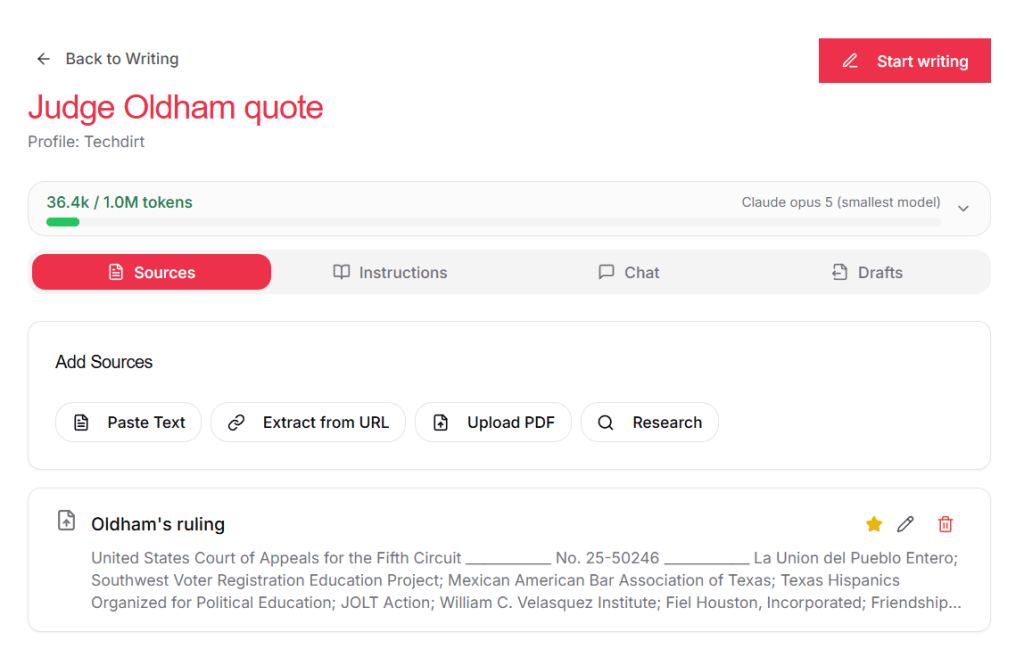
Screenshot showing "sources" tab, showing an uploaded PDF which is "Oldham's ruling" to go with the story I'm writing about Judge Oldham's bonkers opinion.

The tool is specifically trained on my writing, and has a detailed style guide regarding my voice and style, as well as a detailed system prompt of what I am looking for in editorial help vs. what I’m not looking for (e.g., yes, challenge my assumptions and facts, but no do not think you need to rewrite what I’ve written).

After I’ve written the full piece, there’s a button to open up the “AI review” tool (which lets me use any underlying LLM engine I choose, including local ones), which will give me a critical review and make general suggestions about what works and what doesn’t. I do switch up models from time to time to see how they work, but generally will default to either Claude Opus 5 or Sonnet 5. I am also using Gemma 4 locally and am increasingly trying to use that. It’s good on straightforward pieces, but less so once the argument gets more complicated. I’m hopeful that the next generation of local models will be more reliable.

For example here’s part of the initial review of my first draft on the Oldham ruling:
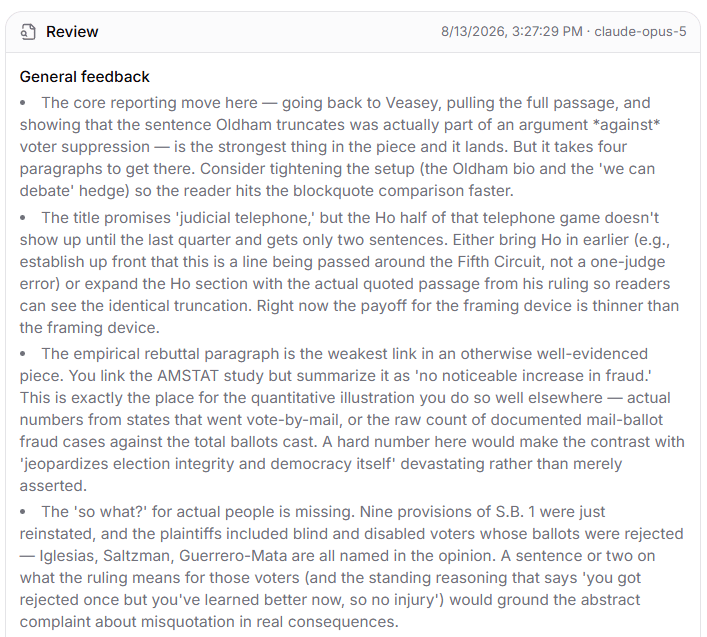
Feedback from the tool:

General feedback

The core reporting move here — going back to Veasey, pulling the full passage, and showing that the sentence Oldham truncates was actually part of an argument *against* voter suppression — is the strongest thing in the piece and it lands. But it takes four paragraphs to get there. Consider tightening the setup (the Oldham bio and the 'we can debate' hedge) so the reader hits the blockquote comparison faster.
The title promises 'judicial telephone,' but the Ho half of that telephone game doesn't show up until the last quarter and gets only two sentences. Either bring Ho in earlier (e.g., establish up front that this is a line being passed around the Fifth Circuit, not a one-judge error) or expand the Ho section with the actual quoted passage from his ruling so readers can see the identical truncation. Right now the payoff for the framing device is thinner than the framing device.
The empirical rebuttal paragraph is the weakest link in an otherwise well-evidenced piece. You link the AMSTAT study but summarize it as 'no noticeable increase in fraud.' This is exactly the place for the quantitative illustration you do so well elsewhere — actual numbers from states that went vote-by-mail, or the raw count of documented mail-ballot fraud cases against the total ballots cast. A hard number here would make the contrast with 'jeopardizes election integrity and democracy itself' devastating rather than merely asserted.
The 'so what?' for actual people is missing. Nine provisions of S.B. 1 were just reinstated, and the plaintiffs included blind and disabled voters whose ballots were rejected — Iglesias, Saltzman, Guerrero-Mata are all named in the opinion. A sentence or two on what the ruling means for those voters (and the standing reasoning that says 'you got rejected once but you've learned better now, so no injury') would ground the abstract complaint about misquotation in real consequences.

The only specific line edits tend to be suggestions on typos or confusing sections, such as here where it suggested a way to clean up and tighten a poorly drafted sentence in my initial draft:
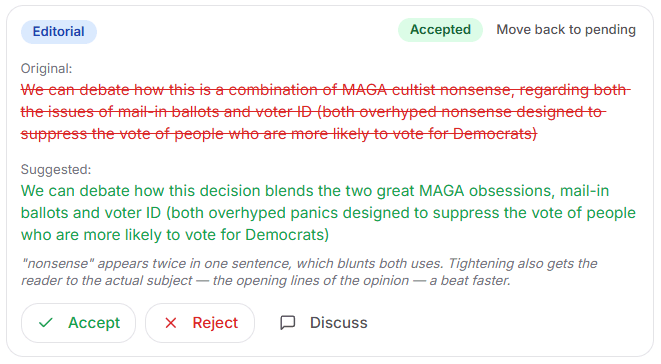
Screenshot showing a suggested of an edit to tighten the sentence, noting that "nonsense appears twice in one sentence which blunts both uses. Tightening also gets the reader to the actual subject - the opening lines of the opinion - a beat faster."

You can also see that “Discuss” button in there, which I will frequently use to debate or discuss certain suggested edits if I think the suggestions miss the mark or are unnecessary. Or I’ll just reject them if I totally disagree.

Usually at that point I’ll do a more thorough rewrite based on my own reread of the article with an eye towards what it called out as problematic. For what it’s worth, this is where the inclusion of original sources is often quite helpful, because the AI will press me on things if its review felt that I’m not being completely fair and honest regarding the source material. Sometimes it calls me out for missing stuff and suggest I dig deeper (it’s not always correct, but often is, and pushes me to reread things even more carefully). Here’s one example, where the AI editor tool told me to go back and review the original documents more closely:
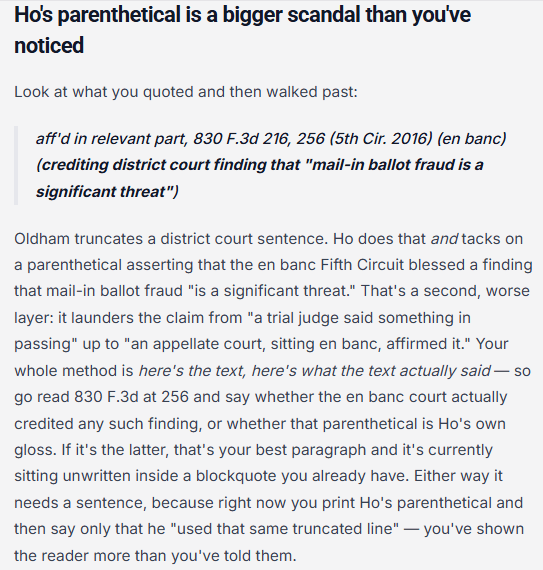
Ho's parenthetical is a bigger scandal than you've noticed
Look at what you quoted and then walked past:

aff'd in relevant part, 830 F.3d 216, 256 (5th Cir. 2016) (en banc) (crediting district court finding that "mail-in ballot fraud is a significant threat")

Oldham truncates a district court sentence. Ho does that and tacks on a parenthetical asserting that the en banc Fifth Circuit blessed a finding that mail-in ballot fraud "is a significant threat." That's a second, worse layer: it launders the claim from "a trial judge said something in passing" up to "an appellate court, sitting en banc, affirmed it." Your whole method is here's the text, here's what the text actually said — so go read 830 F.3d at 256 and say whether the en banc court actually credited any such finding, or whether that parenthetical is Ho's own gloss. If it's the latter, that's your best paragraph and it's currently sitting unwritten inside a blockquote you already have. Either way it needs a sentence, because right now you print Ho's parenthetical and then say only that he "used that same truncated line" — you've shown the reader more than you've told them.

It also catches me when I start rambling, which often happens on a first draft when I’m trying to figure out the best way to nail down a certain point:
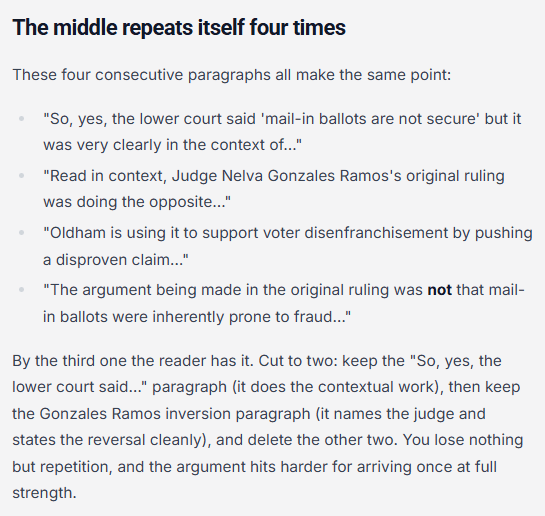
The middle repeats itself four times
These four consecutive paragraphs all make the same point:

"So, yes, the lower court said 'mail-in ballots are not secure' but it was very clearly in the context of…"
"Read in context, Judge Nelva Gonzales Ramos's original ruling was doing the opposite…"
"Oldham is using it to support voter disenfranchisement by pushing a disproven claim…"
"The argument being made in the original ruling was not that mail-in ballots were inherently prone to fraud…"
By the third one the reader has it. Cut to two: keep the "So, yes, the lower court said…" paragraph (it does the contextual work), then keep the Gonzales Ramos inversion paragraph (it names the judge and states the reversal cleanly), and delete the other two. You lose nothing but repetition, and the argument hits harder for arriving once at full strength.

Again, I don’t always follow its suggestions, but it does make me revisit and look at rewriting sections to make them clearer and tighter.

Separately, I have a built in set of “sub-agents” that will check certain things, including suggesting better headlines (this is very hit or miss, but usually at least helps me think of something better than either my initial attempt or its suggestions) and one sub-agent whose whole job is to poke holes in the arguments in the piece (this one is fun, but annoying, as it’s basically trolling myself, but in a way that helps me make the arguments stronger):
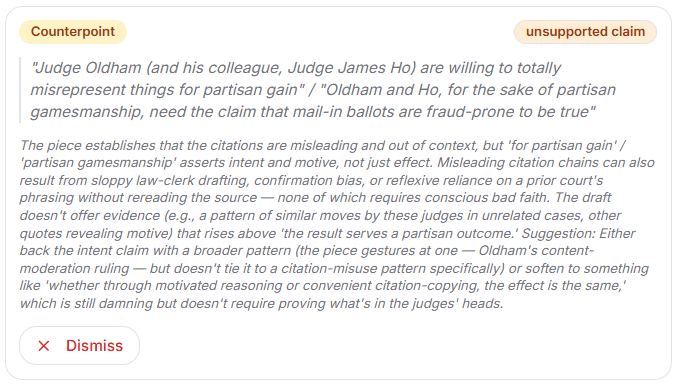
Counterpoint
unsupported claim
"Judge Oldham (and his colleague, Judge James Ho) are willing to totally misrepresent things for partisan gain" / "Oldham and Ho, for the sake of partisan gamesmanship, need the claim that mail-in ballots are fraud-prone to be true"
The piece establishes that the citations are misleading and out of context, but 'for partisan gain

You may notice that the features I appreciate the most here are the ones that in some sense make my life harder, by telling me to work harder, check my sources, and question my arguments. Considering how often we hear about the problem with these tools being how much smoke they blow up the asses of users, it’s certainly possible to set them up to deliberately challenge and provoke you. The parts I find most useful are the parts built to disagree, because it helps make my work stronger by stress testing it before it goes out in the world.

Anyway, once the piece is then written and edited, it’s a two-click process to import the final version into Techdirt’s WordPress system and hand it off to someone else on the team for a human review before it goes into the queue to get posted.

Compared to how I described the process two years ago, the actual writing process hasn’t changed — which is kind of the whole point. The human part (the thing that is central to what I do) doesn’t get automated away. What’s changed is the structure around it. I have total control over the tool now, it’s better trained and designed to help me write better.

There are a few other more experimental features, including one where after I’ve added all my sources to the writing project, I’ll also write a short paragraph (or two or three) about my focus on the article, and the system will ask me some questions based on the sources and how I want to frame the article. This is sometimes useful in testing some of my assumptions before diving into the writing. This has been most helpful when I’m a bit undecided on what the central backbone of a piece really should be. In the past I would just start writing, realize I went down the wrong path, and then start again. Using the “editorial interview” feature has helped me a few times to think deeper about which way I want to take the article before I get to the actual writing.

I also built in a tool to also write a potential outline of the article based on that “interview,” but I’ve only tried to use that a couple times, and neither time did I follow the outline, so I’ll likely just get rid of that feature. Once again, the benefit of having total control over the tool. For all the (reasonable! understandable!) complaints of big tech companies “shoving AI into everything,” with this tool, I decide what goes where, and if something doesn’t work, I can just remove it.

I’ve also built in a bunch of other features that are simply useful for organizing my day and focus. The same tool creates a morning and afternoon briefing based on my tasks, my email, my calendar, and a growing knowledge base about me and my work. It also texts me news stories it finds that might be interesting for Techdirt (based on search criteria I have provided), which I can turn into tasks/writing projects with one response. Just last week I received my Pebble Index 01 ring that I had mentioned last year, and one of the first things I did with it is hack it so that I can speak into it to create tasks. It can also research things and leave the notes in the task tool (and text me back quick facts if I need them).

In short, as I’ve suggested repeatedly, the power of AI tools is in empowering individuals to be able to accomplish what they want to do, rather than replacing humans or doing the fundamental work. Building very personalized tools that I can constantly update and tweak to meet my needs has made me less and less interested in using software that other people built for me. It’s shockingly empowering to look at a feature that doesn’t quite work the way you want, and to be able to just tell your tools “hey, make this work differently” and have it work properly.

As I mentioned up top, using the wizard on that REAL Ratings site, I came out with a score of “one,” noting that I used AI for automation. You could argue that it maybe should be somewhere between one and two, depending on how much you consider the “brainstorming” part of what the editor feature is doing. But I’d argue this is a long way from the assumption many have of “if you use AI you’re using it for slop.”

Either way, I’m still not writing articles with these tools, and I don’t plan to start. The assumption that any use of AI means you’ve handed your brain over to it misses the part I actually find interesting: building your own tools, on your own terms, and telling them what to do rather than the other way around.

Filed Under: ai, editing, editorial review, llms, writing

Companies: techdirt

Read the full article here

Fact Checker

Verify the accuracy of this article using AI-powered analysis and real-time sources.

Get Your Fact Check Report

Enter your email to receive detailed fact-checking analysis

5 free reports remaining

Continue with Full Access

You've used your 5 free reports. Sign up for unlimited access!

Already have an account? Sign in here

#DigitalMedia #Innovation #OpenInternet #TechIndustry #TechMedia #Technology
Share. Facebook Twitter Pinterest LinkedIn Tumblr Email Telegram Copy Link
News Room
  • Website
  • Facebook
  • X (Twitter)
  • Instagram
  • LinkedIn

The FSNN News Room is the voice of our in-house journalists, editors, and researchers. We deliver timely, unbiased reporting at the crossroads of finance, cryptocurrency, and global politics, providing clear, fact-driven analysis free from agendas.

Related Articles

AI & Censorship

Ninth Circuit Ruling Will Force Online Platforms That Host User Speech to Fight Lengthy and Costly Lawsuits Before They Are Dismissed Under Section 230

8 minutes ago
Media & Culture

Voter Ignorance and the Problem of Confusion Caused by Candidates With Similar Names

11 minutes ago
Cryptocurrency & Free Speech Finance

Pennsylvania Cracks Down on AI Data Centers as Backlash Grows

42 minutes ago
Media & Culture

The Greater the Illegal Migrant Population, the Stronger the Case Against Mass Deportation

1 hour ago
Cryptocurrency & Free Speech Finance

Rare Books Traced to Amazon AI Training Facility to Be Scanned and Destroyed

2 hours ago
Media & Culture

No Pseudonymity for U Michigan Student Challenging Discipline for Using “Assertedly ‘Fake’ … Medical Note” “to Obtain an Accommodation”

2 hours ago
Add A Comment
Leave A Reply Cancel Reply

Editors Picks

Voter Ignorance and the Problem of Confusion Caused by Candidates With Similar Names

11 minutes ago

Robinhood CEO urges U.S. to clear path for tokenized stocks as overseas markets advance

31 minutes ago

Cypherpunk Expands Zcash Bet With $33M Mining Deal

35 minutes ago

Pennsylvania Cracks Down on AI Data Centers as Backlash Grows

42 minutes ago
Latest Posts

Foreign journalists to face social media vetting for U.S. visas

1 hour ago

An Update On How I Use AI To Help With Techdirt (It’s Still Not Writing Articles)

1 hour ago

The Greater the Illegal Migrant Population, the Stronger the Case Against Mass Deportation

1 hour ago

Subscribe to News

Get the latest news and updates directly to your inbox.

At FSNN – Free Speech News Network, we deliver unfiltered reporting and in-depth analysis on the stories that matter most. From breaking headlines to global perspectives, our mission is to keep you informed, empowered, and connected.

FSNN.net is owned and operated by GlobalBoost Media
, an independent media organization dedicated to advancing transparency, free expression, and factual journalism across the digital landscape.

Facebook X (Twitter) Discord Telegram
Latest News

Ninth Circuit Ruling Will Force Online Platforms That Host User Speech to Fight Lengthy and Costly Lawsuits Before They Are Dismissed Under Section 230

8 minutes ago

Voter Ignorance and the Problem of Confusion Caused by Candidates With Similar Names

11 minutes ago

Robinhood CEO urges U.S. to clear path for tokenized stocks as overseas markets advance

31 minutes ago

Subscribe to Updates

Get the latest news and updates directly to your inbox.

© 2026 GlobalBoost Media. All Rights Reserved.
  • Privacy Policy
  • Terms of Service
  • Our Authors
  • Contact

Type above and press Enter to search. Press Esc to cancel.

🍪

Cookies

We and our selected partners wish to use cookies to collect information about you for functional purposes and statistical marketing. You may not give us your consent for certain purposes by selecting an option and you can withdraw your consent at any time via the cookie icon.

Cookie Preferences

Manage Cookies

Cookies are small text that can be used by websites to make the user experience more efficient. The law states that we may store cookies on your device if they are strictly necessary for the operation of this site. For all other types of cookies, we need your permission. This site uses various types of cookies. Some cookies are placed by third party services that appear on our pages.

Your permission applies to the following domains:

  • https://fsnn.net
Necessary
Necessary cookies help make a website usable by enabling basic functions like page navigation and access to secure areas of the website. The website cannot function properly without these cookies.
Statistic
Statistic cookies help website owners to understand how visitors interact with websites by collecting and reporting information anonymously.
Preferences
Preference cookies enable a website to remember information that changes the way the website behaves or looks, like your preferred language or the region that you are in.
Marketing
Marketing cookies are used to track visitors across websites. The intention is to display ads that are relevant and engaging for the individual user and thereby more valuable for publishers and third party advertisers.