

 Freedom Index
Listen to the article
After Joseph Johnson was convicted of unauthorized marijuana cultivation in Colorado 11 years ago, his sentence was limited to probation. But because Johnson’s crime could have been punished by more than a year of incarceration, his conviction triggered a federal law that makes it a felony for anyone with such a record to possess firearms or ammunition. In 2025, after a traffic stop and a welfare check in Oklahoma revealed that Johnson owned a gun, he pleaded guilty to two counts of violating 18 USC 922(g)(1) and was sentenced to a year in federal prison.
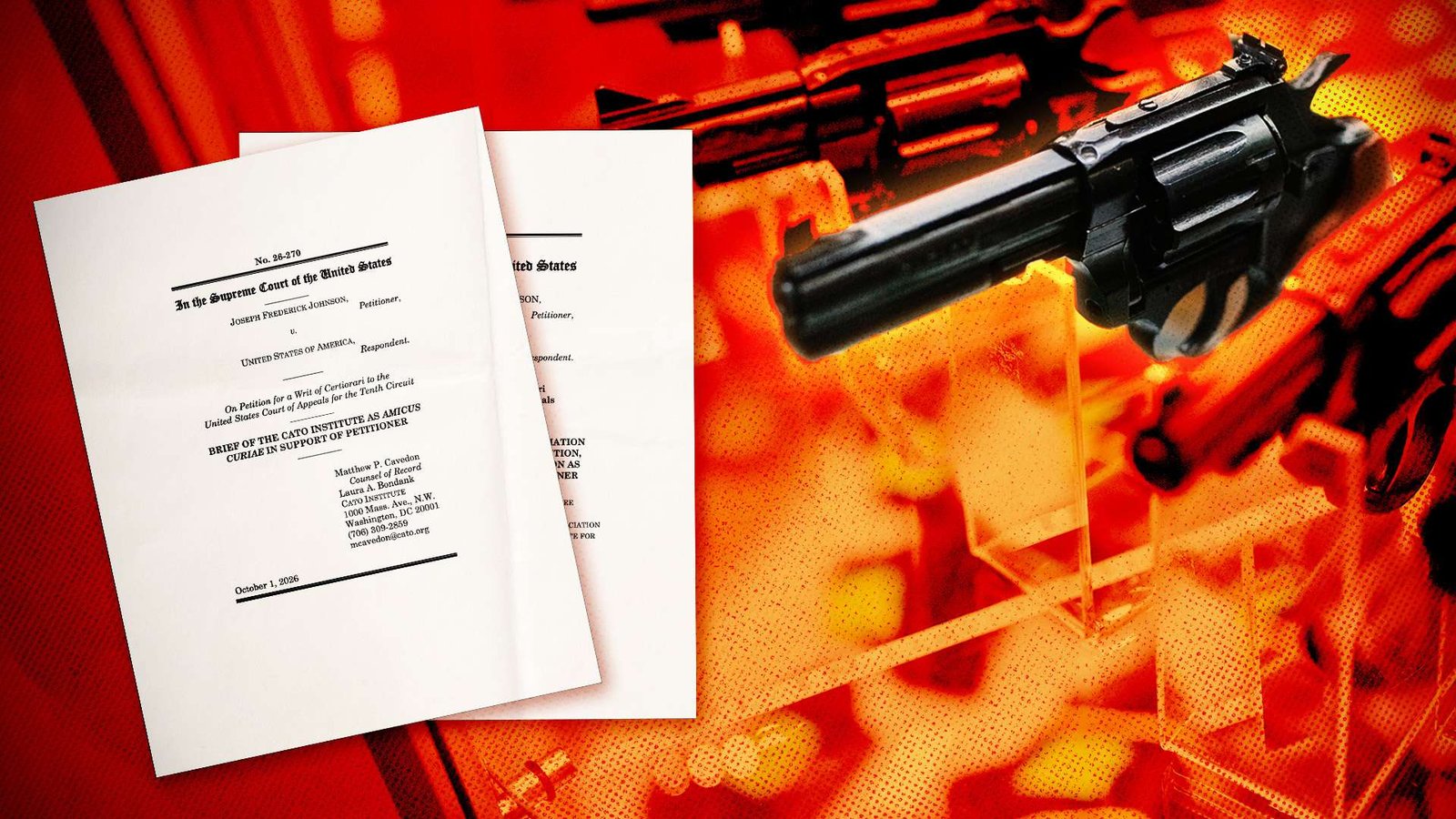
Last April, the U.S. Court of Appeals for the 10th Circuit upheld Johnson’s conviction, rejecting his argument that it violated the Second Amendment. Now Johnson is asking the Supreme Court to overrule the 10th Circuit by allowing as-applied challenges to Section 922(g)(1). His petition, which has been listed for consideration at this Friday’s Supreme Court conference, recently attracted support from the Cato Institute and three leading gun rights groups, which argue that the Second Amendment does not allow the government to categorically disarm nonviolent felons like Johnson.
The Supreme Court regularly receives a large number of petitions in this category and regularly declines to accept them. But its decision last June in United States v. Hemani suggests it may be more receptive this term. Hemani involved 18 USC 922(g)(3), which makes it a felony for an “unlawful user” of “any controlled substance” to receive or possess a firearm. The justices unanimously rejected the prosecution of a Texas cannabis consumer under Section 922(g)(3), saying the government may not disarm people or charge them with illegal gun possession simply because they use marijuana.
In the wake of Hemani, lower courts are addressing the question of what additional evidence is necessary to sustain a conviction under Section 922(g)(3). But in the absence of Supreme Court guidance regarding Section 922(g)(1), appeals courts have split on whether the Second Amendment poses any barrier to prosecutions under that provision. While three appeals courts have allowed people with nonviolent felony records to argue that the law is unconstitutional as applied to them, such challenges have been blocked in six circuits, including the 10th.
The 10th Circuit’s decision in Johnson’s case was not surprising, since the appeals court had rejected an as-applied challenge to Section 922(g)(1) in the 2025 case Vincent v. Bondi. That decision involved Melynda Vincent, a Utah social worker who had lost her gun rights because of a 2008 conviction for passing a bad check at a grocery store. Like Johnson, Vincent did not serve any time behind bars, and her crime did not suggest she was a menace to public safety. But as the 10th Circuit saw it, that did not matter.
When the Supreme Court overturned a local handgun ban in the landmark 2008 case District of Columbia v. Heller, the 10th Circuit noted, the majority said “nothing in our opinion should be taken to cast doubt on longstanding prohibitions on the possession of firearms by felons and the mentally ill,” which a footnote described as “presumptively lawful regulatory measures.” The Court’s 2024 decision in United States v. Rahimi, which upheld a federal law that disarms people subject to domestic violence restraining orders, repeated that language. The 10th Circuit thought that foreclosed Second Amendment challenges to Section 922(g)(1), even by nonviolent offenders.
Not so, gun policy scholar Joseph G.S. Greenlee argues in a brief supporting Johnson’s petition. The Supreme Court “has established that all firearm regulations must be justified by historical tradition, including the regulations that Heller labeled ‘presumptively lawful,'” Greenlee says in the brief, which was filed last Thursday by the National Rifle Association, the Firearms Policy Coalition, and the Second Amendment Foundation.
When a law restricts conduct covered by the Second Amendment’s “plain text,” the Supreme Court said in the 2022 case New York State Rifle & Pistol Association v. Bruen, the government has the burden of “demonstrating that it is consistent with the Nation’s historical tradition of firearm regulation.” That principle jibes with what the Court said about the “presumptively lawful regulatory measures” it listed in Heller: “There will be time enough to expound upon the historical justifications for the exceptions we have mentioned if and when those exceptions come before us.”
Notably, those “exceptions” included “laws forbidding the carrying of firearms in sensitive places such as schools and government buildings.” Yet in Bruen, the Supreme Court rejected the claim that New York’s restrictions on public gun possession could be justified under that heading, saying “there is no historical basis for New York to effectively declare the island of Manhattan a ‘sensitive place.'”
That conclusion, Greenlee argues, shows that Heller‘s reference to “longstanding prohibitions” does not make Section 922(g)(1) immune from the Bruen test. And when you conduct the analysis required by Bruen, he says, you find “there is no tradition that supports disarming peaceable persons.”
Greenlee considers colonial gun regulations that targeted black people, Native Americans, Catholics, Puritans, and Antinomians; Founding-era measures aimed at loyalists and insurrectionists; and 19th century restrictions on gun possession by slaves, freedmen, “tramps,” rebels, intoxicated or mentally unsound individuals, and people who “threaten the physical safety of another.” The unifying theme, he argues, is a tradition of disarming people viewed as dangerous to public safety or national security.
“America’s historical tradition of firearm regulation provides support for the disarmament of only dangerous persons—disaffected persons posing a threat to the government and persons with a proven proclivity for violence,” Greenlee writes. “There is no tradition of disarming peaceable citizens.”
Historically, “nonviolent criminals—including nonviolent felons—who did not demonstrate a propensity for violence retained the ability to exercise their right to keep and bear arms,” Greenlee says. “Indeed, some laws expressly allowed or even required them to keep and bear arms.” After “completing their sentences,” offenders “had full access” to their Second Amendment rights, and “able-bodied males were required to keep and bear arms under the state and federal militia acts.” No one “was disarmed because the law he violated was classified as a felony.”
Cato Institute lawyers Matthew Cavedon and Laura Bondank highlight the implications of the contrary rule embodied in Section 922(g)(1). “The felony label,” which was “once reserved for the gravest crimes,” today “reaches a vast range of conduct with no connection to violence, and legislatures can expand it at will,” they write in Cato’s brief. “Treating that label as a proxy for danger would let lawmakers shrink the Second Amendment’s guarantee simply by writing new felonies, a power to which no other enumerated right is subject.”
Vincent’s lawyers, who last term unsuccessfully sought Supreme Court review of her case, noted that Section 922(g)(1) can be triggered by state offenses such as adultery, defacing a school building, “repeatedly sharing streaming websites’ passwords,” “temporarily using someone else’s car without their consent,” and “using a telephone to make a single anonymous call to annoy or embarrass.” They added that federal law “includes many felonies that involve no danger,” such as “knowingly and unlawfully ‘export[ing] any fish or wildlife'” or making “an unauthorized recording of a movie” in a theater.
“The number of felonies has increased exponentially since the Founding,” Cavedon and Bondank note. “The category of felonies has outgrown its historical core and now covers a huge range of nondangerous conduct….Today, felonies reach well beyond ‘crimes like murder, assault, and rape’ to cover ‘an immense and diverse category’ of conduct, from Mr. Johnson’s marijuana cultivation to ‘selling pigs without a license in Massachusetts.’ Yet § 922(g)(1) treats the murderer, Mr. Johnson, and the unlicensed pig salesman the same: They all lose their right to keep and bear arms.”
That policy seems constitutionally dubious in light of Hemani, which rejected the government’s claim that people who use marijuana are ipso facto “unusually dangerous” and apt to commit “violent crime.” As the Supreme Court saw it, that categorical judgment swept too broadly, obscuring important distinctions that are relevant in assessing the threat posed by a given defendant. “If the government cannot disarm every unlawful drug user without specific inquiry,” Cavedon and Bondank argue, “it cannot do so for everyone convicted of a felony, whatever the nature of the offense.”
Read the full article here
Fact Checker
Verify the accuracy of this article using AI-powered analysis and real-time sources.