

 Freedom Index
Listen to the article
Vučić has referred to Serbian students as “Nazis”. Senior associates have falsely claimed that the protesters represent the “fascist Falanga” and describe them as “hate-filled monsters [and] the worst possible fascists”. Yet Brussels has largely remained silent. That silence is not politically neutral. To stand by while peaceful student protesters are branded Nazis and fascists – thereby associating them with ideologies responsible for genocide and mass persecution – is irresponsible in any circumstances. It is particularly irresponsible at a time of rising antisemitism and extremist rhetoric across Europe.
The values and standards demanded by Serbia’s student movement are, in fact, precisely those the EU itself claims to champion: accountability, functioning institutions, the rule of law, transparency, and democratic responsibility. For the avoidance of doubt, these have nothing in common with the political model represented by Aleksandar Vučić.
Yet this is hardly the first time Vučić has turned European rhetoric against Europe itself.
In a 2020 interview with Euronews, he openly pushed back against Western criticism of Serbia’s relations with Russia and China, saying: “I’m fed up of being lectured and told by all the others about our cooperation with China and Russia, and then I see all the others meeting Xi Jinping and Putin even more often than I do.”
In 2023, after the European Parliament called on Serbia to align its foreign policy with that of the European Union, Vučić dismissed the demand as “hypocritical”. He had previously invoked “hypocrisy” to describe the EU’s position on the legality of Catalonia’s independence referendum. It is difficult to imagine a more efficient diplomatic reversal: a candidate country accusing the club it supposedly wants to join of hypocrisy, while that same club continues to expect reforms, cooperation and progress towards membership.
Most recently, when EU Enlargement Commissioner Marta Kos cancelled a planned visit to Serbia amid the glorification surrounding the return and funeral arrangements of convicted war criminal Ratko Mladić, Vučić dismissed her explanation as “extremely short, but stupid, as usual”. Perhaps Kos remembers that Vučić served as minister of information in the late 1990s, when he targeted independent media with draconian laws and helped sustain a political environment dominated by pro-Milošević propaganda, while the continuation of war and the protection of war criminals remained central to the regime’s political agenda.
Or perhaps she did some basic due diligence.
In 2007, Vučić placed a fake street plaque reading “Ratko Mladić Boulevard” on a Belgrade road named after assassinated Prime Minister Zoran Djindjić.
That same year, as an MP and senior official of the Serbian Radical Party, he declared: “[P]remises of our party in the Serbian Assembly are and will be a ‘safe house’ for Ratko Mladić. My house, as well as the houses of entire family Vučić, and we are not a small family, will be exactly that – safe house [sic] for General Ratko Mladić.”
That history makes the EU’s current balancing act even harder to understand.
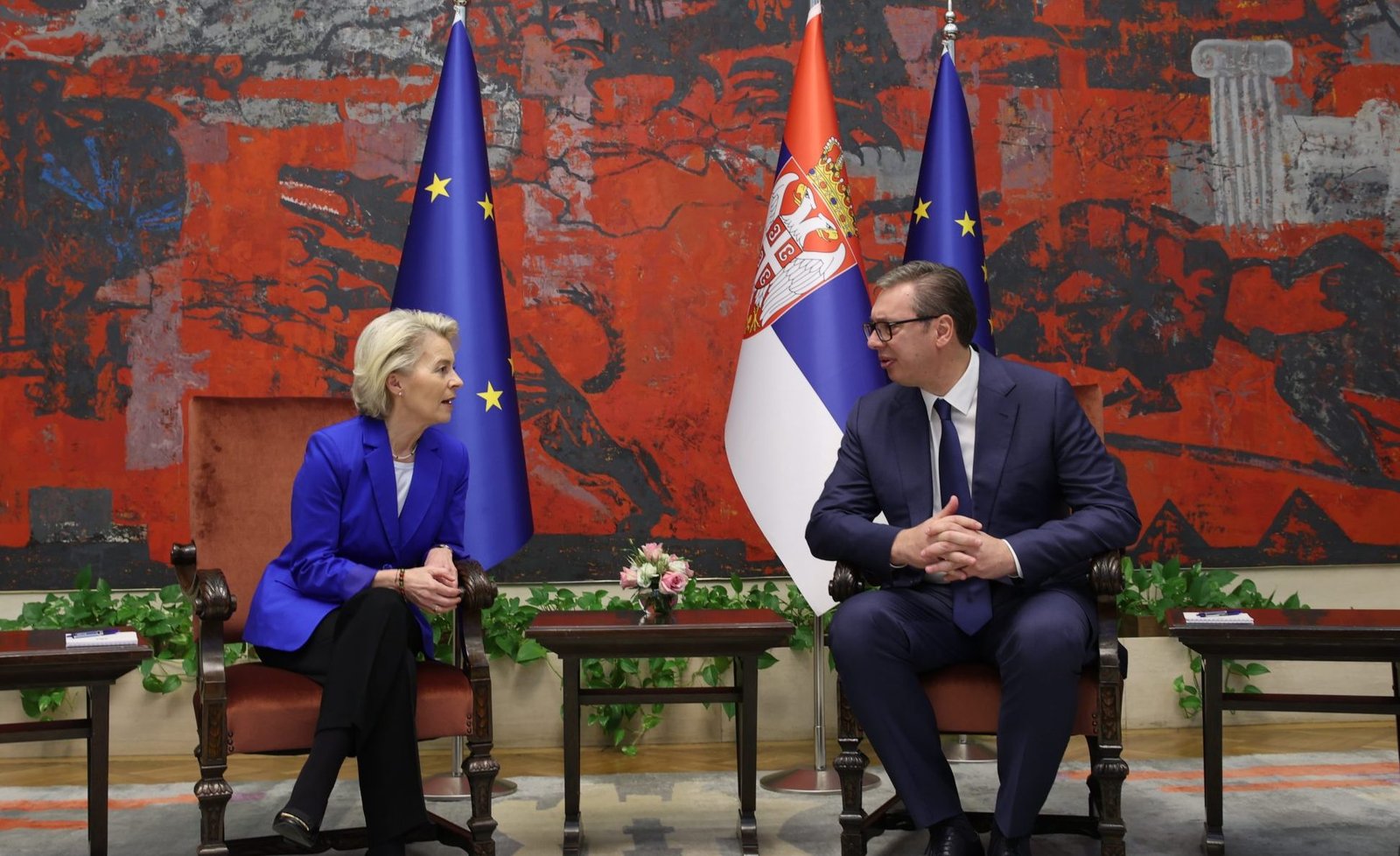
Kos’s position was not openly endorsed by European Commission President Ursula von der Leyen, who has yet to decide whether to make a stopover in Belgrade during her regional tour. On the contrary, Ursula von der Leyen has repeatedly praised “dear Aleksandar”, even as journalists and political opponents have faced increasing pressure.
In 2022, she described Serbia as “one of the most advanced countries on the European path”, adding that the EU was aware of the outstanding issues – including judicial independence, accountability and the fight against corruption – and that she knew Vučić was “very engaged” in addressing them.
Then, at a joint press conference in Belgrade in 2024, she went further: “You have shown that you can meet the necessary benchmarks. You have committed to delivering on reforms, in particular on the fundamentals, as you just said, of rule of law and democracy. And you have shown that deeds follow your words.”
Such praise becomes even more puzzling when set against Vučić’s own assessment of Serbia’s European future. In 2024, he said: “I don’t believe we are going to be a part of the European Union in 2028.”
He added that, if Serbia were to join, “it cannot happen before 2030”, while acknowledging that “what might happen in the meantime, nobody knows”.
Read the full article here
Fact Checker
Verify the accuracy of this article using AI-powered analysis and real-time sources.