Close Menu
FSNN | Free Speech News NetworkFSNN | Free Speech News Network
  • Home
  • News
    • Politics
    • Legal & Courts
    • Tech & Big Tech
    • Campus & Education
    • Media & Culture
    • Global Free Speech
  • Opinions
    • Debates
  • Video/Live
  • Community
  • Freedom Index
  • About
    • Mission
    • Contact
    • Support
Trending

What next after $853 million in weekly ETF inflows?

5 minutes ago

Hyperliquid’s RWA perps boom is eating into the revenue that backs HYPE

1 hour ago

Today in Supreme Court History: August 9, 1974

3 hours ago
Facebook X (Twitter) Instagram
Facebook X (Twitter) Discord Telegram
FSNN | Free Speech News NetworkFSNN | Free Speech News Network
Market Data Newsletter
Sunday, August 9
  • Home
  • News
    • Politics
    • Legal & Courts
    • Tech & Big Tech
    • Campus & Education
    • Media & Culture
    • Global Free Speech
  • Opinions
    • Debates
  • Video/Live
  • Community
  • Freedom Index
  • About
    • Mission
    • Contact
    • Support
FSNN | Free Speech News NetworkFSNN | Free Speech News Network
Home»News»Media & Culture»The ‘Affordability’ Agenda That Taxes Your Dinner
Media & Culture

The ‘Affordability’ Agenda That Taxes Your Dinner

News RoomBy News Room1 day agoNo Comments5 Mins Read1 Views
Share Facebook Twitter Pinterest Copy Link LinkedIn Tumblr Email VKontakte Telegram
The ‘Affordability’ Agenda That Taxes Your Dinner
Share
Facebook Twitter Pinterest Email Copy Link

Listen to the article

0:00
0:00

Key Takeaways

Playback Speed

Select a Voice

Last month, as part of its 2027 budget, the D.C. Council approved a 20-cent fee on carrier-for-hire delivery services. While the fee applies to the delivery of a broad array of household goods, it has been primarily billed as a tax on food delivery, which provides a lucrative source of potential revenue for the District.

D.C.’s new delivery tax is merely the latest example of governments targeting food with stealth tax increases in an effort to enhance government coffers. While the strategy may be tempting as a revenue grab, the losers are everyday Americans who are simply looking for a politician that actually can deliver on an affordability agenda.

D.C.’s delivery tax is expected to raise $9 million annually in revenue, according to Brianne Nadeau, the councilmember pushing the tax. Nadeau argued that the tax would not be passed on to consumers but would rather be paid by the large delivery companies themselves. “These are multimillion, billion-dollar companies that can absorb 20 cents,” Nadeau told DC News Now. “What we need is for them to actually get it together to create a system where you don’t need to be wealthy to order food delivery.”

This level of cognitive dissonance is not restricted to Washington, D.C. In fact, food-related taxes are rising in popularity as a backdoor way to raise revenue, despite government officials on the left and right promising to make food affordable again. These taxes not only hurt restaurants and customers by making food more expensive, but they may even fail as a revenue-raising tool.

So-called “meal taxes” are becoming more prominent across America. Most states tax prepared-food orders from restaurants as part of the general sales tax. As more Americans have taken to eating out in recent years, this already has created an unexpected government windfall. But 13 of the 50 largest cities in the U.S. also impose additional meal taxes on diners, according to a 2024 analysis from the Tax Foundation.

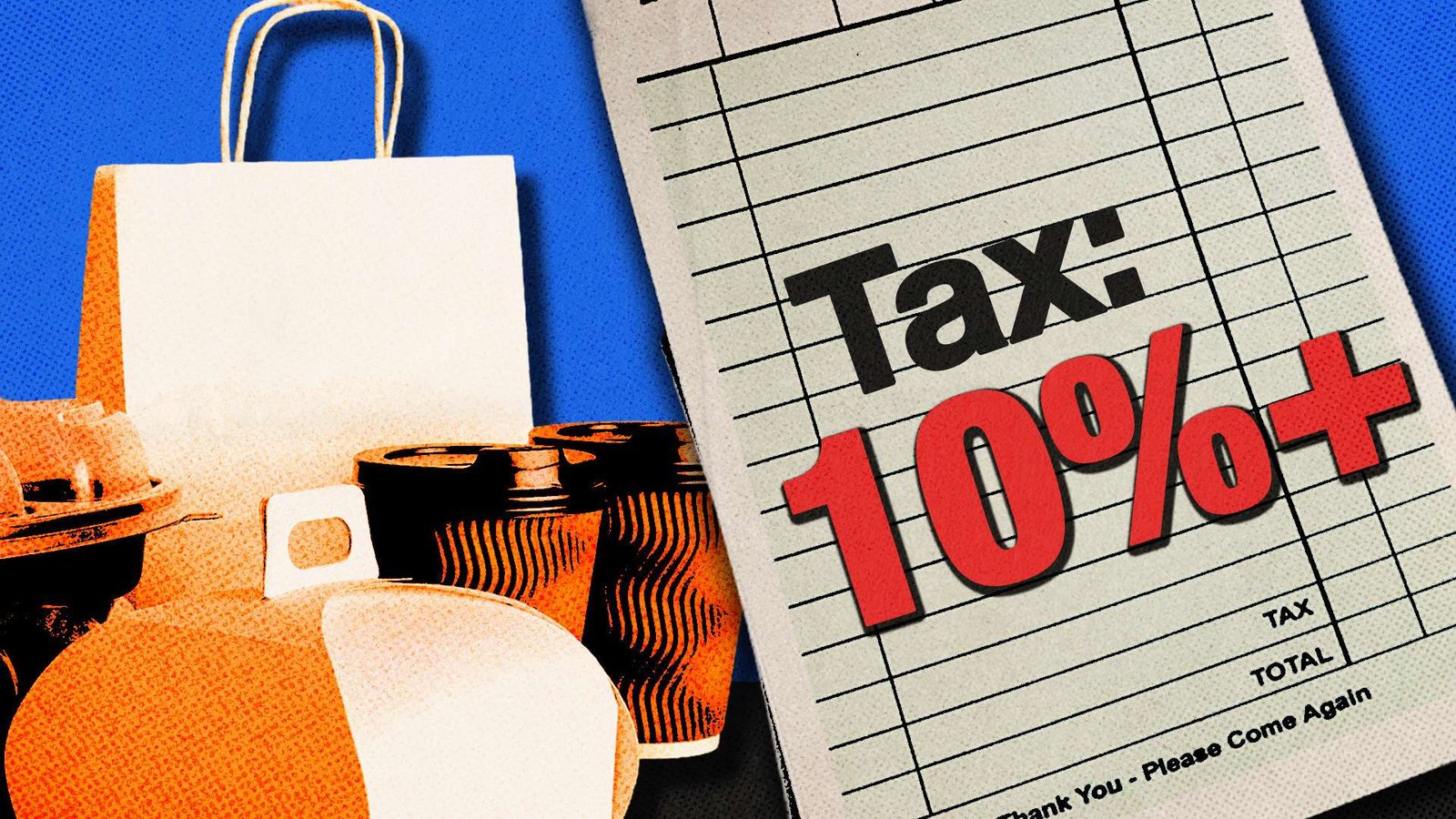
When one combines general sales-tax and meal-tax rates, the combined tax rate on food can range well over 10 percent in many jurisdictions, with Minneapolis (12.03 percent), Chicago (11.75 percent), and Virginia Beach (11.5 percent) among the most egregious offenders, the Tax Foundation found. Worse yet, the organization noted that food taxes are becoming more prevalent, with 29 out of the top 50 cities increasing their taxes on meals (either via sales tax or meal tax increases) over the past decade. Only two cities saw a decrease in food taxes during that time.

Meal taxes are becoming more common in small and medium-sized cities, too. In Virginia, not only does Virginia Beach have a meal tax, but Williamsburg, Richmond, and Petersburg all now have meal taxes. Even a locale as small as Mathews, Virginia has a 4 percent meal tax. According to the Virginia Restaurant, Lodging, and Travel Association, 43 percent of Virginia localities have raised either their meal tax or their transient occupancy tax—a hotel-specific tax that serves a similar purpose as the meal tax—since 2016.

As the experience in D.C. attests, food-related taxes are no longer confined to brick-and-mortar dining. Both Minnesota and Colorado have enacted delivery fees in recent years; Colorado’s fee, which consists of six different sub-fees, has now risen to 31 cents and keeps increasing with inflation every year. At least a half dozen other states have considered imposing similar delivery taxes, while at the municipal level, Seattle has also added a fee onto food delivery.

For politicians, restaurant and delivery taxes appear to be a win-win. It’s far less likely that a concerned citizen will grumble about a 10-cent delivery fee here or a 4 percent meal tax there, compared to a top-line income tax increase. An added bonus is that meals consumed in restaurants are often ordered by tourists or other visitors to a city, providing a handy way to export the tax base to non-residents who lack voting power within the jurisdiction.

But these taxes have a real impact. What’s more, there’s evidence they may have the potential to backfire even when it comes to raising revenue. After Williamsburg, VA, recently increased its meal tax by 30 percent, restaurant sales dropped. While revenue from the heightened meal tax grew by 6.7 percent, overall tax revenue from restaurants saw a 1.5 percent year-to-date decline once the new tax was accounted for (presumably on account of declining restaurant sales leading to a reduction in general sales tax collections from restaurants that offset the meal tax increase).

Let’s put some numbers behind that. A $74 restaurant tab in Williamsburg now comes out to just under $84 by the time Virginia sales tax and the Williamsburg meal tax is factored in. A small increase in a meal tax or a relatively modest delivery fee may not impact some diners, but it has a tangible impact for others. In Colorado, 35 percent of voters said that the delivery fee would make them less likely to order food delivery; in Minnesota, 29 percent of voters said the same.

The reality is that food is increasingly being targeted for taxation in America. Government officials are promising us more affordable eats at the same time they’re making food more expensive than ever.

Read the full article here

Fact Checker

Verify the accuracy of this article using AI-powered analysis and real-time sources.

Get Your Fact Check Report

Enter your email to receive detailed fact-checking analysis

5 free reports remaining

Continue with Full Access

You've used your 5 free reports. Sign up for unlimited access!

Already have an account? Sign in here

#CivicEngagement #MediaAccountability #MediaAndPolitics #MediaEthics #PressFreedom
Share. Facebook Twitter Pinterest LinkedIn Tumblr Email Telegram Copy Link
News Room
  • Website
  • Facebook
  • X (Twitter)
  • Instagram
  • LinkedIn

The FSNN News Room is the voice of our in-house journalists, editors, and researchers. We deliver timely, unbiased reporting at the crossroads of finance, cryptocurrency, and global politics, providing clear, fact-driven analysis free from agendas.

Related Articles

Media & Culture

Today in Supreme Court History: August 9, 1974

3 hours ago
Media & Culture

In Post-Soviet Georgia, a Fledgling Libertarian Movement Faces an Increasingly Authoritarian State

4 hours ago
Media & Culture

AI Is Already Beating Human Doctors in Medical Tests

5 hours ago
Media & Culture

Brickbats: August/September 2026

6 hours ago
Media & Culture

New Survey Data on Public Perceptions of the Supreme Court

18 hours ago
Media & Culture

Race Discrimination in Admissions Suit Against U Washington Can Go Forward

20 hours ago
Add A Comment
Leave A Reply Cancel Reply

Editors Picks

Hyperliquid’s RWA perps boom is eating into the revenue that backs HYPE

1 hour ago

Today in Supreme Court History: August 9, 1974

3 hours ago

Crypto is going through a massive dot-com style shakeout as over 100 projects fold in 2026

3 hours ago

In Post-Soviet Georgia, a Fledgling Libertarian Movement Faces an Increasingly Authoritarian State

4 hours ago
Latest Posts

AI Is Already Beating Human Doctors in Medical Tests

5 hours ago

BIP-110 Chain Falls Behind as Hashpower Support Lags

5 hours ago

Brickbats: August/September 2026

6 hours ago

Subscribe to News

Get the latest news and updates directly to your inbox.

At FSNN – Free Speech News Network, we deliver unfiltered reporting and in-depth analysis on the stories that matter most. From breaking headlines to global perspectives, our mission is to keep you informed, empowered, and connected.

FSNN.net is owned and operated by GlobalBoost Media
, an independent media organization dedicated to advancing transparency, free expression, and factual journalism across the digital landscape.

Facebook X (Twitter) Discord Telegram
Latest News

What next after $853 million in weekly ETF inflows?

5 minutes ago

Hyperliquid’s RWA perps boom is eating into the revenue that backs HYPE

1 hour ago

Today in Supreme Court History: August 9, 1974

3 hours ago

Subscribe to Updates

Get the latest news and updates directly to your inbox.

© 2026 GlobalBoost Media. All Rights Reserved.
  • Privacy Policy
  • Terms of Service
  • Our Authors
  • Contact

Type above and press Enter to search. Press Esc to cancel.

🍪

Cookies

We and our selected partners wish to use cookies to collect information about you for functional purposes and statistical marketing. You may not give us your consent for certain purposes by selecting an option and you can withdraw your consent at any time via the cookie icon.

Cookie Preferences

Manage Cookies

Cookies are small text that can be used by websites to make the user experience more efficient. The law states that we may store cookies on your device if they are strictly necessary for the operation of this site. For all other types of cookies, we need your permission. This site uses various types of cookies. Some cookies are placed by third party services that appear on our pages.

Your permission applies to the following domains:

  • https://fsnn.net
Necessary
Necessary cookies help make a website usable by enabling basic functions like page navigation and access to secure areas of the website. The website cannot function properly without these cookies.
Statistic
Statistic cookies help website owners to understand how visitors interact with websites by collecting and reporting information anonymously.
Preferences
Preference cookies enable a website to remember information that changes the way the website behaves or looks, like your preferred language or the region that you are in.
Marketing
Marketing cookies are used to track visitors across websites. The intention is to display ads that are relevant and engaging for the individual user and thereby more valuable for publishers and third party advertisers.