

 Freedom Index
Listen to the article
Back in May, I wrote about survey data indicating a modest boost in the Supreme Court’s popularity with the public, possibly caused by its February decision in the tariff case (which I helped litigate). Since then, the Supreme Court has issued its major decisions in a large number of cases, including those on birthright citizenship, the Second Amendment, executive removal power, and more. Recently, Marquette Law School came out with a new poll assessing public perceptions of the Court in the wake of those rulings. It finds that the Court as a whole remains modestly unpopular (47% approve, 53% disapprove), but that most of its major recent decisions have majority public support. The Court also remains a bit more popular than just before the tariff ruling, and much more popular than the other two branches of government. There are other interesting findings, as well, including on perceptions of individual justices (about which most of the public is generally ignorant).
As discussed below, the Marquette survey has a few unfortunate methodological problems. But it nonetheless provides some useful information about public perceptions of the Court.
Before going on, I will emphasize, yet again, that the Court’s popularity (or lack thereof) says little about the quality of its decisions. Survey data consistently shows that most Americans know very little about the Constitution and the Court’s work, and a majority of the public cannot even name one Supreme Court justice and know little about them (the Marquette poll further confirms this latter point). I also do not claim that majority public support for decisions I like (including the tariff ruling!) “proves” those decisions are correct. It does not. But, for reasons to be discussed below, public opinion about the Court does matter, in so far as it is important to protecting the institution of judicial review against potential attacks from both the right and the left. It may also be of interest to students of the Court and students of public opinion (I happen to be both).
The Court’s 47% approval rating is slightly higher than the 44% it got in the same poll in mid to late 2025, and about the same as the 46% it got in May (after the tariff case, but before the other rulings). An April Marquette poll showed 42% approval. This is consistent with other survey data indicating a slight improvement in early 2026, possibly driven by the tariff decision. Though the Marquette poll shows more stability than some of the others, and fluctuations between 42 and 47 could just be due to random variation.
The Court also remains much more popular (or, rather, much less unpopular) than the other two branches of government. The Marquette survey finds that President Trump has only a 38% favorability rating (a whopping 60% view him unfavorably), and both congressional Republicans and congressional Democrats, are also highly unpopular, probably even more so than Trump. The same goes for the Republican and Democratic parties generally. This, too, is consistent with previous polls showing that public views of the Court are more favorable than those of the other two branches of government.
Marquette also surveyed public attitudes on 13 significant decisions made by the Court within the last year. And all but two command majority support, including many supported by large majorities:
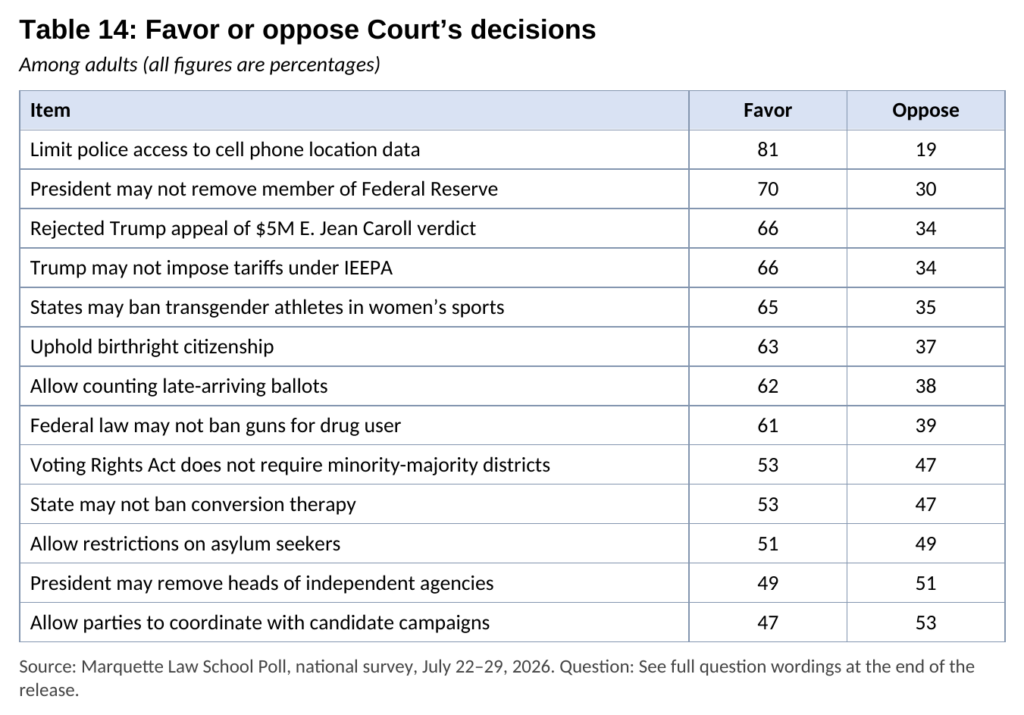
The tariff case (66% support), allowing states to ban transgender athletes from women’s sports (65%), and Trump v. Cook – the decision protecting the autonomy of the Federal Reserve Board (70%) are all highly popular. Louisiana v. Callais – the Voting Rights Act decision that attracted strong left-wing ire – enjoys modest majority support (53%). The only two decisions surveyed that don’t have majority support are Trump v. Slaughter (ruling that the president can remove the heads of most other independent agencies), and a ruling allowing parties to coordinate campaign expenditures with campaigns. And even those two decisions are only modestly unpopular, getting support from 49% of the public, and 47% respectively.
These results suggest that the Court’s majority this year was very much not out of step with public opinion, as critics sometimes charge. I say that even though I myself am not a fan of some of the decisions the public agrees with. While I agree with part of the reasoning of Callais, I worry that the Court’s approach creates way too much leeway for racial gerrymandering by Republicans. I also have significant reservations about Trump v. Slaughter and its relationship to Trump v. Cook; reconciling those two decisions is difficult to say the least.
There are a few methodological issues with this part of the Marquette survey. The survey’s descriptions of the rulings in the questions are fairly detailed and precise. But that very fact might make them hard to understand for respondents who don’t know much about the issues involved (which is likely to be a large proportion of them). In addition, all of these questions are structured as “forced choice” questions, on which respondents do not have the option of answering “don’t know” or “no opinion.” That means the survey is capturing a lot of responses by people who don’t actually have meaningful opinions on the case in question.
In addition, the Court included one case it probably should not have, and omitted at least one that should have been included. The Court did not really rule on E. Jean Carroll’s suit against Trump. As the Marquette survey notes, it merely refused to review the lower court decision in favor of Carroll. This is not actually a precedent-setting decision by the Court, and not that significant for anyone but Trump and Carroll. By contrast, the survey wrongly omits the Court’s terrible decision in the Haitian TPS case, which will both have a massive immediate impact on hundreds of thousands of people and set a bad precedent for future executive immigration policies motivated by racial and ethnic prejudice.
Despite these caveats, it is clear that most of the Court’s recent major decisions enjoy majority public support, some overwhelmingly so. And none are highly unpopular.
Marquette also surveyed public opinion about individual justices:
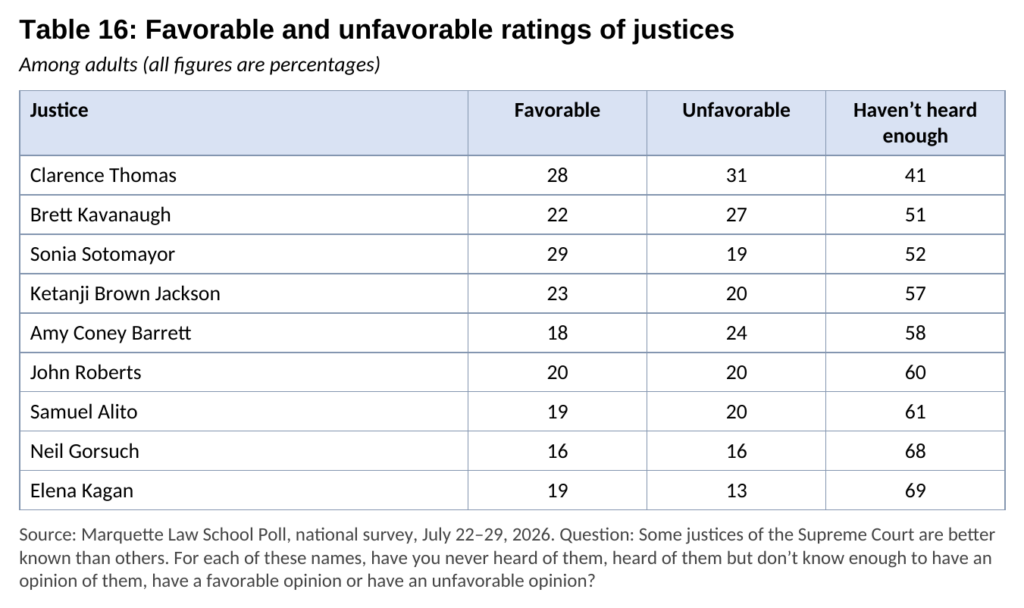
Strikingly – but not surprisingly – Clarence Thomas is the only justice about whom a majority of respondents say they know enough to have an opinion. That’s likely because of a combination of his long tenure, his highly controversial confirmation hearings (which many older respondents may remember), and his being the only Black justice during most of his tenure (until Ketanji Brown Jackson was confirmed in 2022).
The fact that most Americans say they haven’t heard enough to have an opinion of most of the justices (including even Chief Justice John Roberts) is a further indication of widespread public ignorance about the Court and its work. I would add that we should not assume that those who do express an opinion are actually knowledgeable. Studies show that many survey respondents are willing to express views about people and issues they know little about, rather than admit ignorance. Thus, classic surveys show that large numbers of respondents will express opinions about entirely fictional legislation, such as the “Metallic Metals Act.” A 2015 poll found that 30% of Republicans and 19% of Democrats supported bombing the nation of Agrabah (which is actually a fictional entity from the Disney movie Aladdin), rather than admitting they had no opinion or didn’t know about it.
A recent YouGov poll, which I analyzed in my last post on the Supreme Court and public opinion, found higher percentages willing to an express an opinion about the justices. Only 27% said they had “no opinion” about Thomas, while the “no opinion” percentages for the others ranged from 35% to 44%. The key difference between this poll and the Marquette one is that YouGov gave respondents the option of saying they had “slightly” or “very” favorable or unfavorable views, instead of just allowing “favorable” or “unfavorable” (as Marquette did). I suspect many respondents who know little or nothing about the justices were willing to pick “slighly favorable” or “slightly unfavorable” in the YouGov poll, but many such people (in the Marquette survey) were unwilling to express a stronger, more unqualified view.
In both the Marquette survey and YouGov, the liberal justices are more popular than the conservative ones, and the single most popular justice in both surveys is Sonia Sotomayor (29% favorable vs. 19% unfavorable in Marquette; 38-27 in YouGov). This may be because more of the public prefers liberal jurisprudence. But that conjecture is belied by surveys on specific decisions, where many conservative (though, of course, not all) rulings are popular (e.g. – striking down affirmative action policies).
I suspect the bigger factor here is the growing “diploma divide” in American politics. Education is increasingly correlated with support for Democrats, while the Republicans get most of their support from the least-educated parts of the population. Education is also highly correlated with political knowledge. Thus, the kinds of people who have at least some substantial knowledge of the Supreme Court justices are disproportionately likely to be liberal Democrats. On the other hand, those willing to admit they don’t know enough to have an opinion are disproportionately conservative Republicans.
It’s worth noting that none of the justices are wildly unpopular. Even Clarence Thomas – the single most negatively rated justice in both the Marquette and YouGov polls – has only modestly negative approval ratings (-3 in Marquette, and -9 in YouGov). Trump and Congress would love to have approval ratings like that!
Overall, the Court is only modestly unpopular, and its major recent rulings mostly get more support than opposition from the public.
As already noted, this does not prove the Court is doing a good job, either in general or on any specific case. But it is significant, nonetheless.
Today, judicial review faces potential threats from both right and left. Trump and many of his supporters have flirted with the idea of disobeying judicial rulings that go against them, and have at times flouted various lower-court rulings or tried to deceive judges. On the left, there is renewed momentum for undermining judicial review through court-packing (which I documented and criticized here and here). To the extent that the Court and its decisions remain more popular (or at least less unpopular) than the other branches of government, it makes it harder for either right or left to undermine judicial review.
I am far from an unequivocal cheerleader for the Court and its current majority. I think they have gotten some important issues badly wrong, including the Haitian TPS immigration case and the Pung property rights case, just last month. Nonetheless, I think we are far better off with strong judicial review than without it, and that the judiciary is – on the whole – doing its job far better than either Congress or the executive branch right now. For these reasons, I hope the Court can maintain its relative popularity and – ideally – boost it further, at least somewhat.
I would not want the justices to prioritize popularity too much. If the Court became wildly popular, I would worry they aren’t doing enough to protect the rights of unpopular minorities, or to enforce constitutional constraints on government power in situations where politicians pursue popular-but-illegal and dangerous policies. In an ideal world, the Court’s popularity would be totally irrelevant, except perhaps as a subject for academic research. But we don’t live in that ideal world. Far from it.
Read the full article here
Fact Checker
Verify the accuracy of this article using AI-powered analysis and real-time sources.