

 Freedom Index
Listen to the article
A couple of interviews I’ve conducted for Reason in the past few weeks have been rattling around in my head, even though the two people involved—actor-director Andy Serkis and Supreme Court Justice Neil Gorsuch—couldn’t be more different. Between them, they underscore why we need to understand the past better if we’re going to make any sense of the present and build a better future.
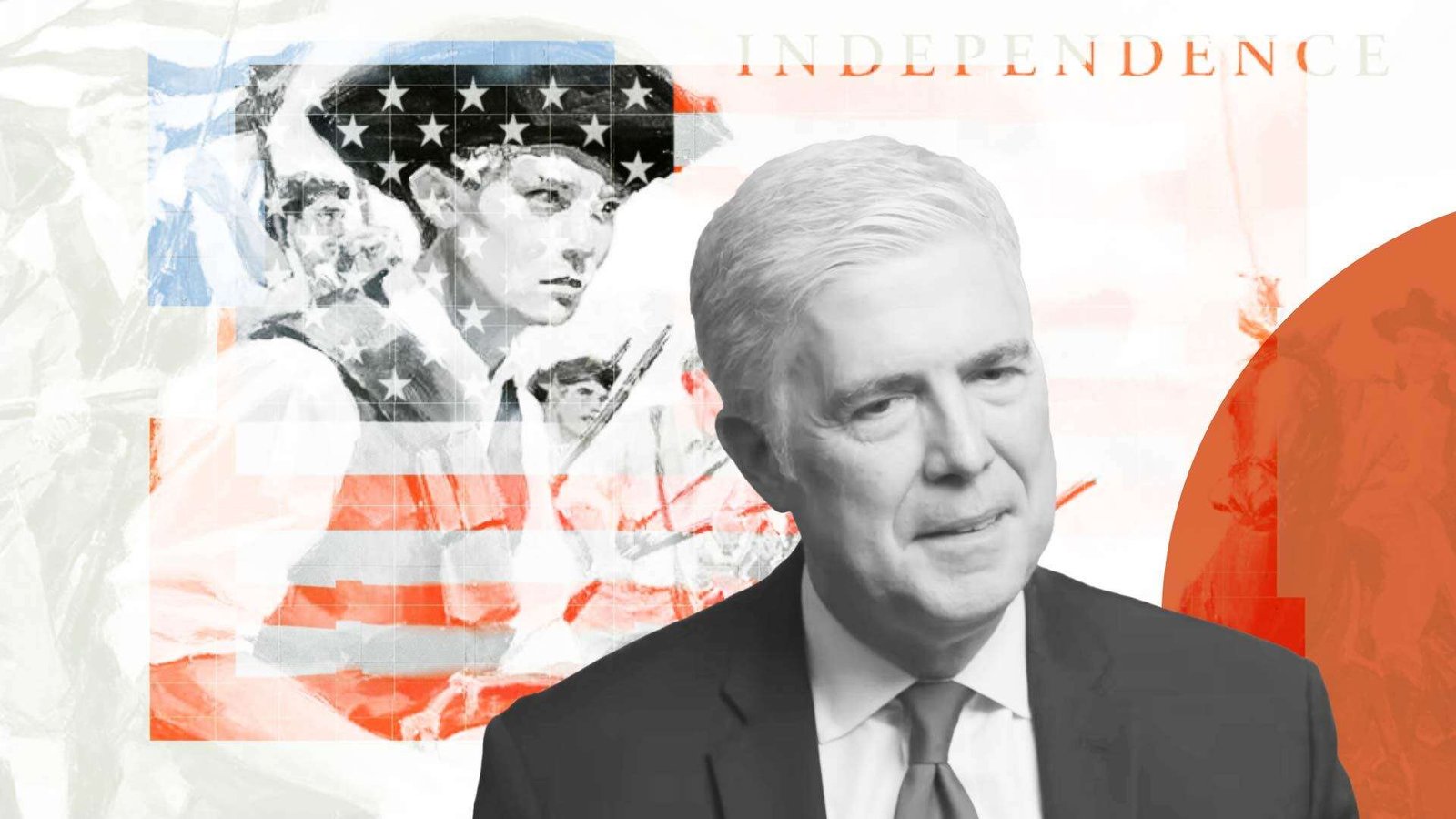
As a performer, Serkis has given life to, among other characters, Gollum, King Kong, and polio-addled proto-punk icon Ian Dury. He’s also the director of a new animated adaptation of George Orwell’s Animal Farm, which is getting taken to the woodshed over at Rotten Tomatoes, where it sports a lowly 26 percent on the Tomatometer. Gorsuch, who joined the Court in 2017, has just coauthored a children’s book. Heroes of 1776 covers the writing, passage, and distribution of the Declaration of Independence.
In my conversation with Serkis, we tangled over questions about history and progress. His Animal Farm swaps out the Soviet context of Orwell’s original and the villain shifts from Joseph Stalin to an expansionist billionaire seeking to take over the farm and build a giant corporate campus. That updating makes the allegory incoherent for several reasons, not least of which is the obvious difference between the ultimate example of totalitarian state coercion and…what, Amazon’s ridiculously forgiving returns policy or its ever-expanding list of employee benefits?
Serkis’s confusion runs deeper than that. When I asked him if world is better off now than when Animal Farm was originally published in 1945, he scoffed. “I don’t necessarily think we are in a better place,” he replied. “And part of this story is about history repeating itself and why is it that we always make the same mistakes?” Later I returned to the topic, asking, “You’re not confident that [almost] 100 years on from World War II and 30 years or so after the collapse of communism, we’re not in a fundamentally better place?” “If you look around the world at the moment and the way we’re living it, it doesn’t seem that way,” he replied.
I realize he had a movie to sell and had been taking a lot of critical arrows for Animal Farm, but I also think he was being honest in saying he sees little in the way of real, actual, measurable progress. In this, he reminds me of many Americans, especially on the left side of the political spectrum, who seem committed to the idea that our country is as sexist, racist, and homophobic as it ever has been and more economically polarized as well. There’s a strong declinist faction on the right too, which often gives us memes about “what they took from us” and nostalgia about what a single salary could supposedly buy in the past.
This is, to put it bluntly, nuts. In the United States, the median income keeps increasing; fears of growing inequality and decreasing economic mobility are unfounded. Younger generations face real problems, but—as economists like Jeremy Horpedahl have shown—they are in many ways doing better than older generations. When communism collapsed in the late 1980s and early ’90s, millions of people were set free; in the ensuing decades, global living standards have risen dramatically enough that the Brookings demographer Homi Kharas was able to document in 2018 that more than half of the planet’s population was at or above middle-class status for the first time in history. Even something as potentially cataclysmic as the current Iran war pales in comparison to where the world was in 1945 or throughout the Cold War.
I think people like Serkis simply discount progress because, however much better things are, they are still far from perfect. That’s understandable, I guess, but it’s as big a category error as swapping out Stalin for a Jeff Bezos–style villain for Animal Farm. So how might we acknowledge that things are far better than they were 30, 50, or a 100 years ago without becoming complacent or smug?
That’s where I think the Supreme Court’s Neil Gorsuch has something to add to the conversation. In Heroes of 1776, he and his coauthor stress that the Declaration “had three great ideas in it. That all of us are equal, that each of us has inalienable rights given to us by God, not government, and that we have the right to rule ourselves.”
I asked him about the Enlightenment universalism he believes was at the heart of the Declaration and about how long it’s taken to include more and more types of people in the American project. “There’s a lot of politicians and a lot of people, influencers or people in the press who say, ‘No, actually all of the people who signed the Declaration were of a very specific kind of ethnic stock,'” I pointed out. “How do you respond to people who say…this is an ethno-state?”
He replied that he’d
push back on that. There’s no doubt that the Revolution, the Constitution, and our country have always had challenges living up to the Declaration. I think of the Declaration as sort of our mission statement, the Constitution our how-to manual. But look at the mission statement. The mission statement is all of us are equal, that we all have an inalienable rights, and that we have the right to self-rule. Those ideas are perfect ideas. They exclude no one.
Now, have we had to work on realizing them? We talk about this in the book, of course, but we could point to that mission statement. Lincoln in the Civil War was able to say, “How can you possibly justify slavery when you say all men are created equal?” The women in Seneca Falls during the suffrage movement said, “You’re absolutely right. All men are created equal, women as well.” Martin Luther King before Lincoln’s memorial in 1963 called the Declaration a promissory note that had come due.
Gorsuch emphasizes not just that progress takes place over time but that it’s a struggle every step of the way. The ideas at the heart of our country, he emphasizes, “are not self-perpetuating. They’re not inevitable.” When I asked him what the next expansion of rights will or should be, he demurred, pointing out that the book tells its readers at the end they are responsible for the future. “You have this mission statement, right? Make it real in your time.”
That’s a lot of responsibility for younger people, but it’s the way things have always been. The future starts by acknowledging the progress that has actually happened, and by finding the courage to keep pushing things forward in an uncertain world.
Read the full article here
Fact Checker
Verify the accuracy of this article using AI-powered analysis and real-time sources.