Close Menu
FSNN | Free Speech News NetworkFSNN | Free Speech News Network
  • Home
  • News
    • Politics
    • Legal & Courts
    • Tech & Big Tech
    • Campus & Education
    • Media & Culture
    • Global Free Speech
  • Opinions
    • Debates
  • Video/Live
  • Community
  • Freedom Index
  • About
    • Mission
    • Contact
    • Support
Trending

Bitcoin breaks Strategy’s STRC ex-dividend date slump for the first time in six months

10 minutes ago

Lazarus Group Malware Targets Crypto, Business Execs via macOS

11 minutes ago

GSR Launches Actively Managed Bitcoin, Ethereum and Solana Basket ETF on Nasdaq

12 minutes ago
Facebook X (Twitter) Instagram
Facebook X (Twitter) Discord Telegram
FSNN | Free Speech News NetworkFSNN | Free Speech News Network
Market Data Newsletter
Wednesday, April 22
  • Home
  • News
    • Politics
    • Legal & Courts
    • Tech & Big Tech
    • Campus & Education
    • Media & Culture
    • Global Free Speech
  • Opinions
    • Debates
  • Video/Live
  • Community
  • Freedom Index
  • About
    • Mission
    • Contact
    • Support
FSNN | Free Speech News NetworkFSNN | Free Speech News Network
Home»News»Global Free Speech»Zambian lawyers fight for media freedom as journalists harassed ahead of election
Global Free Speech

Zambian lawyers fight for media freedom as journalists harassed ahead of election

News RoomBy News Room3 hours agoNo Comments7 Mins Read1,581 Views
Share Facebook Twitter Pinterest Copy Link LinkedIn Tumblr Email VKontakte Telegram
Zambian lawyers fight for media freedom as journalists harassed ahead of election
Share
Facebook Twitter Pinterest Email Copy Link

Listen to the article

0:00
0:00

Key Takeaways

Playback Speed

Select a Voice

Lusaka, April 22, 2026—For months, lawyer Josiah Kalala has been working late into the night on a case he believes could define the future of press freedom in Zambia: preparing arguments, reviewing legal provisions, and consulting colleagues.

Kalala, who heads Chapter One Foundation, a local human rights group, hopes that the hundreds of hours he has poured into this mission will persuade Zambia’s High Court to declare the country’s 2025 cyber laws unconstitutional.

“These laws go to the heart of how people communicate, how journalists work, and how power is held to account,” Kalala told CPJ. “If left unchecked, they have the potential to undermine fundamental freedoms.”

Chapter One Foundation has joined the Law Association of Zambia’s July 2025 petition to overturn key sections of these two sweeping laws, which President Hakainde Hichilema assented to in April 2025. The Committee to Protect Journalists and the International Justice Clinic at the University of California, Irvine School of Law provided advice to local nonprofit Free Press Initiative, which is acting as amicus curae, or a friend of the court, in the case, alongside Amnesty International.

“The laws grant wide powers of surveillance, interception, and data access without sufficiently robust judicial oversight,” Kalala said. “Collectively, these features create a framework that risks arbitrary enforcement and undermines constitutional protections relating to privacy, due process, and freedom of expression.”

Journalists face prison, device seizures

Lawyers challenging the constitutionality of the Zambia’s cyber laws outside the High Court in April. (Photo: Free Press Initiative)

The Cyber Crimes Act goes against recommendations by the United Nations and the African Commission on Human and Peoples’ Rights to tackle defamation with civil remedies. Instead, it jails for up to two years those found to have disseminated “false information” that “causes damage to the reputation of another person” or “subjects another person to public ridicule, contempt, hatred or embarrassment.”

In addition, those who possess “unauthorized data relating to critical information” or “without lawful authority, communicate, disclose or transmit” such data can be imprisoned for up to 15 years. “Critical information” is broadly defined as data that “relates to public safety, public health, economic stability, national security.”

Kalala is concerned that the vague language used to define these offenses could be misused to undermine critical reporting and investigative journalism. 

Similarly, provisions in the Cyber Security Act are overly broad, for example, giving law enforcement officers discretion to search and seize computers and other devices if they have “reasonable grounds to believe” they contain information that they seek, without adequate public interest safeguards for investigative journalism, he said.

Station raided, journalist tasered ahead of election
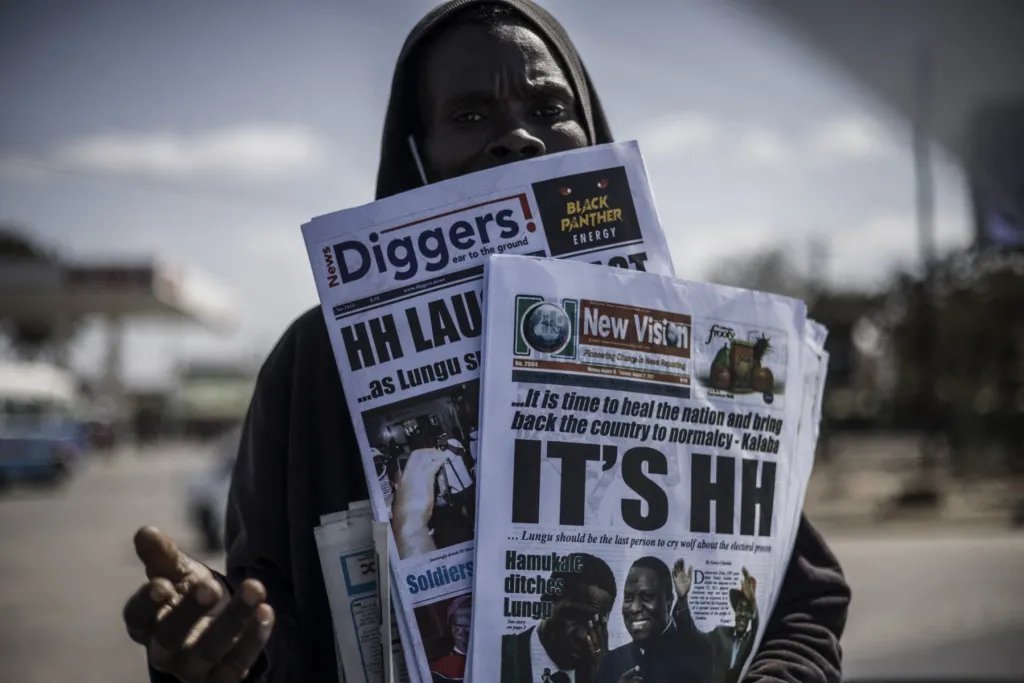
A newspaper vendor carrying Zambian dailies on August 16, 2021, reporting that business tycoon and veteran opposition leader Hakainde Hichilema had won the presidential election with an overwhelming majority.
A newspaper vendor carrying Zambian dailies on August 16, 2021, reporting that veteran opposition leader Hakainde Hichilema had won the election with an overwhelming majority. (Photo: AFP/Marco Longari)

These laws are among pressures on the media ahead of elections scheduled for August 13.

Although Hichilema promised “a new dawn” when “the media will be freed” in his inaugural speech in 2021, CPJ has documented several detentions and assaults of journalists, particularly when covering protests and the opposition.

“Press freedom is a fundamental right that enhances democracy in any country. For Zambia, this is very important as the country prepares for the elections on August 13,” Lauren Mwanza Chisanga, chairperson of the Media Institute of Southern Africa (MISA) advocacy group in Zambia, told CPJ.

MISA’s latest survey found 62% of journalists in Zambia believe the press does not operate freely and 41% had been harassed in the second half of 2025.
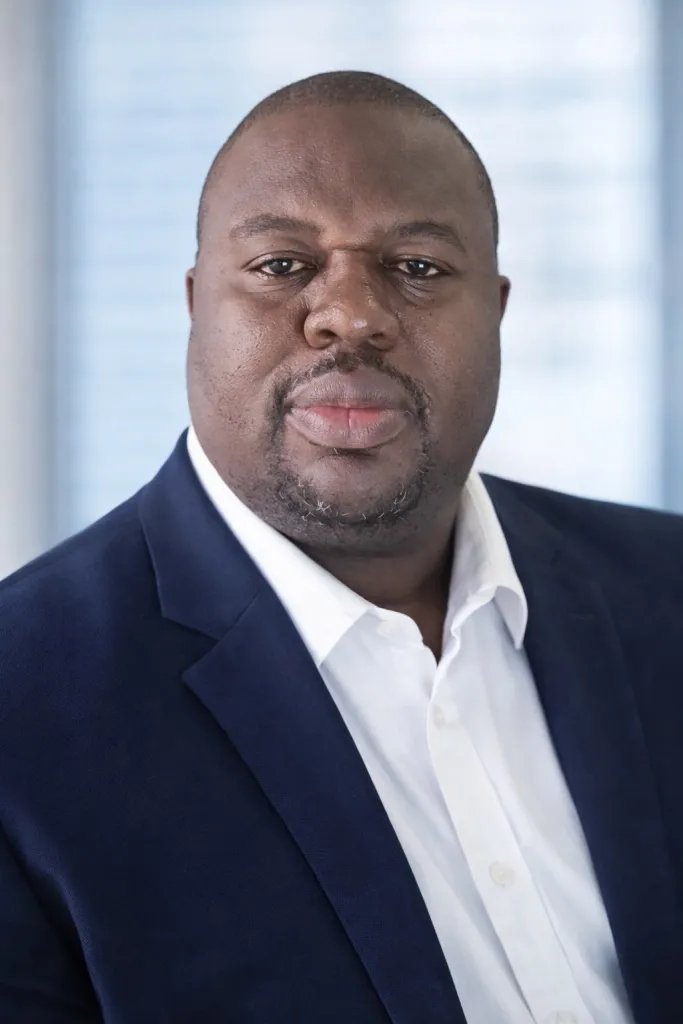
Jeremy Munthali, editor-in-chief of The Mast Newspaper
Jeremy Munthali, editor-in-chief of The Mast Newspaper. (Photo: Courtesy of Jeremy Munthali)

“I would describe the current press freedom climate as strained and increasingly uncertain,” said Jeremy Munthali, editor-in-chief of The Mast newspaper. “There has been a noticeable rise in incidents of harassment and intimidation directed at journalists perceived to be critical of those in authority. These pressures are not always overt, but they are sufficiently present to create a climate of caution within newsrooms.”

On April 8, suspected supporters of the ruling United Party for National Development (UPND), accompanied by police, forced their way into Radio Mpongwe, in central Mpongwe District, and halted the broadcast of a show featuring two party members who were making allegations about corruption in UPND elections.

Station manager Machova Musanshi told CPJ the officers said they had been instructed to stop the program for allegedly attacking “the government leadership.” One of the party critics was taken to a police station to record a statement, while the other hid inside the station, Musanshi said.

In addition, on April 19, Alfonso Kasongo of privately owned Power FM radio was assaulted by suspected UPND supporters at a campaign event. The journalist told CPJ he was filming supporters subduing someone who had thrown stones at party officials when he was beaten and tasered. In a video, reviewed by CPJ, Kasongo is heard identifying himself as a journalist and pleading with his attackers, accompanied by a buzzing sound like tasers emitting an electric charge.

UPND media director Mark Simuuwe told CPJ via email that the ruling party “does not condone violence” and called on the police to “thoroughly investigate all reported incidents involving attacks on journalists” and ensure those involved are arrested and prosecuted “without fear or favour.”

Government spokesperson Cornelius Mweetwa did not respond to CPJ’s requests for comment via phone and messaging app.

Newsrooms self-censor

For newsrooms, such incidents weigh heavily on editorial decisions.
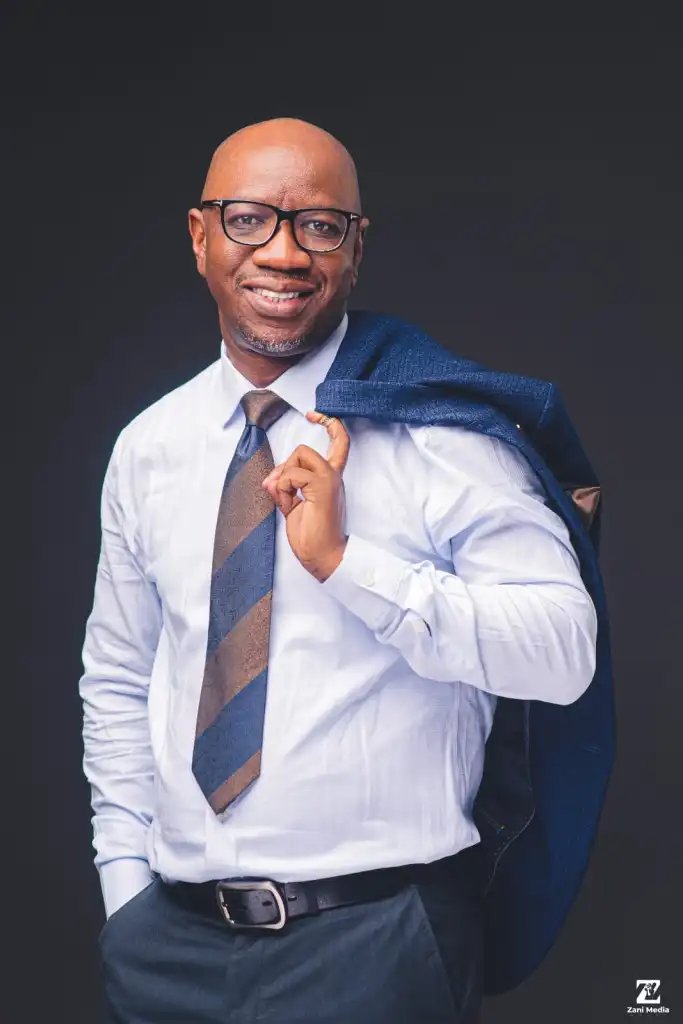
Kennedy Mambwe, managing director of Zambia's digital broadcaster KBN TV.
Kennedy Mambwe, CEO of KBN TV. (Photo: Courtesy of Kennedy Mambwe)

“It’s much like driving on a muddy road; the regulatory environment seems to be giving rise to self-censorship,” said Kennedy Mambwe, CEO of the digital broadcaster KBN TV, which was summoned in 2023 by the regulatory Independent Broadcasting Authority and ordered to stop inviting politicians to present the news. The order is still in force.

“KBN TV is one of the media outlets that has been summoned by the regulator and censured more than any other we know. Even though the reasons sometimes are put across as regulatory in nature, the motive sounds like political intimidation,” he said, adding that using regulators as “political tools” causes “so much damage” to journalism.

The Cyber Security Act is not the only law focused on expanding state surveillance powers.

The Closed-Circuit Television (CCTV) Bill, which proposes to establish a comprehensive legal framework for the installation, operation, and regulation of closed-circuit television, is due to return to parliament for review after Hichilema declined to sign it in February. Although lawmakers approved the draft law in 2025, the president said it risked being intrusive and needed to be revised.

“Expanded surveillance powers can compromise source confidentiality,” said Kalala, adding that the identities of journalists’ sensitive sources could be exposed. 

‘I cannot publish’

As Kalala prepares to return to court in May to continue challenging the new cyber laws, the Zambian Whistleblower’s Thomas Zgambo are already facing the prospectof lengthy prison sentences over sedition charges. The investigative journalist is fighting two cases linked to his reporting on corruption and poor governance. If found guilty, he could be jailed for up to seven years on each count.

Sedition — or conduct that encourages insurrection or rebellion against the government — is an old-fashioned offense under Zambia’s 1930 Penal Code that has long been used to silence dissenting voices. The law defines publications with “seditious intention” as those that aim to “bring into hatred or contempt or to excite disaffection against” the government or among people.
The logo of Zambian Whistleblower, citing the Bible verse, "You will know the truth and the truth will set you free."
The Zambian Whistleblower’s logo cites the Bible verse, “You will know the truth and the truth will set you free.”

The misuse of sedition charges by successive Zambian governments ruffled by legitimate criticism and investigative reporting highlights the risks posed by the new cyber laws, with similarly vague and expansive terms.

“In Zambia, press freedom is like a gift from the executive wing of any government. It is not a right,” said Zgambo, who feels muzzled by the two sedition cases he is facing. “I personally have a lot of stories that I believe are of public interest that I cannot publish because of the current prevailing conditions.”

Despite this, Zgambo’s motivation remains unchanged.

“What motivates me to continue operating despite these challenges is my love for my country. I’m a patriot,” he said.

Editor’s note: Joan Chirwa, CPJ’s southern Africa researcher, is executive director of Free Press Initiative.

Read the full article here

Fact Checker

Verify the accuracy of this article using AI-powered analysis and real-time sources.

Get Your Fact Check Report

Enter your email to receive detailed fact-checking analysis

5 free reports remaining

Continue with Full Access

You've used your 5 free reports. Sign up for unlimited access!

Already have an account? Sign in here

Share. Facebook Twitter Pinterest LinkedIn Tumblr Email Telegram Copy Link
News Room
  • Website
  • Facebook
  • X (Twitter)
  • Instagram
  • LinkedIn

The FSNN News Room is the voice of our in-house journalists, editors, and researchers. We deliver timely, unbiased reporting at the crossroads of finance, cryptocurrency, and global politics, providing clear, fact-driven analysis free from agendas.

Related Articles

Global Free Speech

CPJ shares statement from international legal counsel acting in case of US-Kuwaiti journalist Ahmed Shihab-Eldin

1 hour ago
Global Free Speech

CPJ, partners urge Malta to take action on media reforms 

11 hours ago
Global Free Speech

How the Pentagon is trying to control the narrative

20 hours ago
Global Free Speech

Journalist Mehmet Yetim arrested in Turkey for ‘spreading disinformation’

21 hours ago
Global Free Speech

Hong Kong media tycoon Jimmy Lai, the publisher of shuttered Hong Kong newspaper Apple Daily, during an interview in 2020. Photo: AP Photo/Vincent Yu/Alamy For simply documenting Iranian attacks, hundreds of people have been detained in the United Arab Emirates, all charged under the UAE’s draconian cybercrime laws. They could be jailed for life. Around 70 of those are UK citizens. There should be an outcry from our government. But is there? No, none. No minister has made a public statement condemning the arrests. Instead the Foreign Office has issued statements like this one calling the Gulf countries “our partners” and ones along these lines that offer support to get overseas Brits home – that is, those who aren’t in prison. According to the Foreign Office’s own admission, it’s only offering consular assistance to a select few of the 70 incarcerated. The families of those detained are now voicing their frustration and calling the response inadequate. They’re right but sadly their cries are likely to fall on deaf ears. I cannot tell you the number of meetings and conferences I’ve attended with current and former hostages and their families to discuss the UK government’s woeful response to the plight of people held abroad. Sebastian Lai and a legal team at Doughty Street Chambers have been asking the British government for years to put pressure on China to release Jimmy Lai, who’s been held since 2020; the relatives of Jagtar Singh Johal, a human rights defender from Dumbarton in Scotland held by the Indian government, have been campaigning even longer. Both men are British nationals. The UK should have moved mountains to get them home. But no government has even moved a mound. It’s a trend that goes back decades. Jill Morrell became a fixture of the news in the 1980s after her boyfriend, British journalist John McCarthy, was kidnapped in Beirut. While he was eventually released, he lost years of his life to jail and it was the dogged persistence of Morrell which forced ministers to act. We should be ashamed by all this, even more so when you consider that countries like Ireland and Australia have a better track record. I could joke that a British passport might get you into lots of countries but it sure as hell won’t get you out of them.  Except it’s not the remotest bit funny. A 2023 report by the foreign affairs select committee, which took evidence from Richard and Nazanin Zaghari-Ratcliffe and the families of other political prisoners, condemned the Foreign Office’s attitude as secretive, inconsistent and built on an erroneous belief that quiet diplomacy works. Three years on and it’s hard to see any change. Why exactly are we so callous about our political prisoners abroad? We at Index simply don’t know, though we do have theories (prioritisation of trade over human rights, the diminishing stature of Britain on the global stage, political football around dual nationals, a fear of giving in to hostage-taking – to list four). All we know for certain is the terrible impact of our policy on those incarcerated and on their families. What a sorry state. We have a group of people languishing overseas for simply exercising their free expression rights, and successive governments including our current one which appear unwilling to defend their right to do so. READ MORE

21 hours ago
Global Free Speech

Budapest, Hungary. 13th Apr, 2026. Peter Magyar waves the Hungarian flag after his speech during the TISZA party’s election night event in Budapest. Photo: ZUMA Press/Alamy The Index team has been absorbed in everything Hungary-related this week. No surprise there, given Péter Magyar’s seismic election victory on Sunday, and Index’s roots in eastern Europe. Our latest magazine – just launched – explored the effect Orbán’s had in Hungary and on spreading his brand of illiberal democracy. We’re deep in the conjecture stage, awaiting what happens next and asking what an ex-Fidesz conservative who rode to power on an anti-corruption campaign will mean for freedom of expression. Could be good, could be the same old. We’ll be watching closely. Already some positive news there though: Magyar has announced that he will suspend the Orbánised state media and only restore it when objective and impartial reporting can be ensured. It’s a similar move to the one Donald Tusk made when he became Prime Minister of Poland. Magyar also announced that he’d be looking into Viktor Orbán’s influence campaigns. Martin Bright reported on this for the latest magazine, attending a conference in Brussels which was funded by the Hungarian government and intended to bring together far right parties from around Europe. The event was part of a much wider project paid for partly by Russian oil money (filtered through Hungary) which smacked of foreign interference in European democracy. There now needs to be an urgent investigation of the funding of UK-based organisations and politicians by the Orbán government. And when it comes to illiberal forces meddling in overseas affairs, there is way too much of that around. The Guardian rather made the point for me when they broke the story this week of London’s Victoria and Albert Museum censoring its own catalogues to keep in with Beijing. A series of images were removed upon the request of the Chinese printers. One of the images was a historic map of the British Empire, which included China. Presumably its 1930s borders didn’t dovetail with Beijing’s current narrative around Xinjiang and Tibet. This is not the first time the V&A has done an image swap upon the request of Beijing. Nor is the V&A alone, such interference has been happening for a while. The V&A’s justification came down to cost. Apparently using a Chinese printer is half the price of a British or European one. I don’t doubt that. But while I have no idea of the financial margins we’re talking about here, I do know about the broader consequence: An emboldened China, a country that places bounties on the heads of Hong Kong dissidents and harasses lawyers, protesters, activists and journalists alike over here. This is the real cost of doing business on Beijing’s terms. It’s depressing that our cultural institutions – which are meant to be the leading incubators of plural thought after all – are playing ball. The cost also isn’t confined to China; such capitulation emboldens others. So yes it’s great that this week we’ve potentially been rescued from the full-scale Orbánisation of Europe, but he was ultimately just a symptom of a rotten global order, one where speech rights can be bought by the highest bidder – or in the case of the V&A the one offering the cheapest paper. READ MORE

22 hours ago
Add A Comment
Leave A Reply Cancel Reply

Editors Picks

Lazarus Group Malware Targets Crypto, Business Execs via macOS

11 minutes ago

GSR Launches Actively Managed Bitcoin, Ethereum and Solana Basket ETF on Nasdaq

12 minutes ago

Prison Doesn’t Work the Way You Think

1 hour ago

CPJ shares statement from international legal counsel acting in case of US-Kuwaiti journalist Ahmed Shihab-Eldin

1 hour ago
Latest Posts

UK FCA raids eight illegal peer-to-peer trading hubs

1 hour ago

Aave Deposits Drop by $15B Following Kelp DAO Exploit

1 hour ago

American Bitcoin Shares Spike After Trump-Backed Firm Activates 11K BTC Miners

1 hour ago

Subscribe to News

Get the latest news and updates directly to your inbox.

At FSNN – Free Speech News Network, we deliver unfiltered reporting and in-depth analysis on the stories that matter most. From breaking headlines to global perspectives, our mission is to keep you informed, empowered, and connected.

FSNN.net is owned and operated by GlobalBoost Media
, an independent media organization dedicated to advancing transparency, free expression, and factual journalism across the digital landscape.

Facebook X (Twitter) Discord Telegram
Latest News

Bitcoin breaks Strategy’s STRC ex-dividend date slump for the first time in six months

10 minutes ago

Lazarus Group Malware Targets Crypto, Business Execs via macOS

11 minutes ago

GSR Launches Actively Managed Bitcoin, Ethereum and Solana Basket ETF on Nasdaq

12 minutes ago

Subscribe to Updates

Get the latest news and updates directly to your inbox.

© 2026 GlobalBoost Media. All Rights Reserved.
  • Privacy Policy
  • Terms of Service
  • Our Authors
  • Contact

Type above and press Enter to search. Press Esc to cancel.

🍪

Cookies

We and our selected partners wish to use cookies to collect information about you for functional purposes and statistical marketing. You may not give us your consent for certain purposes by selecting an option and you can withdraw your consent at any time via the cookie icon.

Cookie Preferences

Manage Cookies

Cookies are small text that can be used by websites to make the user experience more efficient. The law states that we may store cookies on your device if they are strictly necessary for the operation of this site. For all other types of cookies, we need your permission. This site uses various types of cookies. Some cookies are placed by third party services that appear on our pages.

Your permission applies to the following domains:

  • https://fsnn.net
Necessary
Necessary cookies help make a website usable by enabling basic functions like page navigation and access to secure areas of the website. The website cannot function properly without these cookies.
Statistic
Statistic cookies help website owners to understand how visitors interact with websites by collecting and reporting information anonymously.
Preferences
Preference cookies enable a website to remember information that changes the way the website behaves or looks, like your preferred language or the region that you are in.
Marketing
Marketing cookies are used to track visitors across websites. The intention is to display ads that are relevant and engaging for the individual user and thereby more valuable for publishers and third party advertisers.