

 Freedom Index
Listen to the article
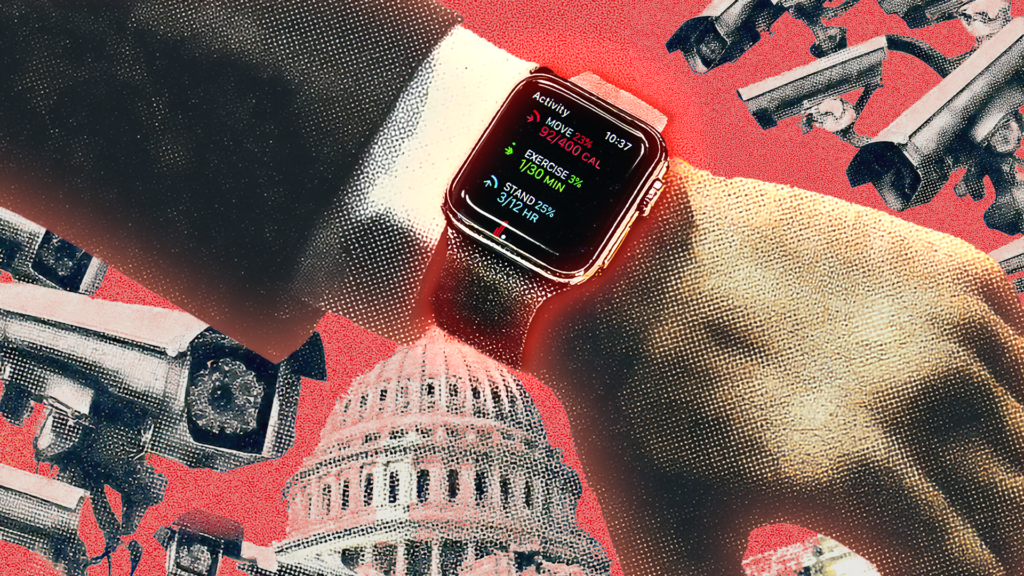
By gathering continuous data about sleep, heart rate, and physical activity, biowearable devices can give individuals more control over their well-being. But they also create a detailed digital record of our daily lives—one that the federal government may soon be able to access readily.
Consider this scenario.
You’ve recently received a government-subsidized biowearable. Accordingly, the authorities now know when you’re sleeping, because the device reports your sleep cycle, location, and daily movements in real time to a cloud server accessible through a legal process. It knows when you’re home. It knows when you leave.
Those data are then obtained by an FBI field office (either through direct purchase or, if necessary, a legal process), because a federal prosecutor has decided that your criticism of immigration enforcement operations and your social media posts supporting Immigration and Customs Enforcement protesters constitute “incitement to violence” against federal agents. Under the Trump administration’s elastic (and legally dubious) domestic terrorism definitions and designations, that is enough to open a criminal investigation.
And because the government has known for weeks when you’re at home sleeping, it knows exactly when to break down your door.
That scenario may sound far-fetched, but it is getting closer to reality. In March, the Department of Health and Human Services (HHS) announced that the Advanced Research Projects Agency for Health (ARPA-H) would begin investing in new biowearable technologies through a program it called Delphi, after the ancient Greek sanctuary where the maxim “know thyself” was inscribed. It’s a fitting name for a program designed to help people understand their bodies, but it also raises an uncomfortable question: Who else might come to know them just as well?
The program aims to develop biosensors capable of continuously monitoring cytokines (cellular inflammation markers) and hormone levels, going substantially beyond what current wearables can detect. Funding will be determined on a competitive basis as private-sector stakeholders submit proposals; no specific appropriation has been announced.
It remains unclear why this taxpayer funding is necessary in a field that is already thriving. The global wearables market was valued at roughly $43 billion in 2024 and is projected to exceed $168 billion by 2030.
Devices worn on the wrist, finger, or skin can already monitor heart rates, blood oxygen levels, sleep patterns, physical activity, and—in the case of continuous glucose monitors—blood sugar levels in real time. Some smartwatches can even conduct electrocardiograms capable of detecting irregular heart rhythms, such as atrial fibrillation.
Until recently, people could access most of this information only during periodic visits to a clinic or hospital. Biowearables now enable people to monitor many of these signals continuously in everyday life.
And the technology is advancing rapidly. Researchers are creating wearable sensors that might soon continuously monitor blood pressure, hydration, stress hormones, and other biochemical markers. Some systems in development aim to detect early signs of infection or metabolic changes before symptoms appear. Within the next decade, wearable devices could provide continuous streams of personalized physiological data that previously required lab tests or clinical monitoring.
This innovation is being propelled by the private sector. Technology companies, startups, and venture capital investors are pouring billions of dollars into wearable health technology. But new risks emerge when government begins to harness this technology for its own purposes. Government funding usually comes with political strings attached, and technologies meant to empower individuals can look very different once governments become involved in their development.
The opening scenario above is not a paranoid fantasy about some distant future. It is an extrapolation from capabilities and legal authorities that exist right now—and from a federal investment and regulatory posture that is actively making them worse.
A surveillance infrastructure built on biowearable data is already taking shape, thanks to a critical structural vulnerability.
Consumer biowearables fall almost entirely outside the two legal frameworks most people assume protect their health data. Many do not fall within the Food and Drug Administration (FDA) medical-device regulatory framework, and the Health Insurance Portability and Accountability Act (HIPAA) does not cover health data unless they are generated within a doctor-patient relationship. That means the intimate physiological data streaming off your wrist every five minutes are often legally available to data brokers, insurers, employers, and law enforcement. Law enforcement agencies in the United States and other jurisdictions have already purchased commercial data—including from wearables—to conduct location tracking.
This gap is not a technical accident. As one peer-reviewed analysis put it, wearable sensor data “can be used to infer deeply private information like mood, stress levels, and behavioral patterns—well beyond what users knowingly disclose.” Despite claims of anonymization, sensor data often contains unique and persistent fingerprints that make true anonymization difficult, if not impossible.
The policy environment surrounding biowearables is moving in two directions at once. In January 2026, the FDA announced guidance allowing more wearables to fall into an unregulated “general wellness” category, exempting them from the agency’s review process without a public comment period. This means more devices generating vastly more intimate health data.
At the same time, HHS Secretary Robert F. Kennedy Jr. has stated his goal of having every American wear a wearable within four years, describing it as one of the largest advertising campaigns in HHS history. The recently announced ARPA-H Delphi program compounds this: The federal government will now fund development of biosensors capable of detecting cytokines and hormones—markers of pregnancy, immune response, stress, and drug metabolism—while simultaneously weakening the regulatory framework that would govern data from those same devices.
If ARPA-H-funded biosensors reach the consumer market under the FDA’s deregulated wellness category, the resulting data streams will be largely unprotected by HIPAA, available to data brokers, and accessible to law enforcement through ordinary legal process—all while the government that funded their development maintains a separate procurement track for the same technology.
Congress has made incremental attempts to address the HIPAA gap. The bipartisan Smartwatch Data Act—introduced by Sens. Jacky Rosen (D–Nev.) and Bill Cassidy (R–La.)—would require consumer consent before wearable health data can be sold or shared. Cassidy has separately introduced the Health Information Privacy Reform Act, which would extend HIPAA-like protections to wearable data. Neither has advanced. Meanwhile, some states have enacted partial protections: Illinois’ Biometric Information Privacy Act and California’s Consumer Privacy Act offer meaningful but incomplete coverage.
The legislative gap is not just technical. It reflects a political failure to confront the reality that the ability to monitor a person’s physiology continuously, in real time, is now embedded in millions of consumer devices, increasingly tied to federal funding and procurement, and available to government agencies that purchase the information from middlemen or directly from the gadget manufacturers if their terms of service say they may sell the data.
Biowearables can empower individuals. Used voluntarily, with strong privacy protections and meaningful consent, they could expand personal health autonomy. But a government that funds the technology, promotes putting it on every American’s wrist, and builds its own procurement pipeline for the same tools isn’t empowering patients. It’s laying the groundwork for the most intimate surveillance infrastructure ever created, one heartbeat at a time.
Read the full article here
Fact Checker
Verify the accuracy of this article using AI-powered analysis and real-time sources.