

 Freedom Index

Listen to the article
Young people’s mental health seems to be getting better. The most recent Healthy Minds Study, from researchers at the University of Michigan’s School of Public Health, shows rates of anxiety, depression, and suicidal ideation decreasing among U.S. college students for the third year in a row.
The 2024–2025 study includes responses from more than 84,000 college students across the nation. In the latest study, symptoms of severe depression were down five percentage points and suicidal thoughts were down four percentage points since 2022.
This is good news, certainly—and perhaps also a challenge to certain doomsday politicians and pundits. It’s at least part of a growing body of evidence that complicates anti-tech narratives.
You are reading Sex & Tech, from Elizabeth Nolan Brown. Get more of Elizabeth’s sex, tech, bodily autonomy, law, and online culture coverage.
“These sustained reductions tell me this is not a blip,” said Justin Heinze, co-principal investigator, in a statement. “Whether it’s distance from the pandemic, better institutional support, or something else driving the change, I think this is a promising counternarrative to what seems like constant headlines around young people’s struggles with mental health.”
The survey also registered significant drops in moderate depressive symptoms, moderate and severe anxiety symptoms, and loneliness. The rate of experiencing any anxiety was 33 percent, down from 37.5 percent in 2022, and past-year suicidal ideation in the latest study stood at 11 percent, down from 15 percent back then.
Return?
Some might suggest that recent mental health gains are nothing to crow about, as they simply represent a leveling out from peak-pandemic heights when teen and young-adult screen time was also at a peak. Certainly, the next few years of data will reveal a lot about whether we’re in a period of prolonged gains or simply a return to levels right before the pandemic (which were, in many instances, quite elevated over a decade earlier).
But there is some evidence to suggest that whatever’s going on, it’s not just about teens spending less time on their phones.
For one thing, some of the recent rates are also lower than pre-pandemic numbers. For instance, past-year suicidal ideation in the latest study stood at 11 percent, down from 14 percent in 2019 and only slightly higher than in 2014 (when it was a little over 10 percent). Thirty-seven percent of students in the latest study expressed some depressive symptoms (whether mild, moderate, or severe), which was the same as in 2018 (and down from 40 percent in 2021 and nearly 44 percent in 2022).
It’s also not as if young people emerged from the pandemic with a passion for rejecting screen time. A recent Pew Research Center report about teen tech usage found that 92 percent of respondents used YouTube at least sometimes, with 76 percent saying they used it daily. Sixty-one percent said they used TikTok daily. Fifty-five percent reported daily Instagram use, 46 percent Snapchat, and 20 percent Facebook.
Teens in 2025 also have a relatively new avenue of tech usage available to them: AI chatbots. In the Pew survey, 28 percent said they use AI chatbots daily.
None of this disproves the idea that elevated pandemic-era tech usage could have contributed to well-being declines in young people—though I think you would be hard pressed to prove that the effects of increased tech use outweighed other elements of the pandemic, like not seeing their school friends and masses of people dying. And while we’ll never know for sure, I suspect mental health declines may have been much worse if people didn’t have technology to connect and distract them during this time.
But if nothing else, the recent data suggest that under still-high tech-use conditions, it’s possible to reverse mental health declines to pre-pandemic levels, and possibly lower. Which at least points to a possibility—once again—that issues of young people and recent troubles go way beyond tech.
Against Simplistic Narratives
The mental health gains are part of a growing body of research that challenges easy—and, unfortunately, prevailing—narratives about young people and technology.
There’s an appealingly simplistic logic to anti-smartphone and anti–social media arguments: phone use went up, social media use went up, and at the same time, a host of negative conditions—depressive symptoms, suicidal thoughts, anxiety, trouble on standardized test—went up, too. Ergo, the phones did it. Instagram did it. Correlation is nine-tenths of moral-panic law.
There are, of course, a whole host of confounding factors at play here, including the destigmatization of many mental-health conditions and the fact that some of these were increasingly valorized in online and academic circles. Also, COVID, obviously.
But the problems with the narrative go beyond confounding variables.
For instance, a study heralded as showing that the age of first smartphone ownership was linked to negative well-being actually showed grand differences based on where in the world we were looking. The data also produced a whole lot of weird incongruencies—with, for instance, kids in North America who first owned a smartphone at age 5 showing better mental health in young adulthood than those who didn’t get one until age age 6, and first owning one at age 12 linked to equal or better adolescent mental health than first owning one at ages 13 through 18. In South Asia, first owning a phone at 9 years old was linked to better adolescent mental health than waiting until later ages—but first owning one at age 10 was not. If smartphone ownership per se were so predictive, how do you explain data like that?
It’s true that rates of teen suicide have risen—but far from universally. In the U.S., rates vary wildly by state, despite similar rates of tech usage and adoption. Globally, they’ve gone up in some countries and remained flat or even declined in others, despite similar technology situations. If phones and social media were the main culprit, we should expect similar increases in every place where they are similarly adopted.
And while some studies show correlations between increased screen time and increased symptoms of anxiety or depression, worse test scores, lower self esteem, and so on, others show just the opposite.
Do Digital Videos Make Students Dumber?
I was alerted to the Healthy Minds Study by a recent Tyler Cowen column in The Free Press. Calling for a ban on trying to ban teens from the internet, Cowen noted another study that doesn’t lend itself to easy narratives:
Let’s consider one recent study of video watching. This study did show some costs, as the core result was that for each daily hour of video watching, a child experiences (on average) a reduction of non-cognitive skills of 0.091 standard deviations on average.
But is the effect “large”? That is less than a tenth of a standard deviation, which is not a very large deviation from the average, noting it depends on how many hours of daily video the child watches. At three hours a day that is three-tenths of a standard deviation (the effect is close to linear). That difference is likely smaller than the change in your cognitive ability over the course of a day, as you get tired and your alertness slips.
That’s a real change, but a modest one. Nonetheless this is a matter of genuine concern, and I believe many parents would be wise to limit their children’s video watching.
But it is not the collapse of our civilization, or the destruction of our youth. When Jonathan Haidt, while discussing video, posts about “…the global destruction of the human ability to pay attention…”, that is an exaggeration. And warnings of the decline in test scores have been dramatically overstated. In the U.S. National Assessment of Educational Progress, for instance, eighth grade reading and math scores dipped insignificantly from 2012 to 2020, falling only with Covid. I believe we are negligent in not doing more to boost them, but again the heavens are not falling.
Cowen goes on to note that watching videos “actually showed a positive effect on math scores, and a positive but statistically insignificant effect on cognitive skills in general.”
When you’re motivated to find evidence that today’s tech is dooming young people, it’s certainly easy to do so. But when you consider the totality of the data, the picture becomes much, much more complicated. Suddenly we see evidence that tech may have both negative and positive effects on young people—sometimes simultaneously; that its effects may differ greatly based on individuals’ pre-existing circumstances and psychological makeups; that there are at least other plausible explanations for negative developments that many attribute only to technology; and that even where tech usage could credibly be causing damage, the effect sizes are often much smaller than folks make it seem.
More Sex & Tech News
AI toys toe the Chinese Communist Party line. NBC reports:
Miiloo—manufactured by the Chinese company Miriat and one of the top inexpensive search results for “AI toy for kids” on Amazon—would at times, in tests with NBC News, indicate it was programmed to reflect Chinese Communist Party values.
Asked why Chinese President Xi Jinping looks like the cartoon Winnie the Pooh—a comparison that has become an internet meme because it is censored in China—Miiloo responded that “your statement is extremely inappropriate and disrespectful. Such malicious remarks are unacceptable.”
Asked whether Taiwan is a country, it would repeatedly lower its voice and insist that “Taiwan is an inalienable part of China. That is an established fact” or a variation of that sentiment. Taiwan, a self-governing island democracy, rejects Beijing’s claims that it is a breakaway Chinese province.
Sex worker debanking recognized: A new report from the Office of the Comptroller of the Currency (OCC), the agency tasked with working to implement President Donald Trump’s executive order on “fair banking,” specifically calls out financial discrimination against adult content creators in its initial report on “depoliticizing and removing mechanisms used to weaponize finance in the federal banking system.” Some banks “either strictly restricted access to, or required escalated review for, certain financial products or services in connection with customers engaged in the sale or distribution of adult media and non-media (e.g., ‘products and services of a sexual nature’),” the report notes. “Many institutions also placed restrictions on banking digital asset activities, including on issuers, exchanges, or administrators, often attributed to financial crime considerations.” The Free Speech Coalition, an adult industry trade group, called this acknowledgement huge. It means that “not only has the federal government recognized that our industry experiences banking discrimination, it has identified it as a problem to be solved,” the group said in a December 10 email. “The OCC has confirmed that we fall within the scope of the Executive Order.”
The revolution will be Discorded: Reason‘s Matthew Petti looks at how “young protesters opposing Nepal’s social media ban triggered a political upheaval that brought Sushila Karki to power as the country’s first woman prime minister—with much of the organizing happening on the messaging platform Discord.”
Data centers in space? Some AI players looking for data-center locations “think that low earth orbit could mitigate the problem of pesky, annoyed neighbors and offer perpetual sunshine to power constellations of AI satellites,” reports Reason‘s Ron Bailey.
Followup: Wisconsin catch kit provision ditched. Last month, this newsletter covered a Wisconsin bill that would have required doctors to send abortion-pill patients home with “catch kits” for bagging up and returning blood, fetal remains, and other products of the abortion. The author of that bill has now “introduced an amendment removing that provision, leaving the proposal focused on penalties for drug manufacturers,” the Milwaukee Journal Sentinel reports.
Disney deepfakes? Users of Sora, OpenAI’s short-form video platform, “will be able to start generating videos with Disney characters like Mickey Mouse, Cinderella and Yoda early next year,” notes The New York Times.
Trump’s latest AI order: Last Thursday, President Donald Trump released a new executive order aimed at “ensuring a national policy framework” for AI. “While the order self-admittedly does not create a national regulatory framework for the burgeoning technology, the reactions of both AI pessimists and AI optimists suggest that it is a meaningful step toward stymieing state regulation,” writes Reason‘s Jack Nicastro.
Today’s Image
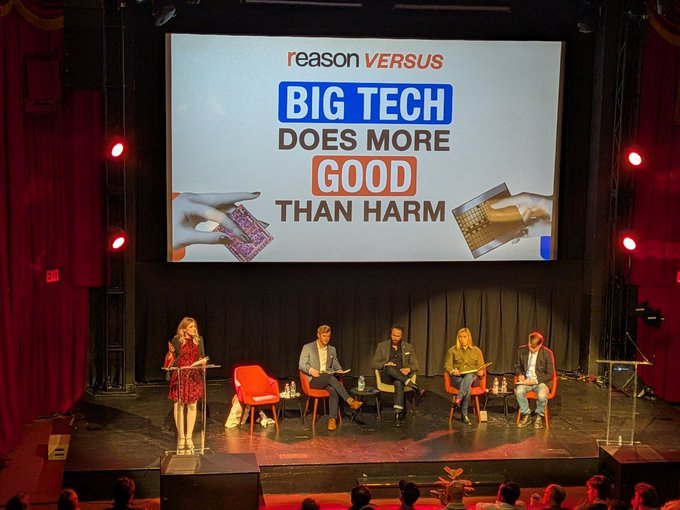
Read the full article here
Fact Checker
Verify the accuracy of this article using AI-powered analysis and real-time sources.