

 Freedom Index

Listen to the article
Brown, who worked at the Florida Fish and Wildlife Conservation Commission reposted this item from an Instagram account that “posts satirical social commentary from the perspective of a whale”:
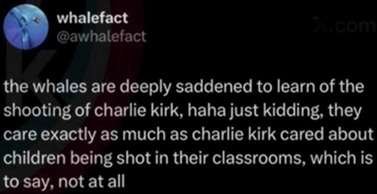
This was apparently a reference to Kirk’s comments that part of the price of the Second Amendment is that there would be “some gun deaths”:
[At an event] held days after three children and three adults were killed in a school shooting in Nashville … Kirk [was] asked by an audience member how to make the point that protecting the Second Amendment is important. Kirk responded that the amendment “is there, God forbid, so that you can defend yourself against a tyrannical government.” But “having an armed citizenry comes with a price, and that is part of liberty,” he said.
“You will never live in a society when you have an armed citizenry and you won’t have a single gun death,” Kirk later said. “That is nonsense. It’s drivel. But I am — I think it’s worth it. I think it’s worth to have a cost of, unfortunately, some gun deaths every single year so that we can have the Second Amendment to protect our other God-given rights. That is a prudent deal. It is rational. Nobody talks like this. They live in a complete alternate universe.”
(This is of course similar to the arguments that rights supporters routinely make when other rights lead to some amount of foreseeable deaths—the Fourth Amendment, the privilege against self-incrimination, the right to bail in many case, and so on. Characterizing it as “not caring at all” about the deaths strikes me as a poor argument, but that’s a separate matter.)
This post became broadly seen (through the “Libs of TikTok” account) and led to lots of criticism, including criticism sent to plaintiff’s employer, the Florida Fish and Wildlife Conservation Commission, which fired her. Plaintiff sued, seeking a preliminary injunction ordering her reinstatement. Judge Mark Walker’s decision yesterday in Brown v. Young (N.D. Fla.) denied that preliminary injunction.
Generally speaking, a government employee’s speech is protected against employer retaliation if (1) it’s said in the employee’s capacity as a citizen and not as part of the employee’s job, (2) the speech involves “a matter of public concern,” and (3) the speaker’s “free speech interests outweighed [the employer’s] interest in effective and efficient fulfillment of its responsibilities.” (This third element is often called the Pickering balance, after the case in which it was articulated.)
The court correctly concluded that the first two elements were satisfied, and that “it’s not a close call”:
First, it is no answer that Plaintiff’s Instagram post, itself, is not original content. Courts have long recognized that re-posting memes or other content from other creators, without further comment, is akin to one’s own speech.
Nor can Defendants immunize themselves by recharacterizing Plaintiff’s speech as mere “association” with another’s speech. Plaintiff spoke when she re-posted the third-party’s speech as her own on her Instagram story. Full stop.
Likewise, there is no contention that Plaintiff’s Instagram story amounts to unprotected government speech that owed its existence to her job at FWC or was even remotely related to the work she performed … [which was] monitoring imperiled shorebirds and seabirds ….
Defendants also contend that Plaintiff’s Instagram story did not touch on a matter of public concern because it conveyed only “personal disdain” and did not contain any “civic commentary.” … [But a] public employee’s negative opinion about a public figure who has nothing to do with their job is generally not the sort of speech touching on a “personal interest” that garners no protection under the Pickering framework. [See, e.g.,] Rankin v. McPherson (1987) (holding that employee was speaking on a matter of public concern when she told a coworker that if another attempt was made on the president’s life, she “hope[s] they get him”) ….
It is also no answer that Plaintiff’s speech was arguably satirical, sarcastic, or insensitive. “Humor, satire, and even personal invective can make a point about a matter of public concern.” Indeed, “[t]he inappropriate or controversial character of a statement is irrelevant to the question whether it deals with a matter of public concern.” Rankin.
But the court held that plaintiff hadn’t [sufficiently clearly] met her burden “to show that her free speech interest outweighs FWC’s interest in the effective and efficient fulfillment of its responsibilities”:
Defendant Tucker[‘s unrebutted declaration] provides evidence that there was a swift and largely negative reaction from the public concerning Plaintiff’s Instagram story which “disrupted agency operations, required diversion of staff resources to manage responses, and raised legitimate concerns about the agency’s credibility and public trust.” While Plaintiff understandably argues that this declaration is short on specifics and largely conclusory, Plaintiff also chose not to seek expedited discovery to depose Defendant Tucker or cross-examine her at the hearing to explore flaws in Defendants’ position.
Without more, this Court cannot conclude on this sparse record that the public’s negative reaction was not disruptive enough to justify the action FWC took…. “The government’s legitimate interest in avoiding disruption does not require proof of actual disruption. Reasonable possibility of adverse harm is all that is required.” …
It’s still possible that, after further discovery, and perhaps after a trial, plaintiff will be able to show that the public reaction was less disruptive than the government says it was, and that plaintiff’s “free speech interests outweighed” the disruption (however such weighing is to be done).
But the basic principle still remains: Under government-as-employer doctrine as it’s currently understood, speech is protected only until it draws enough public condemnation. Once the speech (whether left-wing, right-wing, or any other) is publicized enough that enough people complain to the employer, the Pickering balance comes out in favor of allowing the firing.
I discussed this in a post about the subject right after the Kirk murder. As I noted, if one looks at court cases over the last several decades, they have routinely turned on whether the speech created enough public controversy. When the government is administering the criminal law or civil liability, such a “heckler’s veto” is generally not allowed: The government generally can’t shut down a speaker, for instance, because his listeners are getting offended or even threatening violence because they’re offended. But in the employment context, the Pickering balance often allows government to fire employees because their speech sufficiently offends coworkers or members of the public. (The analysis may differ for public university professors, though it’s not clear how much; see this post for more.)
This conclusion by lower courts applying Pickering might, I think, stem from the judgment that employees are hired to do a particular job cost-effectively for the government: If their speech so offends others (especially clients or coworkers) that keeping the employees on means more cost for the government than benefit, the government needn’t continue to pay them for what has proved to be a bad bargain. Maybe that’s mistaken. Maybe it’s so important to protect public debate, including on highly controversial matters, that public employers should have to keep on even the most controversial employees (see this article by Prof. Randy Kozel, which so suggests in part). But that appears to be the rule.
We see this, for instance, with statements that are allegedly racist, sexist, antigay, antitrans, etc.: If they cause enough public hostility, or seem highly likely to do so, then courts will often allow employees to be fired based on them. But if they largely pass unnoticed except by management and perhaps just a few people who file complaints, then courts are much more likely to hold that the firings may violate the First Amendment (see, e.g., this post and this post, though there are many other such examples).
There are other factors that courts consider, to be sure: For instance, if the employer can show that a person’s speech shows they are unsuited to the job, that makes it easier for the employer to prevail. But even there the magnitude of public reaction is relevant, because one common argument is that one trait required for certain employees is the ability and willingness to instill confidence and respect in coworkers and clients, rather than to produce outrage and hostility.
This creates an unfortunate incentive: Like any heckler’s-veto-like rule, it rewards would-be cancellers, if they only speak out often enough and with enough outrage. But rightly or wrongly, that is how these cases generally shape up.
Read the full article here
Fact Checker
Verify the accuracy of this article using AI-powered analysis and real-time sources.