Close Menu
FSNN | Free Speech News NetworkFSNN | Free Speech News Network
  • Home
  • News
    • Politics
    • Legal & Courts
    • Tech & Big Tech
    • Campus & Education
    • Media & Culture
    • Global Free Speech
  • Opinions
    • Debates
  • Video/Live
  • Community
  • Freedom Index
  • About
    • Mission
    • Contact
    • Support
Trending

Bitcoin OG selling eases as dormant BTC movement hits 4-year low: Thorn

51 minutes ago

Mira Murati’s Inkling AI Model Review: Best Open-Source Model in the West

56 minutes ago

U.S. regulator warns prediction markets against cutting corners in event contracts

2 hours ago
Facebook X (Twitter) Instagram
Facebook X (Twitter) Discord Telegram
FSNN | Free Speech News NetworkFSNN | Free Speech News Network
Market Data Newsletter
Sunday, July 26
  • Home
  • News
    • Politics
    • Legal & Courts
    • Tech & Big Tech
    • Campus & Education
    • Media & Culture
    • Global Free Speech
  • Opinions
    • Debates
  • Video/Live
  • Community
  • Freedom Index
  • About
    • Mission
    • Contact
    • Support
FSNN | Free Speech News NetworkFSNN | Free Speech News Network
Home»News»Global Free Speech»History is being written by the AI victors
Global Free Speech

History is being written by the AI victors

News RoomBy News Room8 months agoNo Comments12 Mins Read1,113 Views
Share Facebook Twitter Pinterest Copy Link LinkedIn Tumblr Email VKontakte Telegram
History is being written by the AI victors
Share
Facebook Twitter Pinterest Email Copy Link

Listen to the article

0:00
0:00

Key Takeaways

Playback Speed

Select a Voice

This article first appeared in Volume 54, Issue 3 of our print edition of Index on Censorship, titled Truth, trust and tricksters: Free expression in the age of AI, published on 30 September 2025. Read more about the issue here.

We are right to be concerned about what artificial intelligence is doing to our present and what it might do to our future. But I am more worried about what it can do to our past.

Access to archives is becoming harder. Manuscripts are fragile, and verifying historical evidence contradicting established narratives is time-consuming. Technology makes history seem fun and exciting by enabling direct communication with historical figures and using visuals that simplify the past, but it weakens our understanding. Artificial intelligence reshapes research by digitising archives and analysing data quickly, but it poses risks. AI often lacks academic rigour, drawing from biased sources and oversimplifying complex events. It presents information with unearned authority, spreading errors rapidly. Unlike historians, AI cannot evaluate credibility, weigh accounts or identify gaps in records.

The result is that our history runs the risk of being skewed towards what’s most accessible online: mainstream narratives drawn from popular databases, digitised books, encyclopaedias, widely-read history books and even crowd-sourced portals. Marginalised voices – Indigenous people, minorities, or communities without digitised records – risk being erased further. When AI amplifies the dominant version of events, alternative interpretations fade into obscurity.

For all its potential, AI cannot replace the human historian. Critical judgment, contextual thought and insights, and the ability to navigate conflicting evidence and picking plausible theories remain essential to safeguarding the integrity of the past.

Consider a recent experiment by Indian historian Anirudh Kanisetti. A trained engineer, Kanisetti has written two engrossing books on the Chaulukyas and the Cholas, two medieval-era dynasties of southern India. Despite his background in engineering, or perhaps because of it, he is sceptical of the use of AI in history. He decided to challenge the Goliath. He sought AI assistance and then wrote about his experience on Instagram. He calls AI “language calculators, and not very good ones”. He asked Copilot, Microsoft’s AI tool which uses OpenAI’s ChatGPT, to write an essay based on his work about a medieval regiment in India.

In its references, the tool produced a paper by an academic Kanisetti knew of, but he had never heard of this paper. He called out Copilot, and it immediately admitted it had made up the fact. Its subsequent apology was insincere. Kanisetti then posed another query, instructing Copilot to cite primary sources. This time, the bot confidently misquoted primary sources and, again, admitted the fabrication when he called it out.

Kanisetti is worried because he knows the sources and can find out when AI is lying; other users may not be that knowledgeable and may rely on AI to do the grunt work of checking citations. As he puts it: “Large language models (LLMs) are trained to seem to be helpful, so you think they have value. But they are actually faffing, lying, fabricating … Engagement generates shareholder value.”

Our information ecosystem is being destroyed, he added.

He has grasped the essence of the problem that is bothering many historians in the global south.

The future historian’s skillset

Aanchal Malhotra, who has written a fascinating history about India’s Partition, told me: “This thought of AI rewriting history is new but a terrifying one, because of the scale it can achieve.”

Doyenne of Indian history Romila Thapar told Index: “What AI can do to history is in a sense already being done by what the Hindutva-vadis [right-wing Hindu nationalists] are doing to Indian history. It is an alternative, distorted history that they are propagating. So far, professional historians are dismissing it by showing that there is no reliable evidence to provide proof of what is being stated in the Hindutva version. One can predict that with the availability of AI there can be massive forging of many documents that will be put forward as proof. So training in professional history will require the ability to recognise forged documents, especially if they are documents that are said to belong to earlier times. The historian of today has to be a multidisciplinary person, but the historian of tomorrow will also have to be trained in the technology of verifying documents and publications.”

She wonders if the techniques of historical excavation will need to change, since the authenticity of three-dimensional artefacts gathered from sites will have to be proved. As soon as an artefact is discovered, will it need to be intensively photographed and marked and documented and a tiny sample be analysed? This will make excavation absurdly expensive if the veracity of every object has to be proved, she adds. And she is concerned about how AI’s apparent ability to bring characters from the past back to life would interfere with what we know to be true.

She also worries about what AI can do to historical questioning and education. If students start asking AI to write their papers and tutorials (as many are), they will become masters at writing prompts, but not at drawing their own analysis. They will know how to use a machine, but truth will elude them. “They won’t know why they have written what they have,” she said.

History abounds with examples of misinterpretations, such as the figurine of a horse in Mohenjo-daro in Pakistan, which suggested that the horse had been domesticated as early as the second millennium BC.

Peter Frankopan, who teaches history at Oxford, told Index: “The skill of a historian is to be able to deal with complex materials… The idea of lots of forgeries is as old as writing systems. Information has always been used and manipulated to embed hierarchies, to spread falsehoods and to manipulate people – whether literate or otherwise. So training historians in the present and future simply requires the right skills to be learned, and the discipline of asking the right questions. Clearly, we have some challenges ahead; but there have always been such problems in the past.”

The risks heighten with the seductive charm of AI-generated visual imagery. Manu Pillai, who has written thoughtful and engrossing books on the history of southern India and, more recently, about the making of modern Hindu identity, told Index it was only a question of time before we find sophisticated imagery or videos generated by AI that would make the crudely written WhatsApp messages appear believable. There are twin dangers in India, he said. There is high digital access but weak digital literacy, “which means large segments of people are likely to be misled. We also live in a time when more and more people have an appetite for conspiracy theories and for ‘alt’ facts, and many therefore would be predisposed to swallow some of the material that comes their way”.

AI for good…occasionally

AI does provide notable benefits, such as drawing patterns from vast amounts of data and deciphering handwriting. It helps restore and better understand complex historical texts. The Arolsen Archives use AI to catalogue documents related to Nazi persecution victims. Yad Vashem uses AI to identify unknown Holocaust victims. The USC Shoah Foundation and Illinois Holocaust Museum use AI-driven holographic displays, voice recognition and virtual reality to create transparent, immersive experiences for remembrance and education.

AI’s inability to separate truth from lies is the real danger. As an aggregator, if it finds a particular version of a story cited more often, it is trained to assume it is part of the mainstream discourse. It overemphasises the dominant narrative over alternative views, which reinforces misinterpretations and falsehoods.
Manila-based Singaporean historian Thum Ping Tjin (better known as PJ Thum) is wary. The founder of New Naratif notes that throughout human history, tools have emerged to make our communication and information exchange quicker, and these tools have raised alarms. They have inevitably been co-opted by those with money and power in order to get more money and power. “They have used those tools to present versions of history to further their own goals,” Thum said.

“In many cases, the worst-case scenario you fear already exists,” he told Index. “Southeast Asian governments have long used their resources to fabricate, censor and present their own version of history and their power to enforce it. Singapore has had an entire industrial complex of official historians repeating the ‘official’ version of history. Professional historians who seek to correct the record are treated as public enemies.”

Thum himself underwent hours of gruelling questioning by government officials when he critiqued Singapore’s official interpretation of how it got separated from Malaysia, and the government introduced a new law intended to attack disinformation but which in effect ensured that the dominant, state-approved narrative would prevail.

Alarmed by the attacks on crucial aspects of American history, primarily dealing with race, the American Historical Association Council has issued guidelines based on principles that reinforce the need for historical thinking, reminding us that AI produces texts, images, audio and video, but not truth. It also warned about AI’s tendency to hallucinate and introduce false certainties.

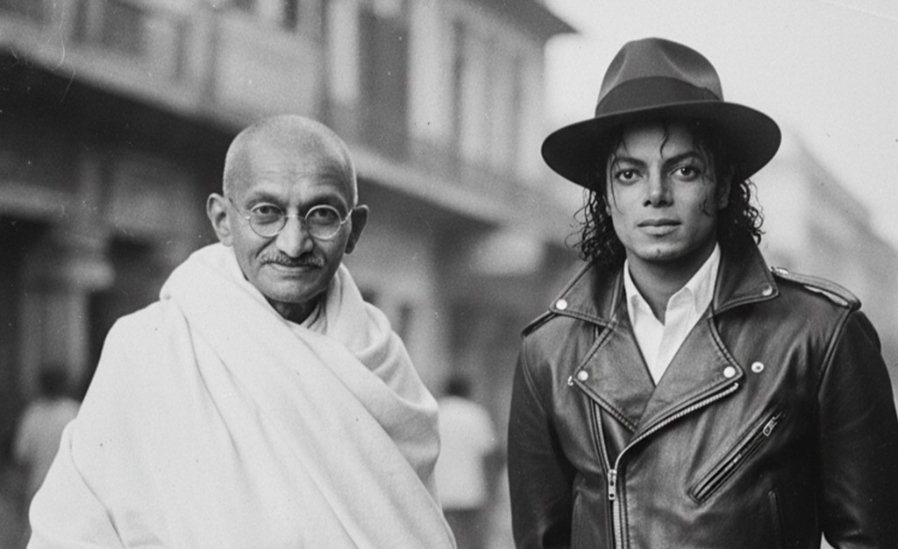
AI’s biggest impact on history is deepfake technology. Erasing inconvenient truths or spreading lies isn’t new – Joseph Stalin famously airbrushed Leon Trotsky out of photos. In the late 1990s, a Malaysian newspaper altered photos to remove Anwar Ibrahim after he fell out with prime minister Mahathir Mohammed.

The problem of AI fakes

Forged documents have long confused historians; for example, Nazi era expert Hugh Trevor-Roper believed the fake Hitler diaries were genuine because of their voluminous content. The fabricated 1903 Protocols of the Elders of Zion fuelled antisemitism and conspiracy theories. Recently, AI-generated deepfake videos, such as one of US congresswoman Alexandria Ocasio-Cortez, which depicted her in Congress arguing that a jeans ad featuring Sydney Sweeney was racist, have gone viral, highlighting new dangers in disinformation.

Kanisetti points out that many Indians consume historical materials now through videos. These don’t claim authenticity, but to the untrained mind the realistic-looking videos appear to be well-researched. “The right wing has no incentive to doctor primary sources yet, because the general public is already uninterested in the ambiguities of evidence-based history,” he said. Many viewers want affirmation of their beliefs; they no longer care if what they are seeing is accurate.

In What is History?, EH Carr wrote: “The facts speak only when the historian calls on them: it is he who decides to which facts to give the floor, and in what order or context.” The selection of facts is integral to historical research. Good historians must be aware of their personal biases and the context of their work. Only humans have the capability to understand the emotions involved and the ethical choices that need to be made; it is why at universities, history is part of the humanities department and not in a scientific lab.

Historians are quick to caution. One of the biggest risks is Holocaust denial and revisionism. Unesco published a report last year with the World Jewish Congress, which showed how hate groups could use AI to deny the Holocaust, including by fabricated testimonies and altered historical records. The Historical Figures app allows users to ‘chat’ with prominent Nazis such as Adolf Hitler and Joseph Goebbels, and it falsely claims that Goebbels (for example) was not intentionally involved in the Holocaust and had tried to prevent violence against Jews. Unesco has its own recommendations for ethics in AI, which it urges governments to follow. It has also asked tech companies to improve their standards and act responsibly.

But governments have neither the capacity nor, in some cases, the willingness to prevent disinformation from spreading widely. Can states be trusted? Can corporations, which are incentivised by maximising shareholder value? Open-source algorithms, digital watermarking and community-based content moderation are all necessary potential solutions, but none is sufficient. Educating the public, particularly young people, on how to critically evaluate information and recognise misinformation is crucial to combat the negative impacts.

Thum told me: “The only defence against this is by educating ourselves to be more sceptical and information-literate; by democratising the tools and skills of history; and by teaching people to be more sceptical and critical of those with information and power, so that we are less likely to be tricked by AI or whatever the next technology is.”

In 1987, I interviewed Salman Rushdie in Bombay, as the city was then known, when he had completed writing The Satanic Verses. Other than his editors, few knew what the novel was about.

When I asked him, he said: “It is about angels and devils and how it is very difficult to establish ideas of morality in a world which has become so uncertain that it is difficult to even agree on what is happening. When one can’t agree on a description of reality, it is very hard to agree on whether that reality is good or evil, right or wrong. When one can’t say what is actually the case, it is difficult to proceed from that to an ethical position. Angels and devils are becoming confused ideas … It is an attempt to come to grips with that sense of a crumbling moral fabric or, at least, a need for the reconstruction of old simplicities.”

AI makes us believe in simplicities, that truth is easy to access, and that answers to complex questions are just one click away. It is the product in our age of instant gratification. Reality, like history, is more nuanced. The challenge lies in our not being condemned to repeat it.

Read the full article here

Fact Checker

Verify the accuracy of this article using AI-powered analysis and real-time sources.

Get Your Fact Check Report

Enter your email to receive detailed fact-checking analysis

5 free reports remaining

Continue with Full Access

You've used your 5 free reports. Sign up for unlimited access!

Already have an account? Sign in here

Share. Facebook Twitter Pinterest LinkedIn Tumblr Email Telegram Copy Link
News Room
  • Website
  • Facebook
  • X (Twitter)
  • Instagram
  • LinkedIn

The FSNN News Room is the voice of our in-house journalists, editors, and researchers. We deliver timely, unbiased reporting at the crossroads of finance, cryptocurrency, and global politics, providing clear, fact-driven analysis free from agendas.

Related Articles

Global Free Speech

CPJ, partners urge White House Correspondents’ Association to publicly defend press freedom at correspondents’ dinner

2 days ago
Global Free Speech

Cockroach Janta Party protestors holding posters of Bhagat Singh at Jantar Mantar, July 2026. Photo: Pelph Hoters/CC0 1.0 Towards the end of last year, when I was editing our magazine about Gen Z revolts around the world, I asked around about India. Was a Gen Z revolt likely there? After all, young people had toppled governments in neighbouring Bangladesh, Sri Lanka and Nepal. The consensus was that despite the increasing authoritarianism of Prime Minister Narendra Modi and his government, India was on a different trajectory to its much smaller neighbours. The young middle class were largely apolitical. Earlier protests had simply “petered out” because the country was so diverse no one could agree with one another. Eight months later, it turns out there is something which unites young people – the understanding that they are despised by the political elites. The Cockroach Janta Party was formed after a satirical call on social media by student Abhijeet Dipke, a recent graduate from a US university who heard the chief justice of India comparing young unemployed people to “parasites” and “cockroaches”. What would happen, he wrote on Instagram, if all cockroaches came together? It was a call that resonated. Within days of being formed the party’s Instagram account had 22 million followers – far more than the nine million following Modi’s BJP. The authorities tried to strangle the movement at birth, and the Cockroach Janta Party‘s X account was closed down pretty quickly by Elon Musk’s platform after anonymous complaints. But that didn’t stop the momentum and soon the anger was focused on the leak of medical exam questions, meaning millions would have to do expensive retakes. The issue was emblematic of wider problems of graduate unemployment reported to be at 40% for under 25s. In the last week we have seen thousands of Gen Z demonstrators taking to the streets calling for the resignation of Union Education Minister Dharmendra Pradhan. Even the India opposition leader Rahul Gandhi (who has not been popular with young people) has tried to get in on the act and was briefly arrested after joining a sit-in in Delhi. Other disturbing responses have included violence used against some protesters, the prohibition of protests near the parliament building in Delhi and the use of internet shutdowns being deployed in areas where demonstrations were planned to start on Monday. Internet freedom campaigners in India, including the Software Freedom Law Centre (SFLC), have condemned the targeting of the protest with an internet shutdown as setting “a dangerous precedent” as it “strikes at the heart of the fundamental right to freedom of speech and expression”. They also are demanding to know why no order was issued to authorise the blackout, seemingly in violation of the law and not in accordance with the Supreme Court’s ruling on this issue. India has long turned to internet shutdowns for the flimsiest of excuses. According to Access Now India was the world leader for shutting down the internet for six years in a row ending in 2023 (ahead of places like Iran, Russia and Myanmar). The SFLC warn that together with reports of social media content about the protest being “shadow banned”, as well as the closure of roads and metro stations, the government seems to be trying to disrupt protest rather than guarantee public safety. None of this is deterring Cockroach Janta Party supporters. If anything, it seems to be encouraging protesters to turn out. And the party’s popularity carries with it a message; globally connected young people are coming together and they are forces to be reckoned with. READ MORE

2 days ago
Global Free Speech

Philippine journalist Marchel Espina charged with unjust vexation over opinion article

2 days ago
Global Free Speech

The Royal Courts of Justice. Photo: StevovoB/NeedPix Years ago when still a baby defence barrister, a brief landed on my desk. The defendant, we shall call him Mohammad, was from Somalia. He was a PhD student travelling for his studies to Germany when civil war broke out. Mohammad’s sister was raped by soldiers; his father murdered. Newly married with a baby, he used all his money to pay for passage to the UK. This meant using forged travel documents. The family were eventually granted asylum. But Mohammad kept the forged passport; a symbol of his past life, perhaps. On a trip to visit German friends, the forged passport was discovered. He was charged with an offence to which he had no defence in law. The first trial saw running battles between me and the judge. At every opportunity he angrily reminded the court  of the defendant’s guilt. His summing up consisted of countering the arguments I had advanced in Mohammad’s defence. After two days deliberating, the jury were discharged, unable to reach a decision. The second trial was before a different judge. No angry exchanges. Just a measured, even-tempered stewardship of proceedings. A unanimous acquittal followed. Absent a bullying judge, this jury felt free to deliver a verdict according to their conscience; a principle called jury equity. I did not explicitly reference this principle in my closing speech. Nonetheless, it has often featured, in cases like Mohammad’s, when attempting to appeal to a jury’s sense of compassion. It was clear when Mohammad walked tearfully from the dock, that every right-minded person in that courtroom knew his prosecution, though lawful, was wrong. And so to the Filton trial and the unprecedented prosecution of my friend, Rajiv Menon KC, due to stand trial on 28 July for alleged contempt of court. Rajiv was lead counsel representing the first of six Palestine Action defendants charged with offences arising out of an incident in 2024 at an arms factory in Filton, Bristol, owned by Israeli-based Elbit Systems. During the incident, the defendents smashed equipment and one injured a police officer.  At the trial the judge made orders prohibiting defence barristers from mentioning jury equity in their closing speeches. That effectively meant forbidding them from telling the jury that they (the jury) were free to act on their conscience despite the law. The trial judge alleges that Rajiv disobeyed the order and has asked another judge to try him for contempt. The Filton trial was, in many ways, different from Mohammad’s. However, the principles at stake are the same. You may not agree with the Filton defendants’ cause or their methods. And, we can all sympathise with the police officer injured whilst doing her job, but we must all surely agree that every defendant deserves a fair trial. By severely limiting some defences, removing other defences altogether, and making orders disallowing defence counsel from referring to long-established basic principles like jury equity, a trial judge is at risk of reducing the jury’s role to a ceremonial one. That is why everyone should care about what happened in the Filton trial and what is happening now to Rajiv Menon. This is not just about a closing speech made by one defence barrister. Most defence barristers have, at some point, relied on the constitutional right of a jury to acquit even when a judge thinks that guilt is a forgone conclusion. It is a principle considered so important that it is enshrined on a plaque in the Central Criminal Court. And yet, today the very mention of it is being prohibited in protest trials, with the accompanying threat of contempt proceedings. This is about the essence of why the jury equity principle is necessary and has survived so long. It is recognised as a useful long-stop against state oppression. I would add, as a Black person who has observed first-hand the oppressive way in which our people are policed, the collective wisdom of twelve strangers along with jury equity, is sometimes our only chance of justice. Let’s be clear, this attack on jury equity and the heavy-handed attempt to gag defence counsel, is an attack upon basic freedoms. It will have a chilling effect on all defence barristers in politically sensitive cases as well as on the right to protest. Other important safeguards will be caught in the dragnet. Defence counsel’s obligation to fight fearlessly and the very concept of jury trial itself, are all up for grabs. In the 1980’s, during a wave of far-right attacks on Black communities in Bradford, twelve men were charged with offences linked to stockpiling 38 petrol bombs. One of the twelve, Tarlochan Gata Aura, admitted making and storing the bombs to protect his community. The late Sibghat Kadri QC, head of the chambers where I trained, was one of the defence barristers in that trial which ended with acquittals despite overwhelming evidence against them. Constantly interrupted by a hostile judge, the defence were warned against making the trial political. Kadri, a barrister who believed it was every lawyer’s duty to fight inside and outside the court, must be turning in his grave. READ MORE

3 days ago
Global Free Speech

CPJ,  partners demand release of Egyptian cartoonist Ashraf Omar on arrest anniversary

4 days ago
Global Free Speech

Hungary’s initial media reforms are promising but lasting safeguards still needed

4 days ago
Add A Comment

Comments are closed.

Editors Picks

Mira Murati’s Inkling AI Model Review: Best Open-Source Model in the West

56 minutes ago

U.S. regulator warns prediction markets against cutting corners in event contracts

2 hours ago

Today in Supreme Court History: July 26, 1892

3 hours ago

Trump Says He Believes in Giving People a ‘Second Chance.’ For 6,000 People, the Answer Was No.

4 hours ago
Latest Posts

South Korea’s largest bank to launch payment service on JPMorgan’s Kinexys

4 hours ago

Bureaucracy, Labor, & Tariffs: How Government Is Making BLTs More Expensive

5 hours ago

Europe’s high regulatory bar could spark new crypto industry M&A wave

5 hours ago

Subscribe to News

Get the latest news and updates directly to your inbox.

At FSNN – Free Speech News Network, we deliver unfiltered reporting and in-depth analysis on the stories that matter most. From breaking headlines to global perspectives, our mission is to keep you informed, empowered, and connected.

FSNN.net is owned and operated by GlobalBoost Media
, an independent media organization dedicated to advancing transparency, free expression, and factual journalism across the digital landscape.

Facebook X (Twitter) Discord Telegram
Latest News

Bitcoin OG selling eases as dormant BTC movement hits 4-year low: Thorn

51 minutes ago

Mira Murati’s Inkling AI Model Review: Best Open-Source Model in the West

56 minutes ago

U.S. regulator warns prediction markets against cutting corners in event contracts

2 hours ago

Subscribe to Updates

Get the latest news and updates directly to your inbox.

© 2026 GlobalBoost Media. All Rights Reserved.
  • Privacy Policy
  • Terms of Service
  • Our Authors
  • Contact

Type above and press Enter to search. Press Esc to cancel.

🍪

Cookies

We and our selected partners wish to use cookies to collect information about you for functional purposes and statistical marketing. You may not give us your consent for certain purposes by selecting an option and you can withdraw your consent at any time via the cookie icon.

Cookie Preferences

Manage Cookies

Cookies are small text that can be used by websites to make the user experience more efficient. The law states that we may store cookies on your device if they are strictly necessary for the operation of this site. For all other types of cookies, we need your permission. This site uses various types of cookies. Some cookies are placed by third party services that appear on our pages.

Your permission applies to the following domains:

  • https://fsnn.net
Necessary
Necessary cookies help make a website usable by enabling basic functions like page navigation and access to secure areas of the website. The website cannot function properly without these cookies.
Statistic
Statistic cookies help website owners to understand how visitors interact with websites by collecting and reporting information anonymously.
Preferences
Preference cookies enable a website to remember information that changes the way the website behaves or looks, like your preferred language or the region that you are in.
Marketing
Marketing cookies are used to track visitors across websites. The intention is to display ads that are relevant and engaging for the individual user and thereby more valuable for publishers and third party advertisers.