

 Freedom Index
Listen to the article
In what we know as the Middle East, a dramatic jump in the emerging pattern of human violence took place around 5500 BCE, the primary evidence being circumvallation, the construction of walled fortifications around population centres.
Circumvallation was not unprecedented. The massive and fabled walls of Jericho appeared around 8000 BCE. Twelve feet high and six feet thick, an estimated 1,800 feet in circumference, the walls were a mute indicator of both the place’s unprecedented wealth—perhaps derived from trading Dead Sea salt—and the need to protect it. But these fortifications stood alone for 2,500 years; and then, rather suddenly, equivalents began to spring up again, as town after town in the Middle East either was destroyed, built walled fortifications, or both.
What was responsible? Had the forces of social complexity simply reached a stage that it had turned these agricultural communities against each other? This was certainly possible; but why had so many simultaneously perceived the environment as being dangerous enough to undertake the massive task of circumvallation? What had changed?
From out of the Steppe, nomads on horseback
The best theory at present is that the process was catalysed by a now-independent shepherd culture that, initially driven by hunger and desperation, had decided to attack the settled because that’s
where grain stores and other good things were to be found and taken.
But even if they managed to surprise their victims, getting away with the loot was an inherent problem, since they came on foot and could be run down. Logically, the best counter to pursuit was brutality, a level of violence that would leave the victims passive and in a state of shock.
Killing quickly and without emotion must have come naturally to shepherds; but verifying this pattern of aggression, and establishing their role in the growing mayhem, remain difficult. One thing is clear, however: War marched steadily onward, becoming a universal feature of the settled societies emergent in the region by 3300 BCE, when things got even more intense with the introduction of bronze and the wheel.
Yet warfare’s future had already taken a wildly divergent path nine hundred years earlier, far to the north, along the edges of the vast steppe above the Black Sea. Here, the rich grasslands could support bigger animals, and pastoralists added cattle to their herds—and after a while the wild horses indigenous to the steppe. At first, it was just for meat, since horse hoofs could poke through ice in winter to reach the grass below, which helped keep them from starving like sheep and goats.
But carbon dating of remaining bones and teeth indicate that, beginning around 4200 BCE, horses started living much longer. This meant they were being used for another purpose. Careful analysis of grooves worn in teeth by what must have been bits, along with characteristic human pelvic and lower-back changes, has now firmly established that the horses were being ridden.
Horses had long been bred for meat. But carbon dating of remaining bones and teeth indicate that, beginning around 4200 BCE, horses started living much longer—indicating that they were now used for another purpose
This added the mobility to reach much farther out into the virgin grasslands of the deep steppe, a capacity further energised around 3000 BCE with the introduction of wheeled wagons drawn by oxen. Now herders could bring everything they needed, including their families. Rather abruptly, the evidence shows a completely independent pastoral existence becoming a fact of life.
Judging by the contents of their kurgans, or burial mounds, things were definitely better out here, but not necessarily more peaceful. Herds thrived and multiplied, as did the attached human groupings. Growing familiarity with the new environment revealed rich copper deposits, soon to be the basis of a relatively huge trade far south with the squabbling city-states of Mesopotamia. Copper, when mixed with a little arsenic, produced bronze hard enough for a variety of weapons they could deploy against each other.
The lesson was plainly not lost on the steppe dwellers. Kurgan contents show they became master metalworkers, fashioning a host of personal ornamentation, along with daggers and spear and javelin tips, not to mention arrowheads—lots of them. Very likely they were propelled by what became the signature weapon of the steppe warrior.
Because of its portability and high rate of fire, the bow is a natural complement to the mobility provided a human combatant, or hunter for that matter, on horseback.
Compounding this was the development of the composite bow—combining their animals’ horns, sinew, and glue to create what would become a veritable ancient superweapon in the hands of riders who spent large portions of their lives on the backs of their surefooted steppe ponies.
This awesome military combination was likely first achieved by a people known to archaeologists as the Yamnayans and assigned by linguists a tongue known as Proto-Indo-European. In a matter of several centuries, these Yamnayans and their derivative cultures were destined to sweep 3,000 miles east and west, over the vast steppe extending from Hungary to western China.
But if the horses and cattle that thrived out here were bigger than flock animals, they were still subject to the same quick starvation from the wild weather, the only salvation being the herds of others. Since they were eminently portable and the featureless environment allowed for escape in any direction, the skills involved in stealing herds naturally developed into the swirling tactics that would prove the end of so many armies of the settled.
But it also resulted in a highly unstable environment on the steppe itself, with various groups being pushed off or simply choosing to leave. The first were the Yamnayans.
On the occidental side, a pattern of long-range raiding was quickly established, the targets being the generally peaceful, female-deity-worshipping communities extending down the Balkan Peninsula, known collectively as Old Europe. Since this was followed by their collapse and replacement with what were now a variety of Indo-European speakers, including pre-Greeks, a violent end might be assumed. But as with most things human, it was likely more complicated.
The archaeological record indicates that frequently the herders peacefully infiltrated areas between Old Europe settlements and formed mutually beneficial trade relationships. This sort of social symbiosis was apparently accompanied by feasting and prestige-based potlatching by the newcomers, which could have resulted in the gradual supplanting of one culture by the other.
Whatever the case, the process led to Pre-Greeks becoming Mycenaean Greeks, settled in what was to become the Hellenic home base, just one part of a wave of Indo-European speakers draping themselves over the indigenous populations across the continent until they reached the Atlantic.
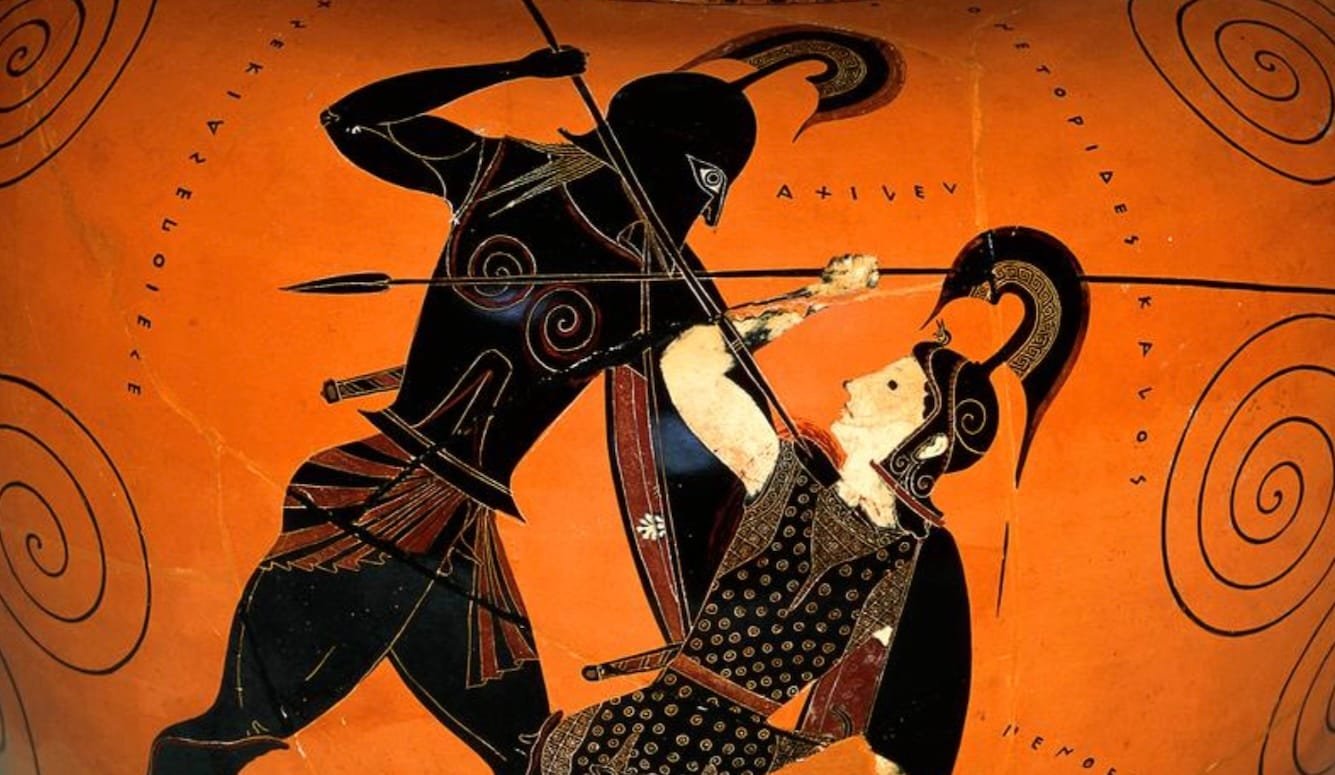
Although Homer is believed to have lived about four hundred years after the events in the Iliad and Odyssey, archaeology has revealed him to be accurate in terms of how the Greeks fought at this point—around 1200 BCE.
In Hellas, as ancient Greece was called, where good farmland was scarce and pastoralism was limited to sheep and goats, inhabitants naturally looked to the sea for sustenance, and not just from the fish. A palace-based power structure emerged, led by bronze-clad princes who went to sea as traders, as pirates, or to sell their services as mercenaries.
This was the violent world described by Homer. And although he is believed to have lived about four hundred years after the events in the Iliad and Odyssey, modern archaeology has revealed him to be remarkably accurate in terms of how the Greeks fought at this point—around 1200 BCE.
Nolan’s Odyssey Review: Beautiful but Dreary
Christopher Nolan’s creation is a big movie in every technical sense. But inside, it is diminished and faded: heroes who aren’t allowed to be heroes and gods who aren’t allowed to be gods.
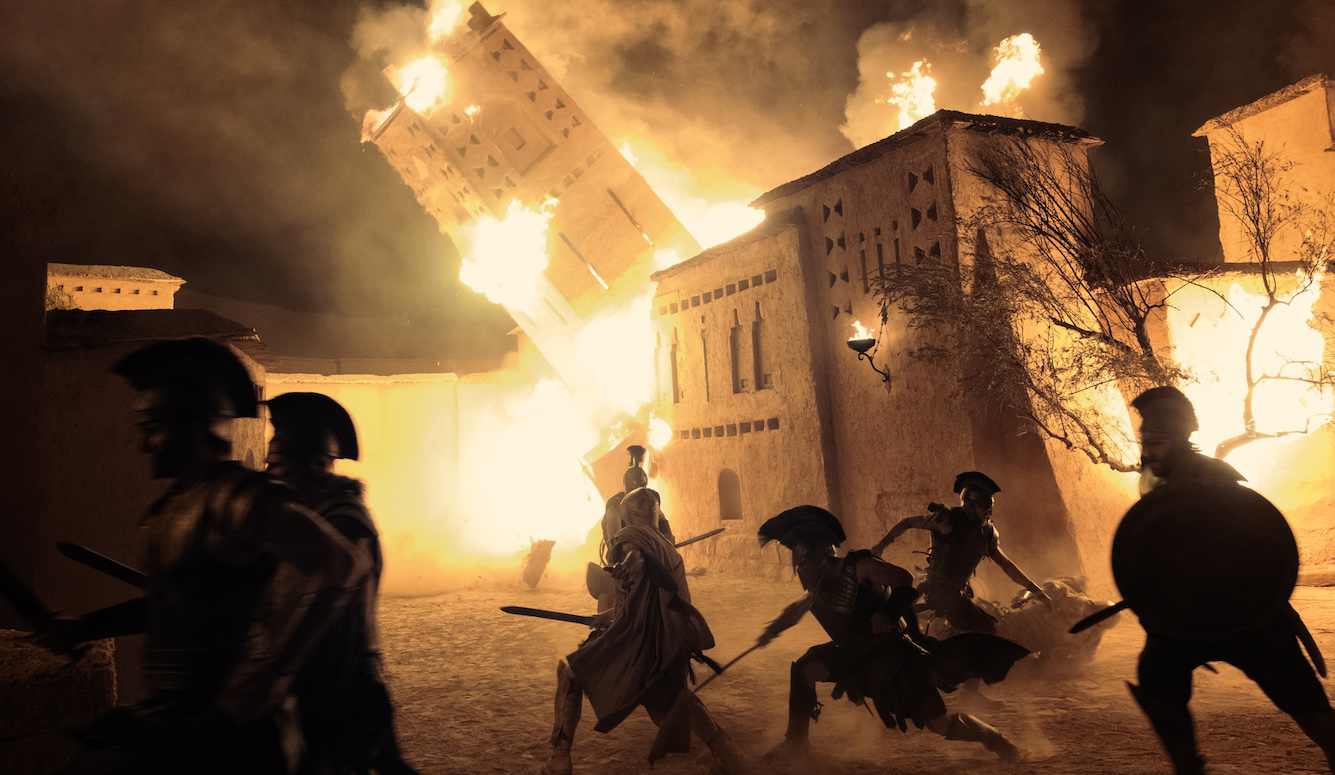
Meanwhile, other Yamnayans and their successor cultures had headed east, eventually all the way to China. By around 2500 BCE, a group now called pre-Indo-Iranians and referring to themselves as arya had pushed through the gap between the Ural Mountains and the Caspian Depression and turned south, motivated apparently by climate change and overpopulation. Sometime after 1300 BCE, the migration split, one element headed toward India and the other spilling out onto the Iranian plateau.
Here the process seems to have taken place in a series of intensifying pulsations, each stage bringing more cattle-breeding families, along with the equestrian bowmen who were their protectors, until the numbers reached into the thousands. These newcomers clung to their nomadic ways and means, horse-riding and archery skills being particularly prized by the final groups entering the Iranian plateau—the Parthava (Parthians), the Mada (Medes), and the Parsa (Persians)—all of them fractious and truculent.
Yet, as with Yamnayans, this profile did not necessarily translate into perpetual aggression against the locals, in this case a sophisticated culture known by contemporaries as Elam and constituting one of history’s oldest urban-based societies. This longevity can be traced to an acute Elamite understanding of alliances and their cultivation, in this case with the Medes and Persians, who in turn welcomed what one scholar termed “a lucrative protection racket”, further incentivised by a healthy trade in meat, dairy products, and wool for gold, lapis lazuli, and also women.
Even though the balance of power gradually shifted overwhelmingly in their favour, the newcomers, particularly the Persians, always had a place for the Elamites, if not in their hearts then definitely in their records, since Elamites could write and the Persians, even in their imperial splendor, never learned.
In a way, this epitomised shepherd culture—it developed rapidly and optimally for its environment, and then stopped. In terms of warfare, this amounted to a massive potential; but conquest of the settled almost inevitably led to a deterioration of skills, since literally and figuratively the new bosses had to get off their horses and rule.
It was a conundrum shepherd culture could never solve, so it continued to exist at the outer edges of humanity, threatening but ultimately self-destructive even at its most successful. Hence, warfare here would be relegated to the role of catalyst, almost randomly impinging on another version of armed conflict, one that came to be waged in the fertile river valleys where most of the people lived. But before this kind of war matured, it had a youthful fling with another form of organised belligerence, one that led to the premature birth of still another member of ancient warfare’s growing family.
Power politics and ‘armoured hedgehogs’
To see how this happened, we must return to the squabbling residents of the Mesopotamian lowlands (modern Iraq) around 2500 BCE, specifically to the cluster of city-states including Ur, Kish, Lagash, Erech, Shuruppak, Larsa, and Umma, known collectively as Sumer.
Actually, the term is purely generic, since Sumerian communities never willingly formed anything resembling a unified polity, but fell instead into a pattern of shifting loyalties and constant intramural violence, a prototype of what we know as a balance of power.
Remarkably, the dry climate and Sumerian literacy have preserved for us two pieces of evidence in particular that demonstrate how it worked. The first and most famous is found in the fragmentary epic cycle detailing the life of Gilgamesh of Erech, a real person but also literally the first hero in written literature. Armed with a battle ax dubbed “Might of Heroism”, and attired in a coat of bronze mail, Gilgamesh was plainly armed for fighting his enemies in close proximity, but not alone.
While he stood at the head of a formidable fighting force, his relationship with his men was hardly one of blind obedience. Hence, when Gilgamesh decides to fight the rulers of Kish over water rights, he must put the issue before an assembly of warriors, which immediately disapproves the scheme, only to reconsider later.
Plainly, when it came to fighting, consent of the governed, or at least the warrior class, was required. Such solidarity was still more graphically displayed in what constitutes history’s first war monument, the Stele of the Vultures carved to commemorate a victory over Umma around 2450 BCE, but preserving for us a limestone snapshot of the Sumerian order of battle.
This was an all-in species of warfare, the participants facing danger in a cooperative fashion, a quality impossible to elicit in any but highly motivated troops.
The stele depicts Eannatum, ruler of Lagash, out front and armed for close combat, leading what amounted to an armoured hedgehog. For the formation following him, advancing shoulder to shoulder behind a barrier of locked rectangular shields and a mass of spears extending from several rows back, constitutes nothing less than a full-fledged phalanx. This indisputable piece of evidence has been largely overlooked by those who study ancient Greece, and therefore attribute this formidable formation to the proverbially bellicose Hellenes.
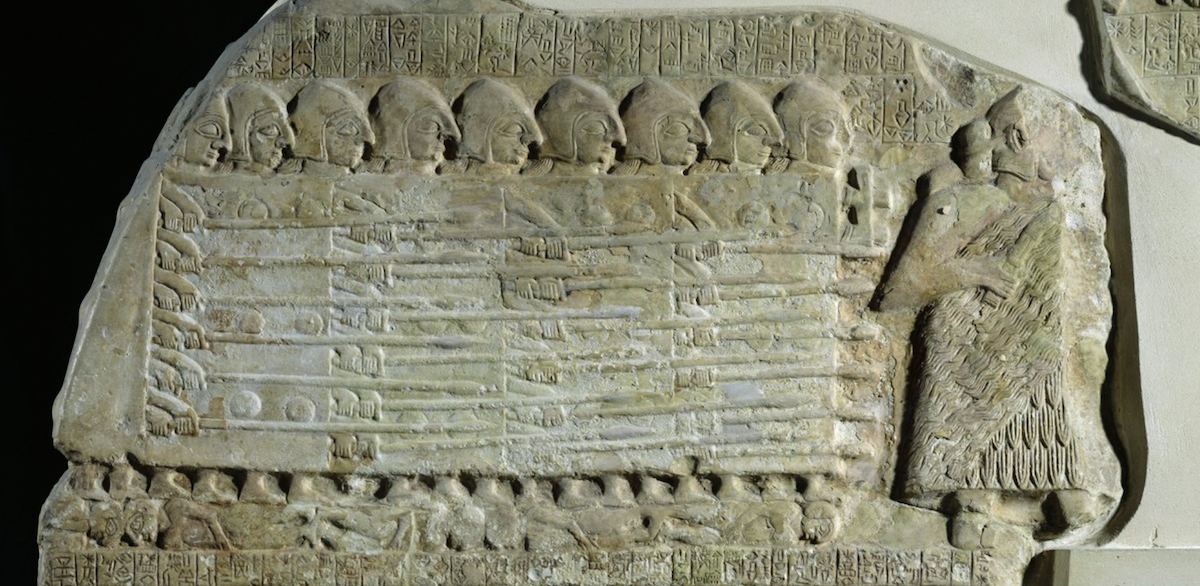
But while they may have placed it almost two millennia too late, they still had the right idea. The Greeks were also locked into a city-state-based balance-of-power system, characteristically adjudicated by combat between phalanxes. This was warfare tailored for amateurs, more demanding of courage to push ever forward than of specialists’ skills and bound to leave many in the front ranks skewered. Thus the Stele of the Vultures records three thousand Ummaite battle deaths in this single encounter. Nor did the death-dealing stop here: “The survivors turned to Eannatum, [and] prostrated themselves for life.” Eannatum marched the Ummaites back beneath their city wall and slaughtered them all.
This was an all-in species of warfare, the participants facing danger in a cooperative fashion, a quality impossible to elicit in any but highly motivated troops, usually those with a stake in society. But in this case, the very ground beneath their feet was tilted against them.
‘Hydraulic civilisation’ and its duelling charioteers
The city-states of Sumer had thrived on the Mesopotamian flat-lands because they were flanked by two great rivers—the Euphrates in the south and the Tigris to the north. The latter not only moved more water but did so at a higher elevation than its sister stream. It was an open invitation to take advantage of the force of gravity and irrigate massively, a cumulative process that would fundamentally change these societies and how they fought.
First and foremost, it was a matter of ditch-digging and eternal maintenance in the hot sun, an activity on this scale bound to require some compulsion, and the degree to which it was applied almost certainly had an inverse relationship with combatants’ enthusiasm for the close-in fighting the phalanx demanded.
But the process rolled on, propelled by vastly increased agricultural production, which had its human equivalent in a population explosion. And since more people required more grain, more ditch-digging and arm-twisting were required—a feedback loop that only intensified until the affected societies had turned truly repressive and hierarchical.
The next step was the destruction of the regional balance of power by a single individual, a feat later achieved by Alexander the Great and Qin Shi Huang of China, but pioneered by a far less well-known figure.
Sargon of Akkad was born around 2300 BCE, as legend has it to a Semite girl who abandoned him, Moses-like, in a cradle of reeds. Fished out of the Euphrates and brought up in Kish, he rose meteorically to become cupbearer to headman Ur-Zababa. And when his patron was dethroned by Lugalzagesi of Erech, Sargon staged a successful surprise attack on his home city. Before he was finished, Lugalzagesi was led away in chains, leaving Sargon poised for a martial career that, according to his own count, led to victory in thirty-four major battles and the establishment of a domain that would stretch eventually from the Mediterranean to the Persian Gulf.
It wasn’t morning in Mesopotamia, but it was clear that a new day had arrived as Sargon proceeded to implement a blueprint for tyranny that would provide the basic floor plan of empire across the ages. His agents fanned out across the alluvium, framing the structure with tax lists, trustworthy locals, garrisons, and royal governors. All these political beams and crossmembers pointed inward toward Agade (or Akkad), the hub Sargon built from the ground up that would be the capital of his Akkadian Empire.
Here he surrounded himself with imperial officials, counting and administering the stream of exactions flowing into Agade. But more critical, given the true nature of the new dominion, was the standing army he kept, quite literally, at his side according to inscriptions reporting that 5,400 soldiers ate daily at his palace.
Whether they still took their place in a phalanx remains open to debate, since no depictions of Sargon’s army in action exist. What is clear was that most of those thirty-four victories were won over vassals in revolt. Much the same proved true of his son and successor, Ramush. It took him nine years to repress the rebels from Sumer to the highlands of Elam and Warahshi, before he was assassinated and replaced by his brother Manishtusu, who accounted for fourteen more years of upland aggression, until he was replaced by his son, Naram-Sin, a ruler bearing the true stamp of Sargon.
Calling himself “King of the Universe” and aspiring to deification, he packed his sixty-four years on the throne with almost nothing but military operations, all of them on the periphery. There is a famous stele, now in the Louvre, depicting Naram-Sin standing on the body of a vanquished foe, a pose that exactly reflected his rulership. Most notably, slung over his shoulder is neither sword nor spear, but a composite bow. This would be the weapon of tyranny’s future, the lethal alternative in a new military environment where all but a few would refuse to fight at close range.
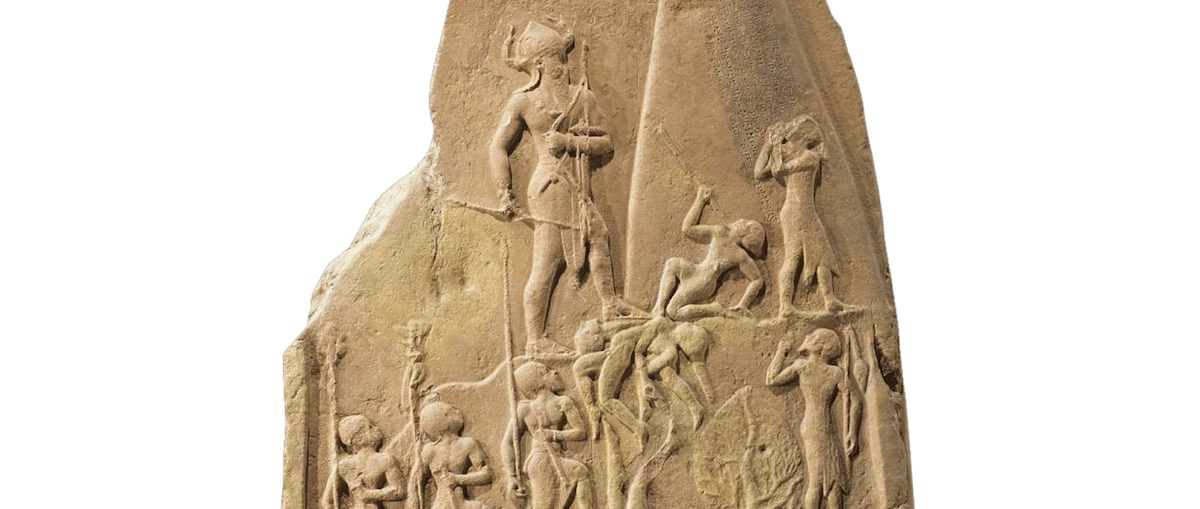
As noted, Naram-Sin’s bow was unlikely to have been a product of the local bronze age, but came instead from those who roamed the steppe. The Mesopotamian metal trade with the inhabitants of the grasslands to the north was already massive, and these bows, along with the skills to make them, were undoubtedly also in high demand. As were horses.
Since they could be delivered on the hoof, the equine trade from the steppe, though it began slowly, was capable of rapid expansion, driven by the emerging market for warhorses from those who led the legions of the settled. Horses were first mentioned in Akkadian texts, but they were considered exotic beasts. By the end of the Akkadian Empire’s 170-year lifespan, however, evidence for their presence had spread to Elam, and by 1700 BCE all the way to Egypt. By this time, horses by the thousands were likely being delivered from the north. But not for riding.
Horses were being hitched to two-wheeled chariots occupied by elite, stoutly armoured warriors festooned with composite bows and a variety of pointed instruments, constituting the new regime’s ultimate weapon. It didn’t matter that actual reconstructions have revealed them to be rickety vehicles of suspect stability, barely controllable on all but the smoothest ground; it was their psychological impact that was crucial. For the armies that would precede the chariots into battle were even more fragile, composed largely of unwilling conscripts with little stake in the outcome besides their own survival.
Picture a legion of untrained agricultural labourers turned soldiers, each armed only with a lightly strung bow and a few reed arrows, awaiting the charge of a thunderous line of chariots. Was it any wonder that in battle after battle they turned and ran? They were the system’s designated fall guys, a sanguinary aperitif, before the opposing leaderships’ chariots came together to settle the final issue in a grand melee among equals.
This, in essence, was the brand of warfare that emerged among societies dependent on large-scale irrigated agriculture—“hydraulic civilisation”, as historian Karl Wittfogel termed it. A pyramid of power had emerged, administered top-down and backed by compulsion at every level, generating the momentum that kept the production and distribution system going, and the taxes flowing.
It worked; but it was cumbersome and grossly unequal in its rewards structure. Hence, at the bottom it generated only halfhearted compliance, particularly on the battlefield. This was compounded by the narrow space at the top, room for as few as several hundred elite fighters with a true stake in imperial survival. Remove them, and it meant the end of empire. Against a steppe-based force or against a phalanx like Xenophon’s, this type of army didn’t stand a chance. And since, even when matched symmetrically, war among the imperially agricultural remained inherently risky, the question looms: Why did they prove—fallen empire after fallen empire—so perpetually belligerent?
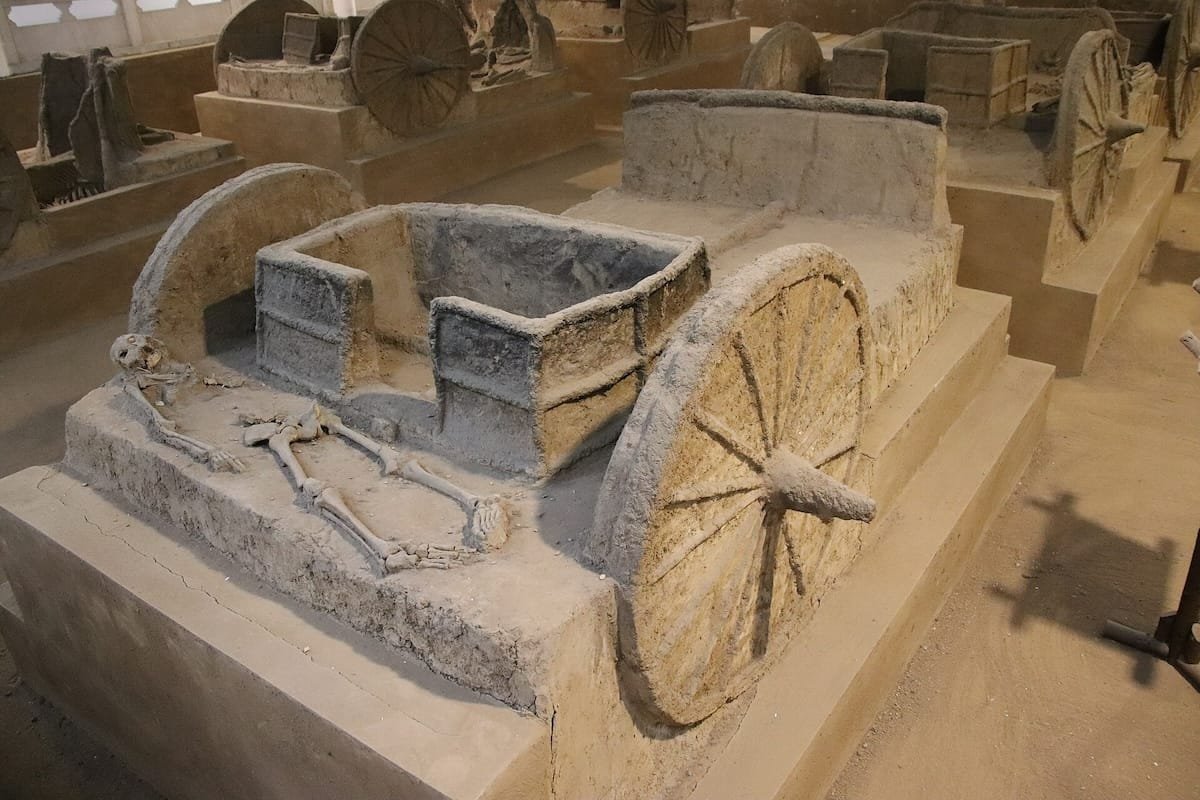
Besides leadership megalomania, the answer, it seems, lies with imperial agriculture’s very metabolism. Living behind walls, for instance, had consequences. It is only in urban communities of several thousand that human contacts become sufficiently frequent to permit diseases to spread unceasingly from individual to individual. A still-larger population of 500,000 is required for an epidemic disease to truly perpetuate itself by bouncing from community to community. That requisite figure was first surpassed by the urban components that constituted greater Sumer, giving it the dubious distinction of having become the founder of pestilence. But it would soon be followed by the rest of Mesopotamia, Elam, and Egypt as the new ecosystem settled in.
Meanwhile, out in the irrigated fields that made all that human fecundity possible, nothing was guaranteed. Crops were subject to weather damage and bacterial and fungal diseases, along with insect infestation sufficient to wipe out virtually an entire yield. Imperial agriculture was good at storing grain against the future, but bad conditions could stretch on for years, leaving chronic human malnutrition in its wake—populations weakened and ready to be drowned in a sea of disease. So it was that imperial agriculture found itself on a demographic roller coaster. And war provided an answer.
Should crops go bad at home, conquest could bring additional and more productive territory, but perhaps more important, people. The history of imperial agriculture was a gauntlet of war-induced population transfers, the most monumental being those of the ever-bellicose Assyrians, who are estimated to have uprooted upward of 4.5 million people over the course of eight hundred years of tyrannical dealings. An exaggerated example, perhaps; but still characteristic of imperial agriculture’s metabolism. So it was that tyranny’s offspring, mounted on a string of rickety chariots, rolled from battle to battle, compelled also to roll the dice of war and quite possibly lose it all in a day.
Excerpted from Band on the Run: Xenophon and the First Great Mercenary Army’s Epic Escape from Persia by Robert L. O’Connell. Copyright © 2026 by Robert L. O’Connell. Reprinted by permission of Simon & Schuster, Inc. All rights reserved.
Quillette invites thoughtful responses to its essays.
Selected responses are published once per week as part of a curated Letters to the Editor feature. If selected, letters appear under the contributor’s real name and may be edited for clarity and length.
To submit a letter for consideration, please email [email protected].
Read the full article here
Fact Checker
Verify the accuracy of this article using AI-powered analysis and real-time sources.