

 Freedom Index
Listen to the article
This week’s podcast is something of a throwback episode—both for Quillette itself and for me personally.
We’re going to be talking about the problem of declining trust in American higher education—a topic that’s been central to Quillette’s journalistic mission since our founding more than a decade ago; and which dominated a lot of the blockbuster essays and exposés that first put Quillette on the map during the late 2010s.
But as noted, it’s also a throwback for me personally, as today’s podcast is centered on a new report from Yale University, where I went to law school in the 1990s. In April 2025, the President of Yale University, Maurie D. McInnis, mandated a 10-scholar committee to address the question of why so many Americans no longer seem to trust places such as Yale University. And that committee published its report last month.
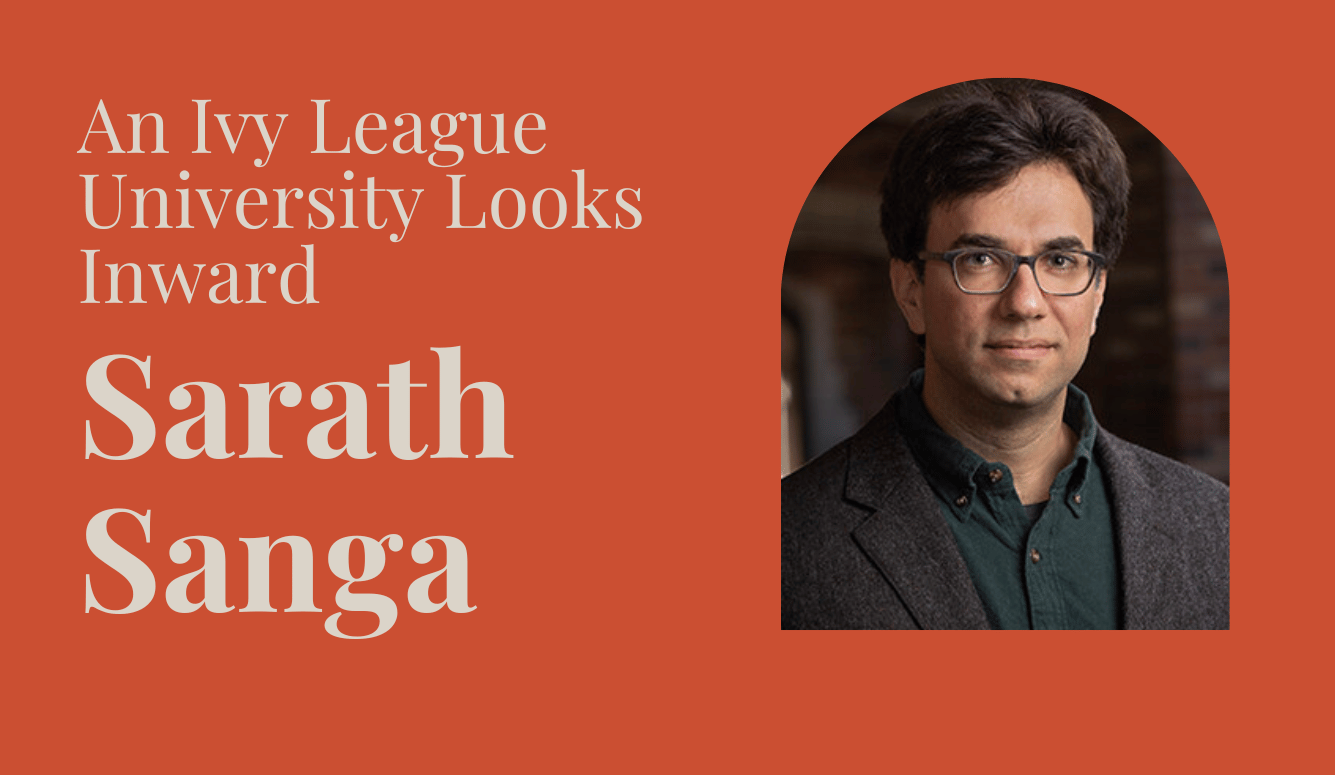
With me to discuss the report’s contents is one of the committee’s members, Professor of Law Sarath Sanga, who serves as co-director of the Yale Law School Center for the Study of Corporate Law. And just to be clear, Professor Sanga joined the faculty of Yale Law School just a few years ago—long after I graduated.
The Report of the Yale Committee on Trust in Higher Education, which Professor Sanga and his fellow committee members finalized on April 10, is a public document. You can read it yourself on the Yale University web site. And it’s a remarkably candid piece of work, full of observations that will please and perhaps displease both sides of the culture war.
On one hand, the authors absolutely do not suggest that the only problem plaguing Yale and other prestigious schools is a smear campaign launched by Donald Trump and his political allies. In fact, Donald Trump’s name doesn’t appear in the report at all, except incidentally, in the titles of articles listed in the source notes.
On the other hand, if you’re expecting the report to be a full-throated denunciation of wokeness or progressive academic mono-culture from start to finish, no, that’s not what it is. Yes, the authors are forthright in noting that political views at places such as Yale are not statistically representative of the United States as a whole. But they also believe that this is just one reason—and perhaps not even the main reason—for the declining status of higher education among the broad public.
The authors note that American universities annually receive billions of dollars in financial support of one kind or another from government sources—a wealth transfer that is supposed to produce important research and quality teaching, but which many Americans now see as a kind of subsidy paid so that the sons and daughters of privileged families can become even more privileged.
Grade inflation and sky-high tuition have also negatively affected the image of universities—especially elite universities—as bastions of the super-rich, whose progressive educators and students hypocritically denounce America’s hierarchical and unequal nature, even as they benefit from it. The antisemitism and anti-Israel encampments that sprouted on campuses beginning in late 2023 only made things worse.
And by the way, on this score, I learned during the interview that Professor Sanga was actually on the campus of Columbia University in May 2025, when New York City police were called in to disperse and arrest violent protesters who’d taken over parts of a university library.
In his conversation with me, Professor Sanga told me that repairing the reputation of universities and colleges has to start with recognition that the American public is owed something in return from the billions of public dollars that are funnelled into higher education—and this payback has to constitute more than just political lectures about social justice and other lofty progressive themes.
Now, I’m editorializing here in my own voice. Professor Sanga’s own advice isn’t really political in nature. Rather, his themes are practical and institutional—the same kind of advice that you’d give to, say, a corporation or activist organization that’s lost its way by losing track of its mission. As Professor Sanga sees it, the role of the university is to promote excellence in teaching and research—not to save humanity or preach transformative ideologies.
Which isn’t to say that humanity doesn’t need saving. It’s just that, as he puts it, organizations typically function best when they operate within defined mandates that accord with their core competencies. Which, in the case of academics, is teaching and creating new information through research.
Please enjoy my interview with Yale Law School professor Sarath Sanga, a co-author of the newly released Report of the Yale Committee on Trust in Higher Education.
Quillette invites thoughtful responses to its essays.
Selected responses are published once per week as part of a curated Letters to the Editor feature. If selected, letters appear under the contributor’s real name and may be edited for clarity and length.
To submit a letter for consideration, please email [email protected].
Read the full article here
Fact Checker
Verify the accuracy of this article using AI-powered analysis and real-time sources.