

 Freedom Index
Listen to the article
The world cannot be safe until China changes.
~Richard Nixon, 1967
In his history/memoir On China, Henry Kissinger provides a telling anecdote from the period just prior to Nixon’s 1972 rapprochement with Beijing. The US ambassador in Warsaw, Kissinger recalls, had instructions to approach China’s delegation at an event in the capital. When the CCP officials in attendance realised that two Americans were talking and pointing at them from the other side of the room, they left their seats and hurried for the exits. They had received no orders on how to deal with such a situation, and communists do not improvise. The Americans followed, the Chinese quickened their pace, and soon both groups of diplomats were running through the corridors, with the Americans shouting: “We want to meet your ambassador!”
This insistence on engaging the Chinese Communist Party over decades was typical of the United States. The US would try to draw China close, sharing knowledge and assistance, and make a friend of an adversary. There have been times when this approach has looked suicidally naïve, weakening the US while boosting a competitor in a way that never occurred with the Soviets. Huge mistakes were made. Washington was never as tough as it needed to be, and so Beijing grew in boldness and strength until it became difficult and costly for Washington to be tough at all.
Some commentators now believe that engagement itself was an unmitigated error. Even Wall Street looks back with regret after all those years as the Party’s number one cheerleader in the West. But while many specific policies of engagement were certainly short-sighted and self-defeating, the decision to draw Beijing close was the right one—for both strategic and humanitarian reasons.
“We made a huge mistake. And ‘we’ being business, government, and military.”
Jamie Dimon on China:
“There was this general assumption they’d become more democratic and more free. And it didn’t really happen that way.”
“Too many people were changing the supply chains just… pic.twitter.com/qHZyD96yZn
— The Hill & Valley Forum (@HillValleyForum) April 17, 2026
Not at first, perhaps. Even before the Communist Party came to power, Washington was already lending an ill-judged hand. During the Chinese Civil War in the late 1940s, US General George Marshall persuaded KMT leader Chiang Kai-shek to pause hostilities and pursue a truce. The ceasefire lasted four months, which gave the CCP time to build up its army (with Soviet help). Marshall would later send American officers to train communist troops at Kalgan. There are various reasons for the CCP’s eventual triumph and seizure of power, not least among which was American interference. And while the KMT was a horrific regime (as it would go on to prove in Taiwan), there are degrees of horror: if the KMT had ruled China instead of the CCP, it’s highly unlikely that Chiang Kai-shek would have matched Mao Zedong’s 80-million kill count.
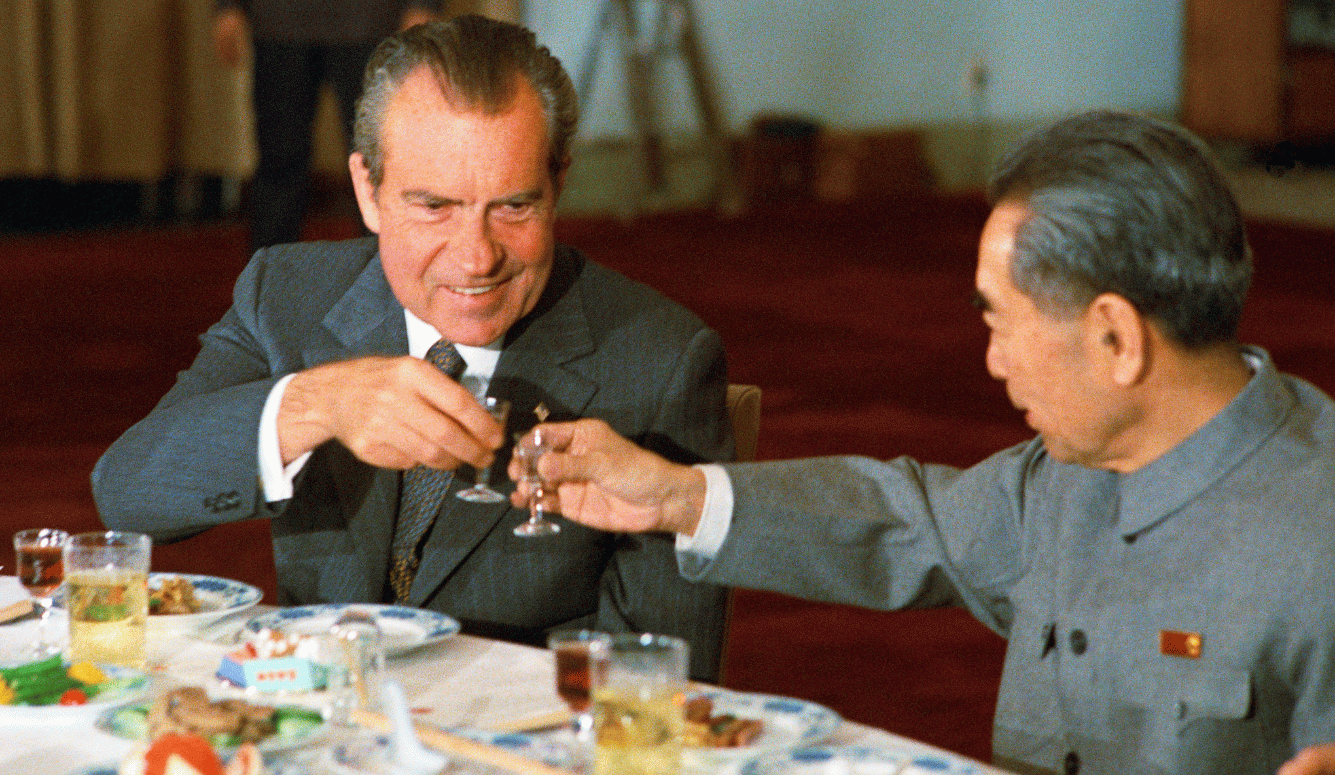
The revolution of 1949 froze relations with the United States for two decades. Then came Nixon’s thaw, an idea he’d spent years developing. The aim was to counterbalance the Soviet Union, and also to protect various East Asian allies from the threat of “Red China.” “We simply cannot afford,” the future President observed in 1967, “to leave China forever outside the family of nations, there to nurture its fantasies, cherish its hates, and threaten its neighbours. … There is no place on this small planet for a billion of its potentially most able people to live in angry isolation.” The task that lay before the United States was to “persuade China that it must change.”
The alternative was stark: a vast rogue nuclear state. And back in Nixon and Kissinger’s time, that rogue state was busily fracturing in the heat and turmoil of Mao’s Great Proletarian Cultural Revolution. There was a non-negligible chance that China could soon become a patchwork of regions controlled by factions of fanatical Red Guards in possession of nuclear warheads, antagonistic to the capitalist world and to each other.
So Kissinger was sent to Beijing in 1971, Nixon followed in 1972, and China was welcomed into the “family of nations.” Trade was unlocked and—slowly at first—China’s great rise began. But Nixon displayed none of the rosy-eyed naivety that would lead later presidents astray when it came to China. He knew only too well what he was looking at:
Dealing with Red China is something like trying to cope with the more explosive ghetto elements in our own country. In each case a potentially destructive force has to be curbed; in each case an outlaw element has to be brought within the law; in each case dialogues have to be opened; in each case aggression has to be restrained while education proceeds; and, not least, in neither case can we afford to let those now self-exiled from society stay exiled forever.
This view would be diluted over the years, as successive administrations pursued the idea of Beijing as a partner and forgot the idea of Beijing as a danger. By the end of the 1970s, Carter’s administration had formally recognised—much too fast for Nixon’s liking—the communists as the sole legal government of China. Beijing was granted Most Favoured Nation trading status (MFN), which guaranteed the lowest tariff rates. Under Ronald Reagan, the United States began exporting torpedoes, helicopters, and artillery-locating radars to the People’s Liberation Army (PLA).
No doubt many in Washington believed all this goodwill was changing the Communist Party, but their hopes would be crushed beneath tank treads in the 1989 Tiananmen Square bloodbath. Even then, George H.W. Bush decided to go easy on the CCP. “I write in a spirit of genuine friendship,” he fawned in the first of two letters he wrote to Deng Xiaoping, just two weeks after the massacre. Despite “difficult circumstances” he maintained “great respect for China’s long-standing position about non-intervention in its internal affairs.”
Indeed, much of Bush’s two letters was given over to fretting about the Chinese crackdown. “Please do not be angry with me,” America’s president begged, “if I have crossed the invisible threshold lying between constructive suggestion and ‘internal interference’.” While it was Nixon himself who privately advised Bush to prevent the breakdown of the US–China relationship in June 1989, Washington had clearly strayed a long way from the ex-president’s diagnosis of the communists as ghetto elements that must be taken in hand.
Bill Clinton would criticise this weakness on the campaign trail in 1992, and once in office he signed an executive order requiring the CCP to improve its human rights record in return for renewal of MFN status. The Party, of course, did nothing of the kind. Instead, it threatened to obstruct US diplomatic and trade priorities. By 1994, Clinton had bowed to pressure from Wall Street and corporate America, who wanted access to the vast Chinese market. MFN status and human rights were abruptly delinked. Trade boomed.
Flushed with success from the Cold War, US policymakers were quite sure they could domesticate the dragon just like they beat the bear, as Robbie Gramer and Christina Lu put it in Foreign Policy. Economic reform, it was thought, would drive political change by creating a new middle class demanding human rights. In 1999, the US–China bilateral trade agreement was signed, setting the terms for entry into the World Trade Organisation (WTO). In 2000, the US–China Relations Act granted China permanent normal trade relations status, ending the need for annual renewal. Finally, in 2001, the People’s Republic acceded to the WTO, and so entered Nixon’s “family of nations.” Washington even wrote tech transfer protocols into the accession agreement—an act of generosity that looks more unwise with every passing year.
Trump, Tehran, and the China Calculus
The CCP will certainly take advantage should Iran turn into a major distraction for the US.
WTO membership supercharged China’s rise, leading to an explosion of exports and foreign investment. Beijing, of course, never played by the rules—it engaged in industrial-scale intellectual-property theft and kept the renminbi exchange rate at artificially low levels to make its exports more competitive. Millions of American manufacturing jobs were lost in what came to be known as the “China Shock.” Doubts grew during the Obama years. Washington joined the Trans-Pacific Partnership in an attempt to shape the rules of trade in the Indo-Pacific before Beijing could do the same. Unfortunately, Donald Trump withdrew the United States from the agreement within days of taking office in 2017.
Prior to Trump’s strange tenure, American leaders spent forty years courting the communists. Frequently, they failed to understand that they were dealing with an unrepentant Marxist-Leninist regime on a non-kinetic war footing that was hiding its face and biding its time, hellbent on undermining and replacing the United States as the hegemon. The CCP made none of the concessions that it promised. Washington and Beijing, says James Kynge, were “sharing a bed but dreaming different dreams.”
At the same time, this engagement improved the lives of hundreds of millions of individual Chinese beyond measure. The CCP likes to crow that it lifted the Chinese people out of poverty. In reality, that task was achieved by two developments. First, peasant farmers spontaneously reintroduced market economics to the countryside amid the chaos of the Cultural Revolution (long before Beijing recognised their success and assumed credit with an “Open Up and Reform” policy). Second, successive American governments opened the nation to the world and to wealth.
While poverty persists in China today, it is not nearly as prevalent as it once was. Change came fast. Just one short decade after Nixon embarked on his great mission, the biggest Chinese cities were already filled with scenes from Mao’s worst nightmares. TIME magazine observed the transformation: “Leggy beauties now glide along sleek runways in Peking modelling the latest Pierre Cardin fashions. Not far away, well-heeled tourists tuck into French cuisine at Cardin’s elegant new Maxim’s de Pékin. Even in rustic glades, jeans-clad teenagers blast out punk rock from ubiquitous cassette players.” Alarmed, Deng Xiaoping launched an Anti-Spiritual Pollution Campaign, but it stood no chance of success. Spiritual pollution had come to China at last.
A national survey from around the same time found that Chinese children were already significantly heavier and taller than they had been ten years earlier. The year Nixon flew to Beijing, infant mortality in the country was 76.4 per 1,000. By 2023, it had fallen to 4.5 per 1,000. There are many more statistics of that kind. Nixon’s policy changed the destiny of countless ordinary human beings, slowing the great flood of personal tragedies that had characterised China’s entire history before reaching its torrential peak in the Mao Zedong years. This alone justifies the opening of diplomatic relations. Indeed, Nixon’s reasons at the time were not only strategic, but also humanitarian:
Poverty that was accepted for centuries as the norm is accepted no longer. In a sense it could be said that a new chapter is being written in the winning of the West: in this case, a winning of the promise of Western technology and Western organization by the nations of the East. The cultural clash has had its costs and produced its strains, but out of it is coming a modernization of ancient civilizations that promises to leap the centuries.
And there was a further paradoxical benefit to engagement. Pulling China close had the effect not only of strengthening a totalitarian regime, but also of limiting that regime—a strange and fragile balance that has held for half a century. China and America are interlocked in a way that makes today’s Cold War very different to the first. Realising its vulnerability to the economic punishment that would follow an imperialist land grab, the CCP is trying to pull away, just like its nervy diplomats in Warsaw back in the 1970s. US$1 trillion has been spent over the past two years in an attempt to decouple the economy and achieve self-sufficiency in agriculture, energy, and semiconductors.
The success, of course, is well publicised. China has become a global leader in select areas, like the automotive industry. Ford licenses battery tech from Fujian’s CATL; Volkswagen partners with EV makers in Guangzhou; and Renault has built an R&D centre in Shanghai though it doesn’t even sell cars in the country.
We can also see the first tentative signs of a decline in China’s dependence on imported energy. A chain of nuclear reactors will soon arise all the way down China’s Pacific coast, from Shandong in the north to Guangdong in the south. Wind and solar now generate over twenty percent of the country’s electricity, reducing some of the need for imported gas (LNG imports fell by fifteen percent last year). But it’s a drop in the ocean. Transport and heavy industry still rely on fossil fuels, and China’s overall energy demand just keeps growing. More to the point, even in Chinese-dominated green industries, American research networks, talent, and demand remain indispensable.
China is reliant on American cattle for its enormous meat intake, imports of which rose by 55 percent between 2019 and 2024. Xi cannot solve this problem by switching to factory farms because he needs the peasants to keep living off the land—a crucial buffer in economic hard times, due to China’s lack of a state welfare system. The nation simply can’t shed its dependence on American meat. No market is big enough to replace the United States.
The Chinese pork industry alone depends on imported soybeans for more than eighty percent of its feed. Beijing is determined to break the addiction to Western soy: researchers are trying to breed a high-yield and pest-resistant superseed, while producers in the country’s northeast are being offered subsidies of US$739 per hectare, which is seventeen times the equivalent corn subsidy. But the Party’s efforts have been hampered by a commitment to buy 25 million tons from the US each year—part of the recent trade truce between the two nations.
Beijing has also been struggling with semiconductors. Back in 2015, the CCP announced a plan to produce seventy percent of China’s chip demand domestically by 2025. The date arrived with the Party still stuck at thirty percent. Dependence had actually soared over the decade: by 2024, annual semiconductor imports reached US$385 billion. This was due in part to the tightening of chip export controls by the first Trump administration and the following Biden administration (a policy that almost crippled companies like ZTE). For Beijing—once again—everything depends on the Americans.
Xi Jinping faces a paradox, says Zongyuan Zoe Liu, senior fellow for China Studies at the Council on Foreign Relations (CFR): “If China is to eventually stand on its own against the United States, it must first pull its rival closer so it can lean on American expertise.” This is the same dynamic that has persisted ever since Nixon’s rapprochement. After all these years, the Communist Party is still handcuffed to its rival, unable to break free. While Beijing may have continued to “cherish its hates and threaten its neighbours,” as Nixon feared, it has done so from within the firm embrace of the United States.
Quillette invites thoughtful responses to its essays.
Selected responses are published once per week as part of a curated Letters to the Editor feature. If selected, letters appear under the contributor’s real name and may be edited for clarity and length.
To submit a letter for consideration, please email [email protected].
Read the full article here
Fact Checker
Verify the accuracy of this article using AI-powered analysis and real-time sources.