

 Freedom Index

Listen to the article
The long-awaited US Digital Asset Market Clarity Act (CLARITY) has hit another snag.
This time, it’s not software developers or the turf war between federal regulators at stake, but the thornier question of ethics — ironic, given many politicians’ demonstrable disdain for them.
After months of negotiations and what Coinbase’s chief executive Brian Armstrong called “thousands of hours of work on both sides,” disagreement over a code of conduct could make or break CLARITY once and for all.
Pretty much everyone agrees the United States needs clearer rules around digital assets. But negotiators are divided over whether the bill’s ethics provisions are strong enough, and, more importantly, who should enforce them.
Democrats worry the current proposal relies too heavily on the Department of Justice, arguing state attorneys general should be able to step in if the DOJ fails to enforce the law.
In a joint statement Wednesday, seven Democratic senators said the Republican proposal “falls short.”
“Key provisions including those addressing ethics for elected officials, consumer protection, illicit finance, conflicts of interest and market integrity must be strengthened,” the senators said.
For their part, Republicans are pushing to keep enforcement of the ethics provisions with the DOJ, arguing that federal rules should be enforced through a single national framework. Attorney and former Republican Senate candidate John Deaton said Wednesday:
“The CLARITY Act is federal legislation… The Department of Justice – not fifty different state AGs with fifty different political incentives and fifty different interpretations – is the appropriate body to enforce federal law.”
Can lawmakers find a middle path before the bill reaches the Senate floor, or has the ethics debate become CLARITY’s biggest obstacle yet?
What the latest ethics proposal actually does
The latest Senate draft made public Wednesday would prohibit the president, vice president, members of Congress and other senior federal officials and their spouses from issuing or sponsoring digital assets while in office.
Democrats oppose current CLARITY text. Source: Senator Ruben Gallego
That means future presidential meme coins would be off the table, at least temporarily, with no Trump 2.0 or Melania 2.0-style token launches while the restrictions are in play.
Related: CLARITY Act could help CFTC deal with prediction markets: Lawyer
The proposal would also prevent crypto platforms from listing assets issued or sponsored by covered officials.
Restrictions would expire in 2029, after President Donald Trump’s current term ends, though covered officials would still be permitted to own cryptocurrencies.
Democrats say current proposal falls short
Democrats have made it clear the text needs additional work before gaining their support, but getting CLARITY over the line isn’t doomed; they’ve also signaled a willingness to see the bill through to the end.
“We have been working in good faith with our Republican colleagues for the past year and will continue doing so to get this over the finish line,” the senators said.
Senator Angela Alsobrooks said negotiators were “fairly close” to reaching an agreement during a Semafor event on Wednesday, despite warning the ethics provisions remained a dealbreaker. The Maryland Democrat said:
“Although I have been supportive to this point, I absolutely will not support on the floor any legislation that does not include provisions around ethics.”
Her main concern is not only the substance of the rules, but who would enforce them.
“It’s an absolute that we cannot completely rely on the DOJ, given what we’ve seen of their inability and their unwillingness to enforce the law,” Alsobrooks said.
The debate has been fueled by Trump’s rapidly expanding crypto business interests spanning meme coins, World Liberty Financial and other digital asset holdings.
Related: Trump claims he can ‘future proof’ crypto regulation with CLARITY Act
The President’s crypto ventures have reportedly generated $1.4 billion on paper, prompting Democrats to argue stronger safeguards are needed to address potential conflicts of interest.
Senator Elizabeth Warren has focused on whether the restrictions go far enough, with the Massachusetts Democrat saying that the latest draft “does nothing to stop President Trump from making his next $1.4 billion from crypto.”
Former SEC official Amanda Fischer also argued the draft would still allow Trump to benefit from his existing projects, with limited restrictions on future crypto income streams.
Republicans say proposal already unprecedented
Republicans reject the idea that the ethics provisions are weak. Senator Bernie Moreno described the draft as containing “the most powerful ethics language in US history,” pushing back against Democratic claims that the provisions are insufficient.
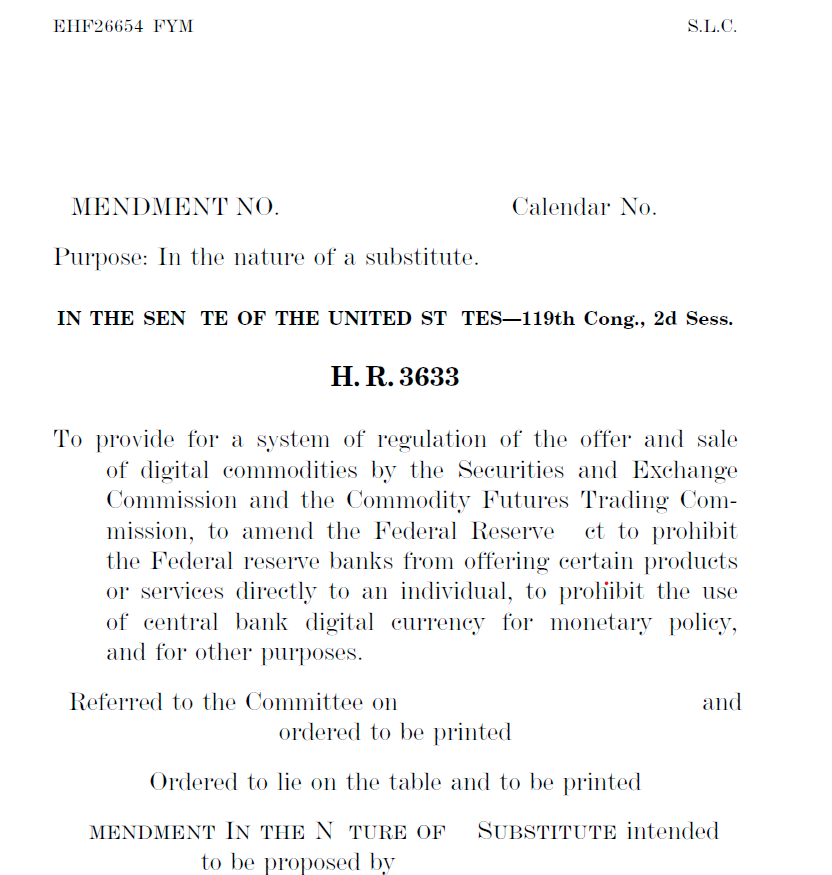
The latest CLARITY Act text. Source: US Congress.
Patrick Witt, a former White House and Senate counsel, said Democratic opposition appeared to rest on one of two positions: either that ethics rules without state attorneys general are “meaningless,” or that they fail to penalize President Trump for past crypto activity.
“If you hold position (1), then you are basically saying that ALL current federal ethics laws are meaningless because none of them are enforceable by state AGs,” he said. “If you hold position (2), then there is literally nothing that can be done to appease you because what you are advocating for is blatantly unconstitutional.”
Others argue that, even if the legislation is imperfect, passing it would be preferable to preserving the status quo. Andreessen Horowitz co-founder Chris Dixon said the US has a similar opportunity to the early internet era, when lawmakers established rules that allowed innovation to flourish rather than forcing new technology into outdated regulatory frameworks.
While acknowledging that “no law is perfect,” Dixon argued the CLARITY Act would deliver long-overdue consumer protections and provide regulatory certainty for blockchain innovation in the US.
Can lawmakers find a middle path?
Despite stumbling over the ethics hurdle, most industry and policy observers still believe a deal remains in reach.
Kristin Smith, former chief executive of the Blockchain Association and now president of the Solana Policy Institute, sees that the latest draft is already a meaningful compromise.
“The new text includes a substantive, one-of-a-kind ethics provision, a necessary step to win the support of Senate Democrats,” Smith told Cointelegraph.
“But ethics is far from the only thing at stake. The Senate has added a full disclosure regime, an entire illicit finance section, and improved spot market regulation.”
Smith warned that rejecting the bill in pursuit of stronger ethics language could leave lawmakers stuck with no market structure legislation at all.
“There is no version of a ‘no’ vote that produces a stronger bill,” she said. “A ‘no’ vote produces no bill at all: no disclosure regime, no illicit finance protections, no spot market improvements, no ethics provisions, nothing.”
Vincent Chok, co-founder and chief executive of stablecoin issuer First Digital, said the fact negotiations have narrowed to ethics rather than the broader structure of the bill is itself a sign of progress.
“The core debate is no longer whether digital assets need a regulatory framework, but how to finalize one that commands broad support,” Chok told Cointelegraph.
He said that while no regulatory framework is likely to be perfect from day one, businesses can adapt to clear rules that evolve over time. Prolonged uncertainty makes long-term investment and product development far more difficult, he said.
Salman Banaei, head of public policy at Plume, a blockchain network focused on tokenized real-world assets, also believes a compromise remains possible, although he cautioned that the White House’s initial ethics proposal “is not a good starting point.”
For now, both sides appear to agree on one thing: a compromise is still possible, but exactly what it looks like remains the biggest unanswered question.
Magazine: Will the crypto lobby’s $189M campaign get CLARITY over the line?
Cointelegraph publishes long-form journalism, analysis and narrative reporting produced by Cointelegraph’s in-house editorial team with subject-matter expertise. All articles are edited and reviewed by Cointelegraph editors in line with our editorial standards. Content published in here does not constitute financial, legal or investment advice. Readers should conduct their own research and consult qualified professionals where appropriate. Cointelegraph maintains full editorial independence.
Read the full article here
Fact Checker
Verify the accuracy of this article using AI-powered analysis and real-time sources.