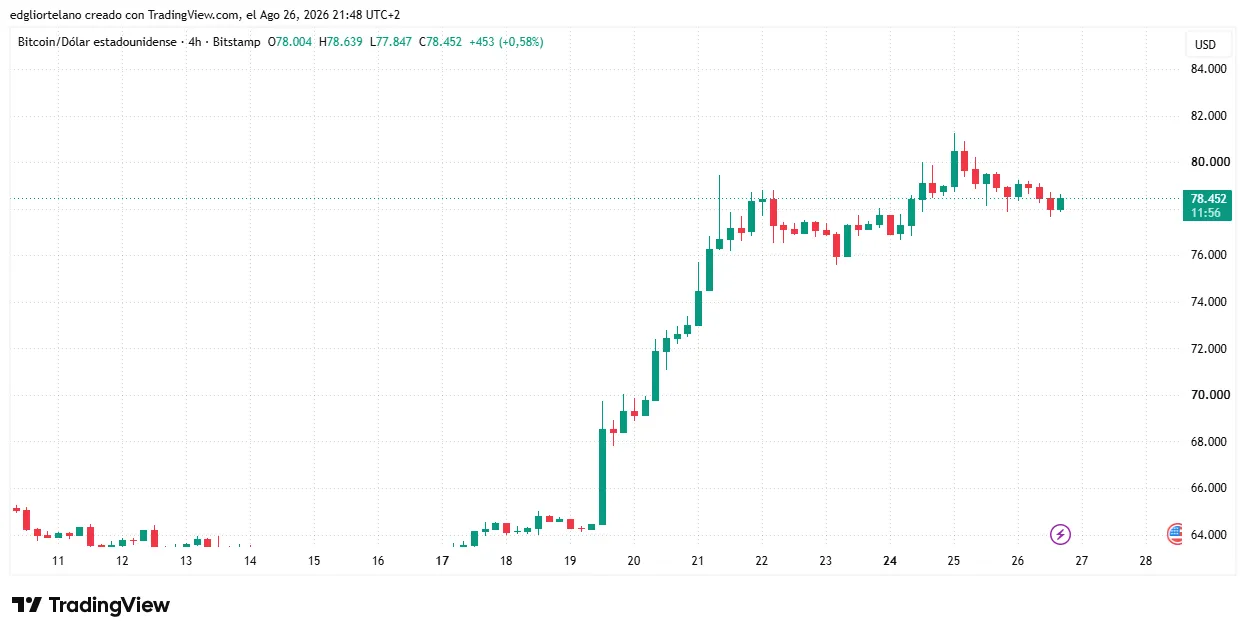
Bitcoin is holding near $78,000 after a hot PCE inflation reading knocked it back from an $81,000 high, with a $6.4 billion options expiry, Fed Chair Kevin Warsh’s first Jackson Hole speech, and Nvidia earnings all landing within 48 hours of each other.
The CME FedWatch tool now prices a 38.4% chance of a September rate hike, down from 82% a month ago, with the Fed’s next decision due September 16.
Analysts are split on what comes next, with some calling this the late stage of a bear market bottoming out and others warning of a bull trap if Bitcoin can’t clear $82,000.
Bitcoin is holding near $78,000 after a rally that briefly took it above $81,000 got interrupted by a hot inflation report. That single data point contributed to erasing roughly $3,000 from Bitcoin’s price in a few hours, a reminder of how fast sentiment can flip when positioning is this stretched.
The bigger issue for crypto traders right now might be timing. Over the next 48 hours, five separate catalysts converge on top of each other: economic data, a giant options expiry, a new Fed chair’s first big speech, Nvidia’s earnings, and a rate decision now three weeks away.
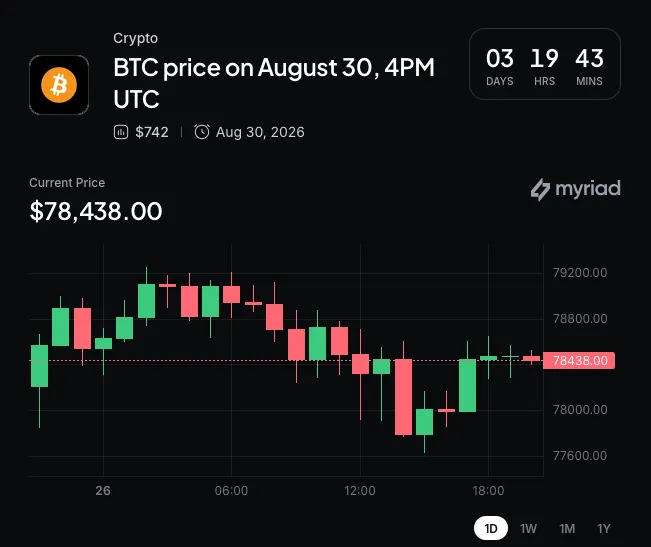
Myriad: Bitcoin next price move? Click to make your prediction.
Each one pulls a different lever on Bitcoin’s price, and together they make this one of the more consequential stretches of the year for Bitcoin. Here’s why each one of those matters for sentiment and fundamental analysis.
Inflation and growth, already in the books
The week’s two biggest data points landed Wednesday morning. July’s Personal Consumption Expenditures (PCE) report, the inflation gauge the Federal Reserve watches most closely, showed prices up 3.7% annually, hotter than the 3.6% forecast, while core PCE held at 3.3% as expected.
The government’s second look at second-quarter GDP came in at 1.5% annual growth, with consumer spending revised stronger than first reported.
PCE matters more than any other inflation gauge because it is what the Fed itself targets when it talks about its 2% goal, not the more commonly cited Consumer Price Index. A hotter print gives policymakers less room to justify cutting rates, and GDP data showing spending holding up removes any argument that the economy urgently needs help.
That combination worked against Bitcoin on Wednesday. Higher-for-longer rate expectations tend to strengthen the dollar and lift bond yields, both of which pull money away from assets that pay no yield. Bitcoin fell from above $81,000 to below $78,000 within hours of the release.
A $6.4 billion options expiry lands Friday
Roughly $6.4 billion worth of Bitcoin options contracts expire on the derivatives exchange Deribit this Friday, the same day as the Jackson Hole keynote. Traders watch a level called max pain, the price at which the largest number of contracts expire worthless, which currently sits near $78,000, below where Bitcoin trades now.
Expiries this size matter because the firms that sold those options have to hedge their exposure by buying or selling actual Bitcoin as the price moves, and a $6.4 billion book creates enough hedging flow to swing the market on its own, independent of any news. The wider the gap between spot price and max pain, the more that hedging activity tends to intensify heading into settlement.
If Bitcoin stays well above max pain into Friday, dealers who sold call options may need to keep buying the underlying asset to stay hedged, which can add upward pressure. If price gets pulled toward the $68,000 zone instead, that dynamic reverses, and expiries this size tend to add volatility either way as positions unwind.
Nvidia’s earnings, after the bell
Degens follow Bitcoin as Wall Street follows Nvidia.
Nvidia reports second-quarter results after Wednesday’s market close, with Wall Street forecasting around $92.3 billion in revenue. The company matters to crypto traders because it is the clearest bellwether for how much money is still flowing into AI infrastructure spending, and much of this year’s Bitcoin rally has moved in tandem with AI stock enthusiasm rather than on its own.
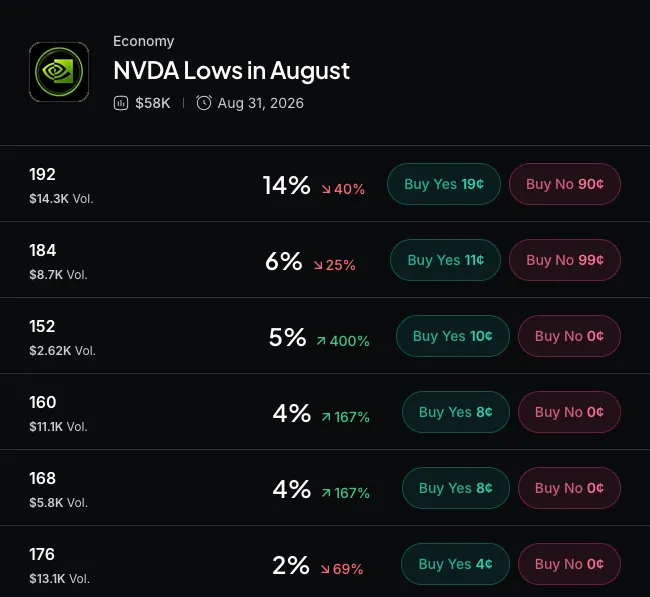
Myriad: NVIDIA Lows in August? Click to make your prediction.
When investors feel confident about tech earnings, they tend to add exposure across the entire risk curve, crypto included. Remember that right now, AI/tech stocks are moving the SP500 but are also in a very risky mood that conservative traders may not want to touch.
A strong beat with confident guidance could pull more capital into risk assets broadly and extend Wednesday’s dip-buying into Bitcoin. A miss, or cautious guidance on AI spending, could do the opposite and drag tech stocks and crypto lower together, given how tightly the two have moved this year.
Warsh’s first test at Jackson Hole
Kevin Warsh, who took over as Fed chair in May, delivers his first keynote at the Fed’s Jackson Hole symposium on Friday. His remarks come three weeks ahead of the Fed’s September 16 rate decision, where policymakers will also publish updated economic projections, Decrypt reported.
It is the first time markets get to hear how a new Fed chair actually talks about policy, not just what the data says. Traders parse the tone as much as the words, since a single line about inflation risk or labor-market weakness can shift rate expectations for weeks.
A dovish tone that downplays the hot PCE print and leans on the softer labor market could push yields and the dollar lower, the same combination that fueled this month’s rally in the first place. A hawkish tone that leans into inflation risk could do the opposite and extend Wednesday’s pullback into the weekend.
Futures pricing has already swung hard in the past month. The CME FedWatch tool, which converts bond market bets into rate-decision odds, now shows a 38.4% chance of a September rate hike, down from 82% a month ago, with 61.6% leaning toward no change.
Where the money is actually flowing
US spot Bitcoin and Ethereum ETFs pulled in $2.6 billion in new money last week, their best week since October 2025, though most of the funds’ growth came from existing coins simply gaining value.
Myriad: How high will Bitcoin go? Click to make your prediction.
ETF flows are the cleanest real-time signal of institutional demand, separate from retail trading or derivatives speculation. Shrinking exchange supply is another stat worth following alongside because it leaves fewer coins available to sell into any new demand, which makes price more sensitive to both buying and selling pressure than in a deeper market.
That scarcity helped fuel a short squeeze last week, when traders betting on falling prices were forced to buy back at a loss, wiping out roughly $3 billion in bearish bets in a single day.
If ETF inflows continue while exchange supply keeps shrinking, the same mechanics could push price higher on relatively modest buying; a reversal to sustained outflows would remove that support just as quickly.
Daily Debrief Newsletter
Start every day with the top news stories right now, plus original features, a podcast, videos and more.
The FSNN News Room is the voice of our in-house journalists, editors, and researchers. We deliver timely, unbiased reporting at the crossroads of finance, cryptocurrency, and global politics, providing clear, fact-driven analysis free from agendas.
We and our selected partners wish to use cookies to collect information about you for functional purposes and statistical marketing. You may not give us your consent for certain purposes by selecting an option and you can withdraw your consent at any time via the cookie icon.
Cookies are small text that can be used by websites to make the user experience more efficient. The law states that we may store cookies on your device if they are strictly necessary for the operation of this site. For all other types of cookies, we need your permission. This site uses various types of cookies. Some cookies are placed by third party services that appear on our pages.
Your permission applies to the following domains:
https://fsnn.net
Necessary
Necessary cookies help make a website usable by enabling basic functions like page navigation and access to secure areas of the website. The website cannot function properly without these cookies.
Statistic
Statistic cookies help website owners to understand how visitors interact with websites by collecting and reporting information anonymously.
Preferences
Preference cookies enable a website to remember information that changes the way the website behaves or looks, like your preferred language or the region that you are in.
Marketing
Marketing cookies are used to track visitors across websites. The intention is to display ads that are relevant and engaging for the individual user and thereby more valuable for publishers and third party advertisers.


 Freedom Index