

 Freedom Index
Listen to the article
I vividly recall a meeting of our philosophy department a few years ago when a student representative—or perhaps a young PhD—broached the topic of “decolonising” the philosophy curriculum. It was bound to happen sooner or later: I had already caught murmurs and whispers about this decolonisation movement in academia. Like other manifestations of “wokeness,” it had emerged across the Atlantic and only later trickled down to Europe. I must have rolled my eyes at the meeting. I vaguely remember speaking out against the idea, though in truth I did not take it very seriously.
Part of me was even inclined to sit back, mildly amused, and see how it would unfold. You see, unlike many philosophers, I do not spend much time studying the illustrious Dead White Males of the canon. Not because I am especially woke, but because I am what philosophers call a “naturalist”: someone primarily concerned with real-world problems of today, in my case science and technology. For some of my colleagues, however, poring over the great works of Kant, Hegel, and Aristotle—seeking ever new interpretations and insights—is a lifelong vocation. Moreover, most philosophers lean left and desire to “stick with the program.” So how, I wondered, would they square the circle of dedicating their lives to Dead White Males—who were often very racist and sexist—while still staying in the good graces of contemporary activists? You can’t exactly rewrite the history of philosophy. It struck me as somebody else’s knot to untangle.
I was terribly wrong to be so insouciant, as I discovered when 7 October happened. I’m not Jewish and don’t have a personal connection to Israel, so initially I didn’t follow the news very closely. I had relegated the attack to the—regrettably vast—mental category of jihadist terrorist attacks across the globe, failing to grasp that this was, in fact, a full-blown invasion. In my naivety, I assumed that after the massacres in Paris, Brussels, Nice, Berlin, and countless other Western cities, everyone had finally woken up to the true nature of jihadism. When a bunch of Allahu Akbar-chanting fanatics slaughtered innocent young people at a music festival, just as they had done at the Bataclan in Paris, it seemed inconceivable to me that any of my colleagues and friends would condone, rationalise, or even celebrate such acts. And yet that is precisely what happened.
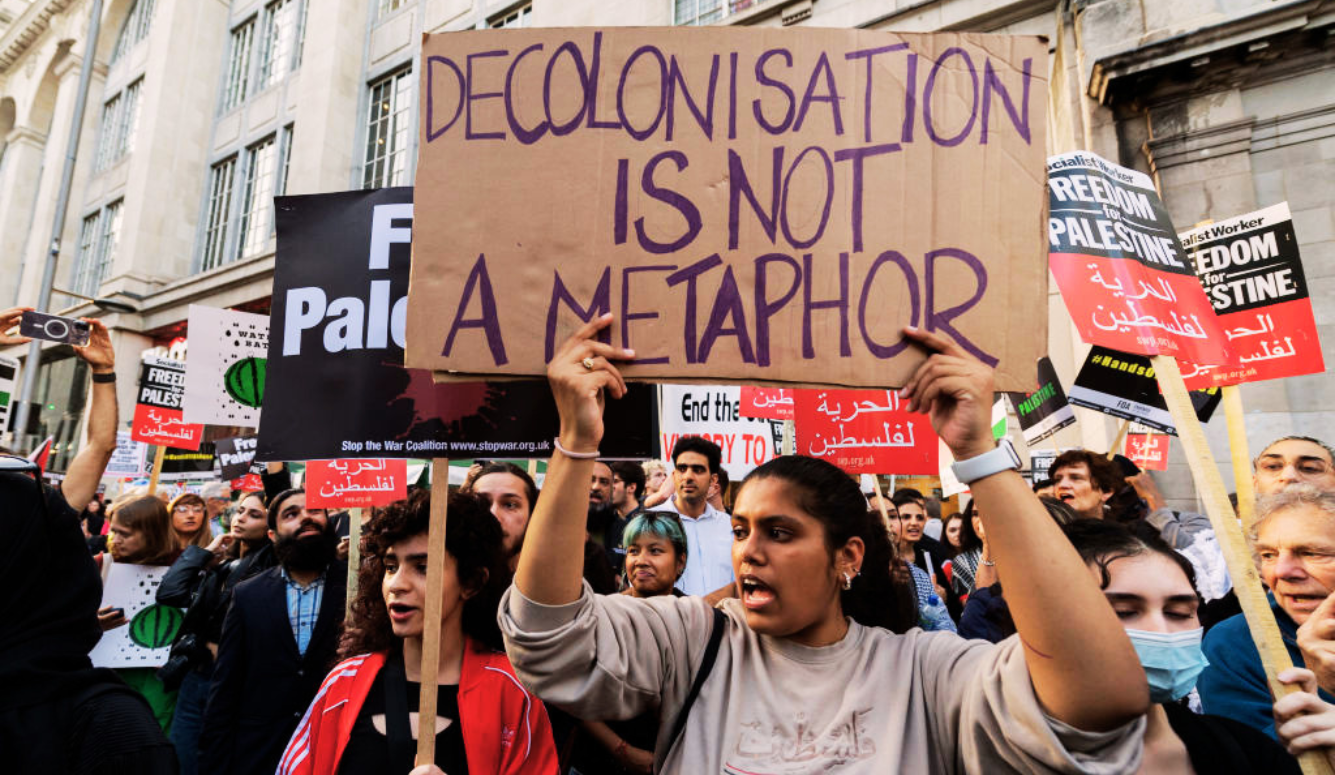
To my horror, within days—even hours—of the attack, when the Israeli army was still fighting off the invaders, I started seeing reactions of excitement and gleeful jubilation on social media. Not from the usual religious maniacs praising Allah, but from left-wing activists at prestigious universities. Academics started breathlessly applying the same framework of decolonisation that I had foolishly brushed aside as amusing but harmless virtue signalling. As the writer Najma Sharif famously posted on X that day, racking up tens of thousands of likes and reposts: “What did y’all think decolonization meant? vibes? papers? essays? losers.”
It was as though she was talking about me. I was one of those “losers” who had been foolish enough to think that decolonisation amounted to little more than papers and essays, along with some harmless but well-intentioned proposals to diversify the philosophy curriculum. If only. What I came to see in the wake of 7 October was something far less benign. Decolonisation operates as a rigid, almost Manichaean ideology that neatly divides the world into evil perpetrators (Western colonisers) and innocent victims (the colonised, indigenous peoples). In this worldview, there is no room for moral ambiguity. Those on the wrong side of the divide are irredeemably rotten and deserve everything that’s coming to them, while those on the side of the angels are completely absolved of any wrongdoing. If they appear to commit atrocities, these are reframed as understandable—perhaps even inevitable—responses to prior injustice. In fact, the more extreme the violence, the greater the wrongs they must have endured.
At one point, many on the Left considered Israel an admirable success story of decolonisation—of an indigenous people driving out the Western colonisers and achieving self-determination in their historical homeland. For a variety of complex historical reasons, however, the Jewish state is now firmly relegated to the side of the oppressors. In fact, Israel is regarded as the settler-colonialist enterprise par excellence, and Palestinians as paragons of victimhood. And that is all the latter-day activists need to know to reach their moral verdicts—which explains why those verdicts came rushing in mere hours into the unfolding event.
Read the full article here
Fact Checker
Verify the accuracy of this article using AI-powered analysis and real-time sources.