Close Menu
FSNN | Free Speech News NetworkFSNN | Free Speech News Network
  • Home
  • News
    • Politics
    • Legal & Courts
    • Tech & Big Tech
    • Campus & Education
    • Media & Culture
    • Global Free Speech
  • Opinions
    • Debates
  • Video/Live
  • Community
  • Freedom Index
  • About
    • Mission
    • Contact
    • Support
Trending

Bitcoin is still stuck below its 200-day average. Treasury yields may be the reason.

2 minutes ago

Kraken Switches from LayerZero to Chainlink after Kelp DAO Hack

3 minutes ago

CLARITY will strengthen dollar stablecoins, but Asia wins on yield: HashKey Research

1 hour ago
Facebook X (Twitter) Instagram
Facebook X (Twitter) Discord Telegram
FSNN | Free Speech News NetworkFSNN | Free Speech News Network
Market Data Newsletter
Friday, May 15
  • Home
  • News
    • Politics
    • Legal & Courts
    • Tech & Big Tech
    • Campus & Education
    • Media & Culture
    • Global Free Speech
  • Opinions
    • Debates
  • Video/Live
  • Community
  • Freedom Index
  • About
    • Mission
    • Contact
    • Support
FSNN | Free Speech News NetworkFSNN | Free Speech News Network
Home»Cryptocurrency & Free Speech Finance»Wall Street’s Tokenization Boom Has a Liquidity Problem: Axis CEO
Cryptocurrency & Free Speech Finance

Wall Street’s Tokenization Boom Has a Liquidity Problem: Axis CEO

News RoomBy News Room1 hour agoNo Comments5 Mins Read1,018 Views
Share Facebook Twitter Pinterest Copy Link LinkedIn Tumblr Email VKontakte Telegram
Wall Street’s Tokenization Boom Has a Liquidity Problem: Axis CEO
Share
Facebook Twitter Pinterest Email Copy Link

Listen to the article

0:00
0:00

Key Takeaways

Playback Speed

Select a Voice

Real-world assets (RWA) crossed $32 billion in market value for the first time on Tuesday, as Wall Street’s love affair with tokenization continues to accelerate.

JPMorgan was the latest to double down on its interest through a filing with the Securities and Exchange Commission for a new tokenized money-market fund for stablecoin issuers on Ethereum.

Not everyone is impressed by the big names and numbers.

“[Most] of the projects out there, and even the traditional finance players coming into crypto, they’re only looking at the issuance layer,” Chris Kim, founder and CEO of liquidity provider Axis, told Cointelegraph. “Nobody is actually focusing on the liquidity side of things.”

Issuing a tokenized asset and being able to trade it are two very different things, Kim argued. The industry’s obsession with market cap figures doesn’t measure how much of $32 billion can actually change hands.

Onchain RWA assets market value grew by about $10 billion in 2026 so far. Source: rwa.xyz

Putting assets onchain is the easy part

Tokenized finance is expected to continue growing. McKinsey & Company projects the tokenized market cap could reach $2 trillion by 2030. Standard Chartered sees $30.1 trillion by 2034.

But Kim claimed that the industry is obsessed with the wrong metrics, as the race to issue is outpacing the ability to trade these assets.

“The tradability around it is going to be an important factor to determine the value of these tokenisation markets going forward. But right now, there isn’t that much trading happening around tokenized RWAs,” he said.

The headline figure doesn’t tell the story of how unevenly liquidity is distributed across asset classes. Tokenized Treasuries, which account for roughly half of the RWA market, benefit from the underlying liquidity of US government debt, as rwa.xyz data shows.

But for other categories, Chainalysis reported that the tokenized assets market cap is drawn from a platform — rwa.xyz — that tracks highly illiquid assets like real estate alongside liquid ones.

“Because these illiquid assets lack continuous secondary market trading, their exact present market value is inherently difficult to measure, meaning certain aggregate valuations should be treated as best-available estimates,” Chainalysis wrote in its April report. 

Chainalysis tracked $40.5 billion in tokenized gold trading volume and found that for most of its history, it had almost no correlation to traditional gold markets, frequently decoupling entirely. It is only since mid-2025 that the two markets have begun moving in tandem.
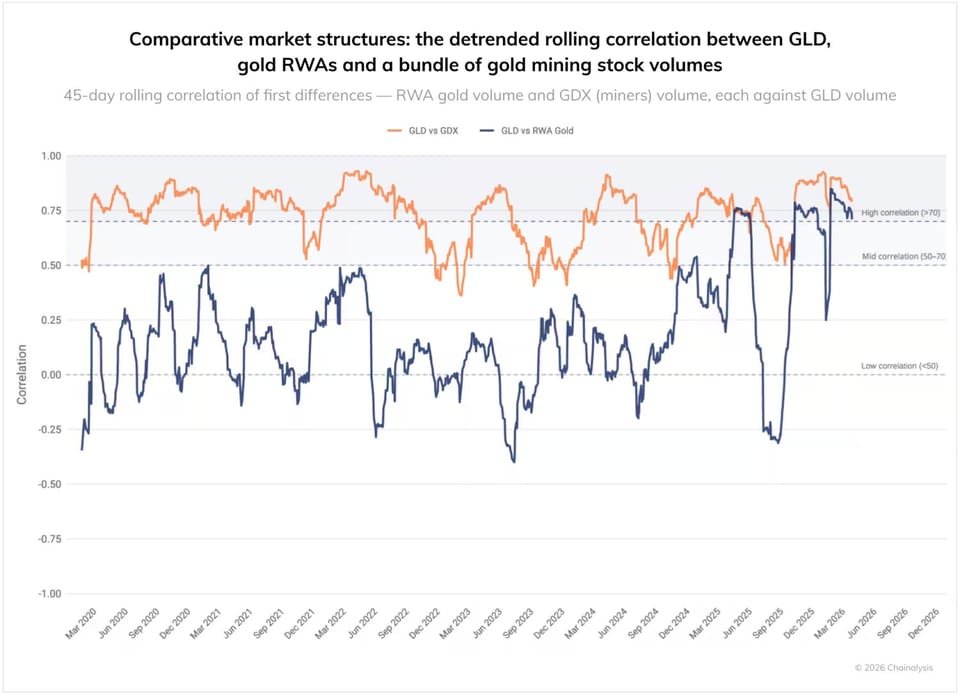
Tokenized gold is beginning to track physical gold prices more closely, but the two markets have not yet fully converged. Source: Chainalysis

Related: Crypto and AI could be dirty words on 2026 midterm campaign trail

In other words, even for one of the most mature tokenized asset classes, onchain trading has only recently started to behave like the real thing.

Fragmentation is taxing the RWA economy

For RWA assets in today’s Web3 economy, the same asset is issued across multiple blockchains.

“The fragmentation is accelerating,” Kim said. “We are seeing the same asset being issued on multiple blockchains in 30 different formats, and they can’t interact with each other.”

Kim has a stake in the narrative. Axis, his arbitrage yield platform, is built on capturing price discrepancies across fragmented markets.

When tokenized assets are spread across blockchains without seamless interoperability, pricing diverges and capital efficiency takes the hit. Issuers can face duplicated legal work and siloed liquidity pools, while investors must navigate different custody models and risk profiles.

The cost of this fragmentation is already measurable, according to a report by RWA.io. Moving capital between networks compounds the problem by costing investors between 2% to 5% per transaction in fees and slippage.
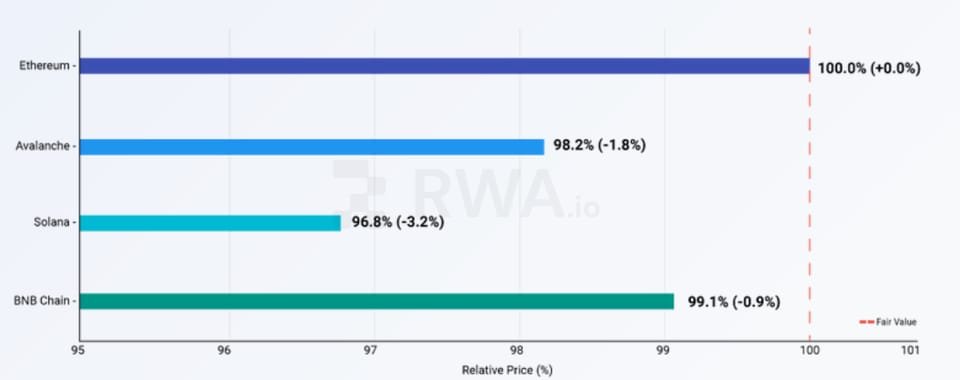
The same tokenized fixed-income asset trades at different prices across blockchains. Source: RWA.io

RWA.io estimated these inefficiencies drain between $600 million and $1.3 billion from the market every year. If the fragmentation persists as the market scales, those annual losses could reach $75 billion by 2030.

The technology to fix this exists, but the infrastructure connecting it all is the missing piece of the puzzle, according to RWA.io. Onchain operational failures drove a 143% increase in financial losses in the first half of 2025 compared to all of 2024.

The long road to a functioning RWA market

Kim is not bearish on tokenisation and views it as an inevitable destination for global capital markets. But inevitable does not mean imminent.

“I view tokenisation as a default standard in the far future,” he said. “But until we get there, we are still going to have a differentiation between TradFi liquidity profiles and on chain liquidity profiles.”

JPMorgan and BlackRock are racing to put assets on chains. But until the liquidity infrastructure catches up, the market cap figure doesn’t fully measure a functioning market.

“We are just maybe in the early innings,” Kim said. “Until more sophisticated liquidity providers are able to synchronise TradFi and onchain tokenised markets, then I think we can only call it a successful alternative to TradFi.”

The IMF has also flagged a longer term concern in a January 2025 note on tokenization and financial market inefficiencies. It warned that while tokenization could reduce some trading costs, it may amplify shocks if institutions become more interconnected and hold lower liquidity buffers as a result. 

In other words, the race to put assets on blockchains may be creating new systemic risks even as the old infrastructure problems remain unsolved.

Magazine: eToro founder timed Bitcoin top perfectly due to belief in 4 year cycles

Read the full article here

Fact Checker

Verify the accuracy of this article using AI-powered analysis and real-time sources.

Get Your Fact Check Report

Enter your email to receive detailed fact-checking analysis

5 free reports remaining

Continue with Full Access

You've used your 5 free reports. Sign up for unlimited access!

Already have an account? Sign in here

Share. Facebook Twitter Pinterest LinkedIn Tumblr Email Telegram Copy Link
News Room
  • Website
  • Facebook
  • X (Twitter)
  • Instagram
  • LinkedIn

The FSNN News Room is the voice of our in-house journalists, editors, and researchers. We deliver timely, unbiased reporting at the crossroads of finance, cryptocurrency, and global politics, providing clear, fact-driven analysis free from agendas.

Related Articles

Cryptocurrency & Free Speech Finance

Bitcoin is still stuck below its 200-day average. Treasury yields may be the reason.

2 minutes ago
Cryptocurrency & Free Speech Finance

Kraken Switches from LayerZero to Chainlink after Kelp DAO Hack

3 minutes ago
Cryptocurrency & Free Speech Finance

CLARITY will strengthen dollar stablecoins, but Asia wins on yield: HashKey Research

1 hour ago
Cryptocurrency & Free Speech Finance

Bitcoin’s Dip Below $80K Could Be ‘Short-Lived’ as STRC Cycle Looms

1 hour ago
Cryptocurrency & Free Speech Finance

Cardano whales now hold 67% of ADA supply in highest share since 2020

2 hours ago
Cryptocurrency & Free Speech Finance

Gemini Revenue Jumps 42% With Credit Cards and New Licenses

2 hours ago
Add A Comment
Leave A Reply Cancel Reply

Editors Picks

Kraken Switches from LayerZero to Chainlink after Kelp DAO Hack

3 minutes ago

CLARITY will strengthen dollar stablecoins, but Asia wins on yield: HashKey Research

1 hour ago

Wall Street’s Tokenization Boom Has a Liquidity Problem: Axis CEO

1 hour ago

Bitcoin’s Dip Below $80K Could Be ‘Short-Lived’ as STRC Cycle Looms

1 hour ago
Latest Posts

Cardano whales now hold 67% of ADA supply in highest share since 2020

2 hours ago

Gemini Revenue Jumps 42% With Credit Cards and New Licenses

2 hours ago

Tezos Tests Post-Quantum Privacy as Founder Slams ‘Half-Baked’ Bitcoin Quantum Theories

2 hours ago

Subscribe to News

Get the latest news and updates directly to your inbox.

At FSNN – Free Speech News Network, we deliver unfiltered reporting and in-depth analysis on the stories that matter most. From breaking headlines to global perspectives, our mission is to keep you informed, empowered, and connected.

FSNN.net is owned and operated by GlobalBoost Media
, an independent media organization dedicated to advancing transparency, free expression, and factual journalism across the digital landscape.

Facebook X (Twitter) Discord Telegram
Latest News

Bitcoin is still stuck below its 200-day average. Treasury yields may be the reason.

2 minutes ago

Kraken Switches from LayerZero to Chainlink after Kelp DAO Hack

3 minutes ago

CLARITY will strengthen dollar stablecoins, but Asia wins on yield: HashKey Research

1 hour ago

Subscribe to Updates

Get the latest news and updates directly to your inbox.

© 2026 GlobalBoost Media. All Rights Reserved.
  • Privacy Policy
  • Terms of Service
  • Our Authors
  • Contact

Type above and press Enter to search. Press Esc to cancel.

🍪

Cookies

We and our selected partners wish to use cookies to collect information about you for functional purposes and statistical marketing. You may not give us your consent for certain purposes by selecting an option and you can withdraw your consent at any time via the cookie icon.

Cookie Preferences

Manage Cookies

Cookies are small text that can be used by websites to make the user experience more efficient. The law states that we may store cookies on your device if they are strictly necessary for the operation of this site. For all other types of cookies, we need your permission. This site uses various types of cookies. Some cookies are placed by third party services that appear on our pages.

Your permission applies to the following domains:

  • https://fsnn.net
Necessary
Necessary cookies help make a website usable by enabling basic functions like page navigation and access to secure areas of the website. The website cannot function properly without these cookies.
Statistic
Statistic cookies help website owners to understand how visitors interact with websites by collecting and reporting information anonymously.
Preferences
Preference cookies enable a website to remember information that changes the way the website behaves or looks, like your preferred language or the region that you are in.
Marketing
Marketing cookies are used to track visitors across websites. The intention is to display ads that are relevant and engaging for the individual user and thereby more valuable for publishers and third party advertisers.