

 Freedom Index
Listen to the article
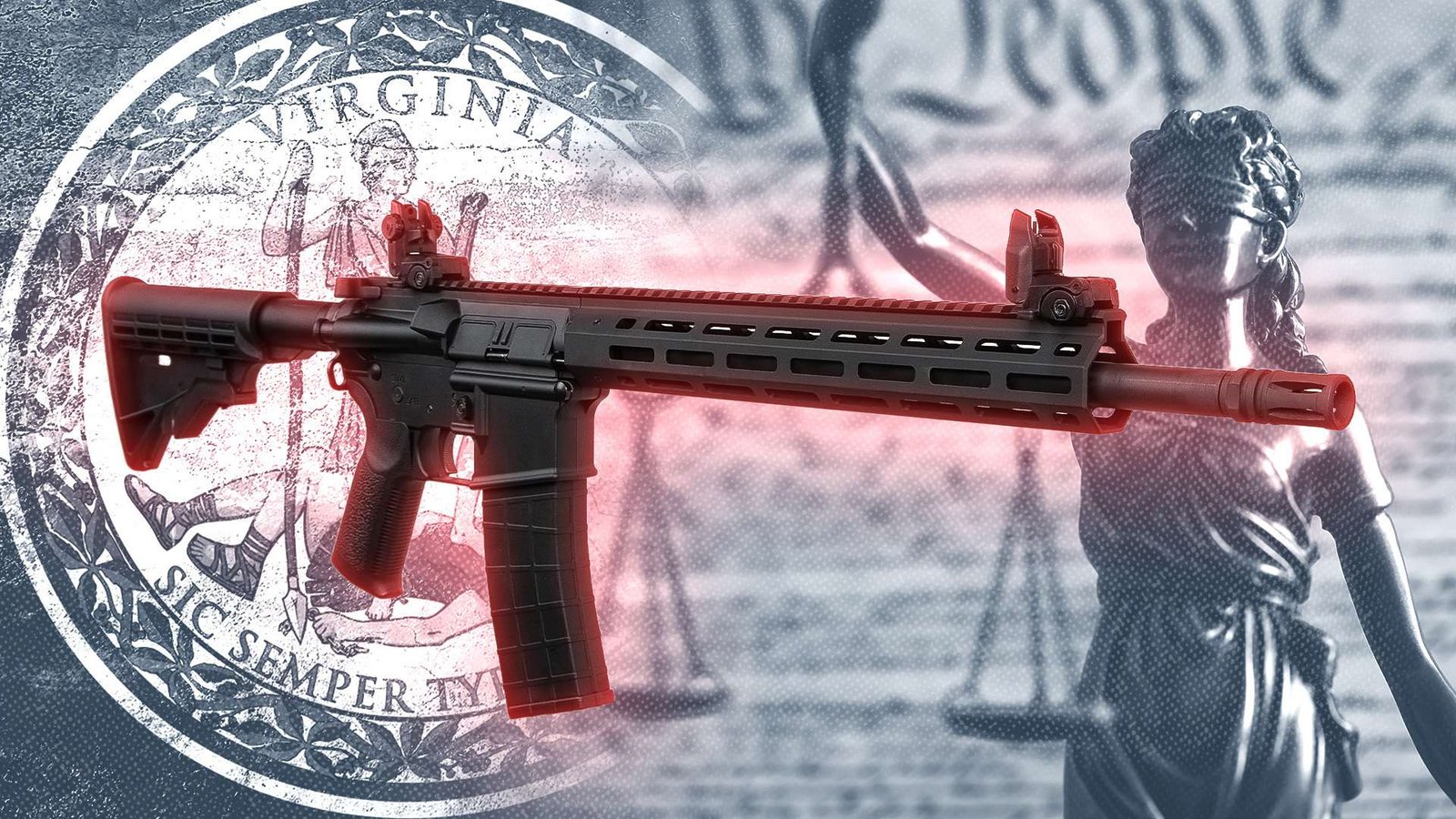
Last month, Virginia became the 12th state to enact an “assault weapon” ban, which Gov. Abigail Spanberger signed into law on April 13. That new law is plainly unconstitutional, the Firearms Policy Coalition (FPC) and two other Second Amendment groups argue in McDonald v. Katz, a lawsuit they filed on Thursday in the U.S. District Court for the Eastern District of Virginia.
“Spanberger’s insane law criminalizes constitutionally protected conduct and bans arms the Second Amendment protects,” said FPC President Brandon Combs. “We’re going to force Governor Spanberger and other government thugs to follow the Constitution and respect the Second Amendment, full stop.”
Virginia’s law resembles other “assault weapon” bans, which typically define that category based on arbitrarily disfavored gun features. The law makes it a crime to manufacture, import, sell, purchase, or transfer “assault firearms,” which it defines to include semiautomatic center-fire rifles that accept detachable magazines and have any of five listed features: 1) a folding or adjustable stock, 2) a thumbhole stock or pistol grip, 3) a second handgrip or protruding grip that can be held by the nontrigger hand, 4) a grenade launcher, or 5) a threaded barrel that can be used to attach a muzzle break, a muzzle compensator, a sound suppressor, or a flash suppressor.
That definition encompasses some of the most popular firearms sold in the United States, including AR-15-style rifles. In January, the National Shooting Sports Foundation (NSSF), the gun industry’s trade association, reported that Americans own more than 32 million “modern sporting rifles,” its preferred term for the models covered by bans like Virginia’s.
Survey data suggest that somewhere between 16 million and 25 million Americans have owned AR-15-style rifles. They commonly report using them for lawful purposes such as self-defense, hunting, and target shooting.
Such rifles are rarely used by criminals. “According to FBI statistics over the decade from 2014 to 2023, rifles of any type were used in an average of 380 homicides per year,” the FPC, the National Rifle Association, and the Second Amendment Foundation note in their lawsuit. “Even if every one of those homicides had been committed with an AR-15-style or other semiautomatic rifle, that would mean that over 99.99% of them were not used in homicide in a given year. Other items used much more frequently in homicide include handguns (an average of 7,044 per year), knives (1,593), and personal weapons like hands and feet (692).”
Although Virginia treats the prohibited rifle features as uniquely suited for crime, they have legitimate functions. Folding and telescoping stocks, for example, “ease carriage over long distances while hunting” and “allow for safe transportation, including in a hiking pack, an ATV, or a boat,” the FPC et al. note. They also “increase the likelihood of successful home defense by permitting safe storage of defense instruments in accessible spaces and making the rifle maneuverable in confined spaces.” An adjustable stock “allows a firearm to be better fitted to an individual shooter, thereby enhancing an individual’s ability to use the firearm safely and effectively.”
Pistol grips “improve accuracy and reduce the risk of stray shots by stabilizing the
firearm while firing from the shoulder,” the complaint says. “They are effectively necessitated by the AR-15 rifle’s straight line design, where the centerline of the barrel is continuous with the stock, a design feature that reduces muzzle rise caused by firing the firearm.” Protruding grips “open hunting and sport-shooting to those for whom recoil poses a challenge.”
A flash suppressor “not only reduces the chances that a home invader will identify his victim’s position but also protects a homeowner against momentary blindness when firing in self-defense,” the lawsuit notes. Flash suppressors also “promote accuracy in target-shooting and hunting (especially at dawn).”
The complaint does not delve into grenade launchers, possibly because their inclusion in Virginia’s ban serves little practical purpose. Grenade launchers are strictly regulated as “destructive devices” under the National Firearms Act, and so are grenades.
Virginia’s law also bans “large capacity” magazines, imposing a 15-round cap. Like the “assault firearm” ban, that provision prohibits arms in common use for lawful purposes. AR-15s are typically sold with magazines that can hold up to 30 rounds. Between 1990 and 2021, according to a 2024 NSSF report, Americans bought more than 400 million rifle magazines with a capacity of 30 or more rounds.
“According to the 2021 National Firearms Survey, 21.6% of firearm owners,
approximately 18 million Americans, have owned handgun magazines that hold more than 15 rounds of ammunition,” the lawsuit notes. “The prevalence of these magazines should not come as a surprise. Many popular handguns are typically sold with magazines holding more than 15 rounds of ammunition, and standard issue magazines for many popular rifles—including the most popular semiautomatic rifles in the country—similarly have a capacity of over 15 rounds.”
The wide reach of Virginia’s law is constitutionally relevant because the Supreme Court has said the Second Amendment applies to arms “in common use” for “lawful purposes like self-defense.” The lawsuit notes that “millions of peaceable people have determined that AR-15-style rifles” and other semiautomatic rifles covered by Virginia’s ban “are optimal for self-defense.”
The complaint suggests possible reasons for that choice: “Many AR-style firearms are chambered for 5.56x45mm NATO ammunition, and will also accept .223 Remington ammunition. These are relatively inexpensive and common cartridges that are particularly well suited for home-defense purposes because they have sufficient stopping power in the event of a home intrusion, but quickly lose velocity after passing through a target and other objects, thus decreasing the chance that an errant shot will strike an unintended target. Also often important, the AR-15 platform, and other platforms, are modular, allowing the individual user and owner to modify the firearm to the specifications that are the safest and easiest for the owner to use given their specific physical and environmental demands for self-defense.”
Regardless of why people might favor the guns that Virginia has banned, the fact remains that millions of Americans use them for lawful purposes. Likewise, it is notable that the prohibited rifles are not the preferred weapons of criminals (even mass shooters), but that fact is clearly not constitutionally decisive. In the landmark 2008 case District of Columbia v. Heller, after all, the Supreme Court held that Americans have a right to own handguns, which it described as “the quintessential self-defense weapon,” notwithstanding their prominence in homicide statistics.
Heller contrasted arms in common use for lawful purposes with “dangerous and unusual weapons,” which the Court said could be banned without violating the Second Amendment. But the guns Virginia has banned “are, in all respects, ordinary semiautomatic firearms,” the complaint says. “To the extent they are different from other semiautomatic firearms, their distinguishing features make them safer and easier to use. Regardless of any new category of arms created by state lawmakers, they cannot be banned because they are not dangerous and unusual.”
Those guns, the FPC et al. say, “are common by all counts: (1) they are common categorically, as they are all semiautomatic in their function and operation; (2) they are common characteristically, as they are all popular configurations of arms (e.g., rifles) with varying barrel lengths and common characteristics like pistol grips; and (3) they are common jurisdictionally, lawful to possess and use in the vast majority of states now and throughout relevant history, for a wide variety of lawful purposes such as self-defense, proficiency training, competition, recreation, hunting, and collecting.”
Under the constitutional test that the Supreme Court prescribed in the 2022 case New York State Rifle & Pistol Association v. Bruen, Virginia has the burden of showing that its ban is “consistent with this Nation’s historical tradition of firearm regulation.” The state “will not be able to demonstrate any such thing,” the lawsuit says. “Heller and Bruen have already established the only historical practice that allows a particular type of arm to be banned—historical restrictions on dangerous and unusual weapons. But to be banned under this historical practice, an arm must be both dangerous and unusual. Arms that are in common use—as the firearms and magazines Virginia has banned unquestionably are—cannot be unusual.”
The argument in McDonald v. Katz mirrors the logic of other lawsuits challenging “assault weapon” bans, including two recently filed by the Justice Department’s Civil Rights Division in the District of Columbia and Colorado. Although federal appeals courts so far have not been receptive to such claims, there are signs that the Supreme Court might be.
In addition to Justice Brett Kavanaugh, who as a judge on the U.S. Court of Appeals for the D.C. Circuit dissented from a 2011 decision upholding the District of Columbia’s “assault weapon” ban, Justices Clarence Thomas, Samuel Alito, and Neil Gorsuch have indicated that they are interested in weighing the constitutionality of such laws. Since granting a petition requires the assent of four justices, that suggests the Supreme Court may soon resolve this issue.
Read the full article here
Fact Checker
Verify the accuracy of this article using AI-powered analysis and real-time sources.