

 Freedom Index

Listen to the article
Back in 2019, Virginia’s legislators made a broadly bipartisan decision to have the state’s congressional map drawn, for the first time, by a commission that would include members of the public.
The commission failed. With its members deadlocked, the state Supreme Court stepped in and appointed two individuals—somewhat amusingly dubbed “Special Masters”—to produce a new map before the 2022 election cycle.
It was a mess, but even so, the result showed the potential benefits of trying to reduce (or at least balance) partisan influence in the district-drawing process. The 11 districts scored well in terms of compactness and competitiveness on various metrics used by redistricting reformers. The Gerrymandering Project at Princeton University gave an “A” to the map.
That congressional map is no more. It was trashed by Virginia voters, who narrowly approved a new congressional map in a referendum that ended on Tuesday night. The new map will remain in place until after the 2030 elections, when (in theory at least) the commission will be tasked with updating it after the next census.
Unlike the old map, the new one is a decidedly partisan effort. Both proponents and opponents of the redrawing effort believe it will send 10 Democrats to Congress next year along with just a single Republican—a huge swing from the state’s current 6-5 split, and a potentially staggering result in a state that Kamala Harris carried by less than 6 percentage points in 2024.
The new districts zig and zag all over the place, in an attempt to spread the influence of Democratic voters in northern Virginia as far as possible. The most egregious is the new 7th district (which includes my home). It resembles a monstrous lobster with its tail on the banks of the Potomac River across from Washington, D.C., one claw stretching to the edge of the Richmond suburbs, and the other reaching all the way to the hollers of Rockingham County on the West Virginia border.
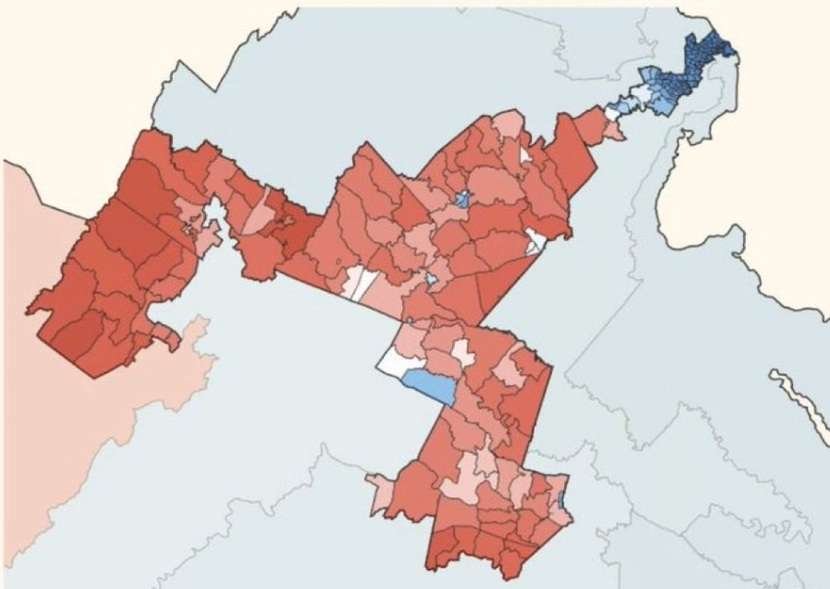
There are all sorts of ways to judge the compactness of a political district—the Polsby-Popper method has become a favorite of reformers, probably in no small part because it is so fun to say. Even so, gerrymandering remains a “you know it when you see it” problem. And you don’t need to run any advanced mathematical equations to come to the obvious conclusion here.
Virginia’s new congressional map is a gerrymandered mess.
Beyond that, there are three other points worth highlighting in the wake of yesterday’s vote.
First, Republicans picked this fight and don’t get to play the victim.
Virginia conservatives are understandably outraged over the “lobstrosity” and the potential loss of several congressional seats. And a lot of conservative journalists and pundits live in northern Virginia, so their audiences will end up hearing a lot about this.
I have little sympathy. At the behest of President Donald Trump, Republicans tore up congressional maps in North Carolina and Texas to carve out more winnable districts this coming November. It’s a desperate (and almost certainly doomed) attempt at protecting a slim GOP House majority. The effort has spilled over to Florida, Missouri, and elsewhere.
If you’re willing to turn every election into a maximalist fight for power and discard the norms that serve as guardrails, you can’t be mad when the other side does it too. In a state like Virginia, where Democrats have an edge, Republicans benefit from norms and procedures that protect the minority. By pushing for more power elsewhere, Republicans inadvertently harmed their voters in Virginia.
Josh Barro is right: If Republicans want Democrats to disarm in the gerrymandering wars, then the GOP should do the same.
Second, Democrats still own this hack job and deserve criticism for it.
It’s tough to top the lobster district in terms of outrageousness, but the language on the ballot question might manage the trick.
The wording of this question is so absurdly biased that it should be rejected without even considering the substance, frankly. (Not my ballot, I live in DC. Stolen from @CorieWhalen.) pic.twitter.com/iQxBRFpqkQ
— Robby Soave (@robbysoave) April 21, 2026
Yes, as already discussed, the whole point of this effort was to respond to Republican gerrymandering in other states. Yes, in that sense, the “fairness” argument isn’t a total nonsequitur.
But come on. The party that likes to position itself as the defender of democracy against the rising tide of disinformation and authoritarianism just used some wildly misleading language to get voters to approve an unprecedented maneuver to grab more congressional seats for itself. That’s certainly not going to help restore trust in the institutions that run our elections.
Finally, this means that redistricting reform is (probably) dead.
As someone who once sincerely believed that we might improve congressional elections (and therefore Congress itself) by figuring out how to reduce the partisan influence in redistricting, this conclusion stings the worst. Redistricting commissions were imperfect solutions—as Virginia’s misadventure at the start of this decade demonstrated. Even so, the trend seemed to be moving in the right direction. Even if you can’t ever hope to excise partisan influence, it seemed like there were ways to temper it.
But we have now broken a norm that will be very difficult to piece back together. If both parties can get away with redrawing districts for the 2026 election, why would they not do the same in 2028 and every two years after that?
Supposedly, Virginia will return power to the redistricting commissions to make new maps for the 2030s, but it is difficult to see that happening. That means the future holds fewer competitive elections, a greater disconnect between voters and the people representing them in the federal government, and less trust in the system to work as it should.
Simply put: Virginia’s voters decided on Tuesday that gaining a slim partisan advantage in this year’s election matters more to them than making structural reforms to strengthen the democratic system.
As long as that’s true, there is little hope for any lasting improvements, and we will remain trapped in this downward spiral of short-term politics driven by power-hungry partisans on both sides.
Read the full article here
Fact Checker
Verify the accuracy of this article using AI-powered analysis and real-time sources.