

 Freedom Index
Listen to the article
In the past few years, governments across the world have rolled out different digital identification options, and now there are efforts encouraging online companies to implement identity and age verification requirements with digital ID in mind. This blog is the second in a short series that explains digital ID and the pending use case of age verification. Upcoming posts will evaluate what real protections we can implement with current digital ID frameworks and discuss how better privacy and controls can keep people safer online.
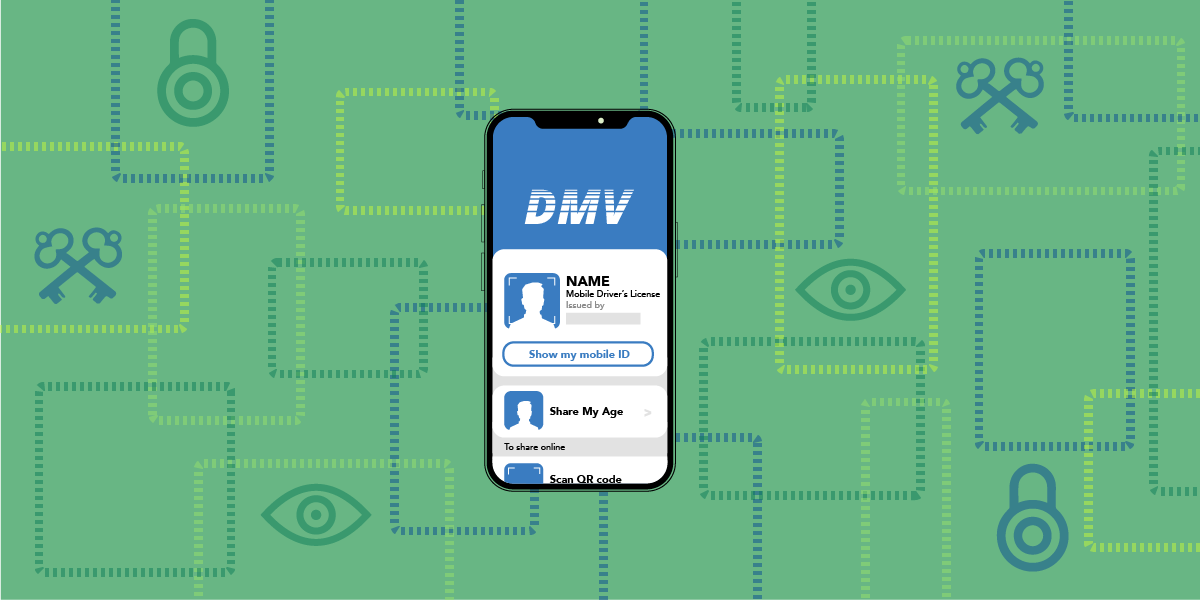
Digital identity encompasses various aspects of an individual’s identity that are presented and verified through either the internet or in person. This could mean a digital credential issued by a certification body or a mobile driver’s license provisioned to someone’s mobile wallet. They can be presented in plain text on a device, as a scannable QR code, or through tapping your device to something called a Near Field Communication (NFC) reader. There are other ways to present credential information that is a little more privacy preserving, but in practice those three methods are how we are seeing digital ID being used today.
Advocates of digital ID often use a framework they call the “Triangle of Trust.” This is usually presented as a triangle of exchange between the holder of an ID—those who use a phone or wallet application to access a service; the issuer of an ID—this is normally a government entity, like the state Departments of Motor Vehicles in the U.S, or a banking system; and the verifier of an ID—the entity that wants to confirm your identity, such as law enforcement, a university, a government benefits office, a porn site, or an online retailer.
This triangle implies that the issuer and verifier—for example, the government who provides the ID and the website checking your age—never need to talk to one another. This theoretically avoids the tracking and surveillance threats that arise by preventing your ID, by design, from phoning home every time you verify your ID with another party.
But it also makes a lot of questionable assumptions, such as:
1) the verifier will only ever ask for a limited amount of information.
2) the verifier won’t store information it collects.
3) the verifier is always trustworthy.
The third assumption is especially problematic. How do you trust that the verifier will protect your most personal information and not use, store, or sell it beyond what you have consented to? Any of the following could be verifiers:
- Law enforcement when doing a traffic stop and verifying your ID as valid.
- A government benefits office that requires ID verification to sign up for social security benefits.
- A porn site in a state or country which requires age verification or identity verification before allowing access.
- An online retailer selling products like alcohol or tobacco.
Looking at the triangle again, this isn’t quite an equal exchange. Your personal ID like a driver’s license or government ID is both one of the most centralized and sensitive documents you have—you can’t control how it is issued or create your own, having to go through your government to obtain one. This relationship will always be imbalanced. But we have to make sure digital ID does not exacerbate these imbalances.
The effort to answer the questions of how to prevent verifier abuse is ongoing. But instead of working on the harms that these systems cause, the push for this technology is being fast-tracked by governments around the world scrambling to solve what they see as a crisis of online harms by mandating age verification. And current implementations of the Triangle of Trust have already proven disastrous.
One key example of the speed of implementation outpacing proper protections is the Digital Credential API. Initially launched by Google and now supported by Apple, this rollout allows for mass, unfettered verification by apps and websites to use the API to request information from your digital ID. The introduction of this technology to people’s devices came with no limits or checks on what information verifiers can seek—incentivizing verifiers to over-ask for ID information beyond the question of whether a holder is over a certain age, simply because they can.
Digital Credential API also incentivizes for a variety of websites to ask for ID information that aren’t required and did not commonly do so previously. For example, food delivery services, medical services, and gaming sites, and literally anyone else interested in being a verifier, may become one tomorrow with digital ID and the Digital Credential API. This is both an erosion of personal privacy, as well as a pathway into further surveillance. There must be established limitations and scope, including:
- verifiers establishing who they are and what they plan to ask from holders. There should also be an established plan for transparency on verifiers and their data retention policies.
- ways to identify and report abusive verifiers, as well as real consequences, like revoking or blocking a verifier from requesting IDs in the future.
- unlinkable presentations that do not allow for verifier and issuer collusion. As well as no data shared between verifiers you attest to. Preventing tracking of your movements in person or online every time you attest your age.
A further point of concern arises in cases of abuse or deception. A malicious verifier can send a request with no limiting mechanisms or checks and the user who rejects the request could be fully blocked from the website or application. There must be provisions that ensure people have access to vital services that will require age verification from visitors.
Government’s efforts to tackle verifiers potentially abusing digital ID requests haven’t come to fruition yet. For example, the EU Commission recently launched its age verification “mini app” ahead of the EU ID wallet for 2026. The mini app will not have a registry for verifiers, as EU regulators had promised and then withdrew. Without verifier accountability, the wallet cannot tell if a request is legitimate. As a result, verifiers and issuers will demand verification from the people who want to use online services, but those same people are unable to insist on verification and accountability from the other sides of the triangle.
While digital ID gets pushed as the solution to the problem of uploading IDs to each site users access, the security and privacy on them varies based on implementation. But when privacy is involved, regulators must make room for negotiation. There should be more thoughtful and protective measures for holders interacting with more and more potential verifiers over time. Otherwise digital ID solutions will just exacerbate existing harms and inequalities, rather than improving internet accessibility and information access for all.
Read the full article here
Fact Checker
Verify the accuracy of this article using AI-powered analysis and real-time sources.