Close Menu
FSNN | Free Speech News NetworkFSNN | Free Speech News Network
  • Home
  • News
    • Politics
    • Legal & Courts
    • Tech & Big Tech
    • Campus & Education
    • Media & Culture
    • Global Free Speech
  • Opinions
    • Debates
  • Video/Live
  • Community
  • Freedom Index
  • About
    • Mission
    • Contact
    • Support
Trending

Review: A Novel Capturing the Cruelty of Mass Incarceration

38 minutes ago

Bitcoin tops $77,000 as best week since 2023 pulls altcoins along for the ride

58 minutes ago

Coldcard Security Upgrade Strengthens Seed Phrase Generation

1 hour ago
Facebook X (Twitter) Instagram
Facebook X (Twitter) Discord Telegram
FSNN | Free Speech News NetworkFSNN | Free Speech News Network
Market Data Newsletter
Friday, August 21
  • Home
  • News
    • Politics
    • Legal & Courts
    • Tech & Big Tech
    • Campus & Education
    • Media & Culture
    • Global Free Speech
  • Opinions
    • Debates
  • Video/Live
  • Community
  • Freedom Index
  • About
    • Mission
    • Contact
    • Support
FSNN | Free Speech News NetworkFSNN | Free Speech News Network
Home»Cryptocurrency & Free Speech Finance»Venice AI Raises $65M Series A at $1B Valuation
Cryptocurrency & Free Speech Finance

Venice AI Raises $65M Series A at $1B Valuation

News RoomBy News Room2 months agoNo Comments3 Mins Read4 Views
Share Facebook Twitter Pinterest Copy Link LinkedIn Tumblr Email VKontakte Telegram
Venice AI Raises M Series A at B Valuation
Share
Facebook Twitter Pinterest Email Copy Link

Listen to the article

0:00
0:00

Key Takeaways

Playback Speed

Select a Voice

The Erik Voorhees-founded Venice AI has achieved unicorn status after raising $65 million in Series A funding at a $1 billion valuation. 

Led by Dragonfly and with backing from Coinbase Ventures, F-Prime, North Island Ventures, Morgan Creek and others, the funding round announced on Wednesday marks the company’s first external capital raise since launching in 2024. 

The fundraising came in the same month Anthropic was forced to suddenly cut foreign access to two of its latest AI models, and comes just weeks after OpenAI was accused in a class-action lawsuit for sharing ChatGPT data with third parties, highlighting the potential appeal of privacy-focused AI platforms. 

“This capital will be used to uphold the First and Fourth Amendments to the Constitution as they relate to mankind’s interaction with AI,” Voorhees said in an X post on Wednesday. 

The First Amendment is part of the United States Constitution protecting five essential freedoms including the freedom of speech. The Fourth Amendment protects people from unreasonable searches and seizures by the government. 

Venice AI courts privacy-focused users

Venice AI, which claims to have 3.5 million users, offers access to over 200 AI models but adds a proxy between the user and the models and allows users to choose the level of privacy they want.

For models from OpenAI, Anthropic, xAI and Google, the proxy obscures users’ IP address, account and session data. Other models offer higher levels of privacy.

Source: Erik Voorhees

“Control over intelligence is the defining fight of the coming decade,” Haseeb Qureshi, managing partner at Dragonfly, said on Wednesday. 

“Whoever owns the AI delivery stack owns a direct window into your interior life. They log all your chats, train on them, and will hand them over when asked. And in the end, they decide the terms on which you’ll get to access the most powerful systems humankind has ever built.” 

Voorhees said the capital will be used to further build out its own data center infrastructure, owning the GPUs that power its platform rather than being forced to rent them at higher costs. 

The remaining capital will be used to grow its customer base, enter new markets, hire talent and acquire “additive businesses,” he added. 
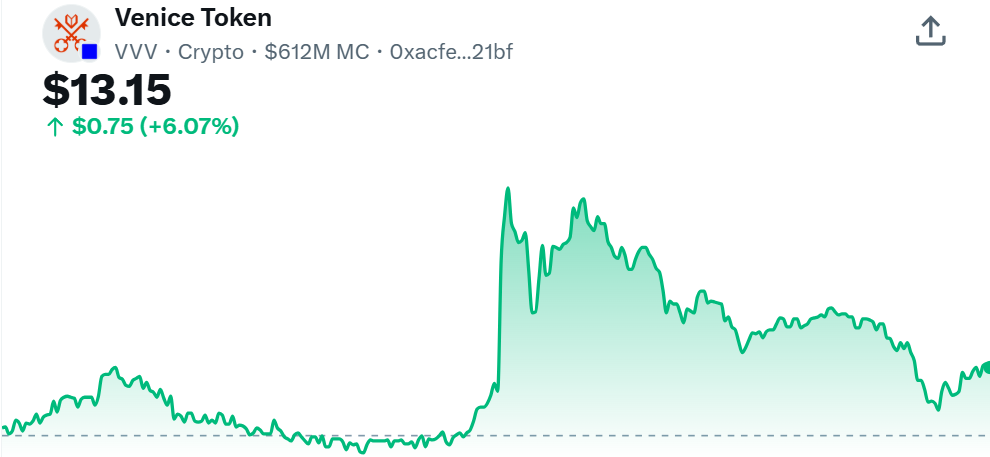
Venice Token rose 6% on Wednesday. Source: X

AI privacy concerns in spotlight 

The capital raise comes amid mounting concerns over user privacy when using AI models. 

Earlier this year, lawyers told Cointelegraph that a user consulting an AI for legal matters could have their chat logs used against them in court. 

Related: AI’s power crunch turns Bitcoin miners’ grid access into an asset

In February, Ethereum Foundation AI lead Davide Crapis and Ethereum co-founder Vitalik Buterin proposed a way to use zero-knowledge proofs and other methods to ensure that a user’s interactions with large language models are private. 

Conversations about privacy when using AI were stirred again in May, when a proposed class action was filed in California federal court accusing OpenAI of disclosing private ChatGPT user data to Google and Meta. 

The complaint alleged that OpenAI embedded Meta Pixel and Google Analytics into the ChatGPT.com website, so that when a user sends a query, the website allegedly sends duplicate data to Meta and Google alongside advertising cookies and personally identifiable information, which is then used to target advertisements to the user. 

Magazine: Bitcoin slides to $58K, XRP hits $1 but onchain data promising: Market Moves

Read the full article here

Fact Checker

Verify the accuracy of this article using AI-powered analysis and real-time sources.

Get Your Fact Check Report

Enter your email to receive detailed fact-checking analysis

5 free reports remaining

Continue with Full Access

You've used your 5 free reports. Sign up for unlimited access!

Already have an account? Sign in here

Share. Facebook Twitter Pinterest LinkedIn Tumblr Email Telegram Copy Link
News Room
  • Website
  • Facebook
  • X (Twitter)
  • Instagram
  • LinkedIn

The FSNN News Room is the voice of our in-house journalists, editors, and researchers. We deliver timely, unbiased reporting at the crossroads of finance, cryptocurrency, and global politics, providing clear, fact-driven analysis free from agendas.

Related Articles

Cryptocurrency & Free Speech Finance

Bitcoin tops $77,000 as best week since 2023 pulls altcoins along for the ride

58 minutes ago
Cryptocurrency & Free Speech Finance

Coldcard Security Upgrade Strengthens Seed Phrase Generation

1 hour ago
Cryptocurrency & Free Speech Finance

Binance Opens the Door to AI Agents That Can Trade Crypto for You

1 hour ago
Cryptocurrency & Free Speech Finance

Treasury's latest measure isn't QE or YCC. Still, bitcoin is skyrocketing. Here's why.

2 hours ago
Cryptocurrency & Free Speech Finance

Bitcoin Passing $75,400 Puts Strategy BTC Treasury Back In Profit

2 hours ago
Cryptocurrency & Free Speech Finance

Strategy sits on $1.4 billion profit on bitcoin holdings as price surges

3 hours ago
Add A Comment

Comments are closed.

Editors Picks

Bitcoin tops $77,000 as best week since 2023 pulls altcoins along for the ride

58 minutes ago

Coldcard Security Upgrade Strengthens Seed Phrase Generation

1 hour ago

Binance Opens the Door to AI Agents That Can Trade Crypto for You

1 hour ago

CPJ joins call to extend UN fact-finding mission on Sudan

2 hours ago
Latest Posts

Reporting in Somalia is becoming a much more dangerous proposition. Photo: UNSomalia/Ilyas Ahmed “Do you know that we can kill you? To us, your life is worth less than a cigarette.” These are the words with which operatives from Somalia’s National Intelligence and Security Agency (NISA) threatened freelance journalist Mohamed Bulbul, days after he co-authored a news report for UK news outlet The Guardian about the prosecution of activist Sadia Moalim Ali. Two days after the article ran in June 2026, Bulbul was having dinner with two fellow journalists at a restaurant in Mogadishu’s Zoobe area when armed men wearing black masks entered the establishment. “They walked straight towards our table [shouting] ‘Stand up! Stand up!’” Bulbul told Index. The masked men beat all three journalists before they dragged him outside, placed a bag over his head and forced him into a vehicle.  After being moved between two police stations and the offices of the regional police commissioner, Bulbul was interrogated by NISA officers about the article. “They asked me why I had published it.” He was then, he said, given three choices: “Work with us and take money, leave the country, or if you refuse both, we will kill you.” Bulbul fled Somalia and is now in an undisclosed safe location. “Saving my own life become my priority,” he said. “I can no longer spend time with my parents or my children.” Bulbul’s experience is not unique. Across Somalia, journalists and press freedom advocates say that intelligence and security agencies are intimidating, detaining and otherwise silencing reporters. Recent cases in Mogadishu and Puntland state indicate the state’s growing reliance on intelligence agencies and extra-legal actions, rather than the police and the courts, to deal with critical journalism. On 2 July, journalist Suways Jama Mohamed was arrested outside her home in Garowe, Puntland. Suways, founder of Suways Media, a Facebook-based news platform covering social issues, was detained after the platform published a 15-second video showing armed militia operating in her neighbourhood. She was held in Puntland’s Garowe Central Prison for 13 days before being released on bail on 15 July. Mohamed has been charged with spreading false information, defamation, insulting public officials and disturbing public order. If convicted, she could face up to three years in prison. Qareen Abdiweli, Suways’ lawyer, has challenged both the legal basis of the charges and the court’s jurisdiction. “A journalist cannot be prosecuted under the Penal Code for acts related to the exercise of their profession,” Abdiweli told RSF. Suways’ defence team have filed a motion asking for the case be referred to the Puntland Media Council, the media regulatory body. The case is pending. Less than two weeks after Suways’ arrest, Mohamed Jama Mohamad, an independent journalist who had previously worked for private television channel SBC TV, was also detained in Puntland state. Mohamed had been reporting on business closures in the city of Bosaso, following an increase in port taxes. Mohamed was taking photographs of the closed market when he noticed several men following him. “They looked suspicious and kept talking on their phones while following me everywhere I went.” Moments later, a vehicle pulled to a halt beside him. “[The people in the vehicle] weren’t police officers,” Mohamed told Source. “Their uniform [sic] looked more like military uniforms.”  Mohamed was forced into the vehicle without explanation, blindfolded and then taken to a detention facility run by the Puntland Intelligence Service (PISA). Mohamed said that he was held for four days without seeing a lawyer or being arraigned before a court.  “I had simply been taken from the marketplace. No warrant. No judge. No lawyer.” According to the Somali Journalists Syndicate (SJS), these arrests are indicative of the government’s wish to suppress free expression. In June, SJS reported the abduction by NISA agents of journalist Mascuud Warsame, founder of Xogbile TV, in Mogadishu. Warsame was released, without charge, after 39 days in detention. For media organisations, these incidents are becoming increasingly familiar. “Compared with previous years, the overall pattern of violations remains consistent,” Abdalle Ahmed Mumin, Secretary General of the Somali Journalists Syndicate, told Index. “But this year has seen a sharp increase in arbitrary arrests [and] politically motivated detentions, particularly during the ongoing political and constitutional crisis in Somalia.” Somalia’s federal government is currently advancing amendments to the country’s constitution despite objections from two federal states. This may have implications for the balance of power between the federal states, and critics fear that it will allow incumbent president Hassan Sheikh Mohamud to extend his current term of office. Mumin said that while journalists in Somalia have long been obliged to deal with intimidation and violence, the first seven months of 2026 have seen a spike in the use of prolonged detention without charge, alongside more overt interventions by Somalia’s intelligence agencies. Security analyst Samira Gaid told Index that Somalia’s security institutions are increasingly being used as a tool to suppress journalism, activists and anyone courageous enough to challenge the government.  “The role of the media is to hold those in public office accountable,” she said.  “Yet journalists are being targeted simply because they reported information that the government did not want the public to know.” International partners, according to Gaid, invested heavily in building Somalia’s security institutions – a key priority following the end of the country’s destructive civil war. “Those institutions are now being used in ways that go beyond the law.”  Gaid said, noting that NISA was created to protect national security rather than investigate journalists or detain civilians engaged in legitimate reporting. The journalists interviewed for this article all described strikingly similar experiences – arrests without warrants, detention by intelligence agencies, questioning over their reporting. For Somalia’s independent media, the message is becoming increasingly clear; reporting on anything deemed sensitive by the authorities may carry consequences extending far beyond the newsroom. READ MORE

2 hours ago

Treasury's latest measure isn't QE or YCC. Still, bitcoin is skyrocketing. Here's why.

2 hours ago

Bitcoin Passing $75,400 Puts Strategy BTC Treasury Back In Profit

2 hours ago

Subscribe to News

Get the latest news and updates directly to your inbox.

At FSNN – Free Speech News Network, we deliver unfiltered reporting and in-depth analysis on the stories that matter most. From breaking headlines to global perspectives, our mission is to keep you informed, empowered, and connected.

FSNN.net is owned and operated by GlobalBoost Media
, an independent media organization dedicated to advancing transparency, free expression, and factual journalism across the digital landscape.

Facebook X (Twitter) Discord Telegram
Latest News

Review: A Novel Capturing the Cruelty of Mass Incarceration

38 minutes ago

Bitcoin tops $77,000 as best week since 2023 pulls altcoins along for the ride

58 minutes ago

Coldcard Security Upgrade Strengthens Seed Phrase Generation

1 hour ago

Subscribe to Updates

Get the latest news and updates directly to your inbox.

© 2026 GlobalBoost Media. All Rights Reserved.
  • Privacy Policy
  • Terms of Service
  • Our Authors
  • Contact

Type above and press Enter to search. Press Esc to cancel.

🍪

Cookies

We and our selected partners wish to use cookies to collect information about you for functional purposes and statistical marketing. You may not give us your consent for certain purposes by selecting an option and you can withdraw your consent at any time via the cookie icon.

Cookie Preferences

Manage Cookies

Cookies are small text that can be used by websites to make the user experience more efficient. The law states that we may store cookies on your device if they are strictly necessary for the operation of this site. For all other types of cookies, we need your permission. This site uses various types of cookies. Some cookies are placed by third party services that appear on our pages.

Your permission applies to the following domains:

  • https://fsnn.net
Necessary
Necessary cookies help make a website usable by enabling basic functions like page navigation and access to secure areas of the website. The website cannot function properly without these cookies.
Statistic
Statistic cookies help website owners to understand how visitors interact with websites by collecting and reporting information anonymously.
Preferences
Preference cookies enable a website to remember information that changes the way the website behaves or looks, like your preferred language or the region that you are in.
Marketing
Marketing cookies are used to track visitors across websites. The intention is to display ads that are relevant and engaging for the individual user and thereby more valuable for publishers and third party advertisers.