Close Menu
FSNN | Free Speech News NetworkFSNN | Free Speech News Network
  • Home
  • News
    • Politics
    • Legal & Courts
    • Tech & Big Tech
    • Campus & Education
    • Media & Culture
    • Global Free Speech
  • Opinions
    • Debates
  • Video/Live
  • Community
  • Freedom Index
  • About
    • Mission
    • Contact
    • Support
Trending

Trump’s Illegal Tariffs Are Finally Being Refunded. Will You Get Any of the Money?

27 minutes ago

Bitcoin-holder Metaplanet raises $50 million in zero-interest bonds to buy more BTC

46 minutes ago

US DOJ strike force 'restrains' $701M in crypto in ongoing scam crackdown

47 minutes ago
Facebook X (Twitter) Instagram
Facebook X (Twitter) Discord Telegram
FSNN | Free Speech News NetworkFSNN | Free Speech News Network
Market Data Newsletter
Friday, April 24
  • Home
  • News
    • Politics
    • Legal & Courts
    • Tech & Big Tech
    • Campus & Education
    • Media & Culture
    • Global Free Speech
  • Opinions
    • Debates
  • Video/Live
  • Community
  • Freedom Index
  • About
    • Mission
    • Contact
    • Support
FSNN | Free Speech News NetworkFSNN | Free Speech News Network
Home»News»Campus & Education»University of North Texas cancels art show — then power-washes protests
Campus & Education

University of North Texas cancels art show — then power-washes protests

News RoomBy News Room15 hours agoNo Comments5 Mins Read330 Views
Share Facebook Twitter Pinterest Copy Link LinkedIn Tumblr Email VKontakte Telegram
University of North Texas cancels art show — then power-washes protests
Share
Facebook Twitter Pinterest Email Copy Link

Listen to the article

0:00
0:00

Key Takeaways

Playback Speed

Select a Voice

East Dallas in the 90s was riddled with crime and turf wars. Growing up there, Victor Quiñonez found solace in his art. He was only four the first time his father, a day laborer, got deported back to Mexico. It happened several times during his childhood, so immigration law became a theme in his family life — and later, in his art.

It turns out that he was good at art, too. His talents got him into Booker T. Washington High School for the Performing and Visual Arts. Then he got a full-ride scholarship to the School of the Museum of Fine Arts at Tufts University. Now, he’s a celebrated artist, going by the tag “Marka27,” and exhibits his work across the country.

This past February, Quiñonez had a scheduled installation titled Ni de Aquí, Ni de Allá (Not From Here, Not From There) at the University of North Texas. The exhibit features giant resin paletas (Mexican popsicles) with seals that read “U.S. Department of Stolen Land Security” and “U.S. Inhumane and Cruelty Enforcement.”

Art is under attack at University of North Texas

The University of North Texas has made a habit of pulling art from public view in recent years.


Read More

But fearing political repercussions, UNT Dean Karen Hutzel canceled the exhibition. Worse, under the cloak of night, school officials later removed student sidewalk chalk messages, posters, and other materials protesting the exhibit’s cancellation. While school administrators can regulate the time, place, and manner of such protests on campus, they must do so in a viewpoint-neutral way — and all the available information suggests that the school specifically singled out these protest messages for erasure.

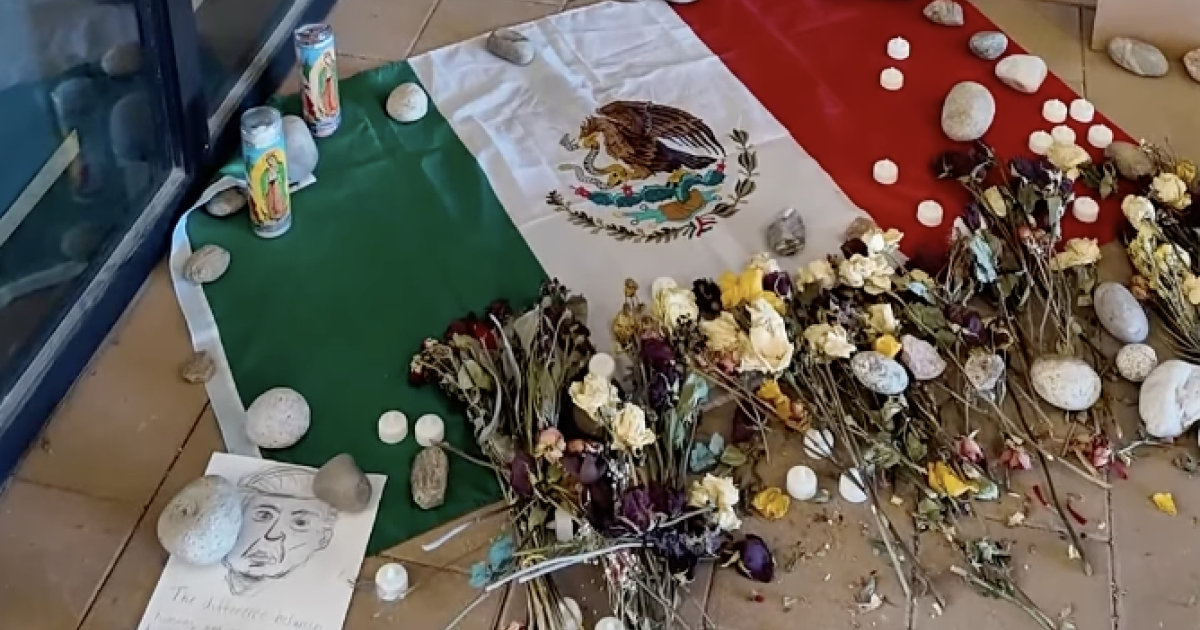
The student group NOISE claims its messages, art, and flowers in honor of the exhibit were “violently taken and ripped apart in the dark of the night” at the direction of school officials. The staff who were responsible for the removal said they were told to do so by school lawyers — and that it was not part of their regular job duties. 

UNT has the right to clear protest materials that obstruct walkways or prevent other normal uses of its space. But chalk and posters generally don’t do that, and the off-hours power-washing suggests the school might not be cleaning up campus so much as silencing its critics. 

The Supreme Court has been extremely clear about such efforts. It has ruled that targeting expression based on its viewpoint is an “egregious form of content discrimination,” adding that government actors (including public universities) must “abstain from regulating speech when the specific motivating ideology or the opinion or perspective of the speaker” motivates the restriction. In addition, the Court said, when regulations or authorities target “particular views taken by speakers,” the violation “is all the more blatant.”

Is that what happened here? Consider: UNT policy explicitly says “chalking on University sidewalks is permissible.” And while the school does prohibit chalking on vertical structures like walls and covered areas such as atriums, video footage shows that at least some of the chalking removed at the behest of administrators  was on university sidewalk space outside the College of Visual Arts & Design building, where school policy explicitly allows chalking. Even when it comes to chalking in restricted areas, staff comments suggest the school normally just lets the elements wash the messages away. 

As happens so often in censorship cases, UNT’s attempts to silence dissent have only fanned the flames. The National Coalition Against Censorship and the ACLU of Texas rightly called out the school with a not-so-subtle mobile billboard truck earlier this month. Around the same time, the Dallas Observer ran the story, “An Act of Censorship Leaves UNT Facing an Identity Crisis.”

Texas is censoring its faculty at industrial scale. And it’s ground zero for America’s latest crisis in artistic freedom. The Lone Star State saw a police raid seize art off the walls from a museum last year, recalling the hysteria of the Mapplethorpe persecutions from the 1980s. But the students at UNT who staged a protest funeral for artistic freedom in Dallas this spring aren’t going to let freedom of expression die in Texas. UNT graduating arts students are protesting the school’s art censorship by boycotting the traditional on-campus “Senior Exit Show” this April in favor of an off-campus alternative. Their protest chalkings were clearly protected by the First Amendment, too.

University of North Texas: Administrators Shutter Art Exhibit Over Anti-ICE Messaging, Restrict Student and Faculty Expression

FIRE urges University of North Texas to recommit to free speech, academic freedom, and artistic expression on its campus.


Read More

Among the messages posted by students were “SILENCING IS POLICY” and “STOP SILENCING STUDENTS YOU ARE MEANT TO PROTECT.” UNT’s lack of self-awareness in silencing such messages is stunning.

UNT is a public university, and following the First Amendment is not optional. It must stop targeting student criticisms for erasure. On March 4, FIRE wrote to UNT regarding its decision to shutter Quiñonez’s art exhibition and its threats of possible future censorship of faculty and students whose expression falls outside the university’s comfort zone. Now, just one month later, it appears some of those threats — namely silencing student expression on themes related to the canceled exhibition — have materialized. UNT must cease its war on free expression on campus and recommit to the First Amendment — because the First Amendment means nothing if administrators can make disfavored speech disappear overnight.


Read the full article here

Fact Checker

Verify the accuracy of this article using AI-powered analysis and real-time sources.

Get Your Fact Check Report

Enter your email to receive detailed fact-checking analysis

5 free reports remaining

Continue with Full Access

You've used your 5 free reports. Sign up for unlimited access!

Already have an account? Sign in here

#CampusSpeech #ConstitutionalRights #FreeExpression #MediaFreedom #SpeechCodes #UniversityLife Art cancels North powerwashes protests show Texas University
Share. Facebook Twitter Pinterest LinkedIn Tumblr Email Telegram Copy Link
News Room
  • Website
  • Facebook
  • X (Twitter)
  • Instagram
  • LinkedIn

The FSNN News Room is the voice of our in-house journalists, editors, and researchers. We deliver timely, unbiased reporting at the crossroads of finance, cryptocurrency, and global politics, providing clear, fact-driven analysis free from agendas.

Related Articles

Campus & Education

The fight for privacy and free speech in the surveillance age

16 hours ago
Campus & Education

California lawmakers threaten free speech regarding immigration groups

2 days ago
Campus & Education

DOJ investigation into University of Washington over off-campus bake sale is a recipe for trouble

2 days ago
Campus & Education

The critics are wrong about Tennessee’s Charlie Kirk Act. Here’s why.

2 days ago
AI & Censorship

Copyright and DMCA Best Practices for Fediverse Operators

3 days ago
AI & Censorship

Palantir Has a Human Rights Policy. Its ICE Work Tells a Different Story

3 days ago
Add A Comment
Leave A Reply Cancel Reply

Editors Picks

Bitcoin-holder Metaplanet raises $50 million in zero-interest bonds to buy more BTC

46 minutes ago

US DOJ strike force 'restrains' $701M in crypto in ongoing scam crackdown

47 minutes ago

Anthropic Using ‘Fear-Based Marketing’ to Promote Claude Mythos: Sam Altman

53 minutes ago

Brickbat: Who Are You

1 hour ago
Latest Posts

A soldier stands guard by a charred vehicle after it was set on fire, in Cointzio, Mexico, Feb. 22, 2026, following the death of the leader of the Jalisco New Generation Cartel, Nemesio Oseguera, known as “El Mencho.” Photo by: AP Photo/Armando Solis, File When I heard the horrifying news of tourists being shot at the Teotihuacán pyramids in Mexico (one Canadian woman was killed), I was struck by a detail – the number of people who wished to remain anonymous when interviewed by the media. I probably shouldn’t have been surprised. For years Mexico was the deadliest place to be a journalist – the media caught between murderous cartels and corrupt officials. The country no longer occupies the number one spot (that goes to Gaza where 53 press members were killed in 2025), but it’s still an incredibly dangerous place to be a reporter. Between October 2024 and October 2025 10 journalists were killed. All of which impacts people’s willingness to go on the record. The journalists’ killings are part of a wider context of extreme violence in Mexico, laid bare two months ago when masked gunmen from the Jalisco New Generation Cartel went on a rampage to avenge the killing of their leader “El Mencho” by security forces. Yes, the Teotihuacán pyramids’ attack seems to have been carried out by a lone assailant with no apparent links to cartels. But violence begets violence – the backdrop counts. The current Mexican president, Claudia Sheinbaum, has condemned the attack on tourists and called for a thorough investigation. Will that happen in a meaningful way? The jury is out. Sheinbaum is not her predecessor when it comes to freedom of expression (Andrés Manuel López Obrador was actually crowned our Tyrant of the Year in 2022 due to his hostility to the media; Sheinbaum is slightly better here). Both leaders though have in different ways struggled to fully confront and discuss the country’s violence. Sheinbaum says the problem is getting better, citing declining murder rates. Others dispute this, pointing to things like the growing numbers of forced disappearances, which don’t count as murder. Obrador did the same. He proclaimed femicide figures had dropped under his leadership, except he narrowed the reporting period to the lowest point, ignoring the time when the numbers rose under him. Anyone who highlighted this was derided as an enemy of Mexico (as we reported in 2023). It’s easy to understand why both leaders would want to downplay the violence – it’s hardly a great look politically, nor does it position Mexico as a “top holiday destination”. And with Mexico hosting the World Cup in June, it’s an extra-sensitive moment. Sadly such tactics don’t stop the realities on the ground. The opposite in fact – they feed into the climate of impunity, where ordinary people are so intimidated they are reluctant to bear witness, even to random attacks, for fear of becoming victims of violence themselves. READ MORE

2 hours ago

BTC ETFs pull $2 billion in 8 days while short-term holders sell

2 hours ago

Trump to Appear at His Memecoin Event on Saturday

2 hours ago

Subscribe to News

Get the latest news and updates directly to your inbox.

At FSNN – Free Speech News Network, we deliver unfiltered reporting and in-depth analysis on the stories that matter most. From breaking headlines to global perspectives, our mission is to keep you informed, empowered, and connected.

FSNN.net is owned and operated by GlobalBoost Media
, an independent media organization dedicated to advancing transparency, free expression, and factual journalism across the digital landscape.

Facebook X (Twitter) Discord Telegram
Latest News

Trump’s Illegal Tariffs Are Finally Being Refunded. Will You Get Any of the Money?

27 minutes ago

Bitcoin-holder Metaplanet raises $50 million in zero-interest bonds to buy more BTC

46 minutes ago

US DOJ strike force 'restrains' $701M in crypto in ongoing scam crackdown

47 minutes ago

Subscribe to Updates

Get the latest news and updates directly to your inbox.

© 2026 GlobalBoost Media. All Rights Reserved.
  • Privacy Policy
  • Terms of Service
  • Our Authors
  • Contact

Type above and press Enter to search. Press Esc to cancel.

🍪

Cookies

We and our selected partners wish to use cookies to collect information about you for functional purposes and statistical marketing. You may not give us your consent for certain purposes by selecting an option and you can withdraw your consent at any time via the cookie icon.

Cookie Preferences

Manage Cookies

Cookies are small text that can be used by websites to make the user experience more efficient. The law states that we may store cookies on your device if they are strictly necessary for the operation of this site. For all other types of cookies, we need your permission. This site uses various types of cookies. Some cookies are placed by third party services that appear on our pages.

Your permission applies to the following domains:

  • https://fsnn.net
Necessary
Necessary cookies help make a website usable by enabling basic functions like page navigation and access to secure areas of the website. The website cannot function properly without these cookies.
Statistic
Statistic cookies help website owners to understand how visitors interact with websites by collecting and reporting information anonymously.
Preferences
Preference cookies enable a website to remember information that changes the way the website behaves or looks, like your preferred language or the region that you are in.
Marketing
Marketing cookies are used to track visitors across websites. The intention is to display ads that are relevant and engaging for the individual user and thereby more valuable for publishers and third party advertisers.