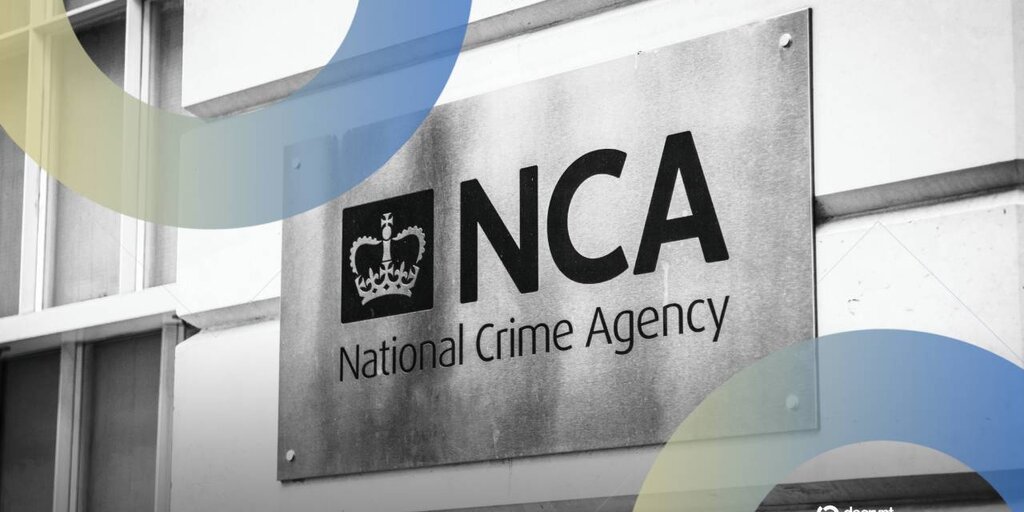
The NECC says criminals are making innovative use of crypto products to move illicit value at scale.
Cryptoassets rank third among nine priorities the agency agreed with the FCA and the Treasury.
A RUSI paper from a roundtable the NECC convened argues against banning crypto privacy tools.
Criminals are making “innovative use of crypto asset products to evade detection and move illicit value at scale,” Britain’s National Economic Crime Centre, a National Crime Agency unit coordinating the country’s response to economic crime, said in its annual report, published this week.
The line sits in a threat assessment describing laundering networks proliferating across borders and combining “novel and traditional” methods, moving money through the licit and illicit systems at once. Many organized crime groups no longer launder their own proceeds, the agency says, outsourcing it to dedicated networks for a fee.
The same passage puts AI beside crypto, citing synthetic identities and process automation used against banks.
Myriad: BTC next move: Pump to $84K or Dump to $55K? Click to make your prediction.
A proactive crypto capability
Cryptoassets now rank third among nine economic crime priorities the NECC agreed with the Financial Conduct Authority, the Home Office and the Treasury and published in July 2025. The list steers where regulated firms point their compliance effort, placing crypto above criminal cash and money mules.
The agency says it is developing “a more proactive and intelligence-led crypto capability to inform our response to cross-cutting priorities,” language pointing away from working referrals and toward generating its own targets. It gives no detail on what that means in practice.
Operation Atlantic, a week-long sprint at NCA headquarters with the U.S. Secret Service, Coinbase, Binance, Kraken and Tether, identified 20,000 approval-phishing victims and froze $12 million in March.
Operation Destabilise, the case against Russian-speaking networks converting street cash into crypto, has reached 129 arrests and more than £25 million seized in the UK, one arrest more than the update given in November.
The agency now says it will expand its Operation Destabilise approach to other “high harm money laundering networks which pose the greatest illicit finance risk to the UK.”
The report also lists, among its academic work, a report on Privacy-Enhancing Technologies in Crypto Industry published by the Royal United Services Institute.
That paper, drawn from a July 2025 roundtable the NECC itself hosted, argued against a crackdown.
Participants said “several times” that privacy tools should not be banned, on the grounds that prohibition would push illicit actors onto unregulated services and leave investigators with fewer firms to ask for information. Its author, RUSI associate fellow Allison Owen, told Decrypt that building trust through compliance features “will ultimately expand the use of the technology.”
Daily Debrief Newsletter
Start every day with the top news stories right now, plus original features, a podcast, videos and more.
The FSNN News Room is the voice of our in-house journalists, editors, and researchers. We deliver timely, unbiased reporting at the crossroads of finance, cryptocurrency, and global politics, providing clear, fact-driven analysis free from agendas.
We and our selected partners wish to use cookies to collect information about you for functional purposes and statistical marketing. You may not give us your consent for certain purposes by selecting an option and you can withdraw your consent at any time via the cookie icon.
Cookies are small text that can be used by websites to make the user experience more efficient. The law states that we may store cookies on your device if they are strictly necessary for the operation of this site. For all other types of cookies, we need your permission. This site uses various types of cookies. Some cookies are placed by third party services that appear on our pages.
Your permission applies to the following domains:
https://fsnn.net
Necessary
Necessary cookies help make a website usable by enabling basic functions like page navigation and access to secure areas of the website. The website cannot function properly without these cookies.
Statistic
Statistic cookies help website owners to understand how visitors interact with websites by collecting and reporting information anonymously.
Preferences
Preference cookies enable a website to remember information that changes the way the website behaves or looks, like your preferred language or the region that you are in.
Marketing
Marketing cookies are used to track visitors across websites. The intention is to display ads that are relevant and engaging for the individual user and thereby more valuable for publishers and third party advertisers.


 Freedom Index