

 Freedom Index
Listen to the article
For years, a major threat to America’s national security has marched its way through halftime shows, band camps, and concert halls—undermining the nation’s strategic ska supply and jeopardizing the domestic reserve of polka.
Finally, the Trump administration is taking action.
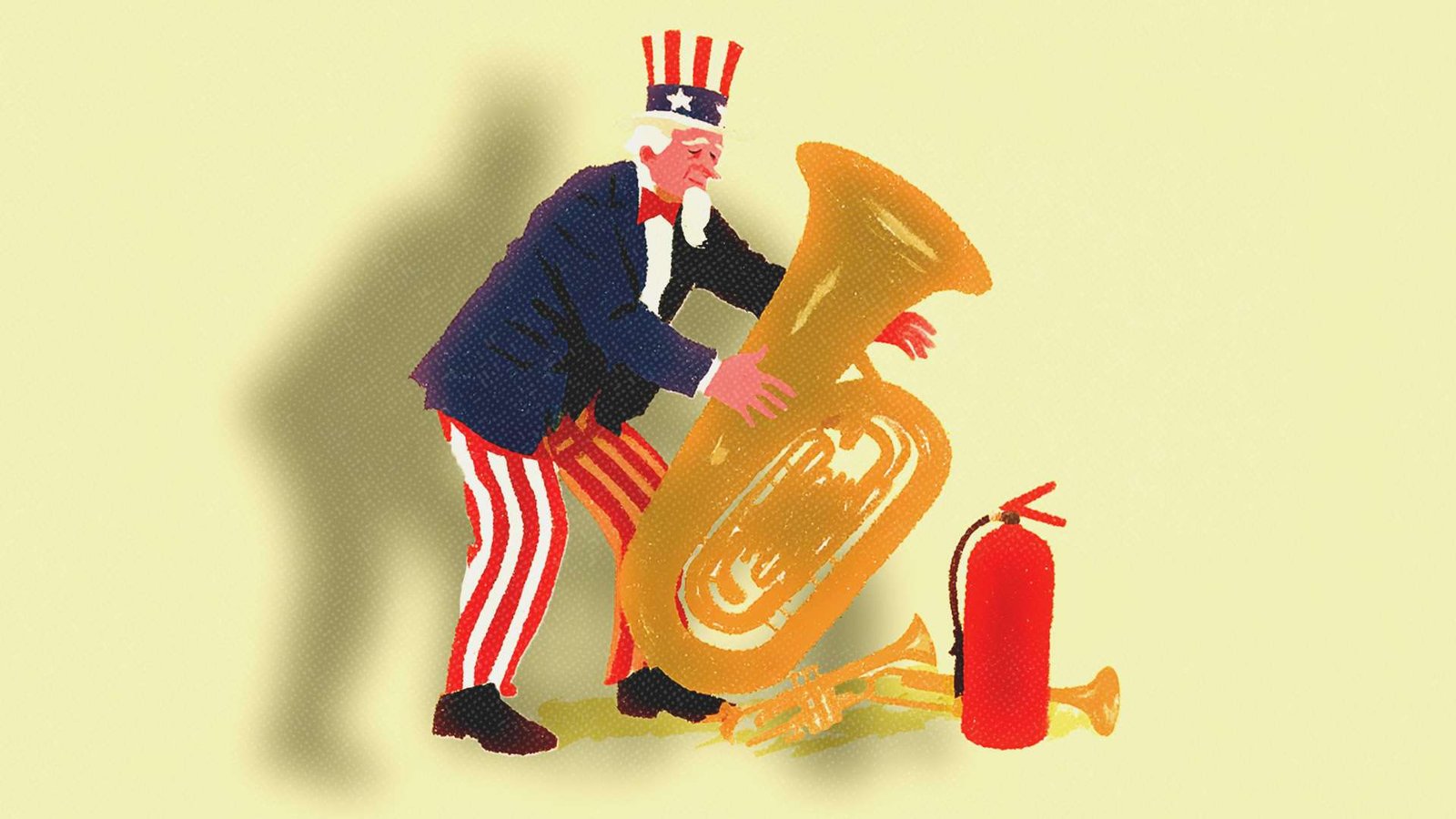
Brass instruments and their parts could soon be subject to additional tariffs as part of a proposal published this week by the Department of Commerce. Those new 25 percent import taxes would be an extension of the tariffs on steel, aluminum, and copper that the Trump administration has imposed under the guise of protecting American national security.
The Commerce Department is seeking to extend those tariffs to a variety of products made from those three materials. The six-page document published this week invokes “national security” nine times as it explains why higher tariffs should be charged on imported construction equipment, safes, fire extinguishers, and several other items.
Obviously, all those products are serious threats to American security, and deserve to be treated as such. But none present the sort of blaring, resonant risk posed by “brass-wind musical instruments and parts and accessories thereof,” which are also included in the tariff plan.
The only people who could possibly object to this idea are just shilling for Big Tuba, right?
“It’s not immediately clear why trumpets threaten to impair U.S. security,” Bryan Riley, director of the free trade initiative at the National Taxpayers Union Foundation, told Reason. “Is the Pentagon concerned that our adversaries plan to drop them on us from planes? And how exactly are trombones a security threat, but not saxophones?”
OK, Riley might have a point. Tariffs on musical instruments don’t actually make sense—and the Trump administration should know that, because it has already hiked tariffs on most instruments, with negative consequences.
The effective tariff rate on all musical instruments hit 16.6 percent during the first quarter of 2026, according to the Peterson Institute for International Economics (PIIE). That’s three times higher than the effective rate in 2024.
Those higher taxes have caused Americans to buy fewer instruments. Musical instrument imports are down 20 percent since 2024, according to PIIE’s analysis of federal trade data.
But, hey, fewer imports ought to be good news for American makers of musical instruments, right? That’s the whole theory behind using tariffs: make imported goods more expensive to protect domestic suppliers.
Unfortunately, that promise seems to be falling flat. Conn Selmer, the Indiana-based company that has long been one of the world’s leading producers of marching band instruments, announced in January that it would be closing its French horn factory in Ohio and offshoring those production lines.
The bottom line: “Higher tariffs have raised prices and suppressed imports—particularly of instruments for beginners—without boosting domestic production,” explained Cullen Hendrix, a senior fellow for PIIE, in May.
Higher tariffs on copper, which is a major component of making brass, have made it more costly for American instrument manufacturers to build everything from flugelhorns to sousaphones. The same is true across the rest of the economy because more than half of all American imports are raw materials or intermediate parts.
If the Trump administration wants to push the economy into a higher tempo, it should eliminate those tariffs—as it has done for farm equipment, food, and other items. Instead, the White House is putting more tariffs on finished instruments and asking American schools, parents, and musicians to pick up the tab.
That’s an idea that’s seriously out of tune at a time when Americans are trumpeting their worries about affordability.
And doing all this under the guise of “national security” is just nonsense. A tuba is not a semiconductor, and there is no indication that the military is running low on bugles. If the White House is going to use its national security tariff powers in such broad and bizarre ways, Congress ought to take those powers away.
Read the full article here
Fact Checker
Verify the accuracy of this article using AI-powered analysis and real-time sources.