

 Freedom Index
Listen to the article
As the industry matures and borrows more pages out of TradiFi’s playbook, crypto projects are starting to adopt some of the behaviors of public companies.
The latest craze rocking cryptoville is token buybacks: using revenue to buy back your own token.
So far in 2026, crypto projects have spent about $640 million on the practice, up around 17% from the same period the year prior, and an order of magnitude more than the $366,000 spent in 2024. Hyperliquid and Pump.fun accounting for almost 90% of the current spend.
So what’s the sudden appeal?
Buybacks can create demand for a token, while burns can reduce the supply making each token more valuable. That dynamic can cause upward pressure on the token price.
It also gives holders a more tangible connection to the economic activity on the underlying protocol. Orest Gavryliak, chief legal officer at decentralized exchange aggregator 1inch, tells Magazine:
“When projects implement revenue-funded buybacks and burns, they typically have one of two objectives in mind: either to decrease the token supply in circulation or to demonstrate the rationale for investing in protocol revenues.”
Gavryliak says that telling users a project has “bought and burned tokens” is “much more straightforward” than explaining how governance rights work, how fees are set, or how the protocol is used.
Related: Pump.fun laid off workers before they received millions in PUMP tokens: Report
But there’s a flipside: every dollar a protocol spends buying its token is a dollar it could have spent hiring developers, expanding the business, strengthening its balance sheet or building the product.
So, as buybacks become one of crypto’s hottest tokenomics tools, are they actually good for the projects using them?
Why crypto projects are buying themselves
You might wonder if projects buying their own token is counterproductive. After all, projects typically sell tokens to raise funds to cover costs.
Almost, but with an important caveat. Using revenue generated to buy back tokens (and then to hold them or burn them) creates an implicit connection between the success of the protocol and the value of its token. That’s something crypto projects have long struggled with. As Max Shannon, senior research associate at Bitwise Europe, explains:
“Buybacks and burns remain an effective way to accrue value to tokenholders: they create a continuous bid in the open market for the token, directly tethering token success to the platform’s adoption.”
That marks a sea-change for an industry that has spent the past couple of years chasing narratives or speculating on the greater fool theory — users who bought Fartcoin or Peanut the Squirrel didn’t do so for their sound economic models.
Some protocols are taking the idea much further than others. Hyperliquid, for example, has used 99% of its revenue to buy back and burn HYPE and 50% of Pump.fun’s revenue goes toward buying and burning its token, with $446.65 million worth of PUMP already removed from circulation.
HYPE Burns. Source: Hyperliquid
DeFi infrastructure protocol Spark offers a slightly different model, acquiring over 143 million SPK through open-market buybacks funded by protocol surplus, according to co-founder and chief executive Sam MacPherson.
But those tokens were not burned, and instead remain in the Spark treasury to reward long-term participants in the ecosystem. MacPherson tells Magazine the point is not simply to reduce supply:
“Tokenholders should participate in the long-term economic success of the protocol, rather than simply receive a distribution every time it generates revenue.”
He says buybacks allow Spark to create that alignment while “retaining flexibility over how and when the acquired SPK is ultimately deployed,” allowing the protocol to make its token economically relevant rather than “a simple dividend mechanism.”
Token buybacks are also a highly tax effective way to return revenue to holders, because users don’t cop a hefty tax bill on dividends or rewards.
Is buying the token really the best use of the money?
While that all sounds perfectly rational, the bigger question is whether buying your own token is really the best use of a project’s funds?
Probably not in every case. MacPherson says:
“The question should be: what is the highest-value use of the next dollar of surplus?”
If a protocol can reinvest capital at attractive returns, he says, that can be “far more valuable” than simply distributing revenue as it arrives.
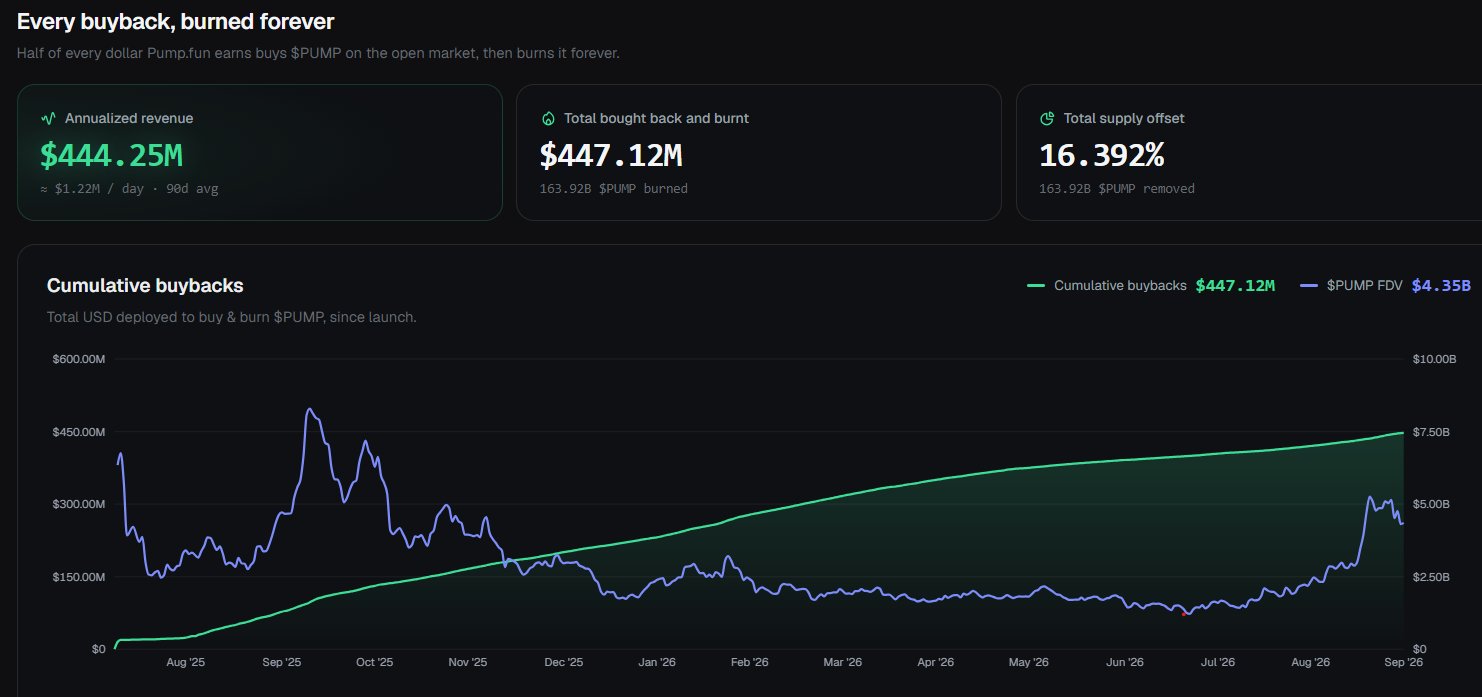
PUMP Burns. Source: Pump.fun
Buybacks can support token economics without actually improving the underlying business.
There is also no ironclad guarantee that buybacks will translate into higher token prices. Pump.fun has been aggressively buying and burning PUMP since July 2025, but the token is still hovering 50% below its September 2025 all-time high. UNI has also given back around half of the gains it made after Uniswap unveiled its UNIfication proposal in November 2025.
Related: Robinhood Chain nears $1B TVL as Uniswap drives liquidity: Standard Chartered
Shannon points out that “many factors” contributed to those price movements, so they don’t prove buybacks failed, but:
“They have prompted investors to debate whether these startup-like projects would be better served by reducing the share of revenue committed to buybacks and burns and reinvesting more in the team and the project itself.”
Investors should make a careful distinction between a buyback scheme that pumps prices, and a successful business model.
A sustainable protocol that generates genuine surplus may decide that buying its token is the best use of some of that money, but equally a project that’s limping along might simply attempt to buyback tokens to move the price. MacPherson notes:
“A buyback doesn’t make an unsustainable protocol sustainable.”
When a token starts looking like a stock
While token buybacks may superficially resemble share buyback program, that doesn’t mean tokens are becoming more like stocks.
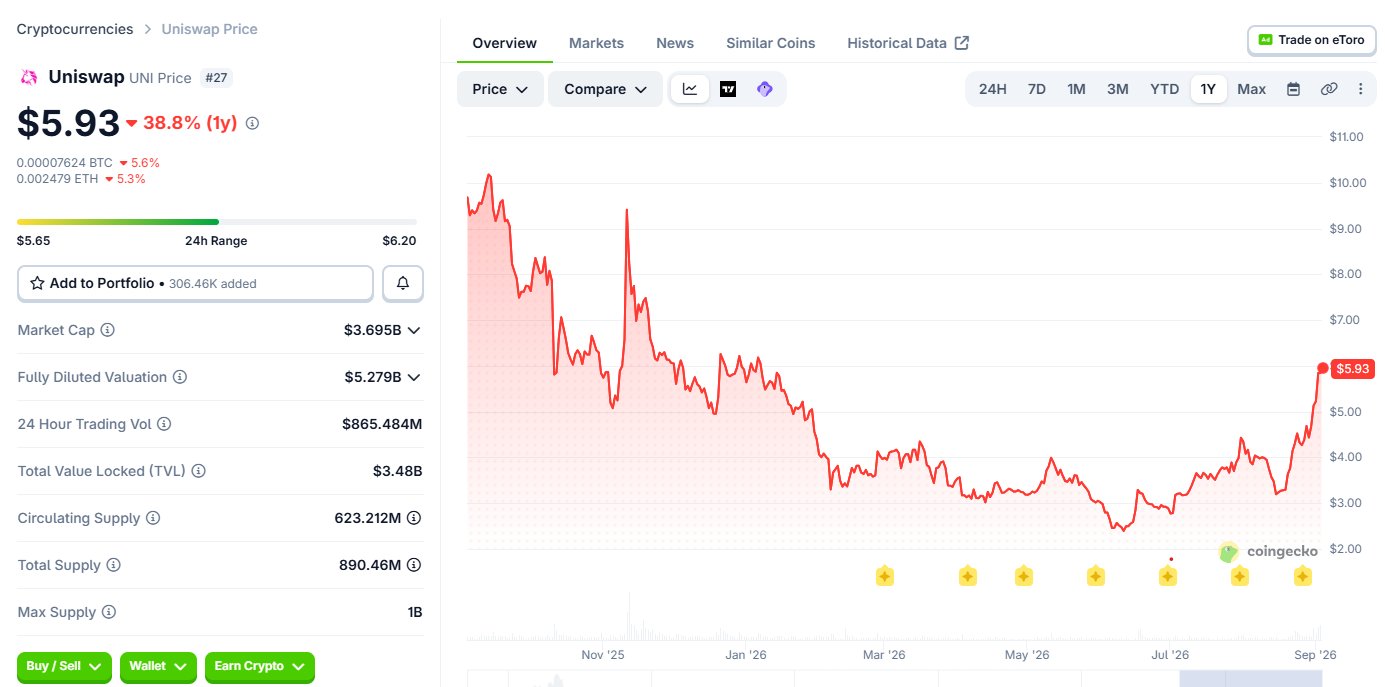
UNI is down around 50% since it started buybacks and burns. Source: Coingecko
A shareholder owns part of a company and may have voting rights, dividends or a claim on its residual assets. Tokenholders generally do not have those same legal rights, and Orest says that distinction is critical. “This is a market mechanism, not a legally enforceable entitlement,” he says.
MacPherson describes SPK as a form of “pseudo-equity” for an onchain protocol. While there isn’t a legal ownership structure in the traditional corporate sense, economically Spark is “trying to create many of the same characteristics: participation in governance, long-term alignment, and a mechanism through which those most committed to the protocol can benefit from its success.”
When buybacks start looking like dividends
But as crypto starts to emulate TradFi buybacks, storm clouds may be gathering on the horizon, as regulators consider what those mechanisms actually amount to.
While the Digital Asset Market Clarity (CLARITY) Act of 2025 remains a draft and should not be treated as settled law, Gavryliak says its proposed framework highlights the key question of where a token’s value comes from:
“If it stems from the functionality of the network itself, then the asset looks like a commodity. But if the value is based on the efforts of the project’s team in matters of shipping, marketing, or providing returns to token holders, then it is already a security. In the end, don’t put the clothes of a stock on the token and expect it to be a commodity.”
At the end of the day, crypto investors want to know what sits underneath a token — revenue, users, sustainable economics — and some credible way for the token to benefit from those things.
While buybacks may offer a solution, they can also be just another piece of financial engineering that makes a token look more valuable than it actually is without fixing the issues underneath, as Gavryliak points out:
“If the buybacks stopped, would there still be a reason to hold the token? If the answer is no, the problem runs deeper than tokenomics.”
Magazine: Mystery surrounds why an OG burned $1M in Bitcoin
Cointelegraph publishes long-form journalism, analysis and narrative reporting produced by Cointelegraph’s in-house editorial team with subject-matter expertise. All articles are edited and reviewed by Cointelegraph editors in line with our editorial standards. Some articles contain affiliate links, from which Cointelegraph may earn a commission. These relationships do not influence which products we review or our editorial conclusions. Content published in here does not constitute financial, legal or investment advice. Readers should conduct their own research and consult qualified professionals where appropriate. Cointelegraph maintains full editorial independence.
Read the full article here
Fact Checker
Verify the accuracy of this article using AI-powered analysis and real-time sources.