Close Menu
FSNN | Free Speech News NetworkFSNN | Free Speech News Network
  • Home
  • News
    • Politics
    • Legal & Courts
    • Tech & Big Tech
    • Campus & Education
    • Media & Culture
    • Global Free Speech
  • Opinions
    • Debates
  • Video/Live
  • Community
  • Freedom Index
  • About
    • Mission
    • Contact
    • Support
Trending

Today in Supreme Court History: October 14, 1911

34 minutes ago

They Walked in Line

53 minutes ago

BlackRock’s Larry Fink names a U.S. recession trigger and its tied to AI

56 minutes ago
Facebook X (Twitter) Instagram
Facebook X (Twitter) Discord Telegram
FSNN | Free Speech News NetworkFSNN | Free Speech News Network
Market Data Newsletter
Thursday, October 15
  • Home
  • News
    • Politics
    • Legal & Courts
    • Tech & Big Tech
    • Campus & Education
    • Media & Culture
    • Global Free Speech
  • Opinions
    • Debates
  • Video/Live
  • Community
  • Freedom Index
  • About
    • Mission
    • Contact
    • Support
FSNN | Free Speech News NetworkFSNN | Free Speech News Network
Home»Opinions»Debates»They Walked in Line
Debates

They Walked in Line

News RoomBy News Room53 minutes agoNo Comments4 Mins Read1 Views
Share Facebook Twitter Pinterest Copy Link LinkedIn Tumblr Email VKontakte Telegram
They Walked in Line
Share
Facebook Twitter Pinterest Email Copy Link

Listen to the article

0:00
0:00

Key Takeaways

Playback Speed

Select a Voice

I.

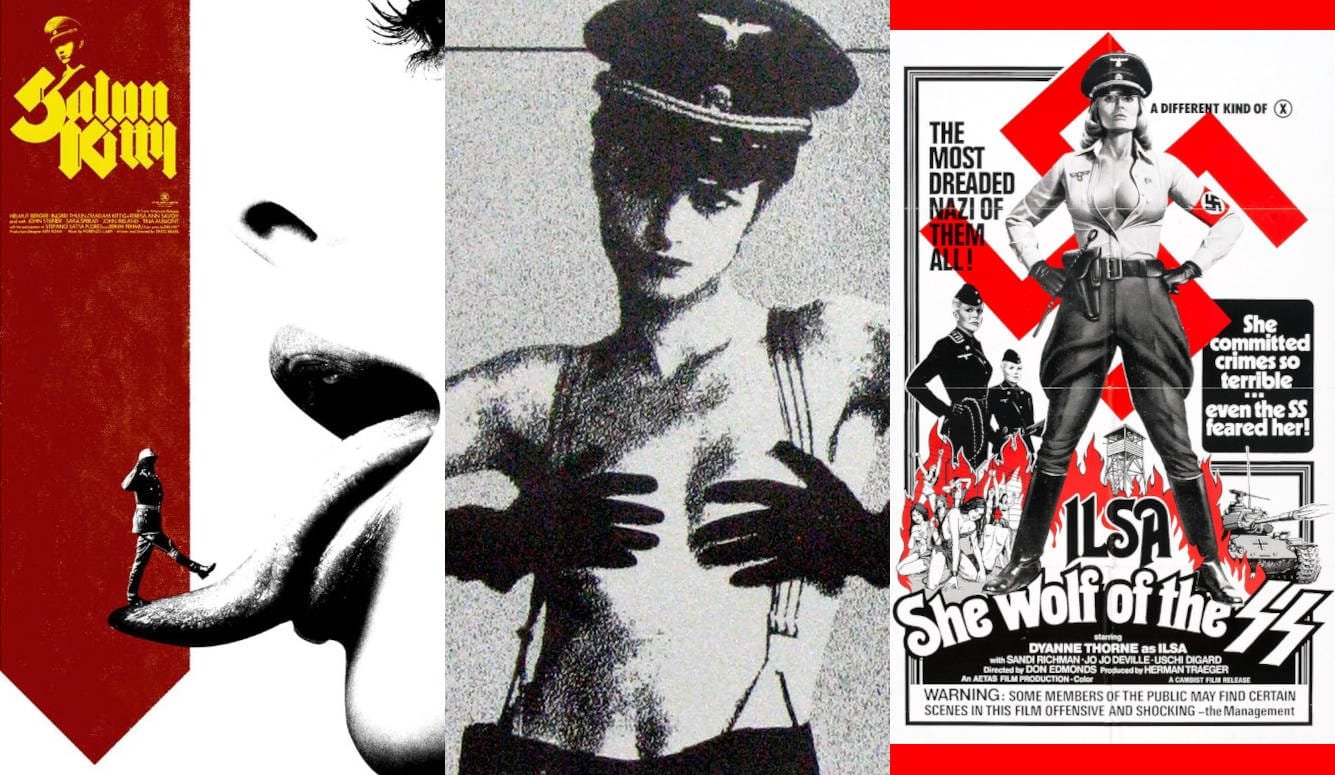
The 1970s saw the rise and fall of a peculiar subgenre of film that became known as “Nazisploitation”—an unusual and never-to-be-repeated mixture of SS atrocities and sex. Many of the movies made by American and Western European (mostly Italian) directors during this brief era were low-budget cheapies destined for urban grindhouses and the suburban drive-in circuit: SS Girls, SS Hell Camp, Gestapo’s Last Orgy (all 1977), and so on. But a smattering of big-name directors also tackled the theme, and the results occasionally acquired cult and even arthouse status. In 1976, Tinto Brass directed Salon Kitty, a seedy melodrama set in an SS-operated brothel in 1939 Berlin. Brass had acquired an avant-garde reputation with his 1970 film Dropout and his award-winning 1971 film La Vacanza, both of which starred Franco Nero and Vanessa Redgrave. Salò, or the 120 Days of Sodom, was the last film completed by Pier Paolo Pasolini before his murder in November 1975. While Salò was not about Nazis per se, it transposed the Marquis de Sade’s most infamous novel to the fascist puppet state established by the Germans during their occupation of Italy from 1943 to 1945.

But the crown jewel of arthouse Nazisploitation was Liliana Cavani’s bizarre 1974 film The Night Porter, starring Dirk Bogarde and Charlotte Rampling. During the early 1960s, Cavani had produced a series of television documentaries dealing with Nazi concentration camps and their victims. While she was making Women of the Resistance (1965), she interviewed a woman who had been a prisoner at Dachau as a teenager. This woman confided to Cavani that after the war she would spend her summer vacations at Dachau. “I asked her why she didn’t go to Hawaii or someplace instead,” Cavani told a New York Times reporter in 1974. “She couldn’t explain. It was the victim returning to the scene of the crime.” To dramatise this strange compulsion, Cavani turned the woman’s story into a twisted tale of erotic obsession involving Max (Bogarde), a sadistic SS functionary at a concentration camp, and Lucia (Rampling), a teenage inmate who becomes Max’s pet prisoner and the object of both his torment and his perverse version of love. After the war, the pair meet by chance and continue their sadomasochistic affair.

In the film’s most famous—and controversial—scene, Lucia dances before a room filled with SS officers while she sings a torch song by Friedrich Hollaender. Her hair is cropped short and she is decked out in Max’s SS peaked cap, over-the-elbow black gloves, and a pair of trousers held up by suspenders that caress her bare breasts. Hollaender was the composer of the music for Josef von Sternberg’s 1930 Marlene Dietrich vehicle, The Blue Angel, a film that had come to epitomise the decadent sexuality of the Weimar Republic. Max rewards Lucia for her performance with the severed head of a fellow inmate about whose unwanted attention she had complained. As Max points out, this is a reenactment of the New Testament story of John the Baptist, in which Salome asks for the prophet’s head on a platter as a reward for her dance. That single scene ignited a fire of “Nazi chic” in outrage-provoking dress and accoutrements among punks, goths, rock stars, clothing designers, and metal freaks in the 1970s and early 1980s. In 1982, British singer Siouxsie Sioux famously posed topless in an homage photo that added spiky leather bracelets and black fingernail polish.

Film critics at the time were not impressed, however. The Night Porter was mercilessly derided upon its release by nearly everyone who reviewed it. In the New York Times, Vincent Canby called it “romantic pornography”; in the Chicago Sun-Times, Roger Ebert described it as “a despicable attempt to titillate us by exploiting memories of persecution and suffering”; and in the New Yorker Pauline Kael remarked that the fact it had been directed by a woman simply demonstrated that “women can make junk just as well as men.” In 1992, Ohio State University professor Linda Mizejewski lumped The Night Porter in with a number of other self-described “antifascist productions” dealing with Nazi Germany that, she said, replicated the very “fascism” and “misogyny” they purportedly condemned.

Nevertheless, The Night Porter has accrued a cult following over the years, and this has been followed by a critical reappraisal of sorts. In an essay accompanying the film’s remastering for the Criterion Collection in 2014, Princeton professor Gaetana Marrone argued that “Lucia and Max show the fundamental face of Nazism, the cold exhibition of a rational violence perpetrated on the individual within controlled systems of power.” Certainly, the film’s defenders object to any attempt to bracket Cavani’s work, with its A-list stars and sophisticated cinematography, with the low-budget drive-in fodder that the word “Nazisploitation” usually conjures up. But the resemblance is inescapable.


Read the full article here

Fact Checker

Verify the accuracy of this article using AI-powered analysis and real-time sources.

Get Your Fact Check Report

Enter your email to receive detailed fact-checking analysis

5 free reports remaining

Continue with Full Access

You've used your 5 free reports. Sign up for unlimited access!

Already have an account? Sign in here

Share. Facebook Twitter Pinterest LinkedIn Tumblr Email Telegram Copy Link
News Room
  • Website
  • Facebook
  • X (Twitter)
  • Instagram
  • LinkedIn

The FSNN News Room is the voice of our in-house journalists, editors, and researchers. We deliver timely, unbiased reporting at the crossroads of finance, cryptocurrency, and global politics, providing clear, fact-driven analysis free from agendas.

Related Articles

Media & Culture

Today in Supreme Court History: October 14, 1911

34 minutes ago
Media & Culture

Fortunately for Society, Plaintiff’s Framework for Retrospectively Punishing News Outlets Is Not the Law

2 hours ago
Media & Culture

Mark Cuban: ‘I’d Get Rid of All Political Parties’

3 hours ago
Media & Culture

New on SCOTUSBlog: “Witnessing a reorientation of the First and Second Amendments on the Roberts court”

4 hours ago
Media & Culture

Second Amendment Rights Not Forfeited by Past Drunk Driving Conviction

5 hours ago
Media & Culture

Fusionism and its Limits

6 hours ago
Add A Comment
Leave A Reply Cancel Reply

Editors Picks

They Walked in Line

53 minutes ago

BlackRock’s Larry Fink names a U.S. recession trigger and its tied to AI

56 minutes ago

South Korea Plans Cybersecurity Overhaul After Crypto Exchange Incidents

59 minutes ago

Fortunately for Society, Plaintiff’s Framework for Retrospectively Punishing News Outlets Is Not the Law

2 hours ago
Latest Posts

Bitcoin mining pool once handling 2.3% of network shuts after hashrate falls 65%

2 hours ago

Australia Proposes Capital, Custody Rules for Crypto

2 hours ago

Mark Cuban: ‘I’d Get Rid of All Political Parties’

3 hours ago

Subscribe to News

Get the latest news and updates directly to your inbox.

At FSNN – Free Speech News Network, we deliver unfiltered reporting and in-depth analysis on the stories that matter most. From breaking headlines to global perspectives, our mission is to keep you informed, empowered, and connected.

FSNN.net is owned and operated by GlobalBoost Media
, an independent media organization dedicated to advancing transparency, free expression, and factual journalism across the digital landscape.

Facebook X (Twitter) Discord Telegram
Latest News

Today in Supreme Court History: October 14, 1911

34 minutes ago

They Walked in Line

53 minutes ago

BlackRock’s Larry Fink names a U.S. recession trigger and its tied to AI

56 minutes ago

Subscribe to Updates

Get the latest news and updates directly to your inbox.

© 2026 GlobalBoost Media. All Rights Reserved.
  • Privacy Policy
  • Terms of Service
  • Our Authors
  • Contact

Type above and press Enter to search. Press Esc to cancel.

🍪

Cookies

We and our selected partners wish to use cookies to collect information about you for functional purposes and statistical marketing. You may not give us your consent for certain purposes by selecting an option and you can withdraw your consent at any time via the cookie icon.

Cookie Preferences

Manage Cookies

Cookies are small text that can be used by websites to make the user experience more efficient. The law states that we may store cookies on your device if they are strictly necessary for the operation of this site. For all other types of cookies, we need your permission. This site uses various types of cookies. Some cookies are placed by third party services that appear on our pages.

Your permission applies to the following domains:

  • https://fsnn.net
Necessary
Necessary cookies help make a website usable by enabling basic functions like page navigation and access to secure areas of the website. The website cannot function properly without these cookies.
Statistic
Statistic cookies help website owners to understand how visitors interact with websites by collecting and reporting information anonymously.
Preferences
Preference cookies enable a website to remember information that changes the way the website behaves or looks, like your preferred language or the region that you are in.
Marketing
Marketing cookies are used to track visitors across websites. The intention is to display ads that are relevant and engaging for the individual user and thereby more valuable for publishers and third party advertisers.