

 Freedom Index
Listen to the article
Hello and welcome to another edition of Free Agent! Make no mistake, this week you should put your feet up (or take an after-work stroll, which is fine too).
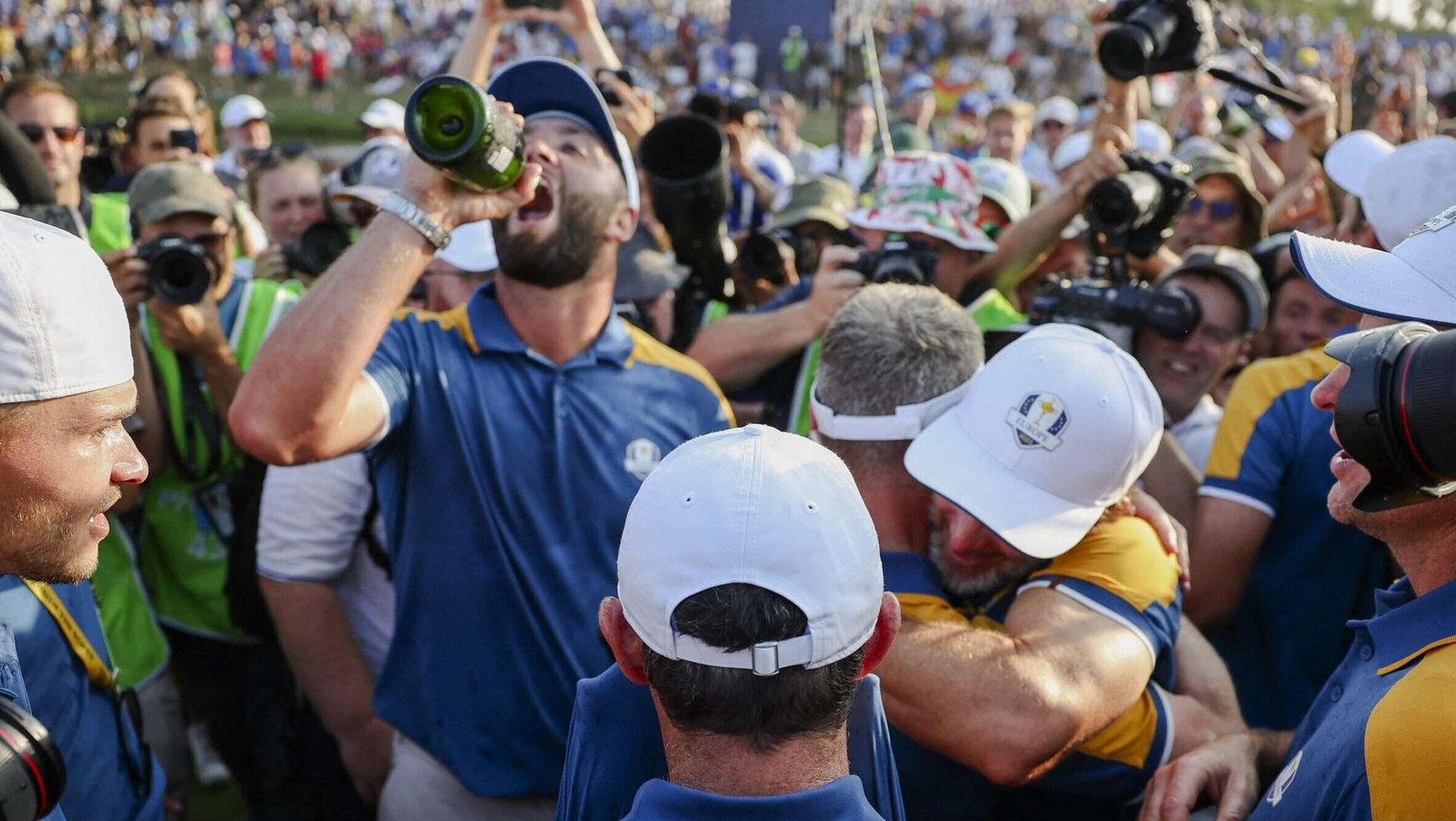
It’s Ryder Cup week, and this refocused golf fan is more excited than ever. We’ll talk about how the competition had to relevel the playing field to make it a fair fight. After that, we’ll cover some new insights on sports bettors and get into what the Jimmy Kimmel suspension has to do with the NFL.
But first, congratulations to the final 11 people still alive in our NFL Eliminator Challenge on ESPN. Several people, including yours truly, exited this week after a slew of upsets in the NFL. Nice to finally have some fun upsets, though.
Don’t miss sports coverage from Jason Russell and Reason.
When the Ryder Cup comes around, I always like to remind people that the U.S. was beating Great Britain and Ireland so badly, for so long, that it stopped being fun.
At first, the Ryder Cup was a fair fight. The U.S. won the first edition in 1927, Great Britain the second, the U.S. won the third, and Great Britain took the fourth. The U.S. won two more before a break for World War II—and then things went off the rails. From 1947 through 1977, the U.S. won every Ryder Cup except two (and one of those was a tie, so the U.S. retained the cup).
In 1979, the Great Britain and Ireland team became the European team. Two Spaniards, Seve Ballesteros and Antonio Garrido, joined the team, and the U.S. couldn’t compete with that.
Just kidding, they won that Ryder Cup and then added two more for good measure.
It wasn’t until 1985 that Europe finally won and made it a real competition. Since the 1979 expansion, Europe has 12 wins, 9 losses, and 1 tie.
The expansion gave Europe a huge demographic advantage. The talent pool was no longer limited to a couple of small islands against an industrial, continent-wide powerhouse. Europe today has roughly 750 million people, depending on how you define “Europe”—that’s over twice as many as America’s 340 million people.
The U.S., though, has wealth on its side. Only a few relatively small European countries have a higher GDP per capita than the U.S.—almost $89,000—and golf is not a poor man’s game (don’t tell my wife). It’s a lot cheaper to just grab your running shoes and hit the road, or head out to the basketball court at the park. Getting really good at golf means expensive lessons; becoming elite costs even more.
Thus, the stage is set for a massive duel between teams representing a few hundred million freedom-loving capitalists against several hundred million more tax-loving squashers of free speech. Reducing it to population and wealth is a bit of an oversimplification (the Americans dominate the non-European team in the Presidents Cup despite a massive population gap), but that, coupled with a strong golf culture, can probably explain a lot.
I, for one, am hoping to see Bennett Scheffler with the Ryder Cup.
Fewer Americans are betting in 2025 than they did in 2024—according to a new report from Leger, a Canadian market research company, which found the same trend in Canada.
About 30 percent of American adults had bet on sports in the past 12 months when Leger surveyed them in 2024. That fell to 26 percent in 2025. Canada experienced a slightly smaller drop from 21 percent of adults to 19 percent. The doomsayers seem to think legalized sports betting would consume us all—I always thought an initial surge in interest would eventually peak and decline, which it seems to have done. It may eventually rise again—especially if states such as California and Texas finally legalize—but I wouldn’t bet on when that might happen.
Let’s move on to betting ads. A small majority of Americans and Canadians said they’ve seen sports betting ads “recently” (54 percent of Americans and 59 percent of Canadians). Of the people who have seen betting ads, 59 percent of Americans say there are “too many,” up seven percentage points from 2024. Canadians are much less tolerant—75 percent said there are “too many” sports betting ads.
Let’s talk about women, too: almost four in 10 American sports bettors are women, and the same is true for fantasy sports players. Betting is much less popular among Canadian women, though: only 25 percent of their sports bettors are women (still more than the 12 percent figure that was guessed by Reason editor in chief Katherine Mangu-Ward).
On September 20, Michael McCarthy of Front Office Sports wrote a piece headlined “Disney Could Face Choice Between [Jimmy] Kimmel and NFL.” On Monday, Disney apparently made its choice, announcing a plan to bring Kimmel back on Tuesday.
It wasn’t exactly a strict one-or-the-other choice as the Front Office Sports headline may have implied. The gist is that bringing Kimmel back may upset Trump, who could use the power of his office to cause a lot of problems for Disney’s deal to purchase NFL media assets like the NFL Network, RedZone, and NFL Fantasy Football. “Given his interest in the NFL, and his history of using media mergers for leverage, it’s hard to see him not playing around with this,” GOP communications pro Ari Fleischer told Front Office Sports. “I doubt this will be a straightforward commercial transaction.”
Even if the Justice Department’s Antitrust Division eventually approves Disney’s deal, it could take up to a year to finalize. It probably doesn’t help that Trump’s Republican allies are feeling a growing fervor for antitrust action, especially when it comes to sports.
For more on the Kimmel situation, you can watch my Reason colleagues Matt Welch and Peter Suderman discuss.
You’ve probably already seen Jordan Davis’ speedy run after blocking a Rams field goal, or Jacob Young’s wild catch off his foot—but have you seen what might be the shortest ever stint in a baseball game?
Giancarlo Stanton just speedran a day at the office ????
Brought in as a pinch-hitter, intentionally walked, and then removed for a pinch-runner pic.twitter.com/ljKEPMMwKw
— MLB (@MLB) September 21, 2025
That’s all for this week. Enjoy watching the real game of the week, Detroit Mercy vs. Robert Morris in women’s soccer.
Read the full article here
Fact Checker
Verify the accuracy of this article using AI-powered analysis and real-time sources.