

 Freedom Index
Listen to the article
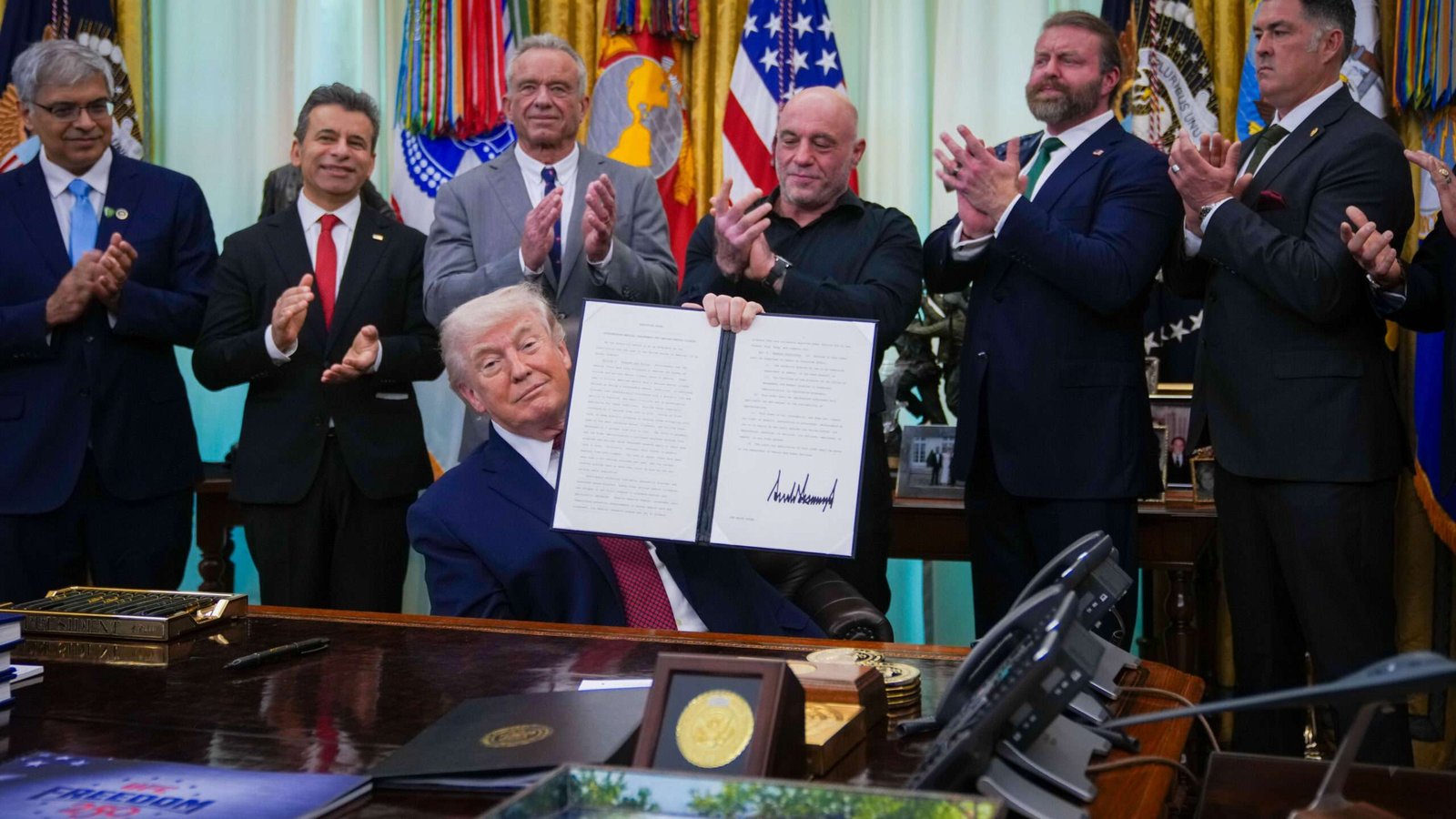
The hugely popular, politically eclectic podcaster Joe Rogan, who endorsed Donald Trump in the 2024 election, says he recently sent the president information about ibogaine, a psychedelic whose boosters portray it as an astonishingly effective treatment for addiction, post-traumatic stress disorder (PTSD), and other psychological problems. “The text message came back,” Rogan said on Saturday as Trump signed an executive order aimed at “accelerating medical treatments for serious mental illness.” According to Rogan, Trump replied: “Sounds great. Do you want FDA approval? Let’s do it.”
Trump’s order may or may not result in ibogaine’s approval as a psychotherapeutic catalyst. But it instructs the Food and Drug Administration (FDA) to facilitate that goal by streamlining the review process for “appropriate psychedelic drugs,” including ibogaine, and providing “at leasty $50 million from existing funds” to state programs investigating their potential. The FDA also is supposed to collaborate with the Department of Veterans Affairs on clinical trials.
In the meantime, Trump wants the FDA to facilitate access to psychedelics under the Right to Try Act. That law allows patients to use “investigational” drugs when they suffer from a “life-threatening disease or condition,” have unsuccessfully tried other treatments, and are unable to participate in clinical trials.
Right to Try access is limited to drugs for which a Phase I clinical trial has been completed, which is not yet true for ibogaine. But a $50 million research program that Texas legislators approved last year, which promises matching grants for privately funded studies, aims to help fill that gap. And on Saturday, FDA Commissioner Marty Makary announced that the agency had just approved “the first iboga investigational new drug clearance,” which “will pave the way for the first-ever human trials in the United States.”
Trump’s order highlights an upswing in the U.S. suicide rate during the last two decades, emphasizing that “veterans often suffer in greater measure from this tragedy.” The order portrays ibogaine and other psychedelics as promising options for Americans “struggling with some of the most insidious mental illnesses.” It notes that the FDA has recognized “specific psychedelic drugs,” including MDMA and psilocybin, as “breakthrough” therapies, meaning they “may demonstrate substantial improvement over existing therapies on one or more clinically significant endpoints.” That designation is supposed to speed the review process. But as the experience with MDMA shows, it is no guarantee of prompt approval.
Trump’s order goes further, instructing the FDA to issue “national priority vouchers” for psychedelics that have been deemed breakthrough therapies. The voucher program, which the FDA announced last June, entails an “ultra-fast timeline” for regulatory review of breakthrough therapies, with a target of one to two months rather than six months or more, when it is consistent with “critical U.S. national health priorities.” Makary said the agency will issue vouchers for three psychedelics this week.
“I’m pleased to announce historic reforms to dramatically accelerate access to new medical research and treatments based on psychedelic drugs,” Trump said when he signed the executive order. “In many cases, these experimental treatments have shown life-changing potential for those suffering from severe mental illness and depression, including our cherished veterans.”
Trump noted that he had heard from “a number of people, including the great Joe Rogan,” who said “we have to do something about this.” Trump also mentioned Makary, Secretary of Health and Human Services (HHS) Robert F. Kennedy Jr., and Mehmet Oz, director of the Centers for Medicare & Medicaid Services, saying they expressed “uniform support.”
As a presidential candidate in 2023, Kennedy said he would aim to legalize psychedelics if elected. Shortly before Trump picked him to run HHS, Kennedy described “aggressive suppression of psychedelics” as part of the FDA’s “war on public health.”
During Saturday’s signing ceremony, Kennedy joined Trump in crediting Rogan for “helping bring national attention to innovative, potentially life-saving treatments for veterans and others living with mental illness and for pushing this conversation into the mainstream.” He also mentioned Rep. Morgan Luttrell (R–Texas), a former Navy SEAL, and Bryan Hubbard, a Lexington, Kentucky, attorney and activist who has played a leading role in promoting ibogaine therapy.
The signing ceremony featured the Texas congressman’s twin brother, former Navy SEAL Marcus Luttrell, whose memoir of his experiences in Afghanistan during Operation Red Wings inspired the 2013 movie Lone Survivor. “Mr. President, thank you so much for having us in here and doing this,” Luttrell said. “You’re going to save a lot of lives with it.”
Luttrell and his brother both credit ibogaine therapy in Mexico with turning their lives around. “I’d like to say how grateful I am to have had the opportunity to go through the program and receive the iboga,” Luttrell said. “It absolutely changed my life for the better. I went through a lot of the programs that the veterans are going through. I always kind of felt like I was a victim coming out of [those programs]. When I came out of this, I felt like I had gotten my life back.”
Studies of ibogaine, which is derived from the root of an African shrub, are limited compared to research on MDMA, psilocybin, and LSD. But a study reported last year in Nature Mental Health suggested that ibogaine, combined with magnesium as a safeguard against the drug’s potentially dangerous cardiac side effects, “safely and effectively reduces PTSD, anxiety and depression and improves functioning in veterans” with traumatic brain injuries. That study involved just 30 subjects, who underwent treatment at a clinic in Mexico, and did not include a control group. The researchers noted that “follow-up controlled clinical trials are needed to confirm the findings from this initial single-arm trial.”
Speaking generally about psychedelic therapy, Makary cautioned scientists against dismissing the experiences of people like the Luttrell brothers. “If we actually listen to those who experience the therapeutic value, we can learn as a medical field,” he said. “We just have to listen the stories of those individuals with dramatic results. That is data, that is scientific data, even from a single individual. We also have randomized controlled trials, and we have to do that because we need to be able to say there’s good support when we recommend these therapeutics. If you look at those trials, there’s a 30 to 40 percent remission rate for conditions like PTSD.”
Makary seemed to have in mind clinical trials of MDMA, which found a difference in that range between subjects who received the drug and subjects who also underwent psychotherapy but received a placebo. Despite those promising results, the FDA declined to approve MDMA-assisted psychotherapy as a treatment for PTSD in 2024. Makary’s comments suggest he is open to reconsidering that decision.
As Gregory Ferenstein, a senior fellow in drug policy at Reason Foundation (which publishes this magazine), noted last year, Makary signaled his interest in psychedelic therapy in a May 2025 interview with NewsNation. He said “this is one of our top priorities at the FDA: to listen to doctors, to listen to patients, and to make sure we don’t get in the way with red tape.”
The Trump administration’s embrace of psychedelic therapy reflects its surprising appeal to conservative Republicans such as former Texas Gov. Rick Perry, Rep. Dan Crenshaw (R–Texas), the Texas legislators who approved funding for ibogaine studies, and the Utah legislators who overwhelmingly backed psychedelic research a few years ago. The experiences of veterans and first responders seem to have played an important role in that trend.
Whatever the explanation, the cross-ideological interest in such research is encouraging, especially since the history of marijuana policy suggests that legalization of medical use can help pave the way to broader reform. But it is important to recognize the limitations of this approach, especially when it relies on FDA approval.
Ibogaine, psilocybin, and MDMA currently are listed in Schedule I of the Controlled Substances Act, the law’s most restrictive category, along with psychedelics such as LSD, mescaline (the psychoactive component of peyote), and dimethyltryptamine (the active ingredient in ayahuasca). If the FDA approved medications based on any of those substances, they would be moved to a lower schedule, but unauthorized use would still be illegal.
Unlike the reforms enacted in Oregon and Colorado, both of which allow adults to use psilocybin (and in Colorado, several other psychedelics) without receiving permission from a medical gatekeeper, the FDA model requires regulatory approval for specific applications. And assuming the FDA does approve psychedelics for medical use, they will be legally available only to people who can obtain a diagnosis and a prescription.
That model excludes most of the reasons why people actually use psychedelics. In a 2023 survey of psilocybin users, for instance, the RAND Corporation found that the most common motivations included “fun” (59 percent), “personal development” (45 percent), “curiosity” (43 percent), and “spiritual growth” (41 percent). Needless to say, these are not applications that the FDA is likely to recognize as legitimate. And while 49 percent of respondents said they used psilocybin for “improved mental health,” even that category overlaps only partly with the diagnoses that would be necessary to obtain prescriptions under federal law.
Trump’s initiative, in short, falls far short of acknowledging that adults have a right to use psychedelics for whatever reasons they deem compelling. It therefore does not do much to address the injustice of threatening people with arrest and prosecution for exercising that right.
Read the full article here
Fact Checker
Verify the accuracy of this article using AI-powered analysis and real-time sources.