

 Freedom Index

Listen to the article
Last week, Senator Eric Schmitt of Missouri got into a heated exchange during a Senate hearing with Stanford’s Daphne Keller. Schmitt, who, as Missouri’s Attorney General, originally filed the Missouri v. Biden lawsuit, was berating Keller over Stanford’s supposed role in helping the Biden administration censor social media during the 2020 election (see if you can spot the time-space continuum problem with that sentence). When Keller pushed back on his characterization of events, Schmitt got increasingly agitated and told her she could “read all about it in Missouri v. Biden.” Keller’s response was instant and devastating: “The one you lost?“
He did not take it well, immediately throwing an embarrassing Senatorial temper tantrum.
And so maybe it’s not surprising that just a week later, Schmitt was doing a victory lap over a “settlement” that his friends in the Trump administration very conveniently worked out with the remaining plaintiffs in the case. The framing, of course, was triumphant. From his post on social media:
Shorter version:
We just won Missouri v. Biden.
As Missouri’s Attorney General, I sued the Biden regime for brazenly colluding with Big Tech to silence Missouri families — censoring the truth about COVID, the Hunter Biden laptop, the open border, and the 2020 election. They tried to turn Facebook, X, YouTube, and the rest into their private speech police, labeling dissent “misinformation” while they pushed their narrative on the American people.
Missouri struck first—and Missouri won big.
And the New Civil Liberties Alliance, which represented many of the plaintiffs, was even more grandiose in its description of the settlement:
The federal government’s social media censorship was the most massive suppression of speech in the nation’s history, it was profoundly important to resist it.
Even the Washington Post editorial board got taken in, writing about the settlement as a “forceful affirmation of First Amendment principles.” Reclaim the Net went even further, claiming the decree represented a “formal, court-enforceable admission: the federal government pressured social media platforms to silence protected speech.”
There’s just one fairly big problem. None of this is true. The case was a dud. While it is true that the district court hyped it up as (what the NCLA repeated) “the most massive attack against free speech in United States’ history,” literally no one else found the same. The Fifth Circuit saw that most of the claims were flimsy and cut back nearly the entire injunction, and the Supreme Court threw it out completely (“the one that you lost”) not only pointing out five separate times that there was “no evidence” to support the claims of censorship, but also calling out the district court’s findings, noting that they “appear to be clearly erroneous.”
It’s quite a misleading victory lap to quote the judge who both higher courts called out for misreading the evidence to say things that the evidence clearly did not say (it was actually worse: the judge fabricated quotes to make it sound like there was evidence when there was not).
As for this “settlement,” anyone who actually reads it would realize that it doesn’t support any of the claims making the rounds.
Now the reason Schmitt claims he didn’t “lose” the case is because, technically, the Supreme Court rejected the case on “standing” grounds — meaning the plaintiffs hadn’t shown they had a legal right to bring the case. But the reason they didn’t have standing was devastating to the plaintiffs’ entire theory. The opinion methodically dismantled the conspiracy theory at the heart of the case:
We reject this overly broad assertion. As already discussed, the platforms moderated similar content long before any of the Government defendants engaged in the challenged conduct. In fact, the platforms, acting independently, had strengthened their pre-existing content-moderation policies before the Government defendants got involved. For instance, Facebook announced an expansion of its COVID–19 misinformation policies in early February 2021, before White House officials began communicating with the platform. And the platforms continued to exercise their independent judgment even after communications with the defendants began. For example, on several occasions, various platforms explained that White House officials had flagged content that did not violate company policy.
The Court further called out how the lower courts had built their case on lies and misrepresentations:
The District Court found that the defendants and the platforms had an “efficient report-and-censor relationship.”… But much of its evidence is inapposite. For instance, the court says that Twitter set up a “streamlined process for censorship requests” after the White House “bombarded” it with such requests. The record it cites says nothing about “censorship requests.” Rather, in response to a White House official asking Twitter to remove an impersonation account of President Biden’s granddaughter, Twitter told the official about a portal that he could use to flag similar issues. This has nothing to do with COVID–19 misinformation.
In other words, the Supreme Court looked at the actual record, found a pile of conspiratorial nonsense, and told the lower courts they got played. This was a loss. A clear, unambiguous loss.
But of course, with Trump back in office and the same crew of ideologues now running the government, it was time to manufacture a win. And so we get this “consent decree.”
On paper, it sounds dramatic. The NCLA breathlessly announced that the settlement “prohibits the U.S. Surgeon General, Centers for Disease Control and Prevention (CDC), and Cybersecurity and Infrastructure Security Agency (CISA) from threatening social media companies into removing or suppressing constitutionally protected speech.” Schmitt claimed the decree means “no more threats of legal, regulatory, or economic punishment. No more coercion. No more unilateral direction or veto of platform decisions.”
But if you actually read the consent decree (and I encourage you to do so, because clearly many of the people celebrating it haven’t), you find something remarkable: the decree prohibits conduct that the Supreme Court found no evidence was happening, while explicitly carving out everything that actually was happening.
First (and most importantly), the decree only applies to three remaining individual plaintiffs (Dr. Aaron Kheriaty, Jill Hines, and Jim Hoft) and two states, and only on five specific platforms. It doesn’t protect anyone else. If you’re a random American whose content gets moderated on social media, this decree does absolutely nothing for you. That certainly doesn’t match what Schmitt claimed.
Second, and more importantly, paragraph 24 of the decree is where the whole thing collapses:
This prohibition does not extend to providing Social-Media Companies with information that the companies are free to use as they wish. Nor does it extend to statements by government officials that posts on Social Media Companies’ platforms are inaccurate, wrong, or contrary to the Administration’s views, unless those statements are otherwise coupled with a threat of punishment within the meaning of the above provision.
That paragraph basically describes exactly what the Biden administration was actually doing — and declares it fine. The government can still share information with social media companies. It can still tell companies that content on their platforms is wrong or inaccurate. It can still express displeasure. It just can’t couple those statements with threats of punishment.
Which is… exactly what the First Amendment already requires. And exactly what the Supreme Court found was not happening in the first place. The consent decree literally codifies the Biden administration’s actual conduct as permissible while grandly prohibiting a phantom version of events that the Supreme Court found no evidence of.
Even better, paragraph 17 of the decree says the quiet part out loud:
The parties acknowledge that this Agreement is entered into solely for the purpose of settling and compromising any remaining claims in this action without further litigation, and, except as stated explicitly in the text of the Agreement, it shall not be construed as evidence or as an admission regarding any issues of law or fact, or regarding the truth or validity of any allegation or claim raised in this action or in any other action.
So the decree is explicitly not an admission of anything. It cannot be construed as evidence of any wrongdoing. The government didn’t admit to censorship. Reclaim the Net’s headline — “US Government Admits Pressuring Social Media Platforms to Censor Protected Speech” — is directly contradicted by the text of the document they’re supposedly celebrating. Did they not read it?
Yes, the preamble quotes Trump’s executive order making grand accusations about Biden-era censorship. But that’s a political document, not a finding of fact. The Trump administration saying the Biden administration did bad things is hardly the same as the Biden administration admitting it did bad things, or a court finding that it did bad things. In fact, the only court to substantively examine the evidence — the Supreme Court — found no evidence to support these claims.
So what we have here is a neat little trick: the Trump administration negotiates a settlement with friendly plaintiffs (some of whom had to drop out of the case because they joined the Trump administration), quotes Trump’s own executive order as if it were established fact, and everyone involved pretends this vindicates the original claims — despite the Supreme Court (and a clean reading of the evidence) having rejected them.
Speaking of those former plaintiffs, let’s talk about the delicious absurdity of how this case ate itself. Dr. Jay Bhattacharya, one of the original individual plaintiffs who claimed he was censored by the Biden administration, had to drop out of the case because he was confirmed as Director of the National Institutes of Health — the agency he claimed (without evidence) had “censored him” even though his lawyers somehow forgot to add NIH as a defendant. Dr. Martin Kulldorff similarly withdrew because of his new role within the Department of Health and Human Services. The supposed victims of government censorship are now running the very agencies they accused of censoring them. And, again, I have to reinforce, that the Supreme Court called out the lack of actual “censorship” for either of these guys.
Both Bhattacharya and Kulldorff were mad that Facebook restricted access to the Great Barrington Declaration, a document they co-authored. But they fail to mention that the person running the Great Barrington Declaration website has publicly revealed that the reason Facebook blocked it was anti-vaxxers mass reporting the site — because they misread the declaration as supporting “forced vaccinations.” (There are more details at the link above).
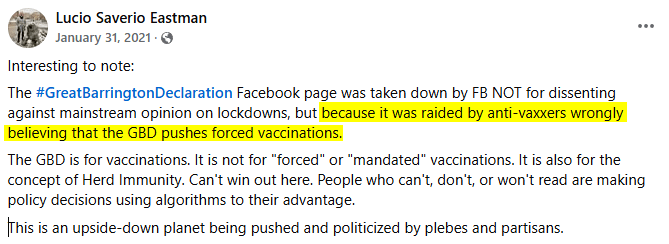
So naturally, despite all this, the fact that they became top officials in the Trump administration should raise questions about how suddenly the administration worked out a friendly settlement with their friends who were still plaintiffs. What a coincidence.
But the real tell is what’s happening right now, while MAGA is celebrating: the Trump admin is doing far worse than anything Biden was even accused of. Yes, while the Trump administration and its gullible friends are busy patting themselves on the back for supposedly defending free speech from the horrors of the Biden administration sharing information with social media companies, it is engaged in conduct that is far, far worse than anything alleged in Missouri v. Biden.
As you’ll certainly recall, the Trump administration’s FCC Chair Brendan Carr went on a podcast and explicitly threatened Disney with regulatory retaliation over Jimmy Kimmel’s monologues, telling them “we can do this the easy way or the hard way.” Hours later, the show was pulled. That’s textbook coercion — exactly the kind that the Supreme Court in both Murthy and Vullo said would violate the First Amendment if proven. Unlike the conduct in the case that just settled, where the Supreme Court found no such proof.
And then we have the even clearer violation: Pam Bondi’s Department of Justice demanded that Apple and Google remove the ICEBlock app from their stores… and bragged about it! That’s the federal government literally ordering private companies to suppress an application. Not sending mean emails. Not sharing information platforms are free to use as they wish. An explicit demand for removal.
“We reached out to Apple today demanding they remove the ICEBlock app from their App Store—and Apple did so,” Bondi added according to the Fox report.
Where’s Schmitt’s outrage? Where’s the NCLA lawsuit? Where’s Philip Hamburger’s condemnation of “the most massive suppression of speech in the nation’s history”?
Nowhere. Because this was never really about free speech. This was about building a narrative that the Biden administration censored conservatives, manufacturing a legal document that appears to vindicate that claim (despite explicitly saying it doesn’t), and then using it as political cover while engaging in an even more extreme version of the conduct you claimed to oppose.
This perfectly matches the pattern Renee DiResta documented in her Lawfare review of Schmitt’s book — which he subtitled “how to beat the left in court” — where she noted his habit of presenting cases he lost as if he won them. The book apparently describes multiple lawsuits where Schmitt failed to achieve his stated legal objectives but then spun the results as massive victories for the narrative benefit. Missouri v. Biden is the crown jewel of this approach: lose at the Supreme Court, negotiate a meaningless consent decree with a friendly administration, declare total victory.
Even the Washington Post editorial board, which gave the decree far more credit than it deserved, couldn’t quite look away from the obvious:
The unfortunate catch is that the settlement only applies to the specific plaintiffs in this particular case. In other words, only the people who initially sued the Biden administration, and public officials from Louisiana and Missouri, will enjoy the court-ordered protections from government censorship. It’s unlikely the current administration would target right-leaning individuals or states, but the consent decree will apply for 10 years.
The settlement also applies only to government pressure on five companies: Facebook, Instagram, X (formerly Twitter), Linkedln and YouTube. That means, for example, Federal Communications Commission Chairman Brendan Carr’s efforts to bully broadcasters to toe the administration’s political line will be unaffected.
So even the Post recognizes that the decree does nothing about actual, current, obvious government coercion of media companies. But somehow this is still a “forceful affirmation of First Amendment principles”? How so? A consent decree that protects three specific people from conduct that wasn’t happening, while the government signing the decree is actively coercing media companies in ways that obviously violate the First Amendment?
The consent decree is a press release disguised as a legal document. It prohibits First Amendment violations the Supreme Court found no evidence of, permits everything the evidence shows the Biden administration was actually doing, and was signed by an administration currently engaged in the exact conduct the decree pretends to prohibit.
The one you lost, indeed.
Filed Under: 1st amendment, aaron kheriaty, brendan carr, daphne keller, donald trump, eric schmitt, free speech, jay bhattacharya, jill hines, jim hoft, martin kulldorff, missouri, missouri v. biden, murthy v. missouri, pam bondi, settlement, supreme court
Companies: ncla
Read the full article here
Fact Checker
Verify the accuracy of this article using AI-powered analysis and real-time sources.