

 Freedom Index
Listen to the article
A year ago, the Department of Homeland Security (DHS) proposed new restrictions on visas for international students and journalists, limiting the former to four years and the latter to 240 days without a discretionary extension. The department portrayed those caps as necessary to combat visa fraud and protect national security. But as thousands of people pointed out during the 32-day public comment period, that rationale did not make much sense, and the downside was obvious: The rule would disrupt press coverage and deter foreign enrollment in U.S. universities, an important source of revenue for those institutions and a major driver of economic growth.
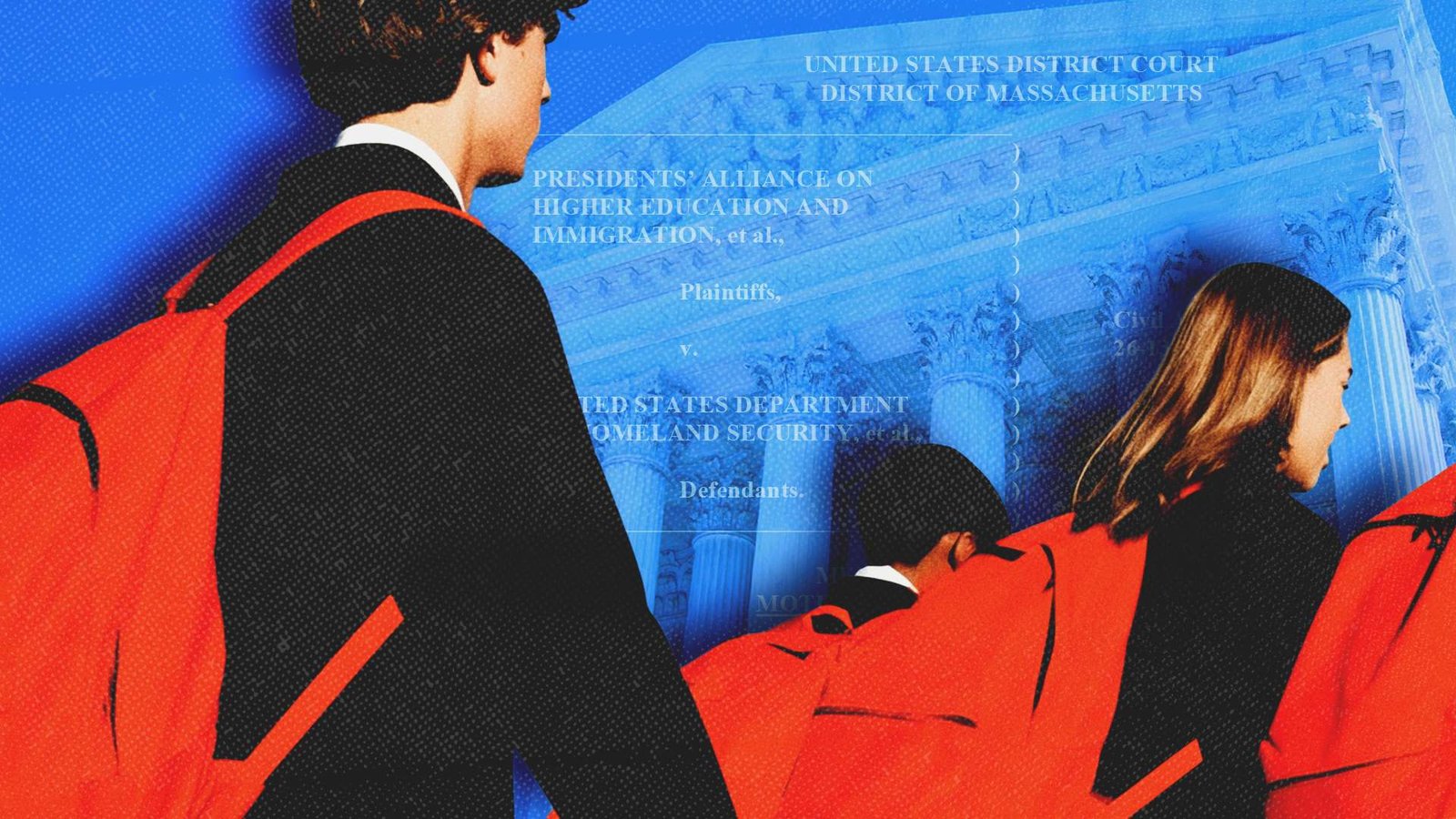
Unfazed by those objections, the DHS finalized its rule in July. Although that might seem like business as usual for a federal bureaucracy, the process that produced the rule was so illogical and heedless that it provoked a preliminary injunction barring enforcement of the limits while a lawsuit challenging them is pending. In a scathing decision this week, a federal judge in Massachusetts concluded that the DHS rule qualifies as “arbitrary and capricious” under the Administrative Procedure Act because the department did not offer a plausible justification, consider alternatives, estimate predictable costs, or meaningfully respond to the points raised by commenters.
“The damage to the higher education system and to the economy of the United States is
likely to be catastrophic,” U.S. District Judge F. Dennis Saylor IV, a former President George W. Bush appointee, writes in response to a lawsuit filed by organizations representing universities, educators, and journalists. “Notwithstanding the scale of the likely harm, the government’s proffered rationales for the rule are exceptionally weak, and the connection between the rule and the problems it purports to address is exceptionally attenuated.”
Although the DHS estimated that complying with the rule would cost about $250 million in the first year, “the real expected costs go far beyond” that figure, Saylor notes. Under prior regulations, foreign students could remain in the United States until they completed their educational programs, including “authorized practical training following completion of studies.” For people earning one or more advanced degrees, that process often takes longer than four years. By ignoring that reality, the DHS rule would undermine the huge scientific and economic benefits generated by international students.
A “flexible and welcoming approach” to foreign students “has allowed U.S. higher education to flourish,” the plaintiffs told Saylor, noting that “education is among the Nation’s top services exports.” That policy, they said, also “has helped power American innovation and productivity, as those students and scholars both perform pathbreaking research while in school and, if they choose to remain in the United States to work after graduation, contribute their talents to leading American companies, or even start their own.”
Major research universities “typically have large percentages of foreign students, particularly at the graduate level,” Saylor notes, citing figures for MIT (40 percent), Harvard (38 percent), Northeastern (57 percent), and Boston University (28 percent). The policy that the DHS wants to revoke “has permitted tens of millions of foreign students and researchers to come to the United States,” he writes. “It has also resulted in groundbreaking research in science, medicine, and technology, substantial economic growth, and a host of other benefits, often on a vast scale.”
U.S.-educated students from other countries, most of whom earn degrees in science, technology, engineering, or mathematics (STEM), play an outsized role in the U.S. economy, accounting for a quarter of billion-dollar startups. They also figure disproportionately in patents and Nobel Prizes. From 1990 to 2010, according to a study cited by the plaintiffs, “the increase in US city-level productivity caused by inflows of foreign STEM workers” was “sufficient in magnitude” to explain between 30 percent and 50 percent of “all aggregate productivity growth in the United States.”
The four-year cap favored by the DHS would throw a monkey wrench into this engine of discovery, innovation, progress, and prosperity. It would introduce a new element of uncertainty for students, since they could not be confident that they would have time to complete their degrees. If four years were not enough, they would have to apply for an extension.
“Any decision by DHS to deny a request for an extension is entirely discretionary and unappealable, even within DHS itself,” Saylor notes. “In other words, a DHS official—based on limited and vague criteria, and with no possibility of appeal—will have the power to cut short the academic, research, or teaching activities of any non-U.S. citizen for no reason or any reason.”
An international student “who is one credit short of graduating,” for example, “could be required to leave the United States without a degree and without any recourse,” Saylor writes. “That introduces, at a minimum, a high degree of uncertainty into the educational process, which will have an obvious deterrent effect on student enrollment.”
In a 2025 Institute for Progress survey cited by the plaintiffs, 49 percent of international students said they would not have enrolled under the new DHS policy, while 16 percent of prospective students said they would be less likely to enroll if the DHS began enforcing the rule. “Even conservatively assuming only a 10% reduction in international student enrollment,” the plaintiffs said, “the negative effects on the American economy are likely to reach tens of billions of dollars each year.” According to an estimate by George Mason economist Michael Clemens, they noted, the annual loss from such a reduction could eventually amount to as much as $145 billion.
The government’s response to such warnings was essentially a shrug. Although the DHS questioned calculations based on survey data, it did not offer contrary evidence, let alone produce its own estimate of the new rule’s economic impact.
The DHS “summarily rejected” commenters’ criticism, “dismissing their concerns as merely ‘speculative,’ based on mere ‘predictions,’ or ‘unquantifiable,'” Saylor notes. “In fact, because it asserted that the impact on enrollment was unquantifiable, it effectively concluded that the cost of that impact was zero. And in support of its own position, it offered almost entirely conclusory statements, non sequiturs, and statements of ‘belief’ without supporting reasoning.”
In addition to economic concerns, critics of the rule noted the potential chilling impact of giving DHS officials complete discretion over whether students or journalists can remain in the country after their initial visa periods have expired. “It is not difficult to imagine how that system might be abused to punish those whose viewpoints or research are disfavored by the officials making the decision” or to “punish disfavored institutions,” Saylor says.
Commenters also worried that press visas “could be denied in retaliation for unfavorable reporting, thereby placing government officials in a position to punish journalists for exercising their First Amendment rights.” Saylor agrees that “the possibilities for abuse are rampant.” In particular, he says, there is an “obvious likelihood” that “the visas of foreign journalists who are critical of the government (or, more particularly, DHS officials) will not be renewed.”
The DHS response to that concern, like its take on the economic consequences of its rule, was not exactly reassuring. The department “does not intend for the rule to chill speech, encourage censorship, or result in viewpoint discrimination,” it said, and “does not have data, and cannot draw on any relevant historical precedence, to quantify or monetize the rule’s potential chilling effect.”
Nor did the DHS plausibly project benefits that might outweigh the costs it refused to consider. The national security justification for the four-year cap on student visas “borders on the absurd,” Saylor says. “It is based almost entirely on a small handful of anecdotes, each of which involved incidents that the new rule would do nothing to prevent or even mitigate.”
Three of those incidents “involved Chinese students attempting to photograph military installations or exercises,” Saylor notes. “The other two involved an individual who overstayed his visa and a Russian intelligence operative who entered the U.S.
with [a student] visa obtained with a fraudulent Brazilian identity.”
The government “makes no real effort” to explain how the four-year limit would “eliminate” or “even reduce” such incidents, Saylor says. “Presumably, a foreign student who wishes to photograph military bases could do so during a four-year period—or, indeed, could do so on a six-month B-1 tourist visa.”
The DHS likewise “did not explain how a four-year cap will prevent individuals from obtaining visas by fraud,” Saylor notes. “Similarly, for those who overstay their visas, DHS offered no real explanation as to how the Final Rule will prevent or deter such abuse to any meaningful degree as compared to the current system.” While the government complained that some visa holders had spent “more than 10 years in student status,” he says, “there is nothing inherently suspect in an education and training program that lasts ten years, particularly at the highest levels.”
As for journalists, “DHS makes no real effort even to defend the new rule on its
merits,” Saylor writes. “In fact, it did not offer any national security or fraud-and-abuse evidence, or indeed provide any reasoned explanation, at all.”
The official justification for the rule is so lame, Saylor says, that it suggests an ulterior motive. “The weakness of the connection between the rule and its purported rationales,” he writes, “raises legitimate questions as to whether its real purpose is not to safeguard national security and protect our borders, but to achieve other, undisclosed, goals,” such as “asserting greater government control over academic institutions and the press.”
Saylor emphasizes that he is not passing judgment on the wisdom of the visa limits. But he concludes that the DHS fell far short of meeting the requirements imposed by the Administrative Procedure Act.
“DHS failed to conduct any reasoned calculation of the costs and benefits of the
Final Rule,” Saylor writes. “DHS failed entirely to perform a meaningful consideration of reasonable alternatives.” It “failed to provide meaningful responses to significant comments,” he says, and it “failed to show that there is a rational connection between the Final Rule and its purported objectives.”
Read the full article here
Fact Checker
Verify the accuracy of this article using AI-powered analysis and real-time sources.