Close Menu
FSNN | Free Speech News NetworkFSNN | Free Speech News Network
  • Home
  • News
    • Politics
    • Legal & Courts
    • Tech & Big Tech
    • Campus & Education
    • Media & Culture
    • Global Free Speech
  • Opinions
    • Debates
  • Video/Live
  • Community
  • Freedom Index
  • About
    • Mission
    • Contact
    • Support
Trending

Crypto Perps Volume Points to Traders Front-Running Robinhood Listings: Kaiko

18 seconds ago

Bitcoin ETFs Draw Investment Surge After Brief Lull Threatens Winning Streak

6 minutes ago

Elite Panic and the Push to Regulate “Misinformation”

44 minutes ago
Facebook X (Twitter) Instagram
Facebook X (Twitter) Discord Telegram
FSNN | Free Speech News NetworkFSNN | Free Speech News Network
Market Data Newsletter
Tuesday, May 5
  • Home
  • News
    • Politics
    • Legal & Courts
    • Tech & Big Tech
    • Campus & Education
    • Media & Culture
    • Global Free Speech
  • Opinions
    • Debates
  • Video/Live
  • Community
  • Freedom Index
  • About
    • Mission
    • Contact
    • Support
FSNN | Free Speech News NetworkFSNN | Free Speech News Network
Home»News»Media & Culture»The Happy Capitalism of Richard Scarry’s Busytown
Media & Culture

The Happy Capitalism of Richard Scarry’s Busytown

News RoomBy News Room2 hours agoNo Comments4 Mins Read880 Views
Share Facebook Twitter Pinterest Copy Link LinkedIn Tumblr Email VKontakte Telegram
The Happy Capitalism of Richard Scarry’s Busytown
Share
Facebook Twitter Pinterest Email Copy Link

Listen to the article

0:00
0:00

Key Takeaways

Playback Speed

Select a Voice

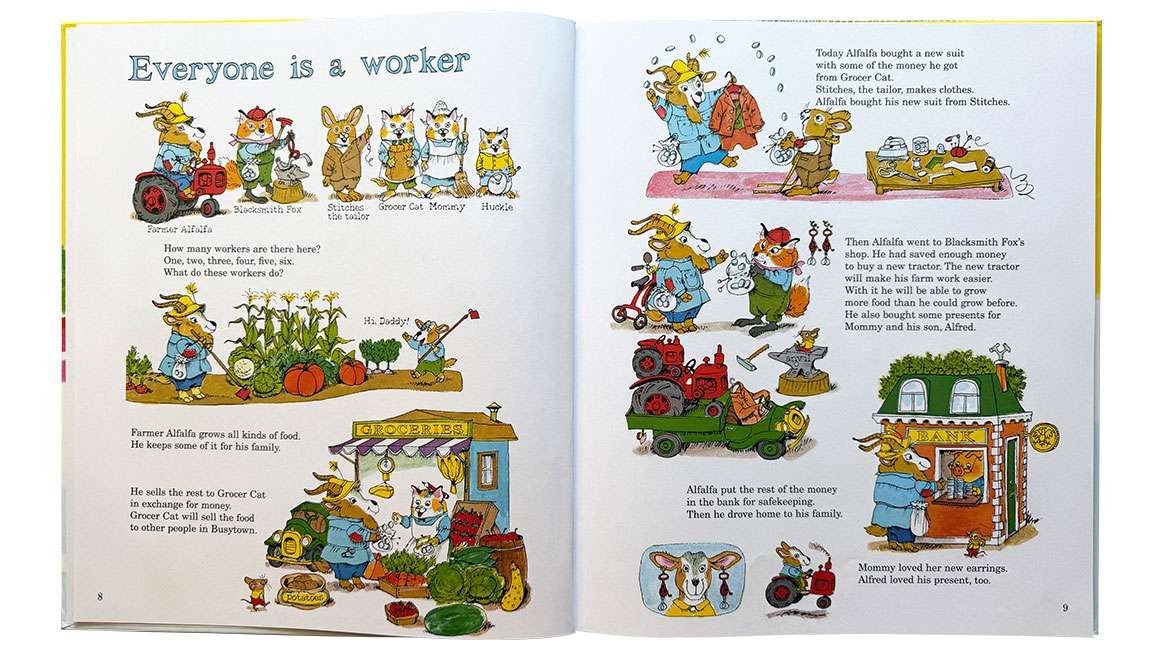
Farmer Alfalfa heads to town with an old truck full of corn. The truck is on the verge of collapse. But after selling his corn to Grocer Cat, Farmer Alfalfa uses the money to buy a new truck.

On another day, Alfalfa sells all kinds of produce and uses the money to make purchases from local merchants, including Stitches the tailor and Blacksmith Fox. Stitches, in turn, uses the money from Alfalfa to buy “an egg beater so that his family can make fudge,” while Fox buys more iron to use in his blacksmith business.

Welcome to the very busy—and pro-market—world of children’s book author and illustrator Richard Scarry. If you were a child in the latter half of the last century, there’s a good chance you read some of Scarry’s books. The man was prolific, completing more than 150 works from the 1950s to the 1980s (with many more Scarry books published after his death in 1994).

The Alfalfa stories come from Scarry’s What Do People Do All Day?, originally published in 1968. Set in Busytown, the book introduces readers to an array of professions—from carpenters and electricians to mail carriers, sailors, stay-at-home mothers, air traffic controllers, and many more.

Along the way, What Do People Do All Day? demystifies industrial processes that may be especially unfamiliar to young readers in the 21st century: how wheat growing in a field becomes the bread you can buy in a bakery, how cotton becomes clothing, how trees become paper, how coal becomes electricity. Some of the steps described by Scarry may now be a little outdated—but that means today’s readers get a history lesson too.

My sons, ages 2 and 4, are fascinated by chapters such as “The story of seeds and how they grow” and “Building a new road.” They are delighted by zany Busytown characters such as Gorilla Bananas (the friendly neighborhood fruit thief) and Lowly Worm (who pops up unexpectedly throughout the vignettes).

To me, the book’s most notable feature is its uncomplicated and nonchalant promotion of free market economics. Again and again in What Do People Do All Day?, Scarry illustrates how capitalism can benefit both buyer and seller. Busytown characters use their labor and skills to provide products and services their neighbors want and, in exchange, earn money that they use to fulfill their own families’ needs or invest in their own business activities.

What makes this especially great is that the book’s pro-market bent feels more incidental than ideological. This isn’t a book that hits readers over the head with a particular worldview. Rather, it implies a defense of free market capitalism just by describing the simple and symbiotic way that free markets work.

It may sound funny to say that realism lies at the heart of books full of anthropomorphic animals, several of whom drive pickle-shaped vehicles. But whimsy and realism go hand in hand in Busytown, in a way that just so happens to showcase some basic economic truths.

If they were ever known, Scarry’s personal political views seem to have been lost to history. But What Do People Do All Day? isn’t the only Scarry book that feels slyly oriented toward individualism.

In The Bunny Book, originally published in 1955, family members of a baby bunny take turns speculating about what the little boy will be when he grows up. “But the baby bunny did not want to be a doctor or a lifeguard or a farmer with a fine red tractor when he grew up,” it says. Instead, “the baby bunny will be a daddy rabbit” who plays games with his kids, reads them books, and tucks them into bed each night.

The Bunny Book—which was illustrated by Scarry and written by his wife, Patricia—never explicitly comments on this gender-role subversion. Unlike so many “message” books aimed at kids today, Scarry’s work lets readers make of the story what they will. It’s not even apparent if the Scarrys intended a message here at all, beyond the fact that this particular cute baby bunny boy’s ambition was to be a dad.

Over the years, Scarry got some flak for nonliberated portrayals of female characters in some of his early books. In later editions, he would add male characters in domestic roles, give the female animals more diverse jobs, and make other updates to keep up with changing mores. But the basic benefits of markets seem to have stood the test of time in Busytown.

This article originally appeared in print under the headline “The Happy Capitalism of Richard Scarry.”

Read the full article here

Fact Checker

Verify the accuracy of this article using AI-powered analysis and real-time sources.

Get Your Fact Check Report

Enter your email to receive detailed fact-checking analysis

5 free reports remaining

Continue with Full Access

You've used your 5 free reports. Sign up for unlimited access!

Already have an account? Sign in here

#FreePress #Journalism #PoliticalMedia #PoliticalNews #PressFreedom
Share. Facebook Twitter Pinterest LinkedIn Tumblr Email Telegram Copy Link
News Room
  • Website
  • Facebook
  • X (Twitter)
  • Instagram
  • LinkedIn

The FSNN News Room is the voice of our in-house journalists, editors, and researchers. We deliver timely, unbiased reporting at the crossroads of finance, cryptocurrency, and global politics, providing clear, fact-driven analysis free from agendas.

Related Articles

Cryptocurrency & Free Speech Finance

Bitcoin ETFs Draw Investment Surge After Brief Lull Threatens Winning Streak

6 minutes ago
Media & Culture

Elite Panic and the Push to Regulate “Misinformation”

44 minutes ago
Cryptocurrency & Free Speech Finance

Andreessen Horowitz Raises $2.2 Billion to Fund Next Wave of Crypto Startups

1 hour ago
Cryptocurrency & Free Speech Finance

Bitcoin’s $81K Rally Comes Amid 66-Day Negative Funding Streak: Here’s Why

2 hours ago
Media & Culture

Congrats Everyone: U.S. Now Ranked 64th In Global Press Freedom

3 hours ago
Media & Culture

Today in Supreme Court History: May 5, 1992

3 hours ago
Add A Comment
Leave A Reply Cancel Reply

Editors Picks

Bitcoin ETFs Draw Investment Surge After Brief Lull Threatens Winning Streak

6 minutes ago

Elite Panic and the Push to Regulate “Misinformation”

44 minutes ago

CPJ, partners urge DOJ to drop charges against journalists in Minnesota protest case

52 minutes ago

Crypto.com’s high-rolling head of marketing to leave after almost six years

1 hour ago
Latest Posts

Microsoft-backed Space and Time Launches Virtual Vaults for Institutional Lending

1 hour ago

Andreessen Horowitz Raises $2.2 Billion to Fund Next Wave of Crypto Startups

1 hour ago

The Happy Capitalism of Richard Scarry’s Busytown

2 hours ago

Subscribe to News

Get the latest news and updates directly to your inbox.

At FSNN – Free Speech News Network, we deliver unfiltered reporting and in-depth analysis on the stories that matter most. From breaking headlines to global perspectives, our mission is to keep you informed, empowered, and connected.

FSNN.net is owned and operated by GlobalBoost Media
, an independent media organization dedicated to advancing transparency, free expression, and factual journalism across the digital landscape.

Facebook X (Twitter) Discord Telegram
Latest News

Crypto Perps Volume Points to Traders Front-Running Robinhood Listings: Kaiko

18 seconds ago

Bitcoin ETFs Draw Investment Surge After Brief Lull Threatens Winning Streak

6 minutes ago

Elite Panic and the Push to Regulate “Misinformation”

44 minutes ago

Subscribe to Updates

Get the latest news and updates directly to your inbox.

© 2026 GlobalBoost Media. All Rights Reserved.
  • Privacy Policy
  • Terms of Service
  • Our Authors
  • Contact

Type above and press Enter to search. Press Esc to cancel.

🍪

Cookies

We and our selected partners wish to use cookies to collect information about you for functional purposes and statistical marketing. You may not give us your consent for certain purposes by selecting an option and you can withdraw your consent at any time via the cookie icon.

Cookie Preferences

Manage Cookies

Cookies are small text that can be used by websites to make the user experience more efficient. The law states that we may store cookies on your device if they are strictly necessary for the operation of this site. For all other types of cookies, we need your permission. This site uses various types of cookies. Some cookies are placed by third party services that appear on our pages.

Your permission applies to the following domains:

  • https://fsnn.net
Necessary
Necessary cookies help make a website usable by enabling basic functions like page navigation and access to secure areas of the website. The website cannot function properly without these cookies.
Statistic
Statistic cookies help website owners to understand how visitors interact with websites by collecting and reporting information anonymously.
Preferences
Preference cookies enable a website to remember information that changes the way the website behaves or looks, like your preferred language or the region that you are in.
Marketing
Marketing cookies are used to track visitors across websites. The intention is to display ads that are relevant and engaging for the individual user and thereby more valuable for publishers and third party advertisers.