

 Freedom Index
Listen to the article
Four years ago, comedian Sarah Silverman told her podcast listeners about how disappointed she was in her friend Dave Chappelle—who’d just done a Saturday Night Live monologue in which he’d (kind of) defended antisemitic gestures from rapper Kanye West and basketball star Kyrie Irving. For about ten minutes, Silverman chirped away anxiously on the subject, feebly attempting to reconcile her personal affection for Chappelle with the creepy content of his SNL set. The whole thing felt tense and halfhearted. Silverman even admitted at one point that she hadn’t wanted to talk about the subject at all, but had been pressured to do so by many of her listeners.
About midway through the podcast, we learn why Silverman is tense. Back in 2007, she reminded everyone, Comedy Central had run an episode of The Sarah Silverman Program in which she’d worn blackface. The comedienne ruefully added that since then, whenever she mentions the issue of race in any context, she’s barraged on social media by still-frame images from that show, alongside comments such as “this you?”
That 2022 podcast episode then devolved into an extended mea culpa. Silverman said her 2007 blackface performance had been “extremely racist,” and that “there is absolutely no context that makes blackface okay.” Channelling the confessional style of anti-racist sloganeering, she avowed that “All I can do is make it right every day whenever and wherever I can for the rest of my life—and I consider it a privilege to do that.”
She also added that the Sarah Silverman Program episode in question had been permanently deleted from “every streamer.” And so, “you will never get to see that episode… even if you were curious.”
I know all about Silverman’s blackface adventures from reading Jacques Berlinerblau’s new University of California Press book, Can We Laugh At That?: Comedy In A Conflicted Age—a portion of which I adapted for publication at Quillette. It’s a great read, notwithstanding the fact that it contains an important mistake that I stumbled upon during my fact-checking protocols.
Can Blackface Be Anti-Racist?
In her early comedy career, Sarah Silverman mocked bigots by impersonating them. What could possibly go wrong?
On page 38 of his book, Berlinerblau repeats Silverman’s claim that her infamous blackface episode—called Face Wars—had been “scrubbed from the internet,” and so cannot be downloaded from “any streaming service or website.” The idea of a comedian appearing in blackface is now so radioactive that I debated whether I even needed to check this fact. Surely it was long gone. But just to make sure, I did my due diligence.
And amazingly, I found the episode almost immediately. Even more amazingly, it wasn’t on some dark-web Nazi-adjacent edgelord site like 4chan, 8chan, or 16chan (or however many chans they’re up to), but rather on Apple TV.
If, like me, you live in Canada, you can find Face Wars at this link—though I’d be surprised if it isn’t removed within a day or two of this column appearing. For whatever reason, Apple apparently removed the episode from the US streaming service—which is what Berlinerblau would have checked when writing his book—but never got around to all of the smaller national markets. (I’ll be sending Apple a media inquiry about the issue shortly after this article goes live, and will add an update if I hear back.)
My little discovery turned out to be a real delight—not because I’m trying to get Silverman cancelled (again), but because it turns out Face Wars is absolutely hilarious. And I say this as an unrepentant intellectual snob who regularly regales Quillette readers with lengthy musings about ancient history and the oeuvre of André Gide. But were it not for the excuse that I was merely fulfilling my professional duty to (exhaustively) fact-check Berlinerblau’s work, I’d ordinarily have never deigned to watch something so culturally downmarket.
In structure, The Sarah Silverman Program (which I’d never heard of before reading Can We Laugh At That?) is a traditional sitcom, with the fictionalised version of Sarah Silverman (whom I’ll refer to by first name, for clarity) getting into various madcap scrapes and shenanigans with her pals in an idealised version of the Valley Village neighborhood of Los Angeles. Co-stars include Brian Posehn, Steve Agee, Jay Johnston, and Silverman’s real-life older sister Laura (whom some readers may remember for voicing the receptionist in the unjustly obscure 1990s-era animated show Dr. Katz, Professional Therapist). But based on my (admittedly limited) viewing, a lot of the plot is just an excuse for Silverman the Younger to do edgy shtick.
Face Wars starts off with Sarah approaching the reception desk at a fancy private tennis club, looking for a court. Sarah isn’t a member of the club, but figures she can play anyway. When the receptionist politely tells her that isn’t possible, Sarah storms off in a huff. Over breakfast at a local diner, she then tells her friends, “I’m a victim of a hate crime! The country club wouldn’t let me play tennis because I’m Jewish. [The receptionist] was like, What’s your name… Silverman? And then she’s like, Get out, Jew!”
To which her incredulous sister exclaims, “She said that?”
Sarah replies: “Yeah, basically… with her eyes. It’s like everywhere I go, I’m a second-class citizen. There is nothing harder than being Jewish in the entire world.”
Of course, the Jew who sees antisemitism everywhere is a well-worn comedic trope. Famous examples include Uncle Leo from Seinfeld, who suspects that a diner is antisemitic because his hamburger was overcooked; and Woody Allen’s character Alvy Singer from Annie Hall (“I was having lunch with some guys from NBC, and I said, Did you eat yet? and [they] said, No, Jew? Not Did you, but Jew eat? Jew?”). But in both of these cases, the persecution complex is presented as a manifestation of neurotic insecurity. Sarah’s character, on the other hand, is carefree and utterly self-absorbed. When a black waiter (“Eugene,” played by actor Alex Désert) overhears her comments and challenges her historical assessment, we get the following exchange:
Eugene: Uh, miss, I, I think there are harder things than being Jewish, like being black.
Sarah: Um, did black people have the Holocaust?
Eugene: No, but we did have 400 years of slavery.
Sarah: Oh, I’m so sorry you guys had to, like, uh, have amazing dance moves and singing voices, while we got, oh yeah, murder showers!
Eugene: Okay, so what you’re saying is that because of our music, we suffer less than the Jews?
Sarah: Yes!
How self-absorbed is Sarah? When an exasperated Eugene then walks away, she turns to her friends with a concerned look, and says, “I don’t think he got my order.”
Eventually, Eugene returns and challenges Sarah to “walk a mile in my shoes.” Naturally, Sarah accepts. And a make-up artist friend of Sarah’s named Eddie Pepitone (played by, you guessed it, comedian Eddie Pepitone) is enlisted to give Sarah a blackface makeover so she can experience life as a black person.
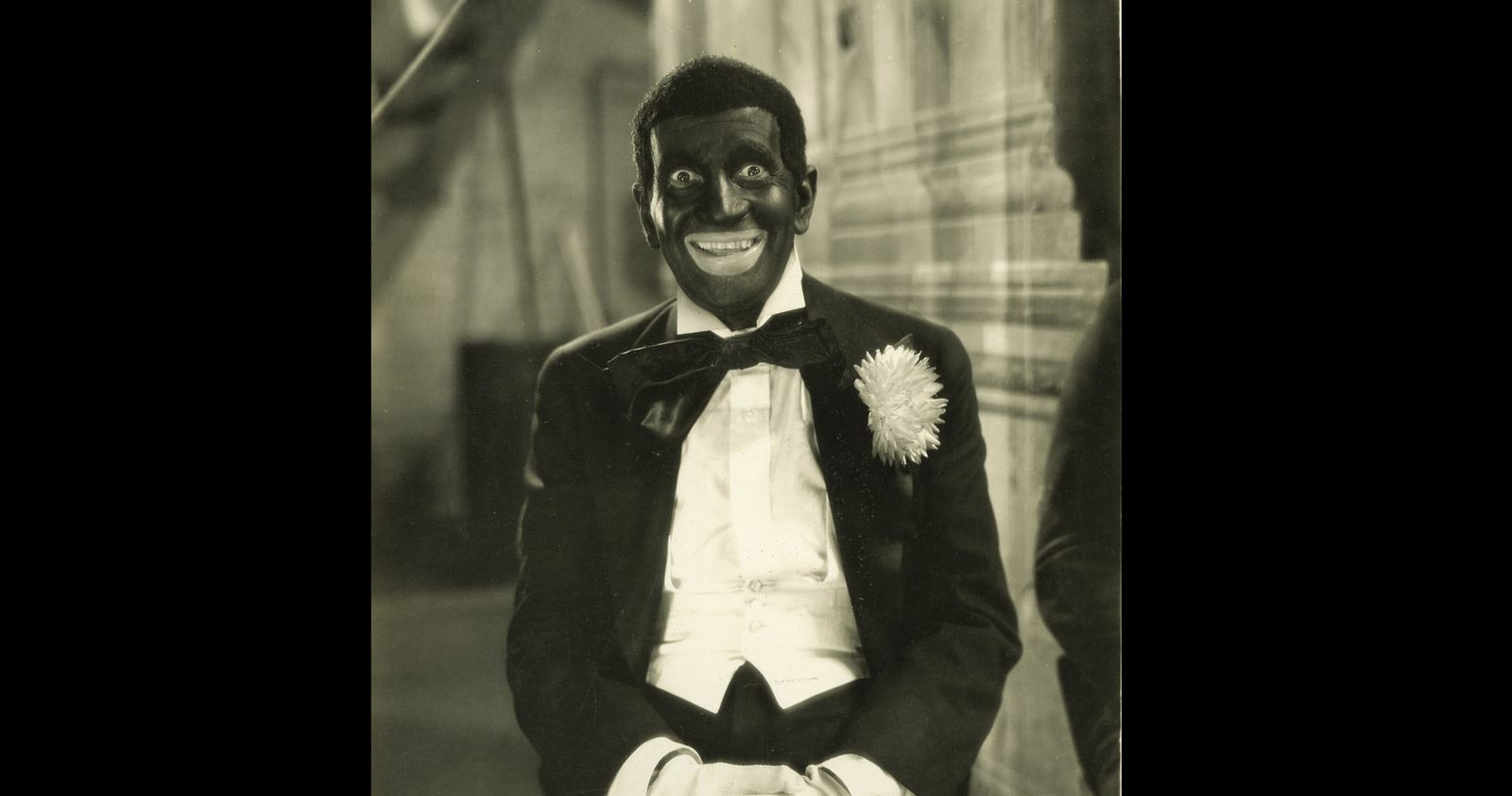
Except that what we’re talking about here isn’t “real” blackface in the style of, say, Al Jolson in Mammy (1930) or Justin Trudeau at his infamous “Arabian Nights” party in Vancouver (2001).
Instead, what Sarah gets is a miniature jet-black cosmetic goalie mask with eye holes and liquid-paper-white lips. Only half her face is covered. Yet Sarah looks in the mirror and ludicrously imagines that she’ll fool the world: “I look like the beautiful Queen Latifah!”
Just to be clear, I’m not arguing that Silverman should have gotten a pass on wearing blackface in Face Wars because she painted only half her face. Rather, I’m arguing that Silverman should have gotten a pass on wearing blackface in Face Wars because her character’s use of blackface is depicted as a reflection of her ignorance and egomania.
And also because it’s absolutely hilarious.
Anyway, as soon as Black Sarah steps out into the world, she’s immediately excoriated by random pedestrians who find her blackface offensive. But she’s so dumb that she thinks these people are actually virulent racists who are haranguing her because they sincerely believe she’s black.
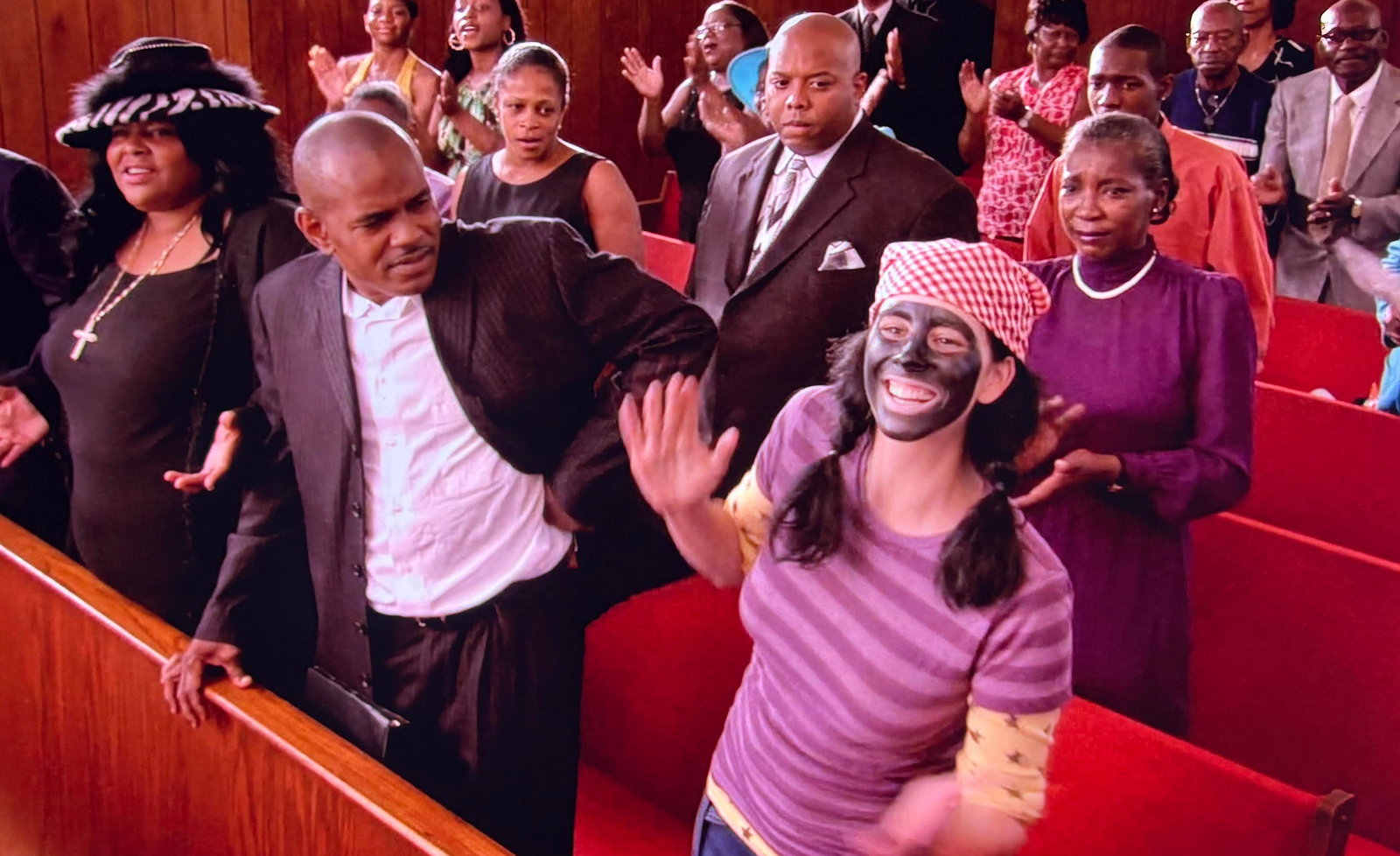
Even more ludicrously, she begins to identify as an actual black person (“I had no idea how cruel white people could be to us”). Seeking to be with her “own kind,” she flees into an all-black Baptist church where she begins vigorously chanting along with the African-American gospel anthem Victory Is Mine. I shouldn’t have to add that she then jumps up on stage in an attempt to outshine the black singers, whereupon she gets unceremoniously thrown out.
Unlike Sarah Silverman’s in-show character, I’m not (completely) clueless. Blackface is a racist cultural institution. As an exhibit at the National Museum of African American History and Culture puts it, it reflected a tradition of “racial derision and stereotyping,” which presented African Americans as “lazy, ignorant, superstitious, hypersexual, and prone to thievery and cowardice.” I understand why even decades-old old frat-party pictures of politicians in blackface are treated as scandalous—and why Comedy Central and other content providers would now want to purge blackface-themed shows from their online offerings.
Except, here’s the thing: Literally everything I just wrote in the paragraph above also serves to explain why Face Wars succeeds as gonzo humour.
Ultimately, character-driven comedy always follows the same pattern, wherein a common human vice or frailty we recognise from daily life—greed, sloth, vanity, gluttony, paranoia, bigotry, anxiety, self-pity—is extrapolated into the realm of the absurd. In the case of Sarah’s affliction, ignorant self-absorption, this process of comic extrapolation calls for scripted scenes in which the character is made to blithely say and do things that bystanders find offensive or shocking. Because that’s what ignorant self-absorbed people do. And there isn’t much that’s more offensive and shocking than blackface.
It’s also worth noting that while Face Wars may sound like nothing more than an extended one-joke comedy sketch, the episode ends in a clever way that qualifies it as bona fide social satire.
Having been cast out onto the street—“forsaken by my own people”—Sarah resolves to give up on race-shifting. “I’m done with it,” she tells a random middle-aged female pedestrian. “There’s nothing harder in the world than being black.”
“Exactly!” the (unnamed) white woman responds, “which is why you can’t stop now! You see, I get what you’re doing. You’re starting a dialogue about race, and I think it’s fantastic.”
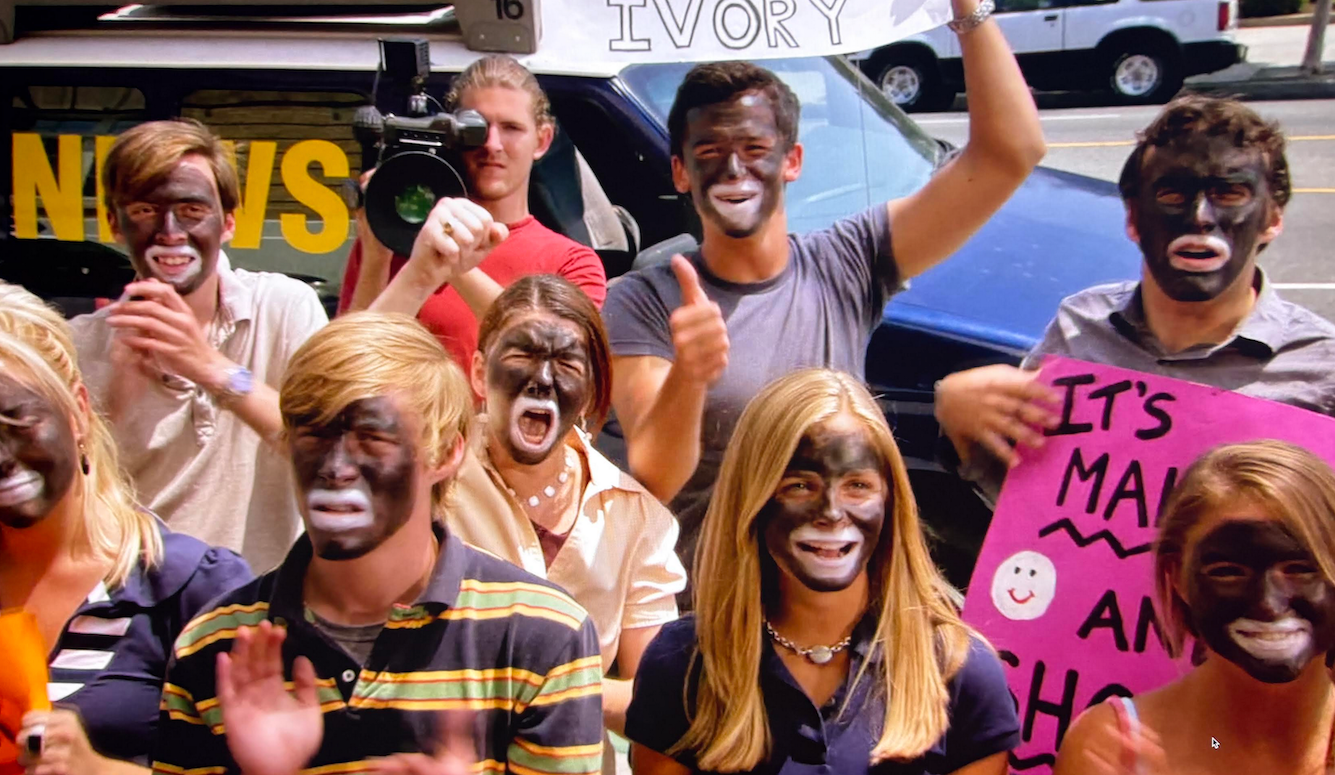
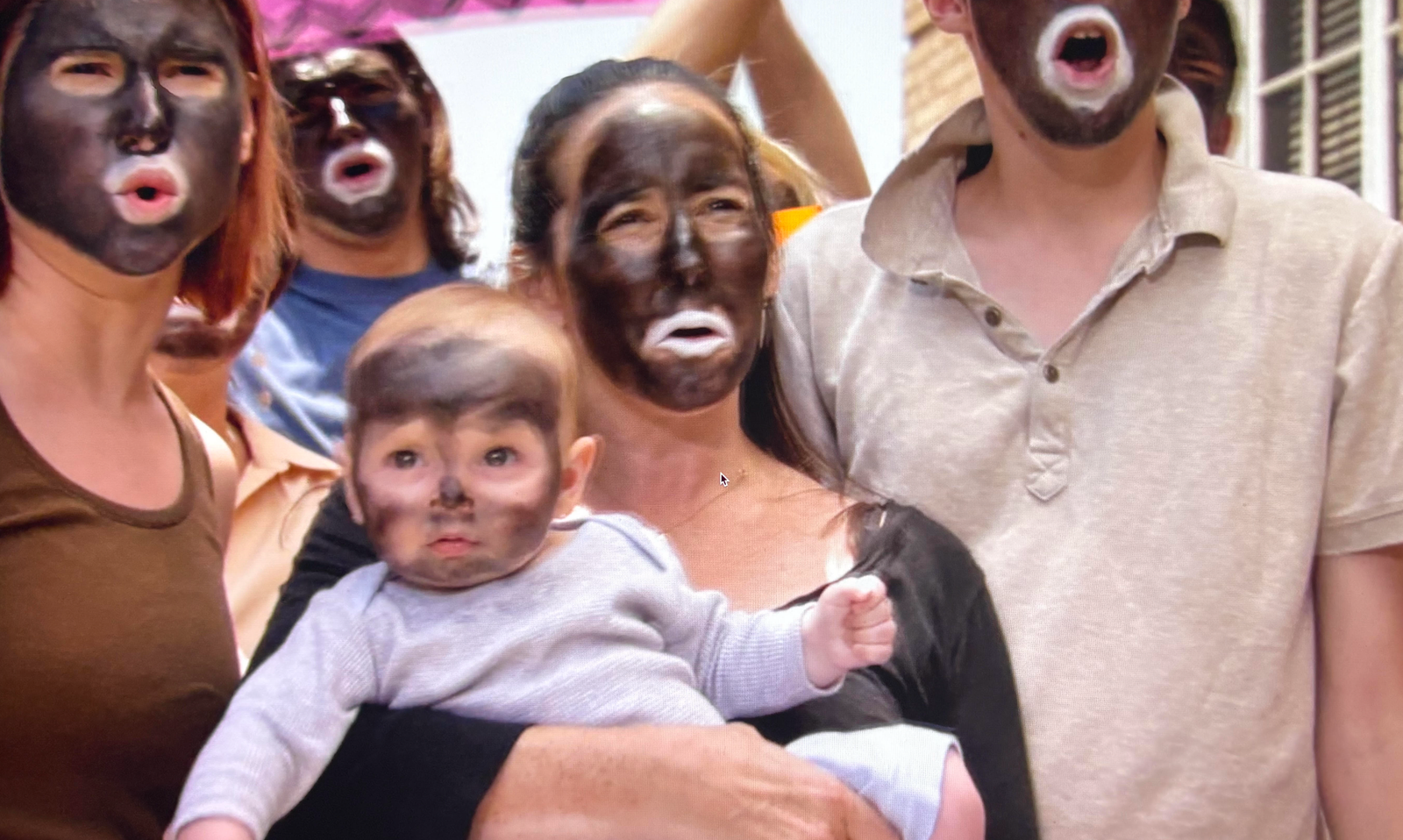
Needless to say, Sarah leans heavily into this new role as race activist (or as she calls herself, an “angry black woman”). After a few other twists and turns, she ends up outside a police station, delivering a consciousness-raising lecture to an audience of anti-racist supporters who want to be part of her bold racial “dialogue.” Every person in the crowd is white, and they’re all wearing blackface. Signs include “Ebony IS Ivory,” and “Black-faced Americans UNITED.”
“I don’t want to compare myself to Abraham Lincoln, but there are some common factors,” Sarah tells an interviewer. “We are both white people fighting for the rights of African Americans. And we are both attracted to men.”
She then turns to the camera and says, “I encourage people to join me in this [blackface] movement. It’s a great way to contribute to society without taking away any of your ‘me time.’ It’s kind of a throw-it-on-and-set-it-and-forget-it kind of bag. Plus, I find it kind of moisturises.”
What you come to realise by the time the credits roll is that it isn’t just Sarah who’s the butt of her joke, but self-satisfied white American progressives more generally. Meanwhile, the black characters in the episode are mostly in the background—exasperated straight men (in the comedic idiom), rolling their eyes as Sarah and her friends make face-painted jackasses of themselves. That doesn’t seem very racist to me.
It’s worth reminding ourselves that Silverman filmed this episode almost twenty years ago—before anyone knew what a hashtag was. Face Wars anticipated the lazy virtue-signalling approach to social justice that would go mainstream a decade later, including (perhaps especially) among her Hollywood friends. What a shame that she’d eventually find herself apologising for this remarkable social clairvoyance.
Epilogue: In the last scene, Sarah is alone at home with Doug, her dog, reflecting on all the profound lessons she’s learned about race in America—and her own racial enlightenment.
“You’re black, Doug, and [yet] I love you to pieces,” Sarah says airily.
“Though I never really think of you as black,” she adds.
“That’s because your hair is straight.”
Quillette invites thoughtful responses to its essays.
Selected responses are published once per week as part of a curated Letters to the Editor feature. If selected, letters appear under the contributor’s real name and may be edited for clarity and length.
To submit a letter for consideration, please email [email protected].
Read the full article here
Fact Checker
Verify the accuracy of this article using AI-powered analysis and real-time sources.