Close Menu
FSNN | Free Speech News NetworkFSNN | Free Speech News Network
  • Home
  • News
    • Politics
    • Legal & Courts
    • Tech & Big Tech
    • Campus & Education
    • Media & Culture
    • Global Free Speech
  • Opinions
    • Debates
  • Video/Live
  • Community
  • Freedom Index
  • About
    • Mission
    • Contact
    • Support
Trending

Nomura-backed Laser Digital wins Japan's first crypto approval in four years

14 minutes ago

Binance says employees questioned in UAE cleared and released

18 minutes ago

Bitcoin Climbs Higher as $1.2 Billion in Shorts Liquidated

19 minutes ago
Facebook X (Twitter) Instagram
Facebook X (Twitter) Discord Telegram
FSNN | Free Speech News NetworkFSNN | Free Speech News Network
Market Data Newsletter
Friday, August 21
  • Home
  • News
    • Politics
    • Legal & Courts
    • Tech & Big Tech
    • Campus & Education
    • Media & Culture
    • Global Free Speech
  • Opinions
    • Debates
  • Video/Live
  • Community
  • Freedom Index
  • About
    • Mission
    • Contact
    • Support
FSNN | Free Speech News NetworkFSNN | Free Speech News Network
Home»News»Global Free Speech»The Bangladeshi army stands guard at the Prothom Alo daily newspaper offices which were set ablaze during protests. Photo: AP Photo/Mahmud Hossain Opu/Alamy This article first appeared in the Spring 2026 issue of Index on Censorship, The monster unleashed: How Hungary’s illiberal vision is seducing the Western world published on 2 April 2026. Smoke rose from two buildings late in the Dhaka night, thick and bitter, flames leaping through the shattered windows and gutting newsrooms. Outside, on Kazi Nazrul Islam Avenue and inbang the heart of Karwan Bazar on the night of 18 December 2025, hundreds of people surged forward, chanting, jeering and hurling stones at the offices of Bangladesh’s premier dailies – the Bengali Prothom Alo (First Light) and the English-language Daily Star. Representing the liberal, secular voice of an increasingly divided Bangladesh, editors and journalists at the two newspapers have faced legal attacks from the government and threats of violence. They have also had threats from sections of the general public. By nightfall, the glass frontage of Prothom Alo’s offices had been smashed. Inside, smoke spread rapidly through the newsroom, curling around desks where reporters had been editing copy only hours earlier. Journalists and staff scrambled for exits as the fire took hold on the lower floors of the building. Across the city, at The Daily Star’s headquarters, a similar scene was unfolding: stones hurled through windows, vehicles torched, entrances blocked and journalists trapped inside as smoke filled stairwells. Videos posted online showed flames licking at the building’s interior as staff shouted for help from the upper floors. From a neighbouring high-rise, senior Prothom Alo reporter Galib Ashraf watched helplessly as the conflagration gutted the newsroom that had been his professional home for years. “This wasn’t just a building burning,” he told journalists later. “It was our history going up in smoke.” The acrid smell of burning paper was mixed with fear as glass crunched underfoot and sirens wailed in the distance. For journalists inside the buildings, the experience was visceral. For those watching from outside – fellow reporters, photographers, passers-by – the message was unmistakable. In Bangladesh, even the largest and most established newsrooms were vulnerable to attack. A month later, when Index visited the charred remains of the two offices, a yellow tape surrounded the building, marking the scene of a crime. Veteran journalist Matiur Rahman, editor of Prothom Alo, forced a smile. “We reached out to everyone that night for help,” he said. On the night of the fire, several journalists at The Daily Star found themselves trapped in their offices. The only escape route was upwards, to the rooftop. One reporter, Zyma Islam, posted on Facebook from inside, her words chilling in their simplicity: “I can’t breathe anymore … there’s too much smoke … I am inside.” Some reporters feared that they would die. Mahfuz Anam, editor of the Daily Star told Index that if he had been around, he would have been lynched. He, too, tried reaching out to the authorities. Whilst everyone was sympathetic, it took a long time for help to arrive. The need for a new leader There was an acute sense of betrayal also hanging in the air when Index visited the offices of the two newspapers. Both Prothom Alo and The Daily Star had argued for a more liberal political order in Bangladesh. In August 2024, the Prime Minister Sheikh Hasina had fled the country when her government agents killed more than 800 student demonstrators. Like many of the country’s educated and middle classes, journalists felt Bangladesh needed a new leader known for probity, someone like the Nobel Laureate Muhammed Yunus. The newspapers supported Yunus, who was known for his pioneering microlending work in Bangladesh, specifically to support indigenous trading women. The fact that he had been persecuted and by Hasina added to his credibility. So there was considerable enthusiasm when he agreed to become the chief adviser of the interim government, the de facto prime minister until elections were held. But his political choices stunned people. Even while expressing faith in the youth, he blindsided the female student leaders responsible for the uprising that felled Hasina by letting the misogynistic Jamaat-e-Islami party dictate terms. Sheikh Hasina had banned the Jamaat, but following her ousting, the Jamaat had a new lease of life and was going to contest the February elections. Disappointed women leaders of the movement left the newly-formed National Citizen Party that the students had formed. Many felt that Yunus had betrayed their hopes. On the night of the attacks, the editors and senior journalists, including editors of rival newspapers, made frantic calls to Yunus and his advisers, as well as senior government officials, pleading for help. None came for a long time – both offices had been reduced to burnt-out shells before the fires were brought under control. There was no explanation forthcoming as to why the police did not arrive at the two newspaper offices, in the heart of Dhaka, to stop the mob before the crowds grew in size. The Daily Star was founded in 1991, two decades after the brutal civil war against Pakistan that led to Bangladesh’s independence – albeit at the cost of hundreds of thousands of lives. Prothom Alo was formed in 1998. The two newspapers have long been recognised as constructive critics of the governments of the day. While both have been accused of pro-India and anti-fundamentalist bias, they are both in fact remarkably independent. Nothing demonstrates this clearer than their dexterous navigation of the tortuous turns of Bangladeshi politics, characterised until recently by the Manichaean divide between the Awami League and the Bangladesh Nationalist Party (BNP) which each took turns holding power since Bangladesh’s independence in 1971. The night the presses stopped The December night of the fires, one of the darkest in the history of newspaper publishing in Bangladesh, was not merely a picture of chaos, it was the symbolic decapitation of independent journalism in Bangladesh. The two newspapers were forced to suspend their print editions, Prothom Alo for the first time in nearly three decades and The Daily Star for the first time in its 35-year existence. Martial law, threats of lawsuits and the arrests and disappearances of reporters hadn’t silenced them. But a mob did succeed where others had failed, even if only for one night. The mobs that converged on Dhaka’s media hubs did not emerge from a vacuum. The proximate cause of the confrontation was the assassination of a student leader, Sharif Osman Hadi, who was the spokesperson for Inquilab Mancha, Platform of the Revolution, which had emerged from the student-led uprising. His killers are still at large. But that anger was quickly and violently redirected at the press. Mobs accused the two newspapers of political bias, branding them “India-backed” and loyal to Hasina. Human rights and press bodies across the world condemned the attacks, not as isolated incidents but rather as symptoms of a deeper malaise. Irene Khan, the UN Special Rapporteur for freedom of expression and opinion, called the arson attacks ‘deeply alarming,’ expressing her outrage over ‘orchestrated mob violence.’ Bangladesh’s media landscape had been corroded for years by oppressive laws, intimidation and impunity. Whilst the arson attacks were dramatic, they were not anomalous. They were the logical culmination of a long, grinding war on free expression in Bangladesh. The erosion began with fear. For more than a decade, Bangladesh has stayed in the bottom quartile of global press freedom rankings (in 2025, it ranked 149th out of 180 countries surveyed by Reporters Without Borders). Editors came to understand which stories would invite legal trouble. Reporters learned when not to quote certain sources. Bloggers discovered that a Facebook post could carry the same risks as an investigative exposé. Some were hacked to death, and many fled to safety, seeking asylum abroad. Digital dissent A major turning point came in 2018, with the enactment of the Digital Security Act (DSA) – a broad and vaguely worded law ostensibly aimed at combating cybercrime and digital harm. In practice, it became a powerful tool for muzzling dissent. The Act’s provisions criminalised a wide range of speech perceived as “false” or “offensive”, leaving journalists, social-media users and activists vulnerable to long jail terms and heavy fines. Rights groups warned early on that the law could and would be abused to silence critics. One of the most emblematic cases involved Shamsuzzaman Shams, a reporter for Prothom Alo arrested in 2023 after writing about rising food prices. The Hasina government charged him under the DSA with spreading “false news”. Nearly 3,000 people, including hundreds of journalists, have been charged under the Act since it was passed into law – this in a country whose constitution guarantees freedom of expression. The DSA’s broad reach is part of a larger pattern, wherein legal mechanisms intended to protect citizens instead serve as implements of fear and silence. In 2020, cartoonist Ahmed Kabir Kishore, for example, spent 10 months in pre-trial detention under the DSA on account of his satirical work, drawing international condemnation for his treatment. The writer Mushtaq Ahmed died in jail in 2021. He had criticised the government’s handling of the pandemic and died of a heart attack, although his supporters and lawyers, including the co-accused, said he had been tortured in jail. Beyond arrests and lawsuits, the threat of violence hangs like Damocles’ sword over independent voices. One of the starkest and most haunting chapters in Bangladesh’s press freedom story is the disappearance of journalists – most notoriously that of Shafiqul Islam Kajol, a photojournalist and editor who vanished in March 2020. Kajol was last seen leaving his Dhaka home a day after being charged under the DSA with a defamation suit, filed by an Awami League politician. CCTV footage showed unidentified men tampering with his motorcycle before he disappeared. Kajol’s family suspected abduction; rights groups demanded investigations that never yielded closure. Authorities denied he was in custody. When Kajol was eventually found, with his hands and feet tied, near the Indian border, Bangladeshi authorities arrested him for trespassing. A narrowing conversation These attacks and deaths are horrifying reminders that journalists and independent thinkers constantly face mortal danger in Bangladesh for the very act of thinking and speaking freely. When journalists fear for their safety and media houses are targets of mob violence, the public conversation narrows. Citizens lose access to independent verification of facts, analysis and accountability reporting, making it easier for misinformation to flourish In the elections in February 2026, the Bangladesh Nationalist Party (BNP) led by former Prime Minister Khaleda Zia’s son, Tarique Rahman, secured a two-thirds majority in parliamentary seats, with their rivals the Awami League not allowed to stand, and Jamaat performing much less well than people had feared. While the BNP’s manifesto has spoken of upholding press freedom, in the binary nature of Bangladeshi politics, it might in fact mean that publications suppressed under the Awami League will have greater freedom – while publications that opposed the BNP might find that not much has changed. A newspaper which BNP leader Rahman was involved with was accused of running campaigns against atheist bloggers. What distinguishes the recent attacks on Prothom Alo and The Daily Star however was not merely their scale, but their symbolism. This was censorship by arson, carried out not by the state directly, but by crowds emboldened by years of official hostility. When governments describe journalists as enemies, traitors or foreign agents, they license others to act accordingly. When attacks on critics of the government are normalised, the moral fabric of society frays. Bengal is the culture of patrikas, pamphlets penned by intellectuals to defy orthodoxy. Shut them down, and it becomes a lesser Bengal. When voices are silenced or endangered, the very sense of a collective narrative – of what holds a diverse nation together – is weakened. READ MORE
Global Free Speech

The Bangladeshi army stands guard at the Prothom Alo daily newspaper offices which were set ablaze during protests. Photo: AP Photo/Mahmud Hossain Opu/Alamy This article first appeared in the Spring 2026 issue of Index on Censorship, The monster unleashed: How Hungary’s illiberal vision is seducing the Western world published on 2 April 2026. Smoke rose from two buildings late in the Dhaka night, thick and bitter, flames leaping through the shattered windows and gutting newsrooms. Outside, on Kazi Nazrul Islam Avenue and inbang the heart of Karwan Bazar on the night of 18 December 2025, hundreds of people surged forward, chanting, jeering and hurling stones at the offices of Bangladesh’s premier dailies – the Bengali Prothom Alo (First Light) and the English-language Daily Star. Representing the liberal, secular voice of an increasingly divided Bangladesh, editors and journalists at the two newspapers have faced legal attacks from the government and threats of violence. They have also had threats from sections of the general public. By nightfall, the glass frontage of Prothom Alo’s offices had been smashed. Inside, smoke spread rapidly through the newsroom, curling around desks where reporters had been editing copy only hours earlier. Journalists and staff scrambled for exits as the fire took hold on the lower floors of the building. Across the city, at The Daily Star’s headquarters, a similar scene was unfolding: stones hurled through windows, vehicles torched, entrances blocked and journalists trapped inside as smoke filled stairwells. Videos posted online showed flames licking at the building’s interior as staff shouted for help from the upper floors. From a neighbouring high-rise, senior Prothom Alo reporter Galib Ashraf watched helplessly as the conflagration gutted the newsroom that had been his professional home for years. “This wasn’t just a building burning,” he told journalists later. “It was our history going up in smoke.” The acrid smell of burning paper was mixed with fear as glass crunched underfoot and sirens wailed in the distance. For journalists inside the buildings, the experience was visceral. For those watching from outside – fellow reporters, photographers, passers-by – the message was unmistakable. In Bangladesh, even the largest and most established newsrooms were vulnerable to attack. A month later, when Index visited the charred remains of the two offices, a yellow tape surrounded the building, marking the scene of a crime. Veteran journalist Matiur Rahman, editor of Prothom Alo, forced a smile. “We reached out to everyone that night for help,” he said. On the night of the fire, several journalists at The Daily Star found themselves trapped in their offices. The only escape route was upwards, to the rooftop. One reporter, Zyma Islam, posted on Facebook from inside, her words chilling in their simplicity: “I can’t breathe anymore … there’s too much smoke … I am inside.” Some reporters feared that they would die. Mahfuz Anam, editor of the Daily Star told Index that if he had been around, he would have been lynched. He, too, tried reaching out to the authorities. Whilst everyone was sympathetic, it took a long time for help to arrive. The need for a new leader There was an acute sense of betrayal also hanging in the air when Index visited the offices of the two newspapers. Both Prothom Alo and The Daily Star had argued for a more liberal political order in Bangladesh. In August 2024, the Prime Minister Sheikh Hasina had fled the country when her government agents killed more than 800 student demonstrators. Like many of the country’s educated and middle classes, journalists felt Bangladesh needed a new leader known for probity, someone like the Nobel Laureate Muhammed Yunus. The newspapers supported Yunus, who was known for his pioneering microlending work in Bangladesh, specifically to support indigenous trading women. The fact that he had been persecuted and by Hasina added to his credibility. So there was considerable enthusiasm when he agreed to become the chief adviser of the interim government, the de facto prime minister until elections were held. But his political choices stunned people. Even while expressing faith in the youth, he blindsided the female student leaders responsible for the uprising that felled Hasina by letting the misogynistic Jamaat-e-Islami party dictate terms. Sheikh Hasina had banned the Jamaat, but following her ousting, the Jamaat had a new lease of life and was going to contest the February elections. Disappointed women leaders of the movement left the newly-formed National Citizen Party that the students had formed. Many felt that Yunus had betrayed their hopes. On the night of the attacks, the editors and senior journalists, including editors of rival newspapers, made frantic calls to Yunus and his advisers, as well as senior government officials, pleading for help. None came for a long time – both offices had been reduced to burnt-out shells before the fires were brought under control. There was no explanation forthcoming as to why the police did not arrive at the two newspaper offices, in the heart of Dhaka, to stop the mob before the crowds grew in size. The Daily Star was founded in 1991, two decades after the brutal civil war against Pakistan that led to Bangladesh’s independence – albeit at the cost of hundreds of thousands of lives. Prothom Alo was formed in 1998. The two newspapers have long been recognised as constructive critics of the governments of the day. While both have been accused of pro-India and anti-fundamentalist bias, they are both in fact remarkably independent. Nothing demonstrates this clearer than their dexterous navigation of the tortuous turns of Bangladeshi politics, characterised until recently by the Manichaean divide between the Awami League and the Bangladesh Nationalist Party (BNP) which each took turns holding power since Bangladesh’s independence in 1971. The night the presses stopped The December night of the fires, one of the darkest in the history of newspaper publishing in Bangladesh, was not merely a picture of chaos, it was the symbolic decapitation of independent journalism in Bangladesh. The two newspapers were forced to suspend their print editions, Prothom Alo for the first time in nearly three decades and The Daily Star for the first time in its 35-year existence. Martial law, threats of lawsuits and the arrests and disappearances of reporters hadn’t silenced them. But a mob did succeed where others had failed, even if only for one night. The mobs that converged on Dhaka’s media hubs did not emerge from a vacuum. The proximate cause of the confrontation was the assassination of a student leader, Sharif Osman Hadi, who was the spokesperson for Inquilab Mancha, Platform of the Revolution, which had emerged from the student-led uprising. His killers are still at large. But that anger was quickly and violently redirected at the press. Mobs accused the two newspapers of political bias, branding them “India-backed” and loyal to Hasina. Human rights and press bodies across the world condemned the attacks, not as isolated incidents but rather as symptoms of a deeper malaise. Irene Khan, the UN Special Rapporteur for freedom of expression and opinion, called the arson attacks ‘deeply alarming,’ expressing her outrage over ‘orchestrated mob violence.’ Bangladesh’s media landscape had been corroded for years by oppressive laws, intimidation and impunity. Whilst the arson attacks were dramatic, they were not anomalous. They were the logical culmination of a long, grinding war on free expression in Bangladesh. The erosion began with fear. For more than a decade, Bangladesh has stayed in the bottom quartile of global press freedom rankings (in 2025, it ranked 149th out of 180 countries surveyed by Reporters Without Borders). Editors came to understand which stories would invite legal trouble. Reporters learned when not to quote certain sources. Bloggers discovered that a Facebook post could carry the same risks as an investigative exposé. Some were hacked to death, and many fled to safety, seeking asylum abroad. Digital dissent A major turning point came in 2018, with the enactment of the Digital Security Act (DSA) – a broad and vaguely worded law ostensibly aimed at combating cybercrime and digital harm. In practice, it became a powerful tool for muzzling dissent. The Act’s provisions criminalised a wide range of speech perceived as “false” or “offensive”, leaving journalists, social-media users and activists vulnerable to long jail terms and heavy fines. Rights groups warned early on that the law could and would be abused to silence critics. One of the most emblematic cases involved Shamsuzzaman Shams, a reporter for Prothom Alo arrested in 2023 after writing about rising food prices. The Hasina government charged him under the DSA with spreading “false news”. Nearly 3,000 people, including hundreds of journalists, have been charged under the Act since it was passed into law – this in a country whose constitution guarantees freedom of expression. The DSA’s broad reach is part of a larger pattern, wherein legal mechanisms intended to protect citizens instead serve as implements of fear and silence. In 2020, cartoonist Ahmed Kabir Kishore, for example, spent 10 months in pre-trial detention under the DSA on account of his satirical work, drawing international condemnation for his treatment. The writer Mushtaq Ahmed died in jail in 2021. He had criticised the government’s handling of the pandemic and died of a heart attack, although his supporters and lawyers, including the co-accused, said he had been tortured in jail. Beyond arrests and lawsuits, the threat of violence hangs like Damocles’ sword over independent voices. One of the starkest and most haunting chapters in Bangladesh’s press freedom story is the disappearance of journalists – most notoriously that of Shafiqul Islam Kajol, a photojournalist and editor who vanished in March 2020. Kajol was last seen leaving his Dhaka home a day after being charged under the DSA with a defamation suit, filed by an Awami League politician. CCTV footage showed unidentified men tampering with his motorcycle before he disappeared. Kajol’s family suspected abduction; rights groups demanded investigations that never yielded closure. Authorities denied he was in custody. When Kajol was eventually found, with his hands and feet tied, near the Indian border, Bangladeshi authorities arrested him for trespassing. A narrowing conversation These attacks and deaths are horrifying reminders that journalists and independent thinkers constantly face mortal danger in Bangladesh for the very act of thinking and speaking freely. When journalists fear for their safety and media houses are targets of mob violence, the public conversation narrows. Citizens lose access to independent verification of facts, analysis and accountability reporting, making it easier for misinformation to flourish In the elections in February 2026, the Bangladesh Nationalist Party (BNP) led by former Prime Minister Khaleda Zia’s son, Tarique Rahman, secured a two-thirds majority in parliamentary seats, with their rivals the Awami League not allowed to stand, and Jamaat performing much less well than people had feared. While the BNP’s manifesto has spoken of upholding press freedom, in the binary nature of Bangladeshi politics, it might in fact mean that publications suppressed under the Awami League will have greater freedom – while publications that opposed the BNP might find that not much has changed. A newspaper which BNP leader Rahman was involved with was accused of running campaigns against atheist bloggers. What distinguishes the recent attacks on Prothom Alo and The Daily Star however was not merely their scale, but their symbolism. This was censorship by arson, carried out not by the state directly, but by crowds emboldened by years of official hostility. When governments describe journalists as enemies, traitors or foreign agents, they license others to act accordingly. When attacks on critics of the government are normalised, the moral fabric of society frays. Bengal is the culture of patrikas, pamphlets penned by intellectuals to defy orthodoxy. Shut them down, and it becomes a lesser Bengal. When voices are silenced or endangered, the very sense of a collective narrative – of what holds a diverse nation together – is weakened. READ MORE

News RoomBy News Room2 months agoNo Comments10 Mins Read8 Views
Share Facebook Twitter Pinterest Copy Link LinkedIn Tumblr Email VKontakte Telegram
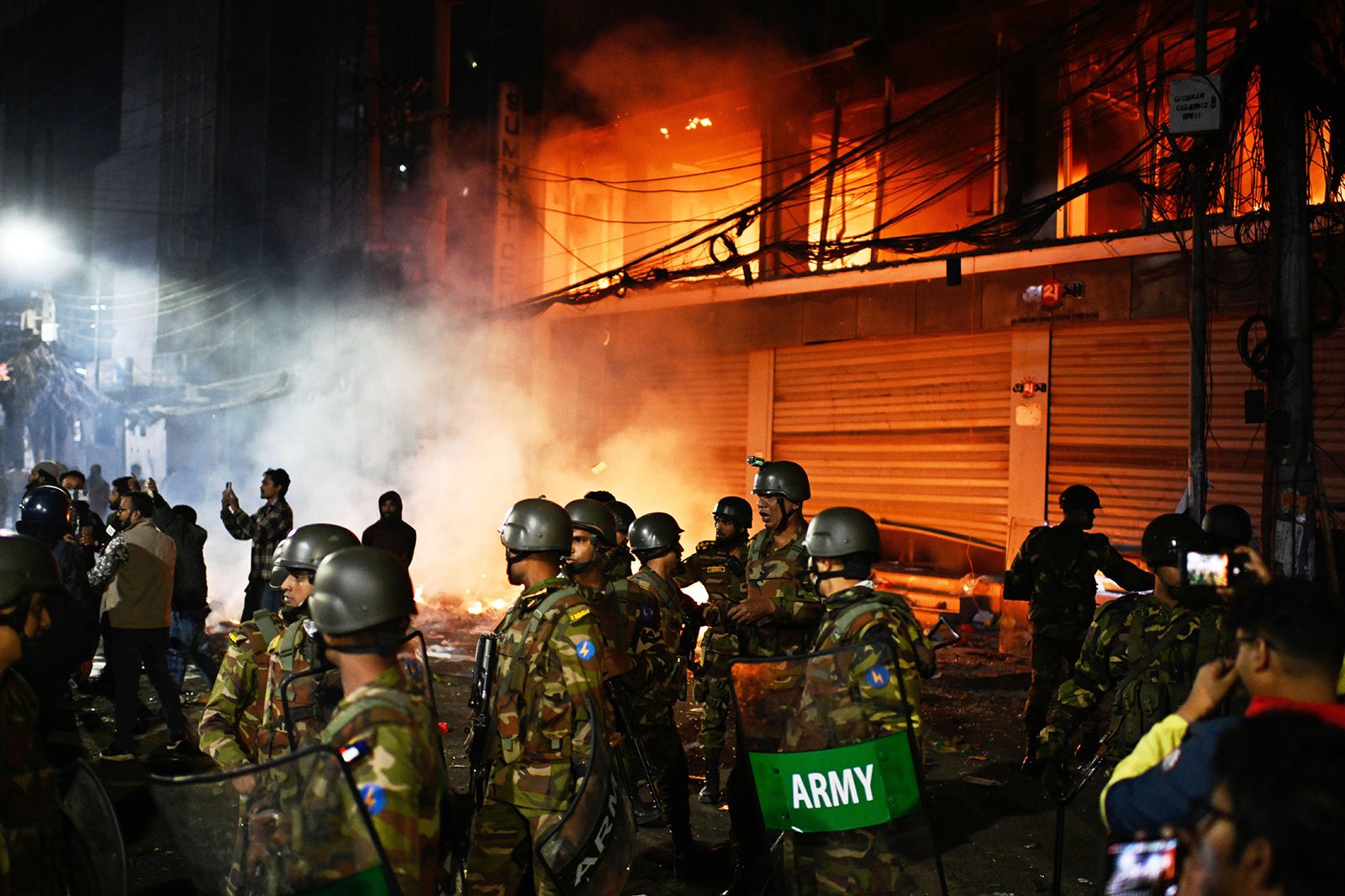
The Bangladeshi army stands guard at the Prothom Alo daily newspaper offices which were set ablaze during protests. Photo: AP Photo/Mahmud Hossain Opu/Alamy


				This article first appeared in the Spring 2026 issue of Index on Censorship, The monster unleashed: How Hungary’s illiberal vision is seducing the Western world published on 2 April 2026.
Smoke rose from two buildings late in the Dhaka night, thick and bitter, flames leaping through the shattered windows and gutting newsrooms. Outside, on Kazi Nazrul Islam Avenue and inbang the heart of Karwan Bazar on the night of 18 December 2025, hundreds of people surged forward, chanting, jeering and hurling stones at the offices of Bangladesh’s premier dailies – the Bengali Prothom Alo (First Light) and the English-language Daily Star. Representing the liberal, secular voice of an increasingly divided Bangladesh, editors and journalists at the two newspapers have faced legal attacks from the government and threats of violence. They have also had threats from sections of the general public.
By nightfall, the glass frontage of Prothom Alo’s offices had been smashed. Inside, smoke spread rapidly through the newsroom, curling around desks where reporters had been editing copy only hours earlier. Journalists and staff scrambled for exits as the fire took hold on the lower floors of the building. Across the city, at The Daily Star’s headquarters, a similar scene was unfolding: stones hurled through windows, vehicles torched, entrances blocked and journalists trapped inside as smoke filled stairwells. Videos posted online showed flames licking at the building’s interior as staff shouted for help from the upper floors.
From a neighbouring high-rise, senior Prothom Alo reporter Galib Ashraf watched helplessly as the conflagration gutted the newsroom that had been his professional home for years. “This wasn’t just a building burning,” he told journalists later. “It was our history going up in smoke.” The acrid smell of burning paper was mixed with fear as glass crunched underfoot and sirens wailed in the distance.
For journalists inside the buildings, the experience was visceral. For those watching from outside – fellow reporters, photographers, passers-by – the message was unmistakable. In Bangladesh, even the largest and most established newsrooms were vulnerable to attack.
A month later, when Index visited the charred remains of the two offices, a yellow tape surrounded the building, marking the scene of a crime. Veteran journalist Matiur Rahman, editor of Prothom Alo, forced a smile. “We reached out to everyone that night for help,” he said.
On the night of the fire, several journalists at The Daily Star found themselves trapped in their offices. The only escape route was upwards, to the rooftop. One reporter, Zyma Islam, posted on Facebook from inside, her words chilling in their simplicity: “I can’t breathe anymore … there’s too much smoke … I am inside.” Some reporters feared that they would die. Mahfuz Anam, editor of the Daily Star told Index that if he had been around, he would have been lynched. He, too, tried reaching out to the authorities. Whilst everyone was sympathetic, it took a long time for help to arrive.
The need for a new leader
There was an acute sense of betrayal also hanging in the air when Index visited the offices of the two newspapers. Both Prothom Alo and The Daily Star had argued for a more liberal political order in Bangladesh. In August 2024, the Prime Minister Sheikh Hasina had fled the country when her government agents killed more than 800 student demonstrators. Like many of the country’s educated and middle classes, journalists felt Bangladesh needed a new leader known for probity, someone like the Nobel Laureate Muhammed Yunus. The newspapers supported Yunus, who was known for his pioneering microlending work in Bangladesh, specifically to support indigenous trading women. The fact that he had been persecuted and by Hasina added to his credibility.
So there was considerable enthusiasm when he agreed to become the chief adviser of the interim government, the de facto prime minister until elections were held. But his political choices stunned people. Even while expressing faith in the youth, he blindsided the female student leaders responsible for the uprising that felled Hasina by letting the misogynistic Jamaat-e-Islami party dictate terms. Sheikh Hasina had banned the Jamaat, but following her ousting, the Jamaat had a new lease of life and was going to contest the February elections. Disappointed women leaders of the movement left the newly-formed National Citizen Party that the students had formed. Many felt that Yunus had betrayed their hopes.
On the night of the attacks, the editors and senior journalists, including editors of rival newspapers, made frantic calls to Yunus and his advisers, as well as senior government officials, pleading for help. None came for a long time – both offices had been reduced to burnt-out shells before the fires were brought under control. There was no explanation forthcoming as to why the police did not arrive at the two newspaper offices, in the heart of Dhaka, to stop the mob before the crowds grew in size.
The Daily Star was founded in 1991, two decades after the brutal civil war against Pakistan that led to Bangladesh’s independence – albeit at the cost of hundreds of thousands of lives. Prothom Alo was formed in 1998. The two newspapers have long been recognised as constructive critics of the governments of the day. While both have been accused of pro-India and anti-fundamentalist bias, they are both in fact remarkably independent. Nothing demonstrates this clearer than their dexterous navigation of the tortuous turns of Bangladeshi politics, characterised until recently by the Manichaean divide between the Awami League and the Bangladesh Nationalist Party (BNP) which each took turns holding power since Bangladesh’s independence in 1971.
The night the presses stopped
The December night of the fires, one of the darkest in the history of newspaper publishing in Bangladesh, was not merely a picture of chaos, it was the symbolic decapitation of independent journalism in Bangladesh. The two newspapers were forced to suspend their print editions, Prothom Alo for the first time in nearly three decades and The Daily Star for the first time in its 35-year existence. Martial law, threats of lawsuits and the arrests and disappearances of reporters hadn’t silenced them. But a mob did succeed where others had failed, even if only for one night.
The mobs that converged on Dhaka’s media hubs did not emerge from a vacuum. The proximate cause of the confrontation was the assassination of a student leader, Sharif Osman Hadi, who was the spokesperson for Inquilab Mancha, Platform of the Revolution, which had emerged from the student-led uprising. His killers are still at large. But that anger was quickly and violently redirected at the press. Mobs accused the two newspapers of political bias, branding them “India-backed” and loyal to Hasina.
Human rights and press bodies across the world condemned the attacks, not as isolated incidents but rather as symptoms of a deeper malaise. Irene Khan, the UN Special Rapporteur for freedom of expression and opinion, called the arson attacks ‘deeply alarming,’ expressing her outrage over ‘orchestrated mob violence.’
Bangladesh’s media landscape had been corroded for years by oppressive laws, intimidation and impunity. Whilst the arson attacks were dramatic, they were not anomalous. They were the logical culmination of a long, grinding war on free expression in Bangladesh.
The erosion began with fear. For more than a decade, Bangladesh has stayed in the bottom quartile of global press freedom rankings (in 2025, it ranked 149th out of 180 countries surveyed by Reporters Without Borders). Editors came to understand which stories would invite legal trouble. Reporters learned when not to quote certain sources. Bloggers discovered that a Facebook post could carry the same risks as an investigative exposé. Some were hacked to death, and many fled to safety, seeking asylum abroad.
Digital dissent
A major turning point came in 2018, with the enactment of the Digital Security Act (DSA) – a broad and vaguely worded law ostensibly aimed at combating cybercrime and digital harm. In practice, it became a powerful tool for muzzling dissent. The Act’s provisions criminalised a wide range of speech perceived as “false” or “offensive”, leaving journalists, social-media users and activists vulnerable to long jail terms and heavy fines. Rights groups warned early on that the law could and would be abused to silence critics.
One of the most emblematic cases involved Shamsuzzaman Shams, a reporter for Prothom Alo arrested in 2023 after writing about rising food prices. The Hasina government charged him under the DSA with spreading “false news”. Nearly 3,000 people, including hundreds of journalists, have been charged under the Act since it was passed into law – this in a country whose constitution guarantees freedom of expression.
The DSA’s broad reach is part of a larger pattern, wherein legal mechanisms intended to protect citizens instead serve as implements of fear and silence. In 2020, cartoonist Ahmed Kabir Kishore, for example, spent 10 months in pre-trial detention under the DSA on account of his satirical work, drawing international condemnation for his treatment. The writer Mushtaq Ahmed died in jail in 2021. He had criticised the government’s handling of the pandemic and died of a heart attack, although his supporters and lawyers, including the co-accused, said he had been tortured in jail.
Beyond arrests and lawsuits, the threat of violence hangs like Damocles’ sword over independent voices. One of the starkest and most haunting chapters in Bangladesh’s press freedom story is the disappearance of journalists – most notoriously that of Shafiqul Islam Kajol, a photojournalist and editor who vanished in March 2020. Kajol was last seen leaving his Dhaka home a day after being charged under the DSA with a defamation suit, filed by an Awami League politician. CCTV footage showed unidentified men tampering with his motorcycle before he disappeared. Kajol’s family suspected abduction; rights groups demanded investigations that never yielded closure. Authorities denied he was in custody. When Kajol was eventually found, with his hands and feet tied, near the Indian border, Bangladeshi authorities arrested him for trespassing.
A narrowing conversation
These attacks and deaths are horrifying reminders that journalists and independent thinkers constantly face mortal danger in Bangladesh for the very act of thinking and speaking freely. When journalists fear for their safety and media houses are targets of mob violence, the public conversation narrows. Citizens lose access to independent verification of facts, analysis and accountability reporting, making it easier for misinformation to flourish
In the elections in February 2026, the Bangladesh Nationalist Party (BNP) led by former Prime Minister Khaleda Zia’s son, Tarique Rahman, secured a two-thirds majority in parliamentary seats, with their rivals the Awami League not allowed to stand, and Jamaat performing much less well than people had feared.
While the BNP’s manifesto has spoken of upholding press freedom, in the binary nature of Bangladeshi politics, it might in fact mean that publications suppressed under the Awami League will have greater freedom – while publications that opposed the BNP might find that not much has changed. A newspaper which BNP leader Rahman was involved with was accused of running campaigns against atheist bloggers.
What distinguishes the recent attacks on Prothom Alo and The Daily Star however was not merely their scale, but their symbolism. This was censorship by arson, carried out not by the state directly, but by crowds emboldened by years of official hostility. When governments describe journalists as enemies, traitors or foreign agents, they license others to act accordingly.
When attacks on critics of the government are normalised, the moral fabric of society frays. Bengal is the culture of patrikas, pamphlets penned by intellectuals to defy orthodoxy. Shut them down, and it becomes a lesser Bengal. When voices are silenced or endangered, the very sense of a collective narrative – of what holds a diverse nation together – is weakened.


				READ MORE
Share
Facebook Twitter Pinterest Email Copy Link

Listen to the article

0:00
0:00

Key Takeaways

Playback Speed

Select a Voice

This article first appeared in the Spring 2026 issue of Index on Censorship, The monster unleashed: How Hungary’s illiberal vision is seducing the Western world published on 2 April 2026.

Smoke rose from two buildings late in the Dhaka night, thick and bitter, flames leaping through the shattered windows and gutting newsrooms. Outside, on Kazi Nazrul Islam Avenue and inbang the heart of Karwan Bazar on the night of 18 December 2025, hundreds of people surged forward, chanting, jeering and hurling stones at the offices of Bangladesh’s premier dailies – the Bengali Prothom Alo (First Light) and the English-language Daily Star. Representing the liberal, secular voice of an increasingly divided Bangladesh, editors and journalists at the two newspapers have faced legal attacks from the government and threats of violence. They have also had threats from sections of the general public.

By nightfall, the glass frontage of Prothom Alo’s offices had been smashed. Inside, smoke spread rapidly through the newsroom, curling around desks where reporters had been editing copy only hours earlier. Journalists and staff scrambled for exits as the fire took hold on the lower floors of the building. Across the city, at The Daily Star’s headquarters, a similar scene was unfolding: stones hurled through windows, vehicles torched, entrances blocked and journalists trapped inside as smoke filled stairwells. Videos posted online showed flames licking at the building’s interior as staff shouted for help from the upper floors.

From a neighbouring high-rise, senior Prothom Alo reporter Galib Ashraf watched helplessly as the conflagration gutted the newsroom that had been his professional home for years. “This wasn’t just a building burning,” he told journalists later. “It was our history going up in smoke.” The acrid smell of burning paper was mixed with fear as glass crunched underfoot and sirens wailed in the distance.

For journalists inside the buildings, the experience was visceral. For those watching from outside – fellow reporters, photographers, passers-by – the message was unmistakable. In Bangladesh, even the largest and most established newsrooms were vulnerable to attack.

A month later, when Index visited the charred remains of the two offices, a yellow tape surrounded the building, marking the scene of a crime. Veteran journalist Matiur Rahman, editor of Prothom Alo, forced a smile. “We reached out to everyone that night for help,” he said.

On the night of the fire, several journalists at The Daily Star found themselves trapped in their offices. The only escape route was upwards, to the rooftop. One reporter, Zyma Islam, posted on Facebook from inside, her words chilling in their simplicity: “I can’t breathe anymore … there’s too much smoke … I am inside.” Some reporters feared that they would die. Mahfuz Anam, editor of the Daily Star told Index that if he had been around, he would have been lynched. He, too, tried reaching out to the authorities. Whilst everyone was sympathetic, it took a long time for help to arrive.

The need for a new leader

There was an acute sense of betrayal also hanging in the air when Index visited the offices of the two newspapers. Both Prothom Alo and The Daily Star had argued for a more liberal political order in Bangladesh. In August 2024, the Prime Minister Sheikh Hasina had fled the country when her government agents killed more than 800 student demonstrators. Like many of the country’s educated and middle classes, journalists felt Bangladesh needed a new leader known for probity, someone like the Nobel Laureate Muhammed Yunus. The newspapers supported Yunus, who was known for his pioneering microlending work in Bangladesh, specifically to support indigenous trading women. The fact that he had been persecuted and by Hasina added to his credibility.

So there was considerable enthusiasm when he agreed to become the chief adviser of the interim government, the de facto prime minister until elections were held. But his political choices stunned people. Even while expressing faith in the youth, he blindsided the female student leaders responsible for the uprising that felled Hasina by letting the misogynistic Jamaat-e-Islami party dictate terms. Sheikh Hasina had banned the Jamaat, but following her ousting, the Jamaat had a new lease of life and was going to contest the February elections. Disappointed women leaders of the movement left the newly-formed National Citizen Party that the students had formed. Many felt that Yunus had betrayed their hopes.

On the night of the attacks, the editors and senior journalists, including editors of rival newspapers, made frantic calls to Yunus and his advisers, as well as senior government officials, pleading for help. None came for a long time – both offices had been reduced to burnt-out shells before the fires were brought under control. There was no explanation forthcoming as to why the police did not arrive at the two newspaper offices, in the heart of Dhaka, to stop the mob before the crowds grew in size.

The Daily Star was founded in 1991, two decades after the brutal civil war against Pakistan that led to Bangladesh’s independence – albeit at the cost of hundreds of thousands of lives. Prothom Alo was formed in 1998. The two newspapers have long been recognised as constructive critics of the governments of the day. While both have been accused of pro-India and anti-fundamentalist bias, they are both in fact remarkably independent. Nothing demonstrates this clearer than their dexterous navigation of the tortuous turns of Bangladeshi politics, characterised until recently by the Manichaean divide between the Awami League and the Bangladesh Nationalist Party (BNP) which each took turns holding power since Bangladesh’s independence in 1971.

The night the presses stopped

The December night of the fires, one of the darkest in the history of newspaper publishing in Bangladesh, was not merely a picture of chaos, it was the symbolic decapitation of independent journalism in Bangladesh. The two newspapers were forced to suspend their print editions, Prothom Alo for the first time in nearly three decades and The Daily Star for the first time in its 35-year existence. Martial law, threats of lawsuits and the arrests and disappearances of reporters hadn’t silenced them. But a mob did succeed where others had failed, even if only for one night.

The mobs that converged on Dhaka’s media hubs did not emerge from a vacuum. The proximate cause of the confrontation was the assassination of a student leader, Sharif Osman Hadi, who was the spokesperson for Inquilab Mancha, Platform of the Revolution, which had emerged from the student-led uprising. His killers are still at large. But that anger was quickly and violently redirected at the press. Mobs accused the two newspapers of political bias, branding them “India-backed” and loyal to Hasina.

Human rights and press bodies across the world condemned the attacks, not as isolated incidents but rather as symptoms of a deeper malaise. Irene Khan, the UN Special Rapporteur for freedom of expression and opinion, called the arson attacks ‘deeply alarming,’ expressing her outrage over ‘orchestrated mob violence.’

Bangladesh’s media landscape had been corroded for years by oppressive laws, intimidation and impunity. Whilst the arson attacks were dramatic, they were not anomalous. They were the logical culmination of a long, grinding war on free expression in Bangladesh.

The erosion began with fear. For more than a decade, Bangladesh has stayed in the bottom quartile of global press freedom rankings (in 2025, it ranked 149th out of 180 countries surveyed by Reporters Without Borders). Editors came to understand which stories would invite legal trouble. Reporters learned when not to quote certain sources. Bloggers discovered that a Facebook post could carry the same risks as an investigative exposé. Some were hacked to death, and many fled to safety, seeking asylum abroad.

Digital dissent

A major turning point came in 2018, with the enactment of the Digital Security Act (DSA) – a broad and vaguely worded law ostensibly aimed at combating cybercrime and digital harm. In practice, it became a powerful tool for muzzling dissent. The Act’s provisions criminalised a wide range of speech perceived as “false” or “offensive”, leaving journalists, social-media users and activists vulnerable to long jail terms and heavy fines. Rights groups warned early on that the law could and would be abused to silence critics.

One of the most emblematic cases involved Shamsuzzaman Shams, a reporter for Prothom Alo arrested in 2023 after writing about rising food prices. The Hasina government charged him under the DSA with spreading “false news”. Nearly 3,000 people, including hundreds of journalists, have been charged under the Act since it was passed into law – this in a country whose constitution guarantees freedom of expression.

The DSA’s broad reach is part of a larger pattern, wherein legal mechanisms intended to protect citizens instead serve as implements of fear and silence. In 2020, cartoonist Ahmed Kabir Kishore, for example, spent 10 months in pre-trial detention under the DSA on account of his satirical work, drawing international condemnation for his treatment. The writer Mushtaq Ahmed died in jail in 2021. He had criticised the government’s handling of the pandemic and died of a heart attack, although his supporters and lawyers, including the co-accused, said he had been tortured in jail.

Beyond arrests and lawsuits, the threat of violence hangs like Damocles’ sword over independent voices. One of the starkest and most haunting chapters in Bangladesh’s press freedom story is the disappearance of journalists – most notoriously that of Shafiqul Islam Kajol, a photojournalist and editor who vanished in March 2020. Kajol was last seen leaving his Dhaka home a day after being charged under the DSA with a defamation suit, filed by an Awami League politician. CCTV footage showed unidentified men tampering with his motorcycle before he disappeared. Kajol’s family suspected abduction; rights groups demanded investigations that never yielded closure. Authorities denied he was in custody. When Kajol was eventually found, with his hands and feet tied, near the Indian border, Bangladeshi authorities arrested him for trespassing.

A narrowing conversation

These attacks and deaths are horrifying reminders that journalists and independent thinkers constantly face mortal danger in Bangladesh for the very act of thinking and speaking freely. When journalists fear for their safety and media houses are targets of mob violence, the public conversation narrows. Citizens lose access to independent verification of facts, analysis and accountability reporting, making it easier for misinformation to flourish

In the elections in February 2026, the Bangladesh Nationalist Party (BNP) led by former Prime Minister Khaleda Zia’s son, Tarique Rahman, secured a two-thirds majority in parliamentary seats, with their rivals the Awami League not allowed to stand, and Jamaat performing much less well than people had feared.
While the BNP’s manifesto has spoken of upholding press freedom, in the binary nature of Bangladeshi politics, it might in fact mean that publications suppressed under the Awami League will have greater freedom – while publications that opposed the BNP might find that not much has changed. A newspaper which BNP leader Rahman was involved with was accused of running campaigns against atheist bloggers.

What distinguishes the recent attacks on Prothom Alo and The Daily Star however was not merely their scale, but their symbolism. This was censorship by arson, carried out not by the state directly, but by crowds emboldened by years of official hostility. When governments describe journalists as enemies, traitors or foreign agents, they license others to act accordingly.

When attacks on critics of the government are normalised, the moral fabric of society frays. Bengal is the culture of patrikas, pamphlets penned by intellectuals to defy orthodoxy. Shut them down, and it becomes a lesser Bengal. When voices are silenced or endangered, the very sense of a collective narrative – of what holds a diverse nation together – is weakened.

Read the full article here

Fact Checker

Verify the accuracy of this article using AI-powered analysis and real-time sources.

Get Your Fact Check Report

Enter your email to receive detailed fact-checking analysis

5 free reports remaining

Continue with Full Access

You've used your 5 free reports. Sign up for unlimited access!

Already have an account? Sign in here

Share. Facebook Twitter Pinterest LinkedIn Tumblr Email Telegram Copy Link
News Room
  • Website
  • Facebook
  • X (Twitter)
  • Instagram
  • LinkedIn

The FSNN News Room is the voice of our in-house journalists, editors, and researchers. We deliver timely, unbiased reporting at the crossroads of finance, cryptocurrency, and global politics, providing clear, fact-driven analysis free from agendas.

Related Articles

Global Free Speech

  Chow Hang-tung and Lee Cheuk-yan, co-leaders of the now disbanded Hong Kong Alliance in Support of Patriotic Democratic Movements of China (HKA) were found guilty today (21 August 2026) of incitement to subversion, because they organised vigils attended by tens of thousands in Hong Kong’s Victoria Park to mark the 1989 Tiananmen Square massacre. The vigils were banned in 2020 and both have been detained since 2021. Below is a translation of Chow Hang-tung’s message to the world, published yesterday I’m curious about tomorrow’s verdict. Justice resides in the hearts of the people; there’s no need to look up to such top-down judgments. One verdict is nothing. Thank you all for walking alongside me in different ways. I have received all your support and blessings. ************ Because I don’t want everyone to worry too much, and I don’t want the focus to be lost, I’m sharing these feelings that have been weighing on my mind since the trial: Several years ago, I made a documentary with friends, trying to visualise the issue of torture by inviting Hong Kong friends to experience the various forms of torture suffered by protesters in China, so that it wouldn’t just remain a “tragedy” on paper. The “torture” depicted in the film was designed and researched by me. I thought I had some understanding of the subject, but only in the last couple of days have I realised I was a completely incompetent “torture officer” back then. I knew absolutely nothing about inflicting physical pain. It’s true that some things are impossible to comprehend no matter how much you read about them; you have to experience them firsthand. I say this because since the trial began, the Correctional Services Department [Hong Kong’s prison authority] has changed its method of transport. It’s no longer just simple handcuffs; now they use a full set of handcuffs, leg irons, waist chains, and ankle chains, and then lead the prisoners like dogs on a chain. From the written description alone, it seems like it’s just more inconvenient and somewhat humiliating, nothing like torture. But it’s only when you actually put on those shackles that you realise the devil is in the details. Ordinary handcuffs have buckles on both sides that connect with slipknots, allowing for limited movement between the hands. However, this set of specially made handcuffs has an outer layer of hard plastic covering the outer layer, locking the hands tightly together. This alone wouldn’t be so bad, but the “rings” on the handcuffs aren’t the round kind you usually see in adult stores (uh, I’ve been there, but only to buy props for filming!). Instead, there’s an additional hard material inside, shrinking into a flat, crescent shape that fits snugly at the thickest part of the wrist. So, when the wrist is inside, there’s absolutely no possibility of rotation; you can only constantly twist your arm to accommodate the angle designed by the handcuffs. That already restricts movement to two dimensions. Then comes the small buckle on the waist chain, which locks the handcuffs above the abdomen. If you dare to relax and let your hands hang down, the buckle will move up and lock into the thicker part of the wrist. Moreover, the locking angle is an extremely unnatural twisted pretzel, forcing one to constantly hunch their shoulders, hunch their back, bend their wrists, and twist their arms to try and avoid the handcuffs getting stuck in their wrist bones. However, complete avoidance is impossible; after all, constantly hunching one’s shoulders for the entire journey from Tai Lam [the prison where Hang-tung is incarcerated] to West Kowloon [the courthouse where the trial is taking place] would likely lead to muscle cramps. So, one can only “choose” which part of the body shall suffer in turn—when the shoulders are too tired, let the bones ache; when the hands are numb with pain, tighten the shoulders further. Then, throughout the entire journey, although most of the time is spent “still,” one is already exhausted from the unseen “muscle battle.” Not to mention, no matter how you are locked, you have to carry your belongings; for me, that means court documents. With that added weight, it is inevitable that the handcuffs will cut into the flesh. The deep marks carved into the wrists don’t fade even after a whole day in court. It turns out that locking a person’s joints in certain relative positions can create a kind of “interlocking” effect between body parts. But to the untrained eye, it’s invisible—”It’s just putting your hands in front of your stomach, child’s play.” Sigh, just looking at that statement, I feel I have no reason to complain; but I never imagined the combined effect of locking all the joints would be so powerful. Thinking back to when I was researching for the documentary, I only focused on finding the most exaggerated physical movements, the torture methods most easily identifiable by the naked eye. I was indeed viewing the victims’ experiences through the eyes of a layman. When I “tortured” my friend, the handcuffs were loosely fastened. I was completely unaware that locking the joints was the key—it really was just a childish experiment. Sophisticated torture, much like mature totalitarianism, avoids the visible, “violent” acts of violence. Its power lies in exploiting and creating internal conflicts among the people, fostering constant mutual surveillance, control, and reporting. This diffuses the perpetrators, making it impossible to identify or apprehend any single “evildoer.” People appear to have “choices,” but they are ultimately forced to choose between harming one party and abandoning another. Power, however, seems detached, never directly intervening. Visible, publicly observable conflicts vanish, leaving only unseen internal strife. The damage to society can be far more lasting and profound than occasional violence. On a more personal level, I find my resistance to physical torture is quite low. When my body aches, my mind becomes blank, overwhelmed by aches and pains, making it impossible to enjoy the scenery as usual. If I were subjected to some of the Ten Great Tortures of the Qing Dynasty, I might confess quickly. The ability to endure torture truly requires dedicated training. So, on the bright side, these 75 days of transport can be seen as initial training in physical endurance—as long as my hands aren’t ruined? To say that this correctional system is intentionally designed to torture prisoners wouldn’t be accurate; it’s just that the prisoners’ comfort or pain isn’t a consideration in its design. So, frankly, what I have endured is far from real torture; at best, it was just a preliminary glimpse. The designers’ primary consideration was probably “safety first,” ensuring prisoners have no possibility of movement. Ultimately, prisoners are at the bottom of the food chain—voiceless, powerless. Our opinions, even after suffering, are meaningless in the face of “safety.” Not to mention asking what security needs there were – frankly, even without handcuffs, a weak scholar like me couldn’t escape. Using so many tricks is overkill, but where can I reason with that? In cases where national security is invoked, even if a lawsuit is filed, it will have to be dropped and legal fees paid. But it’s precisely because I don’t want to never have anywhere to voice my grievances, and I don’t want people to remain silent and at the mercy of others, that I must persist in fighting for democracy and human rights, and for systemic change. In this sense, this new experience offered by Correctional Services is actually helping to strengthen my resolve to fight. Well then, thank you for this generous gift. I will certainly not let you down and will fight this ongoing battle well. I also hope that everyone can gain something from this long trial, perhaps just a little bit of strength, a little bit of encouragement, and that would be enough to fulfill my wish! This message was first posted on Chow Hang-tung’s Patreon account yesterday. We are publishing this with the permission of Brian Kern who translated her message on his Substack account     READ MORE

2 hours ago
Global Free Speech

CPJ joins call to extend UN fact-finding mission on Sudan

6 hours ago
Global Free Speech

Reporting in Somalia is becoming a much more dangerous proposition. Photo: UNSomalia/Ilyas Ahmed “Do you know that we can kill you? To us, your life is worth less than a cigarette.” These are the words with which operatives from Somalia’s National Intelligence and Security Agency (NISA) threatened freelance journalist Mohamed Bulbul, days after he co-authored a news report for UK news outlet The Guardian about the prosecution of activist Sadia Moalim Ali. Two days after the article ran in June 2026, Bulbul was having dinner with two fellow journalists at a restaurant in Mogadishu’s Zoobe area when armed men wearing black masks entered the establishment. “They walked straight towards our table [shouting] ‘Stand up! Stand up!’” Bulbul told Index. The masked men beat all three journalists before they dragged him outside, placed a bag over his head and forced him into a vehicle.  After being moved between two police stations and the offices of the regional police commissioner, Bulbul was interrogated by NISA officers about the article. “They asked me why I had published it.” He was then, he said, given three choices: “Work with us and take money, leave the country, or if you refuse both, we will kill you.” Bulbul fled Somalia and is now in an undisclosed safe location. “Saving my own life become my priority,” he said. “I can no longer spend time with my parents or my children.” Bulbul’s experience is not unique. Across Somalia, journalists and press freedom advocates say that intelligence and security agencies are intimidating, detaining and otherwise silencing reporters. Recent cases in Mogadishu and Puntland state indicate the state’s growing reliance on intelligence agencies and extra-legal actions, rather than the police and the courts, to deal with critical journalism. On 2 July, journalist Suways Jama Mohamed was arrested outside her home in Garowe, Puntland. Suways, founder of Suways Media, a Facebook-based news platform covering social issues, was detained after the platform published a 15-second video showing armed militia operating in her neighbourhood. She was held in Puntland’s Garowe Central Prison for 13 days before being released on bail on 15 July. Mohamed has been charged with spreading false information, defamation, insulting public officials and disturbing public order. If convicted, she could face up to three years in prison. Qareen Abdiweli, Suways’ lawyer, has challenged both the legal basis of the charges and the court’s jurisdiction. “A journalist cannot be prosecuted under the Penal Code for acts related to the exercise of their profession,” Abdiweli told RSF. Suways’ defence team have filed a motion asking for the case be referred to the Puntland Media Council, the media regulatory body. The case is pending. Less than two weeks after Suways’ arrest, Mohamed Jama Mohamad, an independent journalist who had previously worked for private television channel SBC TV, was also detained in Puntland state. Mohamed had been reporting on business closures in the city of Bosaso, following an increase in port taxes. Mohamed was taking photographs of the closed market when he noticed several men following him. “They looked suspicious and kept talking on their phones while following me everywhere I went.” Moments later, a vehicle pulled to a halt beside him. “[The people in the vehicle] weren’t police officers,” Mohamed told Source. “Their uniform [sic] looked more like military uniforms.”  Mohamed was forced into the vehicle without explanation, blindfolded and then taken to a detention facility run by the Puntland Intelligence Service (PISA). Mohamed said that he was held for four days without seeing a lawyer or being arraigned before a court.  “I had simply been taken from the marketplace. No warrant. No judge. No lawyer.” According to the Somali Journalists Syndicate (SJS), these arrests are indicative of the government’s wish to suppress free expression. In June, SJS reported the abduction by NISA agents of journalist Mascuud Warsame, founder of Xogbile TV, in Mogadishu. Warsame was released, without charge, after 39 days in detention. For media organisations, these incidents are becoming increasingly familiar. “Compared with previous years, the overall pattern of violations remains consistent,” Abdalle Ahmed Mumin, Secretary General of the Somali Journalists Syndicate, told Index. “But this year has seen a sharp increase in arbitrary arrests [and] politically motivated detentions, particularly during the ongoing political and constitutional crisis in Somalia.” Somalia’s federal government is currently advancing amendments to the country’s constitution despite objections from two federal states. This may have implications for the balance of power between the federal states, and critics fear that it will allow incumbent president Hassan Sheikh Mohamud to extend his current term of office. Mumin said that while journalists in Somalia have long been obliged to deal with intimidation and violence, the first seven months of 2026 have seen a spike in the use of prolonged detention without charge, alongside more overt interventions by Somalia’s intelligence agencies. Security analyst Samira Gaid told Index that Somalia’s security institutions are increasingly being used as a tool to suppress journalism, activists and anyone courageous enough to challenge the government.  “The role of the media is to hold those in public office accountable,” she said.  “Yet journalists are being targeted simply because they reported information that the government did not want the public to know.” International partners, according to Gaid, invested heavily in building Somalia’s security institutions – a key priority following the end of the country’s destructive civil war. “Those institutions are now being used in ways that go beyond the law.”  Gaid said, noting that NISA was created to protect national security rather than investigate journalists or detain civilians engaged in legitimate reporting. The journalists interviewed for this article all described strikingly similar experiences – arrests without warrants, detention by intelligence agencies, questioning over their reporting. For Somalia’s independent media, the message is becoming increasingly clear; reporting on anything deemed sensitive by the authorities may carry consequences extending far beyond the newsroom. READ MORE

6 hours ago
Global Free Speech

The University of Cambridge. Photo: llee_wu / ICC BY-ND 2.0 Last month Index ran a story about a filmmaker and activist from Pakistan. His name was Roshaan Khattak and he was exploring human rights violations in Balochistan. Cambridge University had accepted him on a research pathway, with the understanding that completing this successfully would lead to him being accepted on the PhD programme. But then Khattak received a death threat and there was an unidentified explosion outside his college which scared him. He expected Cambridge to protect him but instead, as Khattak told Index, he was first locked out of his college then, despite achieving a distinction for his work, was told that he could not progress to doing a PhD and his enrolment was terminated. He saw this, and his supervisors agreed with him, as the university caving in to transnational repression. There has been little national newspaper coverage of his case. On the contrary, there was excessive and sometimes unjustifiable coverage of the allegations of plagiarism made against Professor Jason Arday. He was once hailed by Cambridge as their newest Black recruit and at 37, the youngest professor at the university. As Stephen Bush in the FT observes the question of race then became the focus of the media’s coverage, rather than Arday’s academic integrity. As the university came under increasing pressure, it announced an investigation into Arday. Since Arday’s death, there have been calls to impose curbs on the media. As you might expect, Index strongly opposes any regulation as an impingement of the right – indeed the duty – of the press to report on matters of genuine public interest. What purpose would regulation have served here? It might have shut down legitimate questions about Cambridge and its reputation for academic excellence; about the appointment of academics at the university; and about plagiarism, itself a growing issue across academia. Indeed, public focus on the role of the media in the events of the last few weeks has allowed Cambridge, arguably a more powerful institution than the press today, to evade scrutiny of its role in elevating Arday. Cambridge is supposed to be a world leader in research and teaching, yet when Arday was appointed three years ago, according to the BBC, there were only five other Black professors at Cambridge out of a total of more than 970. The numbers nationally are appalling too: 270 Black university professors in the whole of the country. There are so few Black professors today in British academia that they fear that they too will become the targets of impossible levels of public scrutiny – into their research, into their lives, into their very right to occupy a place in the public sphere on the basis of what they do for a living: in short that their freedom of expression will be curtailed. Also, research at Cambridge seems to be concentrated around subjects that are politically and financially advantageous to the institution – as opposed to research that has clear merit, but is less relevant with respect to commercial interests and priorities. Research income from China topped £23 million in 2024/25. The Judge Business School has formed a partnership with the Kingdom of Saudi Arabia’s defence ministry. I started with Khattak, a scholar from Pakistan whom Cambridge first welcomed and then cast aside. I end with the tragedy of Arday, who became the focus of arguments that extended far beyond the question of the rigour of his academic practice. The link between the two is that Cambridge adopted both as instruments that served its own purposes; then abandoned them when that purpose no longer suited them. Both cases have implications, direct and indirect, for the right to free expression in universities. READ MORE

7 hours ago
Global Free Speech

From prosecutions to bans and spurious copyright claims: how Kazakhstan’s journalists are being silenced

1 day ago
Global Free Speech

CPJ, partners call for Congressional action on visa changes for international journalists working in the US

2 days ago
Add A Comment

Comments are closed.

Editors Picks

Binance says employees questioned in UAE cleared and released

18 minutes ago

Bitcoin Climbs Higher as $1.2 Billion in Shorts Liquidated

19 minutes ago

Tony Is an Anthony Bourdain Origin Story

57 minutes ago

Bitcoin faces $80,000 test as thinner weekend liquidity looms

1 hour ago
Latest Posts

Solana Cuts Blockchain Slot Time to 350 Milliseconds

1 hour ago

Morning Minute: CFTC Will Give Crypto Clarity If Congress Won’t

1 hour ago

Colonizing the Moon

2 hours ago

Subscribe to News

Get the latest news and updates directly to your inbox.

At FSNN – Free Speech News Network, we deliver unfiltered reporting and in-depth analysis on the stories that matter most. From breaking headlines to global perspectives, our mission is to keep you informed, empowered, and connected.

FSNN.net is owned and operated by GlobalBoost Media
, an independent media organization dedicated to advancing transparency, free expression, and factual journalism across the digital landscape.

Facebook X (Twitter) Discord Telegram
Latest News

Nomura-backed Laser Digital wins Japan's first crypto approval in four years

14 minutes ago

Binance says employees questioned in UAE cleared and released

18 minutes ago

Bitcoin Climbs Higher as $1.2 Billion in Shorts Liquidated

19 minutes ago

Subscribe to Updates

Get the latest news and updates directly to your inbox.

© 2026 GlobalBoost Media. All Rights Reserved.
  • Privacy Policy
  • Terms of Service
  • Our Authors
  • Contact

Type above and press Enter to search. Press Esc to cancel.

🍪

Cookies

We and our selected partners wish to use cookies to collect information about you for functional purposes and statistical marketing. You may not give us your consent for certain purposes by selecting an option and you can withdraw your consent at any time via the cookie icon.

Cookie Preferences

Manage Cookies

Cookies are small text that can be used by websites to make the user experience more efficient. The law states that we may store cookies on your device if they are strictly necessary for the operation of this site. For all other types of cookies, we need your permission. This site uses various types of cookies. Some cookies are placed by third party services that appear on our pages.

Your permission applies to the following domains:

  • https://fsnn.net
Necessary
Necessary cookies help make a website usable by enabling basic functions like page navigation and access to secure areas of the website. The website cannot function properly without these cookies.
Statistic
Statistic cookies help website owners to understand how visitors interact with websites by collecting and reporting information anonymously.
Preferences
Preference cookies enable a website to remember information that changes the way the website behaves or looks, like your preferred language or the region that you are in.
Marketing
Marketing cookies are used to track visitors across websites. The intention is to display ads that are relevant and engaging for the individual user and thereby more valuable for publishers and third party advertisers.