Close Menu
FSNN | Free Speech News NetworkFSNN | Free Speech News Network
  • Home
  • News
    • Politics
    • Legal & Courts
    • Tech & Big Tech
    • Campus & Education
    • Media & Culture
    • Global Free Speech
  • Opinions
    • Debates
  • Video/Live
  • Community
  • Freedom Index
  • About
    • Mission
    • Contact
    • Support
Trending

BTC drops below $77,000 as rising oil and Iran risks stall the rally

5 minutes ago

Bitcoin Bulls Battle For Control With Emphasis On $80K Reclaim

7 minutes ago

Malicious Web Pages Are Hijacking AI Agents, And Some Are Going After Your PayPal

9 minutes ago
Facebook X (Twitter) Instagram
Facebook X (Twitter) Discord Telegram
FSNN | Free Speech News NetworkFSNN | Free Speech News Network
Market Data Newsletter
Monday, April 27
  • Home
  • News
    • Politics
    • Legal & Courts
    • Tech & Big Tech
    • Campus & Education
    • Media & Culture
    • Global Free Speech
  • Opinions
    • Debates
  • Video/Live
  • Community
  • Freedom Index
  • About
    • Mission
    • Contact
    • Support
FSNN | Free Speech News NetworkFSNN | Free Speech News Network
Home»News»Media & Culture»Supreme Court Declines To Address Section 230 in Two Cases for This Term
Media & Culture

Supreme Court Declines To Address Section 230 in Two Cases for This Term

News RoomBy News Room7 months agoNo Comments5 Mins Read1,798 Views
Share Facebook Twitter Pinterest Copy Link LinkedIn Tumblr Email VKontakte Telegram
Supreme Court Declines To Address Section 230 in Two Cases for This Term
Share
Facebook Twitter Pinterest Email Copy Link

Listen to the article

0:00
0:00

Key Takeaways

Playback Speed

Select a Voice

The U.S. Supreme Court’s new term began this week. In addition to the cases the court announced it would take up, it also declined many others, including two that asked the justices to consider and potentially reevaluate a cornerstone of the modern internet.

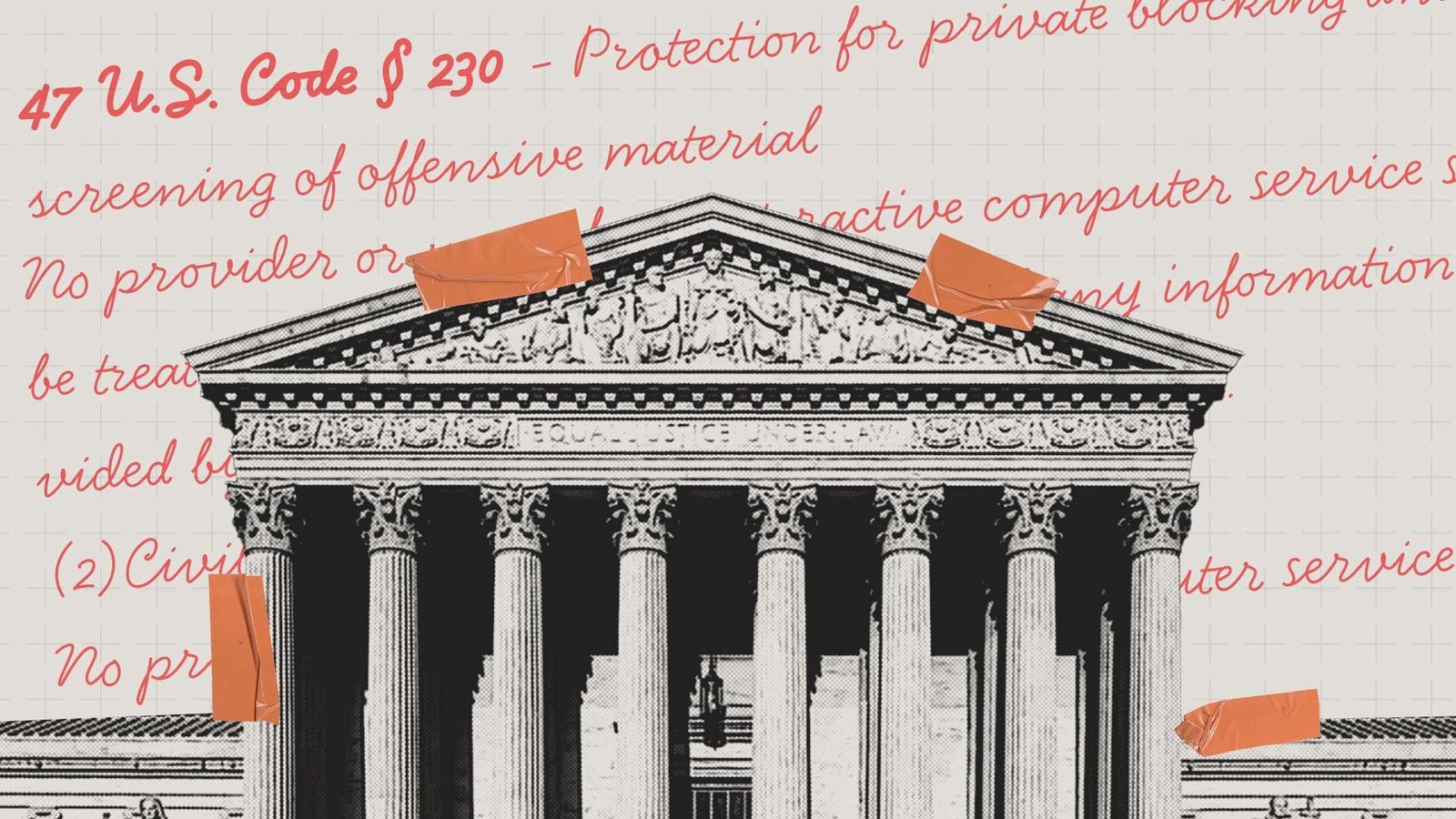
Section 230 of the Communications Decency Act holds that “no provider or user” of a website or online service “shall be treated as the publisher or speaker of any information provided by another” user, nor shall they “be held liable” for any moderation decisions “voluntarily taken in good faith.”

In practice, this allowed the internet to flourish, as website owners and administrators could moderate content as they saw fit without worrying they could be held liable for illicit content that somebody else posted. The succinct statute has been referred to as “the twenty-six words that created the internet.”

In May 2022, far-right provocateur and internet personality Laura Loomer sued Facebook, Twitter, and their respective CEOs for banning her from their platforms for posting hateful content. (She was also banned from Uber and Lyft.) She later amended the complaint to add Procter & Gamble as a defendant, arguing the company “demanded” Facebook remove her from its platform before it would advertise.

Just days earlier, Loomer had launched her second campaign for a seat in the U.S. House of Representatives. In her lawsuit, she alleged the companies “engaged in the commission of predicate acts of racketeering” by kicking her off, irreparably damaging her campaigns, and she sought over $10 billion in damages.

Judge Laurel Beeler of the U.S. District Court for the 9th Circuit dismissed Loomer’s lawsuit with prejudice, meaning she could not refile it later. In part, Beeler determined that under Section 230, Facebook and Twitter could not be sued over moderation decisions.

Loomer appealed to the Supreme Court, calling the 9th Circuit’s interpretation “overbroad” and arguing that “the need for this Court to clarify the scope of Section 230 immunity is urgent.” But on Monday, at the outset of its new term, the Supreme Court denied Loomer’s petition, leaving the 9th Circuit’s decision as the last word. No explanation was given, though four of the nine justices must agree to take up a case. Justice Samuel Alito recused himself from considering the petition, though the reason could be that he owns stock in Procter & Gamble.

At the same time, the court denied another petition that invoked Section 230, filed after white supremacist Dylann Roof murdered nine black parishioners in a church in Charleston, South Carolina, in 2015. Clementa Pinckney’s widow sued Facebook on behalf of their daughter, a minor referred to as “M.P.,” saying Facebook’s algorithm radicalized Roof by feeding him racist content.

“Facebook’s design and architecture is a completely independent cause of harm from the content itself,” the lawsuit claimed. “The content could not possibly have the catastrophic real-world impact it does without Facebook’s manipulation-by-design of users.” As a result, Facebook should lose “the so-called liability shield” afforded by Section 230.

Again, the court was not swayed by the argument. “Courts, having made a textual reading of the broad language of Section 230, have consistently interpreted the statute to bar claims seeking to hold internet service providers liable for the content produced by third parties,” wrote Judge Richard Mark Gergel of the U.S. District Court for South Carolina. “The balancing of the broad societal benefits of a robust internet against the social harm associated with bad actors utilizing these services is quintessentially the function of Congress, not the courts.” The U.S. Court of Appeals for the 4th Circuit later agreed.

M.P. appealed to the Supreme Court, arguing her case “presents a question of exceptional importance.” And this week, the Supreme Court denied M.P.’s petition for appeal. (The court is also considering whether to take up a separate case, John Doe v. Grindr, which claims Grindr is liable for a teenager’s sexual assault that took place after joining the dating app.)

This was not a foregone conclusion: In particular, Justice Clarence Thomas has indicated multiple times in recent years that he feels the court should take up Section 230. “We should consider whether the text of this increasingly important statute aligns with the current state of immunity enjoyed by Internet platforms,” Thomas wrote in 2020.

“We will soon have no choice but to address how our legal doctrines apply to highly concentrated, privately owned information infrastructure such as digital platforms,” Thomas added in 2021. “In many ways, digital platforms that hold themselves out to the public resemble traditional common carriers,” like utilities that are subject to greater government restrictions.

Thankfully, the court has so far not acted on Thomas’ recommendation. Weakening Section 230 would not be a panacea for the problems of social media, and in fact, it could make many things worse.

Some, like M.P.’s lawsuit, suggest Section 230 allows social media firms to get away with moderating too little, allowing unsavory content to spread if it drives engagement; they suggest weakening the statute would require companies to be more mindful of what’s on their platforms. But it could actually have the opposite effect. “Before Section 230, a platform could limit its liability either by doing virtually no content moderation or by doing lots of it. Remove Section 230 and the dilemma returns,” Corbin Barthold wrote at Reason in 2022.

M.P.’s case, in particular, is tragic. But altering or ending Section 230 would make the internet worse while not making people meaningfully safer online.

Read the full article here

Fact Checker

Verify the accuracy of this article using AI-powered analysis and real-time sources.

Get Your Fact Check Report

Enter your email to receive detailed fact-checking analysis

5 free reports remaining

Continue with Full Access

You've used your 5 free reports. Sign up for unlimited access!

Already have an account? Sign in here

Share. Facebook Twitter Pinterest LinkedIn Tumblr Email Telegram Copy Link
News Room
  • Website
  • Facebook
  • X (Twitter)
  • Instagram
  • LinkedIn

The FSNN News Room is the voice of our in-house journalists, editors, and researchers. We deliver timely, unbiased reporting at the crossroads of finance, cryptocurrency, and global politics, providing clear, fact-driven analysis free from agendas.

Related Articles

Cryptocurrency & Free Speech Finance

Malicious Web Pages Are Hijacking AI Agents, And Some Are Going After Your PayPal

9 minutes ago
Media & Culture

Judge Just Noticed The Obvious Problem With Trump Suing His Own IRS For $10 Billion

36 minutes ago
Media & Culture

The Correspondents’ Dinner Shooting Is No Excuse for More Security Theater

37 minutes ago
Cryptocurrency & Free Speech Finance

Google Employees Demand CEO Block Military AI Contracts in Open Letter

1 hour ago
Media & Culture

A Few Thoughts on the Chatrie Oral Argument

2 hours ago
Cryptocurrency & Free Speech Finance

Crypto Exchange Gemini Launches Agentic Trading Feature for AI Agents

2 hours ago
Add A Comment

Comments are closed.

Editors Picks

Bitcoin Bulls Battle For Control With Emphasis On $80K Reclaim

7 minutes ago

Malicious Web Pages Are Hijacking AI Agents, And Some Are Going After Your PayPal

9 minutes ago

The Internet Still Works: SmugMug Powers Online Photography

35 minutes ago

Judge Just Noticed The Obvious Problem With Trump Suing His Own IRS For $10 Billion

36 minutes ago
Latest Posts

The Correspondents’ Dinner Shooting Is No Excuse for More Security Theater

37 minutes ago

MARA Holdings targets bitcoin quantum threat and network resilience with new foundation

1 hour ago

Bernstein Says IREN Pivot to AI Cloud Could Drive $3.7B Revenue

1 hour ago

Subscribe to News

Get the latest news and updates directly to your inbox.

At FSNN – Free Speech News Network, we deliver unfiltered reporting and in-depth analysis on the stories that matter most. From breaking headlines to global perspectives, our mission is to keep you informed, empowered, and connected.

FSNN.net is owned and operated by GlobalBoost Media
, an independent media organization dedicated to advancing transparency, free expression, and factual journalism across the digital landscape.

Facebook X (Twitter) Discord Telegram
Latest News

BTC drops below $77,000 as rising oil and Iran risks stall the rally

5 minutes ago

Bitcoin Bulls Battle For Control With Emphasis On $80K Reclaim

7 minutes ago

Malicious Web Pages Are Hijacking AI Agents, And Some Are Going After Your PayPal

9 minutes ago

Subscribe to Updates

Get the latest news and updates directly to your inbox.

© 2026 GlobalBoost Media. All Rights Reserved.
  • Privacy Policy
  • Terms of Service
  • Our Authors
  • Contact

Type above and press Enter to search. Press Esc to cancel.

🍪

Cookies

We and our selected partners wish to use cookies to collect information about you for functional purposes and statistical marketing. You may not give us your consent for certain purposes by selecting an option and you can withdraw your consent at any time via the cookie icon.

Cookie Preferences

Manage Cookies

Cookies are small text that can be used by websites to make the user experience more efficient. The law states that we may store cookies on your device if they are strictly necessary for the operation of this site. For all other types of cookies, we need your permission. This site uses various types of cookies. Some cookies are placed by third party services that appear on our pages.

Your permission applies to the following domains:

  • https://fsnn.net
Necessary
Necessary cookies help make a website usable by enabling basic functions like page navigation and access to secure areas of the website. The website cannot function properly without these cookies.
Statistic
Statistic cookies help website owners to understand how visitors interact with websites by collecting and reporting information anonymously.
Preferences
Preference cookies enable a website to remember information that changes the way the website behaves or looks, like your preferred language or the region that you are in.
Marketing
Marketing cookies are used to track visitors across websites. The intention is to display ads that are relevant and engaging for the individual user and thereby more valuable for publishers and third party advertisers.