An anonymous Polymarket trader put $1 million on Spain to beat Cape Verde in their Group H opener on June 15, 2026.
Spain and Cape Verde drew 0-0, resulting in the trader losing everything.
Polymarket user “Fishalive” bet against Spain at just 9¢ a share, netting a $4.3 million profit.
Press F to pay respects.
Someone put $1 million on Spain to win a football match against a team making its World Cup debut. The market on Polymarket priced the draw at 6.6 cents. The logic was airtight. The outcome was not.
🚨BREAKING: Someone just put $1M on Spain to WIN their match vs Cape Verde today
— Polymarket Sports (@PolymarketSport) June 15, 2026
Spain, the reigning European champions on a 30-match unbeaten run, faced Cape Verde—a small Atlantic archipelago nation ranked 67th in the FIFA standings, appearing at a World Cup for the first time in history. The match ended 0-0 at Mercedes-Benz Stadium in Atlanta.
The bettor who dropped a million dollars on the favorite walked away with zero.
The potential $1,085,943.48 payout evaporated in 90 minutes of football played against a team that, per Polymarket’s own pre-match odds, had less than a 1% chance of winning the entire World Cup.
The man, the save, the legend
Cape Verde’s 40-year-old goalkeeper Josimar Évora, aka “Vozinha”—arguably the hero of the entire tournament’s first week—finished the match with eight saves. He stopped a Ferran Torres shot in the corner. He pushed a Mikel Oyarzabal header over the crossbar. Torres also hit the crossbar from what ESPN described as Spain’s best chance of the game. Lamine Yamal, the star player of the Spanish selection, was not able to prove his superiority.
The scoreline was so improbable it drew immediate comparisons to the biggest upsets in World Cup history. Cape Verde had come through Confederation of African Football (CAF) qualifying with seven wins, two draws, and a single defeat—avoiding the inter-confederation playoffs entirely—but nothing in those results suggested they could neutralize a Spain side that had beaten England, France, and Germany in recent memory.
Memes and GIFs flooded X within minutes of the final whistle. Every “surest bet in sports” joke had a new entry. The image of Spain’s shot counter stopped at 27—versus Cape Verde’s six—became the visual shorthand for the sting of a “sure thing” gone wrong.
“Fishalive” understood the assignment
On the other side of this trade was a Polymarket trader who goes by Fishalive. According to the user’s Polymarket profile, an account that joined the platform in June 2026 with just two total predictions—bought “No” on Spain winning at an average price of 9¢ per share. That’s a position that says Spain had maybe a 9% chance of winning. The market was pricing it at 92%.
The user bought a bit over 4.7 million shares at that price. When the final whistle confirmed a 0-0 draw, those “No” shares resolved at 100¢ each. The position value hit $4,738,433.49. The profit on the day: $4,310,481.12—a more than 1,000% return.
🚨BREAKING: Someone named “fishalive” put $400k on Spain NOT to win vs Cabo Verde at 9% odds…
— Polymarket Sports (@PolymarketSport) June 15, 2026
This is how prediction markets work when they work: Someone prices in a scenario the crowd dismisses, bets size, and collects when it hits. The question is always edge or luck.
Losing big on sure things
The $1 million Spain bet is dramatic, but it’s not the first time Polymarket has served up a cautionary tale about betting at extreme odds. Traders who buy “Yes” at 90¢ or above are making a statement about probability—they’re saying the true chance is even higher than 90%. When reality disagrees, the loss isn’t just financial.
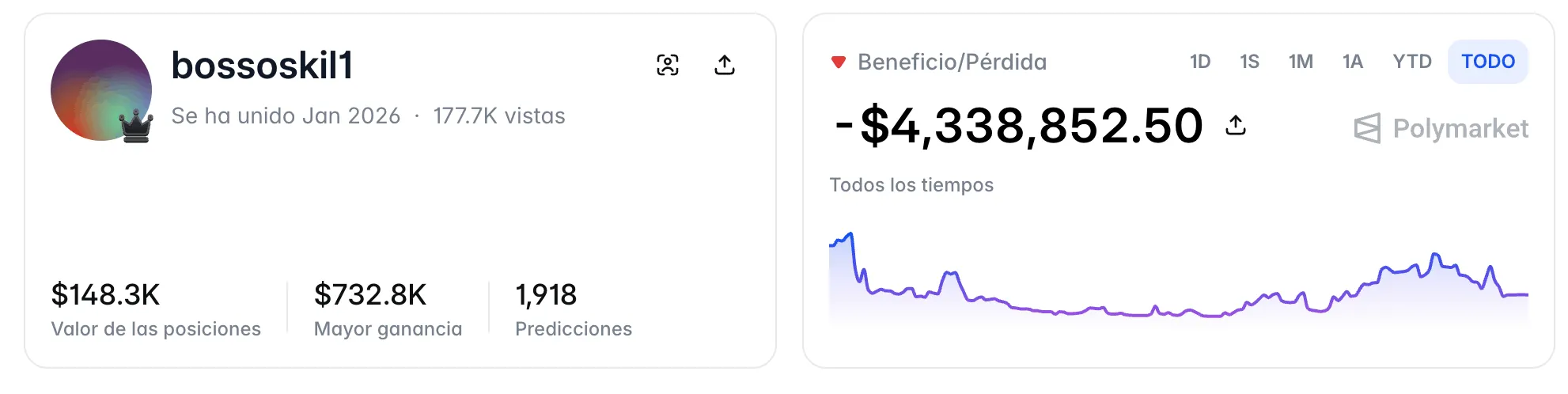
A trader known as “beachboy4” lost more than $2 million on Polymarket in 35 days, with a single $1.58 million position on Liverpool to win its match against Leeds United on January 1 2026 being the biggest hit. A separate trader, bossoskil1, burned through $2.36 million in just eight days across 53 U.S. sports markets with no hedging or stop-loss strategy.
Today this account sits at a net $4.3 loss.
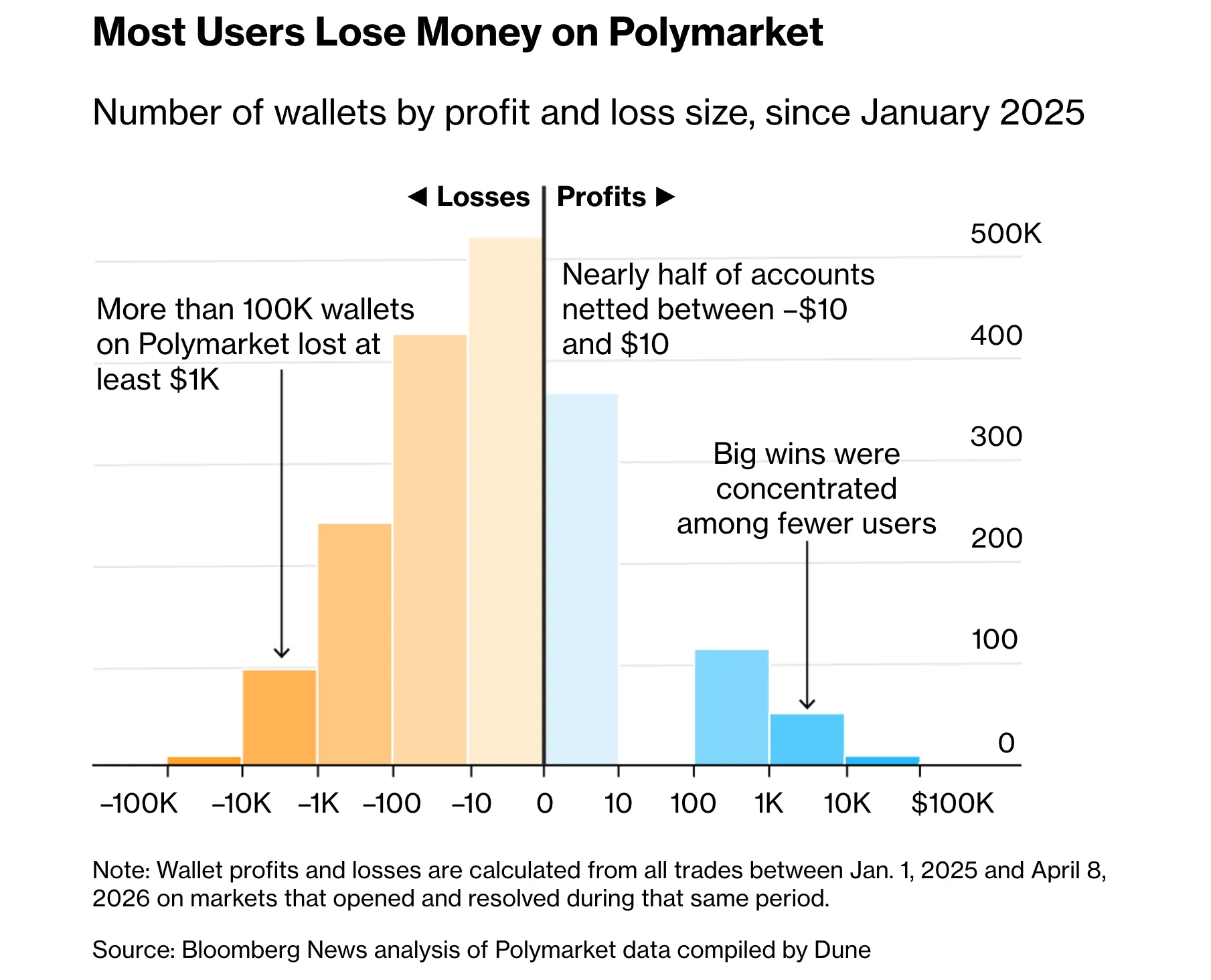
A Bloomberg analysis published in April 2026 found that since January 2025, more than 100,000 Polymarket accounts had recorded losses of at least $1,000—nearly double the number of wallets posting comparable gains.
Source: Bloomberg
A University of Toronto-led academic study covering 2.4 million users found that 68.8% had lost money since 2022, and that users who lose money disproportionately trade at extreme prices—below 10¢ or above 90¢.
Which is exactly what the anonymous Spain bettor did today.
Meanwhile, on Kalshi and Polymarket combined, the 2026 World Cup winner market has crossed $2.34 billion in volume. States including Tennessee have already sent cease-and-desist letters to both platforms over sports prediction markets. Regulators are watching. Traders are still betting. The vast majority of those who participated in the Spain-Cape Verde market are likely hurting, and somewhere on the internet, “Fishalive” is having a very good Monday.
Cape Verde plays Uruguay next on June 21.
Daily Debrief Newsletter
Start every day with the top news stories right now, plus original features, a podcast, videos and more.
The FSNN News Room is the voice of our in-house journalists, editors, and researchers. We deliver timely, unbiased reporting at the crossroads of finance, cryptocurrency, and global politics, providing clear, fact-driven analysis free from agendas.
We and our selected partners wish to use cookies to collect information about you for functional purposes and statistical marketing. You may not give us your consent for certain purposes by selecting an option and you can withdraw your consent at any time via the cookie icon.
Cookies are small text that can be used by websites to make the user experience more efficient. The law states that we may store cookies on your device if they are strictly necessary for the operation of this site. For all other types of cookies, we need your permission. This site uses various types of cookies. Some cookies are placed by third party services that appear on our pages.
Your permission applies to the following domains:
https://fsnn.net
Necessary
Necessary cookies help make a website usable by enabling basic functions like page navigation and access to secure areas of the website. The website cannot function properly without these cookies.
Statistic
Statistic cookies help website owners to understand how visitors interact with websites by collecting and reporting information anonymously.
Preferences
Preference cookies enable a website to remember information that changes the way the website behaves or looks, like your preferred language or the region that you are in.
Marketing
Marketing cookies are used to track visitors across websites. The intention is to display ads that are relevant and engaging for the individual user and thereby more valuable for publishers and third party advertisers.


 Freedom Index