

 Freedom Index
Listen to the article
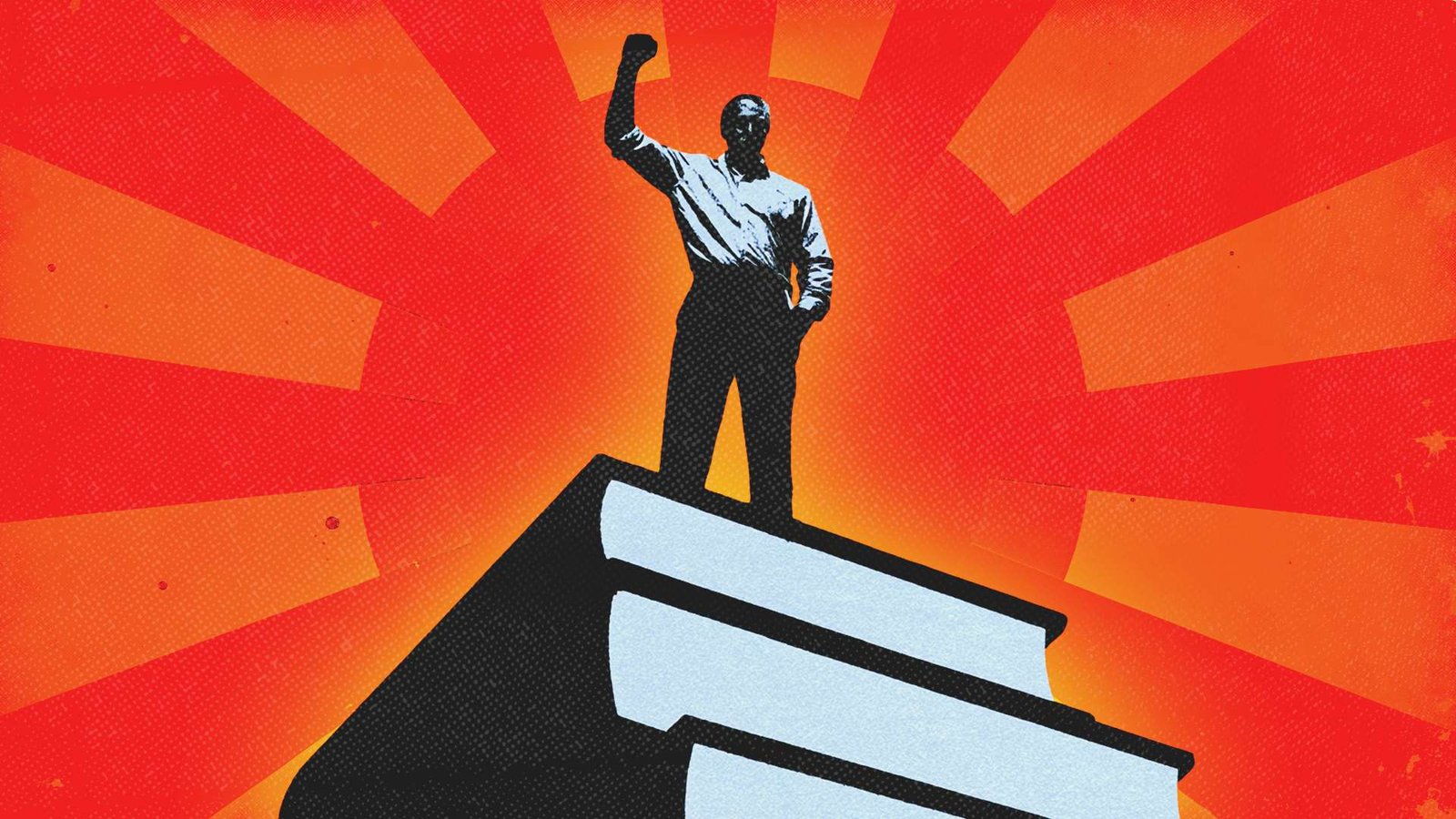
The Democratic Socialists of America (DSA) and its allies, who are rapidly gaining traction in the Democratic Party, want to turn “food, education, energy, medicine, and transportation” into “common goods and utilities” run by the government “in a future without capitalism.” But never mind, I’m told. I’m assured by responses to my recent column on the surge in left-wing radicalism that “when your representatives vote and allocate your tax dollars for a library,” that is “democratic socialism.”
You are reading The Rattler from J.D. Tuccille and Reason. Get more of J.D.’s commentary on government overreach and threats to everyday liberty.
Oh, really? So, we’re talking about borrowing books and not eliminating private property or the DSA’s embrace of totalitarian regimes in Cuba and Venezuela? You could have fooled me.
But, of course, they are trying to fool me with bait-and-switch arguments that substitute cute and cuddly public libraries—who doesn’t like stacks of books?—for seizing the means of production and state control of essentially everything. Because libraries are so innocuous, socialists fall back to them.
“If you think the GOP is terrified of my politics now, just wait until they find out about public libraries,” DSA–affiliated Rep. Alexandria Ocasio-Cortez (D–N.Y.) huffed in 2018 shortly before her election to Congress.
“If today, you and I were to introduce the idea of a building that lends out books for free, we would be slandered in the same way that so many new ideas are slandered today, and yet that’s the library,” New York City’s socialist Mayor Zohran Mamdani insisted to Jon Stewart.
Ocasio-Cortez, let’s point out, wants a government monopoly on healthcare and for taxpayers to pay everybody’s college tuition. Mamdani plans to set up taxpayer-subsidized grocery stores, and the head of his Office to Protect Tenants, Cea Weaver, believes “homeownership is a weapon of white supremacy” and that the state should “seize private property.” Sure, they’re talking about libraries.
This is what’s called a “motte-and-bailey fallacy,” by which a person advancing a hard-to-sell position retreats to something less insane when challenged. That’s how we go from “nationalize everything” to “libraries.” But libraries are an odd example for socialists to choose as a fallback.
Lending libraries got a boost in America from Benjamin Franklin. “During the early years of the United States, books were not widely available. Standard English reference works were expensive and difficult to find: they had to be shipped to the colonies from Europe, and the average person could not afford to purchase the books that well-rounded intellectuals thought worth reading,” according to The Library Company of Philadelphia. To ease access, Franklin and his friends organized that private library, which continues to exist as a membership organization, like the Boston Athenaeum and similar institutions.
Today’s public libraries had to wait a bit. They really took off under the sponsorship of Andrew Carnegie. “Starting in 1881 with a gift of a library to his birthplace of Dunfermline, Scotland, Carnegie—and later his foundation—gave some $56 million to build 2,509 public libraries. Of these Carnegie Libraries, 1,681 were built in the United States,” notes the Andrew Carnegie Foundation.
Most are now operated by governments with tax dollars supplementing other fundraising. But the library we’re familiar with began in private organization and philanthropy. They’re also largely obsolete.
“There’s other things to do these days, other ways to gain access to reading matter,” the Adam Smith Institute observed in 2016 amidst news that library patronage had declined by a third in a decade in the U.K. (and by half in the U.S.). “Any PC, tablet or smartphone has access to tens of thousands of free titles. It simply becomes less necessary to have that publicly funded service.”
Writing for Bleeding Heart Libertarians in 2018, West Virginia University business professor Christopher Freiman suggested that those who are unable to afford even the low prices of today’s digital reading materials could be given targeted subsidies. “They could then use this extra income to buy a library membership or they could spend it on something they’d like more,” he wrote. “If public libraries are the embodiment of the ideal of your economic system, that’s a bad sign for your system.”
It’s a bad sign, but it’s the fallback, because socialists don’t want to defend a “future without capitalism” and calls to “seize private property.” Then again, chances are they also don’t want to defend DSA support for “solidarity with Venezuela” and “self-determination and socialism in the country.” So, they deflect.
“Almost all democratic socialist countries, like Canada and Australia have universal health care. Do those countries really look totalitarian?” a response to my column challenged me.
Australia and Canada are democratic socialist? Really? According to the Fraser Institute’s Economic Freedom of the World report, all three rank among the “most free” (least government-burdened) economies. The U.S holds 5th place, Australia 7th, and Canada 11th. Australia has the largest public sector of the three, making up 28.92 percent of jobs as of 2021, compared to 21.11 percent in Canada and 13.41 percent in the U.S. But most employment is in the private sector in all three countries. And the country with the largest ratio of private to public employment does best. U.S. per capita GDP is $90,026, compared to $65,129 in Australia and $55,697 in Canada. And the U.S. has been widening its lead.
True, Canada has a state-dominated healthcare system, the closest to true socialist medicine among the three. But that’s nothing to boast about when the University of Calgary School of Public Policy finds “health care-related reasons (access and quality combined) account for 25.62 per cent of observed relocations” by Canadians to the U.S. Relative to Canada, Australia and the U.S. have mixed healthcare systems with both government and private coverage.
Socialists like to underline calls for “Medicare for all” with a cartoonish attribution of dissatisfaction with American medicine to the alleged failures of capitalism. But big-government economist Paul Krugman wrote this week that “U.S. healthcare is better described as partially privatized socialism than as anything resembling a free market”—a characterization the Cato Institute’s Michael Cannon largely agrees with. Cannon calls Krugman’s admission “a useful corrective to claims that the US health sector’s excessive prices and spending, low-quality care, and access gaps are due to free markets.”
The free-market capitalist elements of the U.S. economy are what work best and make us prosperous. The all-too-many socialist aspects cause harm and require market-oriented reforms to improve them.
And none of us should buy socialists’ arguments that they really mean to embrace (increasingly obsolete) public libraries when they repeatedly call to end capitalism, seize private property, and hold up totalitarian countries like Cuba and Venezuela as models.
Read the full article here
Fact Checker
Verify the accuracy of this article using AI-powered analysis and real-time sources.