Close Menu
FSNN | Free Speech News NetworkFSNN | Free Speech News Network
  • Home
  • News
    • Politics
    • Legal & Courts
    • Tech & Big Tech
    • Campus & Education
    • Media & Culture
    • Global Free Speech
  • Opinions
    • Debates
  • Video/Live
  • Community
  • Freedom Index
  • About
    • Mission
    • Contact
    • Support
Trending

Bitcoin UTXO Signal Points to Bear Market Bottom

26 minutes ago

Fidelity Defends Bitcoin’s Long-Term Security Model

7 hours ago

Federalist Society Courthouse Steps Podcast on Pung v. Isabella County Takings Case

7 hours ago
Facebook X (Twitter) Instagram
Facebook X (Twitter) Discord Telegram
FSNN | Free Speech News NetworkFSNN | Free Speech News Network
Market Data Newsletter
Sunday, June 28
  • Home
  • News
    • Politics
    • Legal & Courts
    • Tech & Big Tech
    • Campus & Education
    • Media & Culture
    • Global Free Speech
  • Opinions
    • Debates
  • Video/Live
  • Community
  • Freedom Index
  • About
    • Mission
    • Contact
    • Support
FSNN | Free Speech News NetworkFSNN | Free Speech News Network
Home»News»Global Free Speech»Serbia police target journalists as anti-government protests escalate
Global Free Speech

Serbia police target journalists as anti-government protests escalate

News RoomBy News Room9 months agoNo Comments4 Mins Read786 Views
Share Facebook Twitter Pinterest Copy Link LinkedIn Tumblr Email VKontakte Telegram
Serbia police target journalists as anti-government protests escalate
Share
Facebook Twitter Pinterest Email Copy Link

Listen to the article

0:00
0:00

Key Takeaways

Playback Speed

Select a Voice

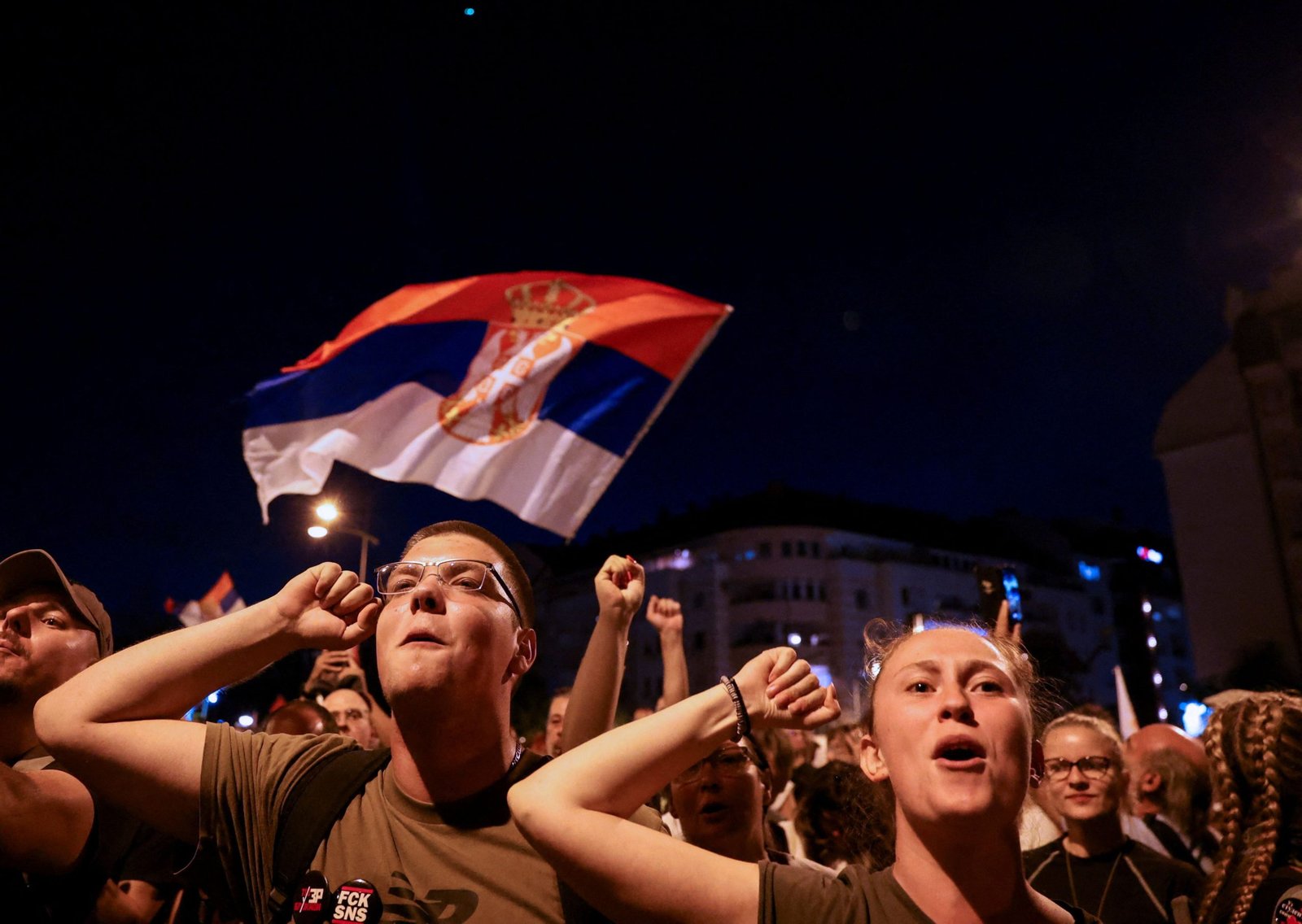
Berlin, September 25, 2025—Serbian journalists have increasingly reported being deliberately targeted by police, especially when covering police violence, as President Aleksandar Vučić’s authoritarian government toughens its stance against anti-government protests that began 10 months ago with a deadly railway station collapse.

Journalists caught up in the unrest report that police not only fail to protect them from protesters but also deliberately harass, beat, and detain them, prevent filming, and confiscate and destroy their equipment.

In August, local press freedom groups said the attacks were happening “on a near-daily basis.” At least 28 journalists reported that police had targeted them since June 1, 2025, according to CPJ’s review of the most serious cases documented by local press freedom groups.

“CPJ urges Serbia to conduct swift and transparent investigations into dozens of claims of police violence against journalists, and hold the perpetrators to account,” said Attila Mong, CPJ’s Europe representative. “Serbia is at a crossroads, and the authorities should demonstrate a commitment to journalist protection if they take the country’s future accession to the European Union seriously.”

So far this year, the Independent Journalists’ Association of Serbia has recorded 19 physical assaults, surpassing the 17 in all of 2024. 

CPJ’s emailed request for comment to the Ministry of the Interior, which oversees the police, did not receive a reply. 

Since CPJ’s June 3 report, we have documented the following incidents involving the police:

  • On September 5, in the northern city of Novi Sad, police attacked and obstructed multiple journalists covering a protest, repeatedly saying that no one was allowed to film police actions.

Officers kicked news site 021 reporter Emir Kahrimanović despite his “Press” vest, visible press card, and attempts to identify himself. 

Police forced  weekly Vreme reporter Katarina Stevanović to lie on the ground for about 15 minutes and told her she could not record. 

Police pushed Nemanja Šarović while he was reporting live for KTV, grabbed his microphone, and smashed it. 

  • On September 1, in Novi Sad, a police officer seized the phone of Beta News Agency reporter Božidar Milovac while he was covering a protest. Although Milovac identified himself as a journalist, officers said he was not allowed to film and forced him to delete his footage.
  • On August 31, in the northern city of Zrenjanin, traffic police detained KTV reporter Nemanja Šarović, the station’s owner, Danijel Radić, and their driver for several hours after they filmed a ruling Serbian Progressive Party rally. Upon release, the police filed a criminal complaint against the driver for allegedly attacking an officer.
  • On August 20, in Novi Sad, police repeatedly hit and violently pushed reporters Lea Apro of news channel N1 TV and Žarko Bogosavljević with Razglas News. Both were wearing “Press” vests and had clearly identified themselves. Apro’s left arm was injured as they documented police dispersing a protest.
  • During protests in the capital, Belgrade, on August 13, 14, and 15, several journalists said police targeted them. 

Police beat freelance photojournalist Marija Čolaković, injuring her arms and legs, while she was wearing a “Press” vest and carrying journalist accreditation.

An officer sprayed an unknown chemical substance on Vuk Cvijić, a journalist at the weekly newspaper Radar, while he was covering a protest.

Police struck freelance photojournalist Gavrilo Andrić with a baton on his helmet and knocked him to the ground while he was standing about 100 meters from protesters, wearing a “Press” vest.

Police pushed reporters Teodora Šulj of news site Zoomer and Ana Milosavljević, who works for the news site Mašina. An officer snatched Šulj’s phone as they were filming. 

  • On July 29, in Kraljevo, central Serbia, police repeatedly struck Dragan Jeković, a camera operator from Nova TV, with a truncheon. 
  • On July 25, in Lazarevac, central Serbia, police detained reporter Dragoljub Đorđević of newspaper Radnički list Kolubara overnight for allegedly participating in a highway blockade. He denied the charges, saying he had been documenting the blockade from the side of the highway. He was released with traffic violation misdemeanor charges.
  • On July 2, in Belgrade, police struck Radar journalist Vuk Cvijić with a shield, shoved him, and attempted to seize his phone as he was filming police during a protest.
  • On July 1, in Belgrade, police detained freelance photojournalist Aleksa Stanković as he documented a protest. Officers accused him of posting a video on social media of a police officer making inappropriate comments about women passing by during his shift. They forced Stanković into a van, where a masked police officer struck him on the head and demanded he delete his footage and his professional Instagram profile. When he refused, they destroyed his memory card. 
  • On June 10, police prevented freelance photojournalist Gavrilo Andrić from documenting a protest in Belgrade. One officer swung at his camera, grabbed his backpack and pulled him, demanding his ID. Although Andrić told police he was a journalist and presented his press card, the officer insisted he leave. 


Read the full article here

Fact Checker

Verify the accuracy of this article using AI-powered analysis and real-time sources.

Get Your Fact Check Report

Enter your email to receive detailed fact-checking analysis

5 free reports remaining

Continue with Full Access

You've used your 5 free reports. Sign up for unlimited access!

Already have an account? Sign in here

Share. Facebook Twitter Pinterest LinkedIn Tumblr Email Telegram Copy Link
News Room
  • Website
  • Facebook
  • X (Twitter)
  • Instagram
  • LinkedIn

The FSNN News Room is the voice of our in-house journalists, editors, and researchers. We deliver timely, unbiased reporting at the crossroads of finance, cryptocurrency, and global politics, providing clear, fact-driven analysis free from agendas.

Related Articles

Global Free Speech

Belarus jails journalist Kyril Pazniak for 3.5 years 

1 day ago
Global Free Speech

CPJ, partners express urgent concern to NATO over press accreditation denial for Turkey summit in July

1 day ago
Global Free Speech

The high price journalists paid for LGBTQ+ reporting, and how to protect yourself now

1 day ago
Global Free Speech

Al-Arabiya correspondent killed by car bomb in Yemen

2 days ago
Global Free Speech

CPJ, partners call on EU to review approach toward Tunisia amid critical human rights decline

2 days ago
Global Free Speech

Photo by: Stephen Barnes/Medical/Alamy UK news this week is dominated by a damning report led by senior midwife Donna Ockenden that reveals how more than 500 mothers and babies were harmed or died at maternity units in Nottingham. This isn’t the first scandal Ockenden has investigated. A few years back terrible failings were revealed in Shropshire hospitals run by the Shrewsbury and Telford NHS Trust where 201 babies and nine mothers died.  We spoke to Ockenden for the magazine and she repeated this: “women aren’t listened to”. Another common thread was cover-up. Secrecy is not a one-off, it’s a pattern, wrote Martin Bright when he reported on the Shropshire scandal for Index. As Bright said, “this is not a historical story; it is an ongoing crisis”. Maternity scandals happen not only in Britain but all over the world. Last year’s protests in Morocco were ignited after eight women died in a maternity ward in Agadir because of severe medical neglect. In Egypt last week Omnia Sweidan, a former resident physician in obstetrics and gynaecology at Alexandria’s El-Shatby University Hospital, wrote a Facebook post detailing a series of abusive incidents faced by women at Alexandria’s Al-Shatby Hospital. It was read and shared by tens of thousands. Within 24 hours of posting, instead of the government declaring an investigation, security forces arrested Sweidan. While she was apparently later released, she’s been accused of spreading false news and misusing social media. She could end up in jail. Meanwhile, Afghanistan has one of the highest maternal mortality rates in the world – the figures of deaths and injuries are rising, but to what no one really knows. The Taliban won’t publish the data, probably to cover-up the true numbers. I’ve navigated maternity services myself in the UK. I’ve generally had good experiences and I’m very grateful to the NHS. But my experiences have not been uncomplicated – my daughter very nearly died. What saved her, I’ve been told, were a few factors – my race (white), my class (middle), where I live (London) and the fact that I relentlessly badgered those at my local hospital for weeks on end saying things didn’t feel right. Let me be clear here though: one shouldn’t have to be a dogged white Londoner to get good medical care. And a recent health committee report revealed terrible inequalities faced by people who are members of ethnic minorities, stating that “[B]abies that are Black or Black British Asian or Asian British have a more than 50% higher risk of perinatal mortality”. At Index we typically work on stories where dissidents take on the powerful: leaders, oligarchs and tech bros. The victims of maternity care scandals might not appear the same. But there is much that unites them. At the end of the day if the response you get from a doctor or nurse to a basic medical request is a shrug or a sneer, your free speech is being violated. If the systems view calls for accountability as dissent that must be silenced, then they are censoring. We grew up being told we’re lucky, that childbirth was one of the leading causes of death before the advent of modern medicine. For many of us that’s true. Just not all of us. That’s a travesty demanding urgent attention – in Nottingham and beyond. READ MORE

2 days ago
Add A Comment

Comments are closed.

Editors Picks

Fidelity Defends Bitcoin’s Long-Term Security Model

7 hours ago

Federalist Society Courthouse Steps Podcast on Pung v. Isabella County Takings Case

7 hours ago

50K BTC Flow Adds Pressure To Bitcoin Price: Will The Sell-off Deepen?

8 hours ago

This Week In Techdirt History: June 21st – 27th

8 hours ago
Latest Posts

Why a selloff in gold and silver is dragging bitcoin down

9 hours ago

Yuma Launches Bittensor AI Fund for Institutional Investors

9 hours ago

Coinbase and OKX try to lure in Binance’s users after it failed to secure a MiCA license

10 hours ago

Subscribe to News

Get the latest news and updates directly to your inbox.

At FSNN – Free Speech News Network, we deliver unfiltered reporting and in-depth analysis on the stories that matter most. From breaking headlines to global perspectives, our mission is to keep you informed, empowered, and connected.

FSNN.net is owned and operated by GlobalBoost Media
, an independent media organization dedicated to advancing transparency, free expression, and factual journalism across the digital landscape.

Facebook X (Twitter) Discord Telegram
Latest News

Bitcoin UTXO Signal Points to Bear Market Bottom

26 minutes ago

Fidelity Defends Bitcoin’s Long-Term Security Model

7 hours ago

Federalist Society Courthouse Steps Podcast on Pung v. Isabella County Takings Case

7 hours ago

Subscribe to Updates

Get the latest news and updates directly to your inbox.

© 2026 GlobalBoost Media. All Rights Reserved.
  • Privacy Policy
  • Terms of Service
  • Our Authors
  • Contact

Type above and press Enter to search. Press Esc to cancel.

🍪

Cookies

We and our selected partners wish to use cookies to collect information about you for functional purposes and statistical marketing. You may not give us your consent for certain purposes by selecting an option and you can withdraw your consent at any time via the cookie icon.

Cookie Preferences

Manage Cookies

Cookies are small text that can be used by websites to make the user experience more efficient. The law states that we may store cookies on your device if they are strictly necessary for the operation of this site. For all other types of cookies, we need your permission. This site uses various types of cookies. Some cookies are placed by third party services that appear on our pages.

Your permission applies to the following domains:

  • https://fsnn.net
Necessary
Necessary cookies help make a website usable by enabling basic functions like page navigation and access to secure areas of the website. The website cannot function properly without these cookies.
Statistic
Statistic cookies help website owners to understand how visitors interact with websites by collecting and reporting information anonymously.
Preferences
Preference cookies enable a website to remember information that changes the way the website behaves or looks, like your preferred language or the region that you are in.
Marketing
Marketing cookies are used to track visitors across websites. The intention is to display ads that are relevant and engaging for the individual user and thereby more valuable for publishers and third party advertisers.