

 Freedom Index
Listen to the article
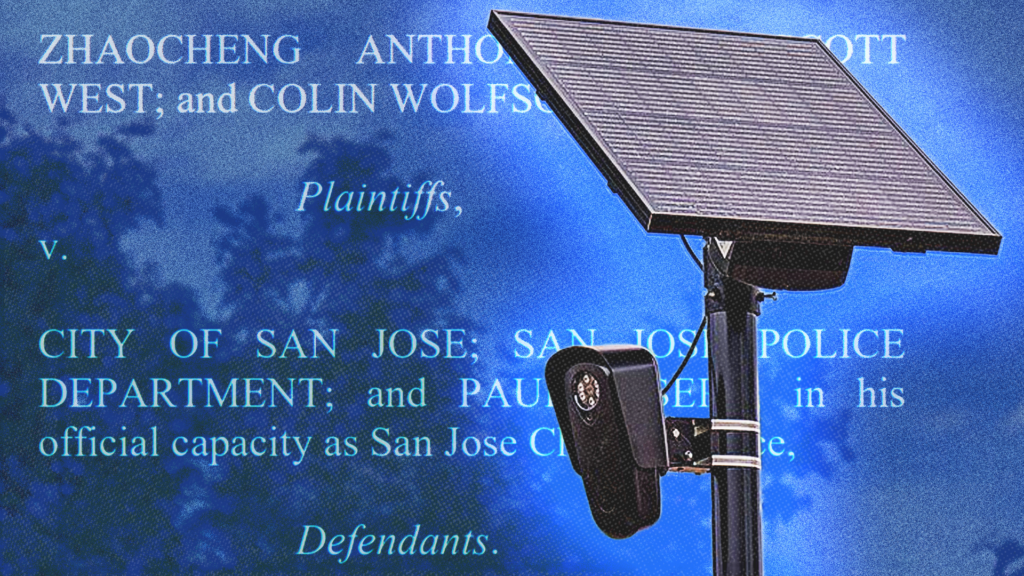
Five years ago, police in San Jose, California, began using automatic license plate readers (ALPRs) to record information about vehicles traveling through the city. The initial experiment involved four Flock Safety cameras at a single intersection. Today the San Jose Police Department (SJPD) has access to data captured by a network of 474 ALPR cameras that blanket the city, recording residents as they go about their daily lives.
More than 1,000 SJPD employees are authorized to search that information, which does not require a warrant, probable cause, or even individualized suspicion of involvement in criminal activity. Because San Jose shares its information, it also can be perused by people at nearly 300 other government agencies across California.
That “creepy” and “deeply intrusive” surveillance system violates the Fourth Amendment, the Institute for Justice argues in a lawsuit it filed on Wednesday in the U.S. District Court for the Northern District of California. “Government employees search San Jose drivers’ data thousands of times every day with almost no oversight, creating a situation that’s ripe for abuse,” warns Institute for Justice attorney Michael Soyfer.
The lawsuit involves three named plaintiffs, but it aims to represent a class consisting of “all San Jose residents who were drivers of vehicles” that have been photographed by the city’s cameras during the last year or will be photographed in the future. The plaintiffs are seeking a court order that would require the SJPD to delete or block access to images and data collected by the cameras after 24 hours unless it has “a specific warrant based on probable cause” or invokes a recognized exception to the Fourth Amendment’s warrant requirement.
The SJPD initially retained ALPR information for a year, paying Flock, which installs the devices and charges rent for them, an extra $300 per camera to store the data for that long. “There is no need for that information,” the city’s digital privacy officer conceded in 2024. “It is strictly what our attorney’s office has decided is the current interpretation.” That interpretation changed in response to a public outcry, and the SJPD currently keeps the data for a month, which is Flock’s default.
Despite that concession, the city is still collecting a huge amount of information about the locations and itineraries of drivers. In 2024, the ALPR system recorded more than 360 million images. “Thousands of government employees across California have
access to this massive trove,” the lawsuit notes, “and they search it with abandon—nearly 2.5 million times in the last six months of 2025, an average of over 15,000 searches per day.”
Although that database is supposed to help detect and prevent crime, “only a tiny sliver of those photographs” prove “relevant to law enforcement,” the complaint says. In 2024, for example, about 0.25 percent of those 360 million or so images corresponded to one of the SJPD’s “hotlists,” which include stolen vehicles, drivers with outstanding warrants, criminal suspects, and missing persons.
The lawsuit explains how the city’s ALPR cameras, combined with artificial intelligence software, license plate databases, video camera footage, and ALPR data from other jurisdictions, have enabled routine, far-reaching surveillance that was financially and technologically infeasible until recently. It is a situation that would have dismayed the Fourth Amendment’s framers.
In addition to license plate numbers, which can easily be connected to names, addresses, and other personal information, police can search “vehicle fingerprints” that Flock’s software generates based on each car’s characteristics. The software also can produce a “vehicle journey map” showing “everywhere the car has been seen,” the complaint notes. It can be used to “analyze patterns of movement,” “flag repeat visitors to a location,” “identify vehicles frequently seen together,” “generate lists of vehicles that have visited multiple locations of interest,” and “predict the future route a vehicle might take.”
Nearly all of this information involves innocent people who have done nothing to justify police attention. It includes data that can reveal a person’s work and shopping habits, relationships, and visits to locations such as health care facilities, immigration lawyers’ offices, houses of worship, and political protests.
“All of this is done without a warrant,” the lawsuit notes. “No officer ever has to establish probable cause, swear to the facts in a warrant application, or await the approval of a judge. Instead, all they need to do is log in and enter a vague justification to pull up monthly logs of people’s movements. Because of this, officers can run searches based on a hunch, idle curiosity, or even personal animus. Around the country, officers have been caught using ALPR databases to stalk their ex-partners, monitor protestors, and even track down a woman who reportedly had an abortion.”
Given such dangers, what safeguards has San Jose established to prevent abuse of its digital dragnet? The SJPD’s ALPR policy says the cameras may not be used to “collect data that is not within the public view,” “monitor individual or group activities legally allowed in” California or “protected by the First Amendment,” aid immigration enforcement, issue “automated citations…without manual review,” or collect data for profit. But “in practice,” the lawsuit says, “SJPD employees commonly search ALPR data without probable cause, a warrant, or individualized suspicion.”
Because judicial approval is not required, the SJPD’s official restrictions can be easily evaded. Although the information is not supposed to be used for immigration enforcement, for example, federal officials can and do gain access to it because it is widely shared across the state. According to the complaint, the city “has admitted that federal agencies,” including Immigration and Customs Enforcement (ICE), “were able to get ‘side-door’ access” by “asking friendly California law enforcement officers to run searches.”
That workaround is potentially problematic not just for unauthorized residents but also for U.S. citizens who oppose the Trump administration’s deportation campaign. The lead plaintiff, Tony Tan, is a software engineer who grew up in China. Tan “goes to protests in downtown San Jose and across the Bay Area,” the complaint says. He “also volunteers as a legal observer to monitor ICE activity in San Jose and inform people of their rights.”
Tan “has heard stories of ICE and other law enforcement officers retaliating against people who criticized or opposed them,” the lawsuit says. ICE agents, for example, have been “accused of using license plates to identify legal observers, so that [they] can show up at their homes or place them on watchlists.” As Tan sees it, “the Flock Cameras make that type of retaliation all too easy” by “placing an unprecedented record of people’s movements across a city in the hands of so many officers without any judicial oversight.”
Tan’s background makes him especially sensitive to such risks. “As an engineer specializing in privacy, I know how important it is to protect people’s data and how even just a few points of location history can reveal profound and sensitive insights about a person’s life,” he says. “Having spent time in China, I know what an authoritarian surveillance state looks like, and I worry about the proliferation of similar mass surveillance technologies across the United States. I want to ensure that police state tactics do not become commonplace here.”
San Jose’s ALPR system has “the potential to reveal where [Tan] goes, what he does, and whom he associates with in a way that would have been impossible in the past,” the lawsuit notes. If a private individual “created a similar record of his movements,” it adds, Tan “would consider it stalking.” He “finds this creepy,” the complaint says. “It reminds him of the Chinese surveillance state.”
According to Tan’s lawyers, San Jose’s ALPR system is unconstitutional as well as creepy because it “violates a subjective expectation of privacy that society is prepared to recognize as objectively reasonable”—the Fourth Amendment test that the Supreme Court established in the 1967 case Katz v. United States. Historically, they note, Americans expected that “the government would not and could not create a retrospective catalogue of every person’s movements across hundreds of strategically chosen locations in a city.” San Jose’s use of ALPR cameras, the plaintiffs argue, “contravenes society’s traditional expectation of privacy by generating a long-term, retrospective, and easy-to-search government database of people’s movements, with no requirement that police have a warrant, probable cause, or even individualized suspicion to collect or search the data.”
That conclusion is consistent with the logic of the Supreme Court’s 2018 ruling in Carpenter v. United States, which held that warrantless tracking via cellphone location data violated the Fourth Amendment. Like the data collection at issue in that case, San Jose’s ALPR system can reveal detailed information about an individual’s past whereabouts and travels.
The Fourth Amendment “prohibits searches, including electronic surveillance, unless the government has obtained a specific warrant supported by probable cause,” the complaint notes. “This requirement is subject only to a few, narrow exceptions. None of these exceptions apply to Defendants’ warrantless, suspicionless operation of the Flock Cameras.”
This lawsuit is part of an Institute for Justice project that aims to curtail abuse of ALPR cameras, which have proliferated across the country in recent years. Flock alone has installed some 90,000 cameras in more than 5,000 local jurisdictions. The company says its “mission” is “to eliminate crime” by “collect[ing] the objective evidence police need to solve crime, which includes license plates and vehicle information.” Flock is unfazed by civil liberties concerns about that mission. Garrett Langley, the company’s president, says his goal is “a Flock camera on every street corner.”
Read the full article here
Fact Checker
Verify the accuracy of this article using AI-powered analysis and real-time sources.