

 Freedom Index
Listen to the article
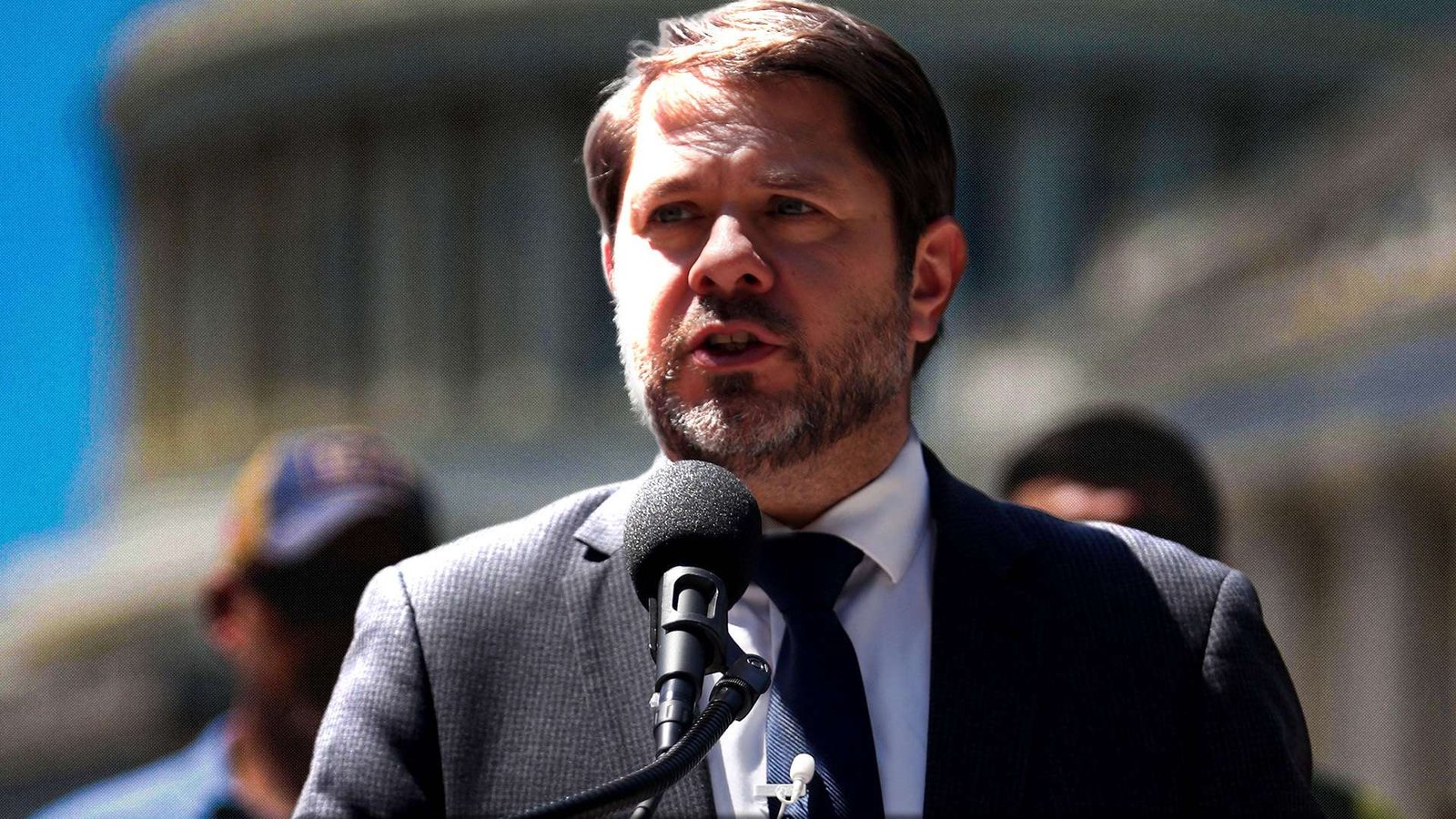
In a 32-page plan unveiled Wednesday, Sen. Ruben Gallego (D–Ariz.) claims that the American dream is being blocked by officials who have “let billionaires and giant corporations create our unbalanced economic system.” To “rebuild” America’s middle class, Gallego calls for establishing “a New Deal–style public service jobs program” that “funds jobs that allow AI-displaced workers to help families and serve communities.”
And that might be the tamest idea in this sprawling populist platform. It’s unlikely that any of Gallego’s plans will actually be signed into law anytime soon. But his proposals do provide some insight into what policies progressive candidates could be offering in 2028.
Gallego’s plan calls on the government to mandate higher pay rates for overtime and holiday work, expanded unemployment insurance, and sick, vacation, and family leave. He wants higher taxes on capital gains, plus a new “corporate ‘robot’ tax” to discourage companies from using automation. He would “require employers and workers to bargain over workplace technology,” ostensibly placing employees on equal footing with owners in deciding the direction of a private enterprise.
Indeed, to “protect workers,” Gallego would consider banning “complete automation,” would place “hard caps on technology deployment,” and would institute requirements for “human operators.” While that might protect jobs in the short run, it could cripple the companies that employ many of those workers—autonomous ride-sharing and delivery companies, of course, and also the autonomous manufacturing companies critical to the aerospace, healthcare, software, and defense industries.
Gallego would ban mergers involving companies worth more than $100 billion, use the tax code to discourage large mergers, and “expand antitrust statutes to scrutinize serial small merger rollups.” This would probably have the opposite of the intended effect: Rather than operate in the red, employers would cut jobs to pay taxes and shutter businesses altogether.
Gallego also calls for a $20 federal minimum wage. In 2023, when Sen. Bernie Sanders (I–Vt.) and a group of progressive lawmakers proposed to raise the minimum wage to $17 per hour within five years, the Congressional Budget Office (CBO) found that the plan would increase the budget deficit, lead to “higher prices for goods and services,” increase social welfare spending, and lead to 700,000 fewer jobs by 2029. With Gallego pushing for a higher federal minimum wage in less time (three years, rather than five), the impacts are sure to be worse.
Incumbent unions would be big winners in Gallego’s plan. He plans to “triple union density by 2035” by “automatically certifying a union if over 50 percent of workers have signed authorization cards, banning companies from holding captive audience meetings, granting all workers collective bargaining rights, and expanding career pathways into union work.” Under federal labor law, employees can already vote to form unions if 30 percent of employees agree. Workers can also bypass the election process entirely and ask for voluntary recognition if over 50 percent sign authorization cards.
Gallego’s plan would create new bureaucracies for those union workers to exploit, such as a “Worker Empowerment Corps” and an “Office of Worker Advocacy,” and would institute “whole-of-government labor enforcement collaborations” that would bring the force of several federal agencies against employers that violate his labor laws. Ironically given his misgivings about data centers and AI, Gallego proposes integrating AI into systems that monitor workers’ rights enforcement.
In addition to raising taxes on capital gains, foreign profits, and stock buybacks, Gallego would explore a new 10 percent excise tax on data centers and a tax on the revenues of large AI companies to pay for his ideas. Of course, many data centers don’t generate revenue in the traditional sense right now; as of November 2025, the leading AI companies had invested 16 times more than they earned in revenue.
The senator’s plan is called “Saving the Middle Class and Restoring the American Dream.” But most Americans define the American dream as having “freedom of choice in how to live.” Gallego would instead give the government more control over people’s lives.
Read the full article here
Fact Checker
Verify the accuracy of this article using AI-powered analysis and real-time sources.