

 Freedom Index
Listen to the article
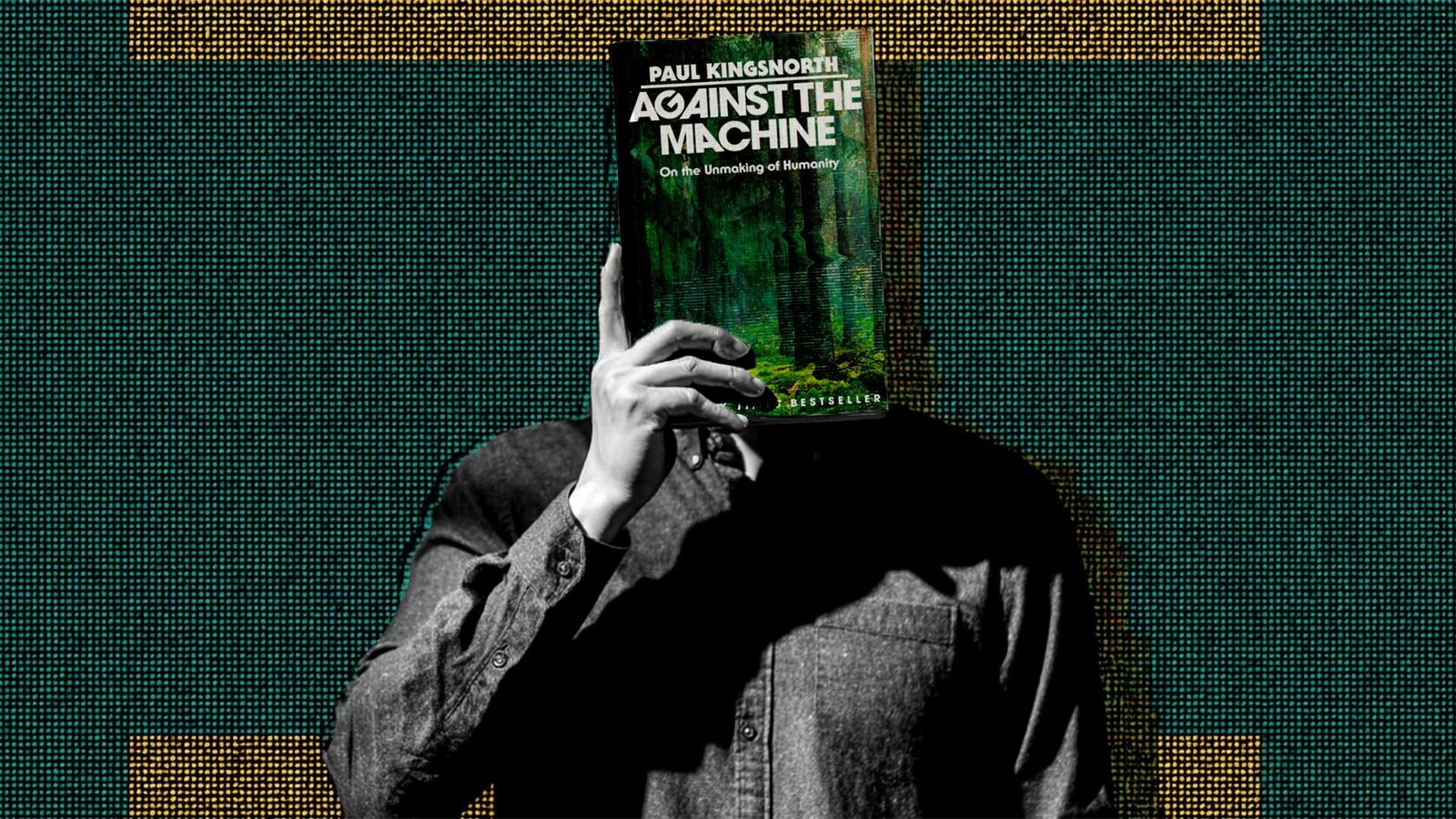
Against the Machine: On the Unmaking of Humanity, by Paul Kingsnorth, Thesis, 368 pages, $32
Since about 1970, infant mortality in the United States has decreased by roughly 75 percent. The United Kingdom has seen a similarly striking decrease. Globally, infant mortality is dramatically lower now than in the early 1970s.
Those are dull percentages—statistics, not individuals. But over time, they represent millions of babies, children, and eventually adult human lives that would not have existed if prior rates of infant mortality had held. You may know some of these people yourself. Depending on the circumstances of your birth, you may be one. Our modern world is full of them.
And that’s just the last five and a half decades. In the century prior to the 1970s, the total decline was even larger. A newborn’s survival went from a gamble to something closer to a certainty. In postwar America, the decline in infant mortality was so significant that it may have been partly responsible for the baby boom. Yes, there are still too many children who don’t make it to their first birthday. But the number is practically infinitesimal compared with the norm prior to the industrial revolution.
Or consider global nutrition. In 1970, about a third of people in developing countries were undernourished. Today, that figure is a little less than nine percent. Yes, there are still too many people who struggle with undernourishment—and global hunger has ticked up slightly since 2015. But there are far, far fewer people struggling to feed themselves today than there were five and a half decades ago.
What happened? Improvements in public health and sanitation, the increasing availability of antibiotics, and changes in medical practice and technology, including specialized neonatal intensive care units that keep especially vulnerable newborns alive. Hunger has been reduced by better scientific advances in seeds and fertilizer, by improved irrigation practices, by advances in global trade that make it easier to move food from one part of the world to another.
What happened, in a word, was progress. And that is exactly what Paul Kingsnorth is against.
Kingsnorth says this explicitly in his new book, Against the Machine. One of his concluding chapters is titled “Against Progress.” Earlier in the book, he responds dismissively to a lengthy quote from Jeff Bezos, who anticipates a time when a trillion human beings will populate not only the Earth but the solar system.
The Bezos quote is the only time the book mentions infant mortality, but Kingsnorth has nothing to say about that. Instead, he responds to a separate part of Bezos’ argument: that more people will mean more talent, more genius, more Mozarts. Kingsnorth reacts with a smirk and a shrug. He questions the idea “that a trillion people is more ‘interesting’ than seven billion.” Bezos, he writes, “doesn’t say what we would do with all these extra Mozarts. Do we need that much classical music?” Kingsnorth’s vision of human flourishing apparently doesn’t include all that many humans, or much flourishing.
Kingsnorth argues for unpacking the “unquestioned assumptions” in visions like the one Bezos presents. Kingsnorth’s assumptions are worth laying out too. He began his public life as a radical environmentalist. When he was younger, he practiced Wiccan rituals and protested globalization and free trade, which he still opposes. He’s now a Christian, but he retains a wholly mystical view of the natural world and an instinctive skepticism of nearly any tool or practice that alters its character or rhythms—which, given his response to Bezos, seems to include people. The book is subtitled On the Unmaking of Humanity, but it sometimes seems as if it is Kingsnorth who would like to unmake humanity.
Kingsnorth pitches his book as a pro-human manifesto, a rallying cry for those lost in a soulless technological dystopia to realign culture, politics, and daily life in a way more closely attuned to human history and human nature. Much of it is focused on technology, particularly television, the internet, and screens of all kinds. But it’s really a manifesto against the idea of progress itself.
Late in the book, in a chapter titled “What Progress Wants,” he writes that “we have been divorced from our traditional ways of understanding and navigating the world”; he goes on to say that while he has made “economic and political claim[s],” he is really making a “spiritual claim.”
On the contrary, while Kingsnorth sometimes touches on politics and economics, he barely makes any substantive arguments to back up his ideas. His gestalt is almost entirely spiritual. Across 300-odd pages, there are precious few facts, figures, statistics, studies, or numbers. He rejects the idea that such trivialities have any value at all: He grumbles about “the numbers-obsessed rationalism that underlies this new, corporate-friendly green technocracy” and admits that those who share his worldview “have no five-point plan of our own, and we can’t peer-review our intuition, so our complaints don’t convince anybody who matters.” Nearly any time he mentions data or measurement, it is with disdain.
Instead of measurement, Kingsnorth has intuition, senses, feelings, and belief without evidence. Something is deeply wrong with modernity. He can’t prove it. He just knows. This feeling is not just what motivates his arguments; it is his argument.
Early in the book, he presents his case as an elaboration of a widely shared sense that something is profoundly amiss with modernity. “You can feel the great craters that it makes in the world,” he writes. “You can feel what is being tarmacked and neatened and rationalised into oblivion, and the depth of what is leaving, but you cannot explain or justify it in the terms which are now the terms we live by. You just know that something is wrong. Everybody tells you that you feel this because you are infected with something called ‘nostalgia’, or that you picked up a dose of ‘Luddism’ or ‘Romanticism’ at a party or in a doctor’s waiting room. Basically, there is something wrong with you. You don’t understand Progress, which is always and everywhere a Good Thing. But you can feel something going on that is not a good thing, and it doesn’t matter how many lies, damned lies or statistics are produced to prove otherwise. You can feel this something enveloping you.”
This is what all the degrowthers, declinists, and tech-pessimists have in common: an intuition, a feeling, a tingling, tantalizing, spiritual sense that something has gone wrong—and precious little solid evidence to back it up. That something is tied to trade, technology, and the great evil they see as progress. They just know it is wrong. And they hope that, by poetically declaring as much, they can convince you of the same.
It is hard to argue with this sort of thing, because there is not really anything to argue with. Kingsnorth has his feelings and his intuitions, none of which I share. I have numbers, studies, and measurements that reflect real facts about the physical world. He says he does not care about numbers or studies or measurements. Where does an argument, let alone a conversation, go from here?
Throughout the book, Kingsnorth complains that champions of progress and modernity evade argument by relying entirely on unexamined assumptions. Kingsnorth prefers to evade argument by insisting that anything that departs from his intuition simply must be wrong.
At times, Kingsnorth comes close to understanding the limitations of his intuitions. He has a strong belief in the connection between people in places, and he calls himself a nationalist. But he allows that governments of nations have not done much to promote his agenda, and in fact have thwarted it. As the book progresses, he devotes increasing energy to arguing against being governed at all—though this does not make him any more sympathetic to free trade.
His muddled intuition on the question of nationalism—that nations are good but governments are not—eventually give way to an approving quotation of the anarchist philosopher Pierre-Joseph Proudhon’s comment that “to be GOVERNED is to be watched, inspected, spied upon, directed, law-driven, numbered, regulated, enrolled, indoctrinated, preached at, controlled, checked, estimated, valued, censured, commanded, by creatures who have neither the right nor the wisdom nor the virtue to do so.”
“Nothing,” writes Kingsnorth, “has the reach of the modern state.” This skepticism of state power is an intuition I actually do share. But I wouldn’t expect to convince those who don’t by simply insisting that we can all feel it.
Kingsnorth is a capable, often elegant, writer. And he probably does speak for a widely shared, if considerably less intense and specific, sense that modernity has gone off the rails, that technology has overtaken minds, that culture has become stupid and shallow, and that politics has become uglier as a result. But the fact is that in his lifetime, human suffering has been reduced, and the material living standards of vast swaths of the world have indeed improved. Progress is, in fact, good, whether or not you can feel it.
PETER SUDERMAN is features editor at Reason.
Read the full article here
Fact Checker
Verify the accuracy of this article using AI-powered analysis and real-time sources.