

 Freedom Index
Listen to the article
Note: the following review contains plot spoilers.
In the opening lines of his poem Ithaka, Constantine P. Cavafy (1863–1933), the second-most famous Greek poet to make his theme the perilous homecoming of the Trojan War hero Odysseus, wrote
As you set out for Ithaka
hope your road is a long one,
full of adventure, full of discovery.
Laistrygonians, Cyclops,
angry Poseidon—don’t be afraid of them:
you’ll never find things like that on your way
as long as you keep your thoughts raised high,
as long as a rare excitement
stirs your spirit and your body.
(The translation is from Edmund Keeley and Philip Sherrard’s 1975 compilation, C.P. Cavafy, Selected Poems.) Christopher Nolan’s newly released blockbuster The Odyssey duly cinematises these comic-book fixtures of “adventure” in Homer’s epic: the cannibalistic giants called the Laestrygonians (the Latinate spelling of the word); the even more gigantic and cannibalistic Cyclops, Polyphemus; and the duly angry (if never seen) ocean-god Poseidon, who happens to be Polyphemus’s father and is not pleased when Odysseus drives a blinding stake through his son’s single eye.
What is missing from Nolan’s film is the “rare excitement” that “stirs your spirit and your body.” The Odyssey is, to put it bluntly, a three-hour downer. In Nolan’s screenplay, Odysseus (Matt Damon), is not “the man of many tropes”, as Homer described him (andra…polytropon)—the wily king of Ithaca who leads his men in and out of trouble as they sail around the Mediterranean for years after Troy’s fall. Rather, he is a man of only one trope: guilt.
Homer’s epic ends with Odysseus, back in Ithaca and disguised as a beggar, nearly single-handedly slaying—with some help from his son Telemachus and his faithful swineherd Eumaeus—every last one of the 108 freeloading suitors who’d been plotting to kill his son while eating his long-suffering wife, Penelope, out of palace and home (while also pestering her to marry one of them). He then falls into bed with the thrilled Penelope. Some of you may recoil at the sheer bloodiness of the mass slaughter (the victims of which included a gaggle of maidservants who’d been sleeping with the suitors when they should have been loyally serving Penelope). But others will think they all deserved it.
Nolan’s film, by contrast, ends with Odysseus, also in beggar’s rags, pouring out a monologue of self-loathing to Penelope (Anne Hathaway), who has summoned him to her chambers. In this scene, the two are separated by a grille-like wooden screen, which will remind Catholic viewers of going to confession. This device is necessitated by the fact that Odysseus is still supposed to be incognito at this point. In Homer’s original, Odysseus had received miraculous help from the goddess Athena in perfecting his disguise. But as detailed at greater length below, Nolan pretty much eliminated the gods from his narrative (except as background props) in order to make the narrative more “accessible.”
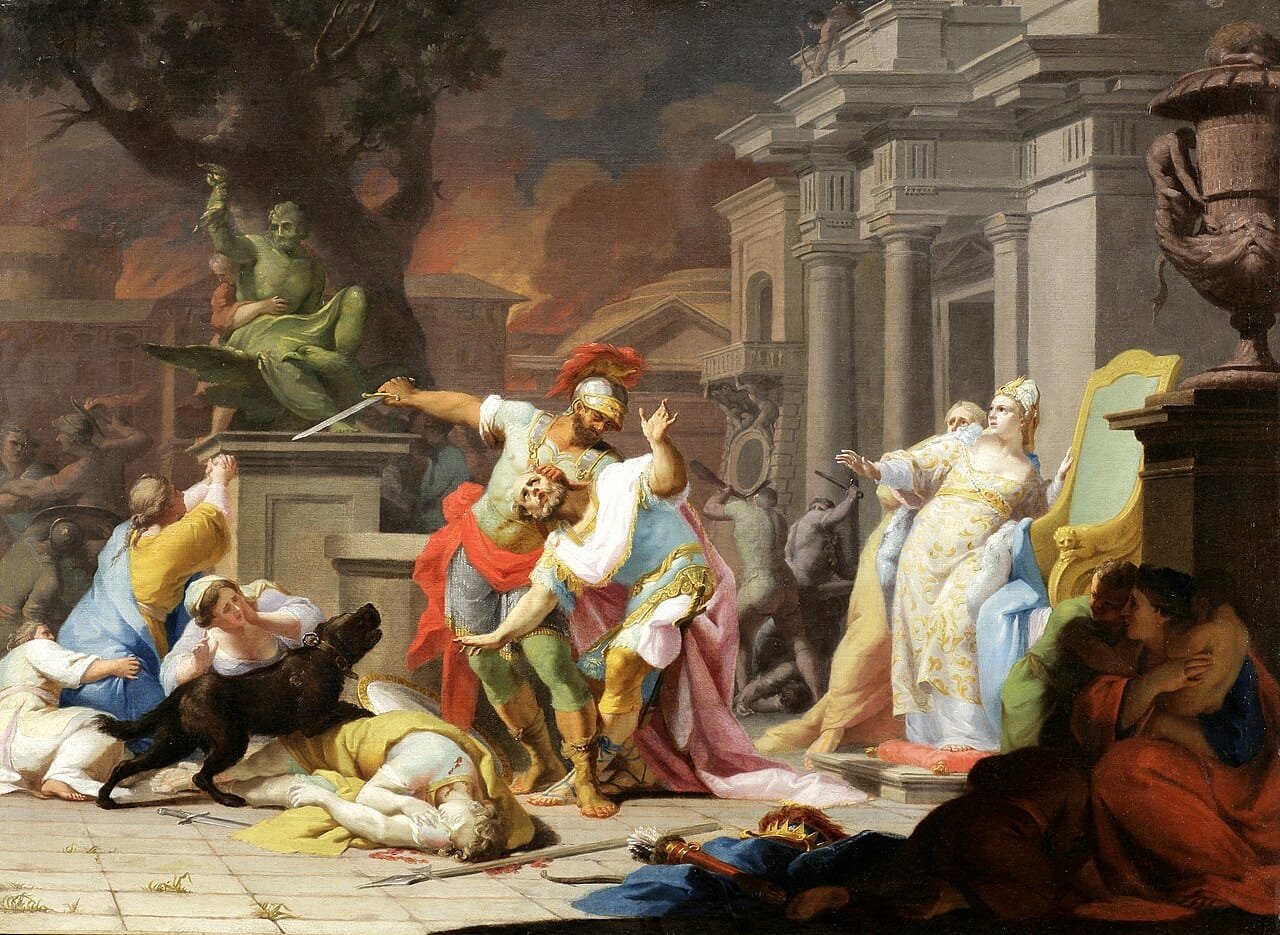
Odysseus’s sin, we learn from his agonised peroration, was designing the Trojan Horse, the hollow sculpture stuffed with Greek warriors (including Odysseus himself) that the Trojans unwittingly dragged into their city, having been told it was a gift from the retreating Greeks, who were supposedly going home following a decade-long siege. Once inside the hitherto impregnable walls of Troy, the warriors open the gates to let in the rest of the Greek army—and they all burn Troy to the ground, plunder its treasures, rape, murder, and enslave its inhabitants, and desecrate its temples.
“What if the Odysseus we knew lost his way? What if, when he opened the gates of Troy, he saw ten years of rage pour into that city in one night?” the beggar-in-disguise tells Penelope in a voice breaking with anguish. “We left them a gift, an offering of peace that they took into their homes. We violated all that was sacred between people and turned a fight into a hunt…What if Odysseus knew, as he walked through fires of anarchy and pain and in the days of sweaty celebration that followed, what if he knew exactly what he had done?”
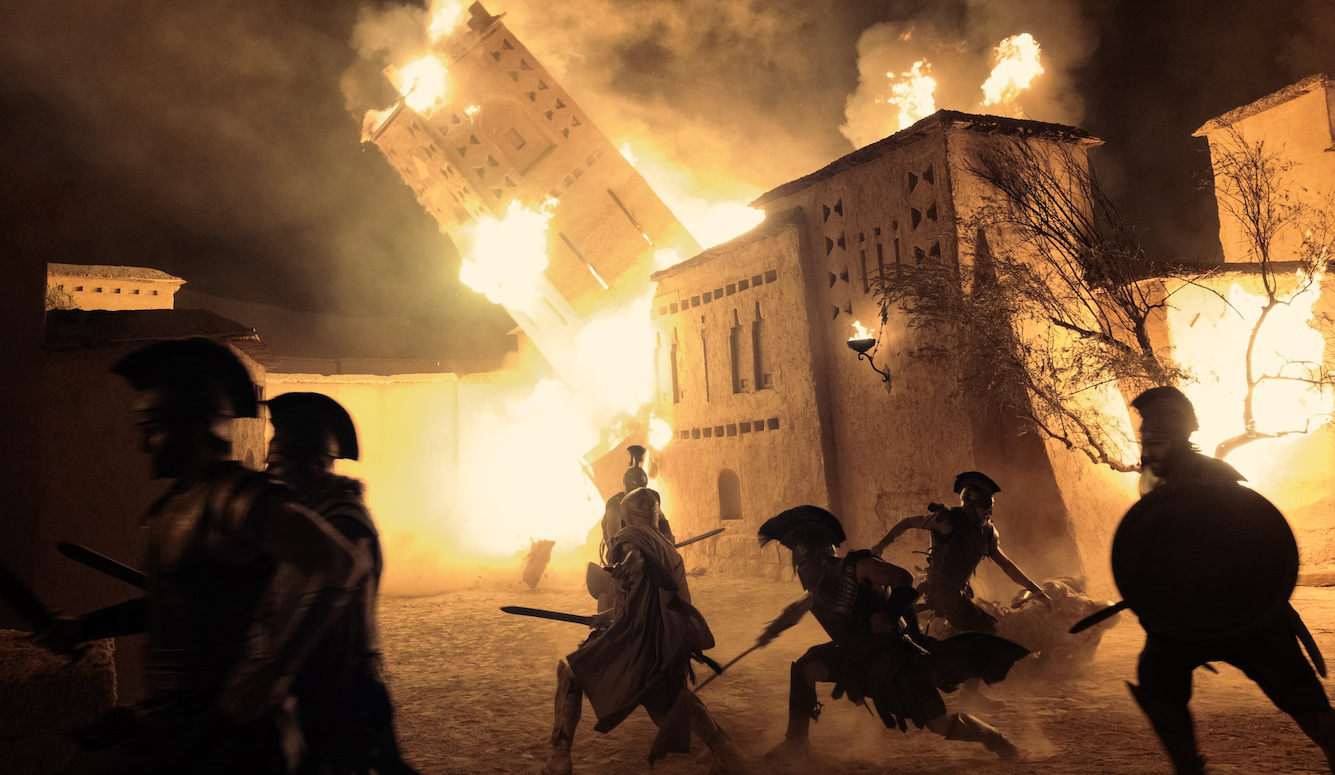
All this is spoken to the accompaniment of a horrifying flashback that is the visual and emotional centrepiece of Nolan’s film. The flames leap past Troy’s battlements into the night sky, with the pillaging soldiers in their plumed helmets back-lit like the silhouettes on Greek black-figure pottery, and the crimes filling up a smoking middle distance. Bronze gongs clang, and the aulos, a double flute dating to at least the sixth century B.C., wails hauntingly. For this, thank Ludwig Göransson, who also composed the score for Nolan’s Tenet (2020) and Oppenheimer (2023). It was the one tableau in the entire three hours of this movie that genuinely moved me.
After that confession, Odysseus’ rout of the suitors, drawn out and overproduced, feels like an anticlimax. We next see him abdicating his throne as a self-imposed punishment, leaving son Telemachus (Tom Holland) to rule over Ithaca while he sails off into mysterious exile with a veiled Penelope at his side. I had to ask: “What did she do to deserve this fate?”
In Homer’s epic, by contrast, the ever-helpful Athena, goddess of wisdom, prolongs the night and signals rosy-fingered Dawn to take her time arriving so that Penelope and Odysseus can enjoy hours of love-making and he can regale her with the tales of his adventures. Watching the couple’s decidedly un-erotic exit in Nolan’s movie, I wondered if Odysseus would ever forgive himself long enough to realise that Penelope might be in the same room (or boat).
This is not to say that The Odyssey doesn’t have admirable aspects, mostly in regard to its special effects. It is often visually beautiful. Shot entirely in 70-millimetre IMAX (a first for a feature-length film) on a US$250 million budget, it should be. (I was lucky to view the movie on a large IMAX screen at the National Air and Space Museum in Washington, D.C.) The burning-of-Troy episode is magnificent—as are the travails of Odysseus’ fleet amid storms, the whirlpools of Scylla and Charybdis, and ultimately shipwreck and devastation as Odysseus loses his entire crew.
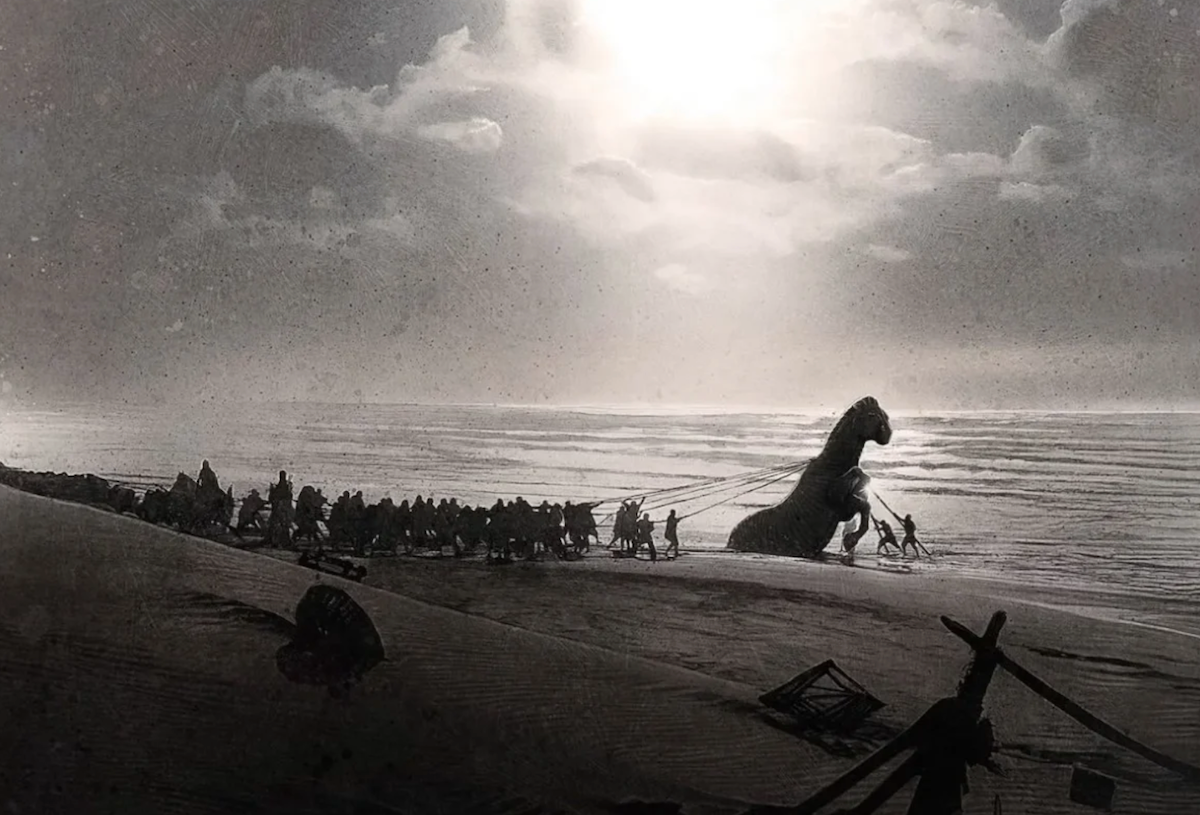
Nolan used next to no CGI. Polyphemus is an ingeniously constructed 59-foot puppet, Troy is a hilltop set containing about 60 structures, Odysseus’ ship is a real-life replica of a Viking longboat (ancient and early-medieval shipbuilding and techniques were surprisingly similar), and the famous transformation of Odysseus’ men into pigs by the sorceress Circe (Samantha Morton) is a camera-angle illusion. The effect is of a satisfyingly tangible reality that computer generation simply cannot produce.
Still, the sets are mostly dreary. The fall of Troy, if it occurred historically, took place around 1190 B.C., at the height of Greece’s Late Bronze Age civilisation. But the structures in Nolan’s movie, modelled after the Palace of Mycenae on the Peloponnesus and similar ruins, look already faded and decrepit. Nolan is notorious for his greyed-out cinematic palettes, and here the brilliantly sunny Mediterranean beach-scapes that enthral visitors to modern Greece and its islands look more like the fog-beset English Channel in his Dunkirk (2017). Odysseus and his men dress almost entirely in Batman black in this film, with dingy leather armour that has been criticised for bearing little resemblance to the colourful and brightly polished battle-wear of archaic Greeks. It’s supposed to be the Bronze Age, we’re told again and again, but where’s the bronze?
This brings us to the casting. Not the “DEI” controversy that has roiled conservative media and glazed over the eyeballs of everyone else—although the Greeks have a point in complaining that not a single Greek actor (nor, indeed, any actor of Mediterranean descent) was cast in a visible role in this dramatisation of an ur-Greek literary treasure. Still, there is something silly in kvetching about a black Helen of Troy in a film whose lead star looks about as authentically Greek as Johnny Appleseed.
Read the full article here
Fact Checker
Verify the accuracy of this article using AI-powered analysis and real-time sources.