Close Menu
FSNN | Free Speech News NetworkFSNN | Free Speech News Network
  • Home
  • News
    • Politics
    • Legal & Courts
    • Tech & Big Tech
    • Campus & Education
    • Media & Culture
    • Global Free Speech
  • Opinions
    • Debates
  • Video/Live
  • Community
  • Freedom Index
  • About
    • Mission
    • Contact
    • Support
Trending

Victory! Flock Ends Rollout of Audio “Distress Detection” of Human Voices

7 minutes ago

JK Rowling Threatens To Sue Amnesty International Into Oblivion For Expressing An Opinion About A Charity She Funds

9 minutes ago

Court Rejects Claim That Allowing Allegedly Biologically Male Student in Girls’ Restroom Violates Equal Protection Clause and Title IX

10 minutes ago
Facebook X (Twitter) Instagram
Facebook X (Twitter) Discord Telegram
FSNN | Free Speech News NetworkFSNN | Free Speech News Network
Market Data Newsletter
Friday, July 17
  • Home
  • News
    • Politics
    • Legal & Courts
    • Tech & Big Tech
    • Campus & Education
    • Media & Culture
    • Global Free Speech
  • Opinions
    • Debates
  • Video/Live
  • Community
  • Freedom Index
  • About
    • Mission
    • Contact
    • Support
FSNN | Free Speech News NetworkFSNN | Free Speech News Network
Home»News»Media & Culture»My New Jotwell Review of Anna Law’s Book “Migration and the Origins of American Citizenship”
Media & Culture

My New Jotwell Review of Anna Law’s Book “Migration and the Origins of American Citizenship”

News RoomBy News Room1 hour agoNo Comments4 Mins Read1,233 Views
Share Facebook Twitter Pinterest Copy Link LinkedIn Tumblr Email VKontakte Telegram
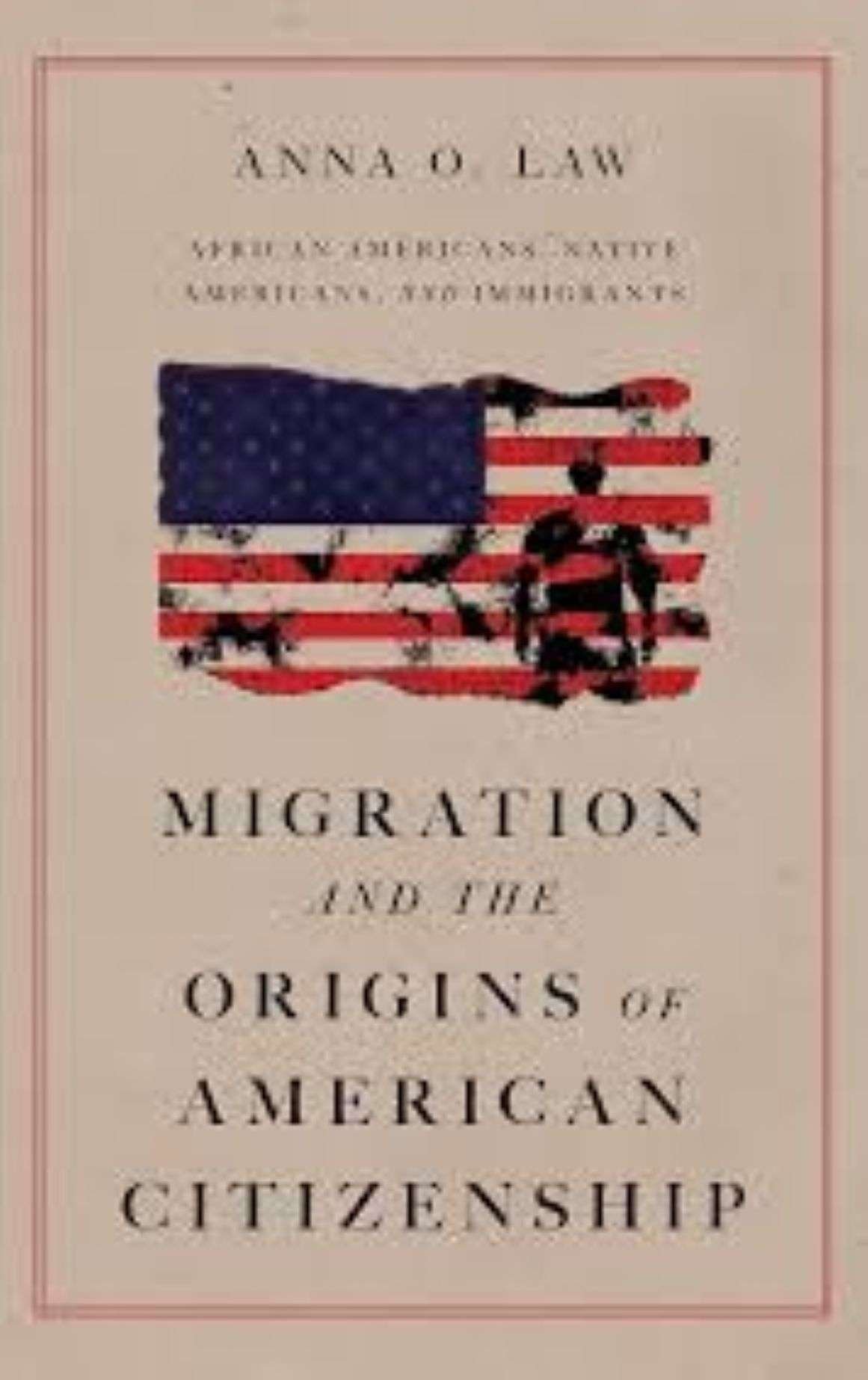
My New Jotwell Review of Anna Law’s Book “Migration and the Origins of American Citizenship”
Share
Facebook Twitter Pinterest Email Copy Link

Listen to the article

0:00
0:00

Key Takeaways

Playback Speed

Select a Voice

Political scientist Anna O. Law is one of the leading experts on the history and development of American immigration policy…. Her new book builds on her previous scholarship and that of others to bring together three interlinked topics that are usually considered separately: the development of immigration law and policy in the early republic, policies on slavery and internal migration, and policy towards Native Americans.

Law makes the by-now familiar point that, during the first century of American history, power over international migration overwhelmingly resided in the hands of state governments, rather than the federal government. In a more novel and distinctive move, she links this to the desire of many Founding-era Americans and subsequent generations to preserve state authority over internal migration, slavery, and dealings with Native Americans.

Southern slave states sought to retain control over importation of slaves and in-migration of free Blacks—ensuring a steady supply of the former, while restricting the latter, lest they upset the system of racially based slavery. Some northern states also sought to keep out or at least restrict free Blacks, out of racism. Many states further tried to restrict entrance by “paupers”—people believed likely to become dependent on welfare and charity….

All of this helped lead to a Constitution that did not give the federal government much, if any, control over migration, at least in peacetime. States wanted to retain that control for themselves. As Law points out, the Constitution doesn’t clearly assign power over migration to any level of government. But the historical evidence suggests the general understanding in the Founding era was that international and domestic migration were largely under state control.

One can put the point even more strongly: Given the extensive and detailed enumeration of other federal powers in the Constitution—including such relatively minor ones as “fix[ing] the standard of weights and measures” and establishing “post roads”—it would be extremely surprising if the Founders gave the federal government so major a power as that of immigration restriction without making it explicit….

Law concludes that federalism largely failed to enhance liberty when it comes to international and internal migration. She correctly emphasizes the many restrictionist aspects of state control, often motivated by racial or ethnic bigotry. She notes, also, that neighboring states sometimes imitated each other’s restrictive policies rather than countering them.

Law is certainly right that state policy on both internal and international migration during the first century of American history was far from a paragon of virtue and inclusion. But other aspects of her account strongly suggest that leaving this policy area under state control was still likely better than federalization would have been.

Variation between states often worked to the advantage of migrants. As Law describes, ship owners and employers often arranged to land new immigrants in states with less restrictionist polices. From there, they could move on to other states—including those with tighter restrictions on landing. Moreover, as Law outlines in one of the more insightful and original parts of her account, the state of New York—which, in the nineteenth century as now, had the single biggest East Coast port—had very open policies, with few restrictions on migration. Immigrants and shipping lines took advantage of that….

Law also may somewhat overstate the extent to which racial and ethnic discrimination guided immigration policy. Undoubtedly, there was a great deal of that. But many of the Founders also took Enlightenment liberal ideology seriously, and recognized that it implied an open immigration policy.

In his General Orders to the Continental Army, issued at the end of the Revolutionary War in 1783, George Washington stated that one of the reasons the United States was founded was to create “an Asylum for the poor and oppressed of all nations and religions….”  Jefferson, Madison, and others said similar things. This talk was backed by actual policy at the federal level, and in more liberal-minded state governments.

When it comes to non-white immigrants, as Law notes, the Naturalization Act of 1790, and succeeding legislation until after the Civil War, limited citizenship to whites. That was undoubtedly caused by a combination of racism and fear that an increasing population of Black immigrants would imperil racially based slavery. But this restriction did not prevent non-white migrants from coming to the US and living and working here….

In sum, leaving immigration policy largely to state governments likely led to substantially more open immigration than might otherwise have been the case, and the Founders’ liberal Enlightenment ideals had some real impact. At the same time, Law is right to point to the many severe deviations from those ideals, especially at the state level and with respect to Blacks….

Law’s new book is essential reading for anyone interested in the constitutional and political history of American migration policy.

Read the full article here

Fact Checker

Verify the accuracy of this article using AI-powered analysis and real-time sources.

Get Your Fact Check Report

Enter your email to receive detailed fact-checking analysis

5 free reports remaining

Continue with Full Access

You've used your 5 free reports. Sign up for unlimited access!

Already have an account? Sign in here

#Democracy #FreePress #IndependentMedia #Journalism #PoliticalCoverage
Share. Facebook Twitter Pinterest LinkedIn Tumblr Email Telegram Copy Link
News Room
  • Website
  • Facebook
  • X (Twitter)
  • Instagram
  • LinkedIn

The FSNN News Room is the voice of our in-house journalists, editors, and researchers. We deliver timely, unbiased reporting at the crossroads of finance, cryptocurrency, and global politics, providing clear, fact-driven analysis free from agendas.

Related Articles

Media & Culture

JK Rowling Threatens To Sue Amnesty International Into Oblivion For Expressing An Opinion About A Charity She Funds

9 minutes ago
Media & Culture

Court Rejects Claim That Allowing Allegedly Biologically Male Student in Girls’ Restroom Violates Equal Protection Clause and Title IX

10 minutes ago
Legal & Courts

Leaked Police Drone Videos Highlight Need For Independent Review of the Technology’s Usefulness

15 minutes ago
Cryptocurrency & Free Speech Finance

Galaxy Puts Its Name on Texas Tech’s Stadium in a 15-Year, Crypto-Native Deal

42 minutes ago
Media & Culture

The Documents Trump Declassified To Blame China For The 2020 Election… Actually Show Russia Was The One Meddling For Him

1 hour ago
Media & Culture

Why the EU’s Proposal to Criminalize Hate Speech Violates Freedom of Expression—and Won’t Reduce Intolerance or Extremism,” by Jacob Mchangama & Natalie Alkiviadou

2 hours ago
Add A Comment
Leave A Reply Cancel Reply

Editors Picks

JK Rowling Threatens To Sue Amnesty International Into Oblivion For Expressing An Opinion About A Charity She Funds

9 minutes ago

Court Rejects Claim That Allowing Allegedly Biologically Male Student in Girls’ Restroom Violates Equal Protection Clause and Title IX

10 minutes ago

Leaked Police Drone Videos Highlight Need For Independent Review of the Technology’s Usefulness

15 minutes ago

The payment war shifts to distribution as stablecoins reach mainstream status

22 minutes ago
Latest Posts

OKX Europe Lets Users Convert USDT to MiCA-Compliant USDC

26 minutes ago

Galaxy Puts Its Name on Texas Tech’s Stadium in a 15-Year, Crypto-Native Deal

42 minutes ago

Your Vision. Your Legacy. Your Future.

1 hour ago

Subscribe to News

Get the latest news and updates directly to your inbox.

At FSNN – Free Speech News Network, we deliver unfiltered reporting and in-depth analysis on the stories that matter most. From breaking headlines to global perspectives, our mission is to keep you informed, empowered, and connected.

FSNN.net is owned and operated by GlobalBoost Media
, an independent media organization dedicated to advancing transparency, free expression, and factual journalism across the digital landscape.

Facebook X (Twitter) Discord Telegram
Latest News

Victory! Flock Ends Rollout of Audio “Distress Detection” of Human Voices

7 minutes ago

JK Rowling Threatens To Sue Amnesty International Into Oblivion For Expressing An Opinion About A Charity She Funds

9 minutes ago

Court Rejects Claim That Allowing Allegedly Biologically Male Student in Girls’ Restroom Violates Equal Protection Clause and Title IX

10 minutes ago

Subscribe to Updates

Get the latest news and updates directly to your inbox.

© 2026 GlobalBoost Media. All Rights Reserved.
  • Privacy Policy
  • Terms of Service
  • Our Authors
  • Contact

Type above and press Enter to search. Press Esc to cancel.

🍪

Cookies

We and our selected partners wish to use cookies to collect information about you for functional purposes and statistical marketing. You may not give us your consent for certain purposes by selecting an option and you can withdraw your consent at any time via the cookie icon.

Cookie Preferences

Manage Cookies

Cookies are small text that can be used by websites to make the user experience more efficient. The law states that we may store cookies on your device if they are strictly necessary for the operation of this site. For all other types of cookies, we need your permission. This site uses various types of cookies. Some cookies are placed by third party services that appear on our pages.

Your permission applies to the following domains:

  • https://fsnn.net
Necessary
Necessary cookies help make a website usable by enabling basic functions like page navigation and access to secure areas of the website. The website cannot function properly without these cookies.
Statistic
Statistic cookies help website owners to understand how visitors interact with websites by collecting and reporting information anonymously.
Preferences
Preference cookies enable a website to remember information that changes the way the website behaves or looks, like your preferred language or the region that you are in.
Marketing
Marketing cookies are used to track visitors across websites. The intention is to display ads that are relevant and engaging for the individual user and thereby more valuable for publishers and third party advertisers.