Close Menu
FSNN | Free Speech News NetworkFSNN | Free Speech News Network
  • Home
  • News
    • Politics
    • Legal & Courts
    • Tech & Big Tech
    • Campus & Education
    • Media & Culture
    • Global Free Speech
  • Opinions
    • Debates
  • Video/Live
  • Community
  • Freedom Index
  • About
    • Mission
    • Contact
    • Support
Trending

Michael Saylor says BTC winter is over. Market analyst disagrees, says bitcoin was in a pullback

11 minutes ago

Wisconsin sues Kalshi, Polymarket, others over sports event contracts

14 minutes ago

Aave Leads ‘DeFi United’ Push to Contain $292M KelpDAO Fallout

16 minutes ago
Facebook X (Twitter) Instagram
Facebook X (Twitter) Discord Telegram
FSNN | Free Speech News NetworkFSNN | Free Speech News Network
Market Data Newsletter
Friday, April 24
  • Home
  • News
    • Politics
    • Legal & Courts
    • Tech & Big Tech
    • Campus & Education
    • Media & Culture
    • Global Free Speech
  • Opinions
    • Debates
  • Video/Live
  • Community
  • Freedom Index
  • About
    • Mission
    • Contact
    • Support
FSNN | Free Speech News NetworkFSNN | Free Speech News Network
Home»Cryptocurrency & Free Speech Finance»More than 90% of Web3 games failed after $15 billion boom as gamers never showed up: Caladan
Cryptocurrency & Free Speech Finance

More than 90% of Web3 games failed after $15 billion boom as gamers never showed up: Caladan

News RoomBy News Room12 hours agoNo Comments3 Mins Read466 Views
Share Facebook Twitter Pinterest Copy Link LinkedIn Tumblr Email VKontakte Telegram
More than 90% of Web3 games failed after  billion boom as gamers never showed up: Caladan
Share
Facebook Twitter Pinterest Email Copy Link

Listen to the article

0:00
0:00

Key Takeaways

Playback Speed

Select a Voice

Web3 gaming burned through up to $15 billion chasing a token-driven future that gamers never bought into.

Data from Caladan, a market-making and trading firm, shows roughly 93% of so-called GameFi projects are now effectively dead, with token values down about 95% from their 2022 peaks and funding to studios collapsing 93% by 2025.

Investors and studios poured billions into tokens and non-fungible tokens (NFTs) before building blockchain-based games containing tradable properties. Then capital shifted into AI, asset tokenization and infrastructure, and more than 300 games shut down, turning Web3 gaming into a cautionary tale about chasing speculation over product-market fit.

“Capital was destroyed at every layer simultaneously,” the report states, pointing to venture capital, retail NFT buyers, gaming guilds and Telegram’s 300-million-user tap-to-earn wave as parallel casualties. Hamster Kombat alone lost 96% of its users within six months of launch. YGG, the flagship gaming-guild token, trades 99.6% below its November 2021 peak.

(Caladan)

Individual post-mortems are brutal. Pixelmon raised $70 million in a 2022 NFT mint and, four years on, still has no public game. Ember Sword burned through $18 million over seven years of development before shutting down last May with no refunds. Gala Games is embroiled in a lawsuit alleging its co-founder diverted $130 million in tokens. Square Enix quietly wound down its Symbiogenesis experiment last July.

Structural mismatch

The failure wasn’t just a bad cycle or weak execution. The data indicate it was a structural mismatch between a model built around financial incentives and an audience that consistently signaled it wanted entertainment instead.

At the heart of the boom was GameFi, the play-to-earn model that turned gameplay into a financial feedback loop.

Players bought tokens or NFTs, earned rewards in those same assets, and cashed in as long as newcomers kept piling in. Once the inflows slowed, the math broke down. Token prices slumped, rewards thinned out, and users walked away — dragging entire in-game economies down with them.

Axie Infinity, the sector’s one-time flagship, watched daily active users crater from roughly 2.7 million at the peak to around 5,500 today, according to DappRadar data.

The demand side never caught up with the flood of capital. Even at the height of the mania, just 12% of gamers had tried a crypto game, according to a Coda Labs survey, cited by Caladan.

Capital allocation made the problem worse. Studios raised tens or hundreds of millions of dollars before shipping viable products, removing the pressure to build games that could retain players.

(Caladan)
(Caladan)

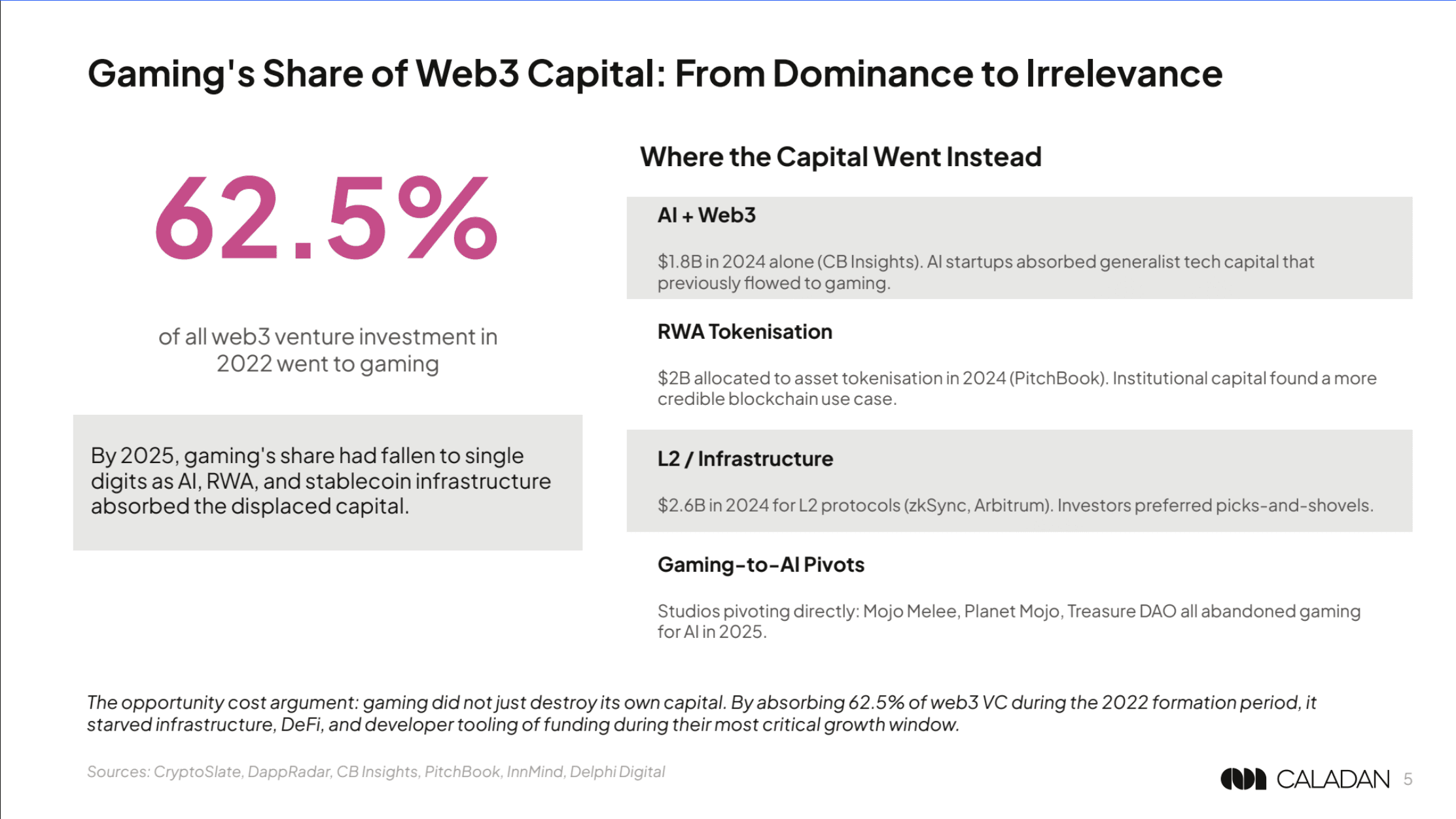
The most telling data point may be where the money went instead. Gaming commanded 62.5% of all Web3 venture investment in 2022; by 2025, its share had collapsed to single digits as AI, real-world-asset tokenization and layer-2 infrastructure absorbed the displaced capital.
(Caladan)
(Caladan)

Even Animoca Brands, the sector’s most prolific backer, has cut gaming to roughly 25% of its portfolio and is pivoting to stablecoins, RWAs and AI.

At the same time, development timelines stretched three to five years, while tokens traded in real time and demanded constant momentum. By the time many projects were ready to launch, their associated tokens had already collapsed.

The result is a sector that expanded rapidly on speculative demand and contracted just as quickly when that demand faded. More than 300 blockchain games have shut down, according to DappRadar, and remaining investment has shifted away from titles toward infrastructure.

What was once pitched as the future of gaming now looks more like a cautionary example of what happens when financial engineering runs ahead of product market fit.

Read the full article here

Fact Checker

Verify the accuracy of this article using AI-powered analysis and real-time sources.

Get Your Fact Check Report

Enter your email to receive detailed fact-checking analysis

5 free reports remaining

Continue with Full Access

You've used your 5 free reports. Sign up for unlimited access!

Already have an account? Sign in here

Share. Facebook Twitter Pinterest LinkedIn Tumblr Email Telegram Copy Link
News Room
  • Website
  • Facebook
  • X (Twitter)
  • Instagram
  • LinkedIn

The FSNN News Room is the voice of our in-house journalists, editors, and researchers. We deliver timely, unbiased reporting at the crossroads of finance, cryptocurrency, and global politics, providing clear, fact-driven analysis free from agendas.

Related Articles

Cryptocurrency & Free Speech Finance

Michael Saylor says BTC winter is over. Market analyst disagrees, says bitcoin was in a pullback

11 minutes ago
Cryptocurrency & Free Speech Finance

Wisconsin sues Kalshi, Polymarket, others over sports event contracts

14 minutes ago
Cryptocurrency & Free Speech Finance

Aave Leads ‘DeFi United’ Push to Contain $292M KelpDAO Fallout

16 minutes ago
Cryptocurrency & Free Speech Finance

BTC price, U.S. dollar move in near-perfect opposition. It hasn’t been this extreme in almost 4 years.

1 hour ago
Cryptocurrency & Free Speech Finance

Metaplanet Raises $50M in Zero-Interest Bonds to Buy Bitcoin

1 hour ago
Cryptocurrency & Free Speech Finance

Morning Minute: Soldier Arrested for $400K Polymarket Insider Bet on Maduro Raid

1 hour ago
Add A Comment
Leave A Reply Cancel Reply

Editors Picks

Wisconsin sues Kalshi, Polymarket, others over sports event contracts

14 minutes ago

Aave Leads ‘DeFi United’ Push to Contain $292M KelpDAO Fallout

16 minutes ago

After Viktor Orbán’s Defeat in Hungary, the ‘New Right’ Needs a New Foreign Despot To Admire

57 minutes ago

BTC price, U.S. dollar move in near-perfect opposition. It hasn’t been this extreme in almost 4 years.

1 hour ago
Latest Posts

Metaplanet Raises $50M in Zero-Interest Bonds to Buy Bitcoin

1 hour ago

Morning Minute: Soldier Arrested for $400K Polymarket Insider Bet on Maduro Raid

1 hour ago

Congress Still Has a Chance To Curb Section 702 Surveillance Abuses

2 hours ago

Subscribe to News

Get the latest news and updates directly to your inbox.

At FSNN – Free Speech News Network, we deliver unfiltered reporting and in-depth analysis on the stories that matter most. From breaking headlines to global perspectives, our mission is to keep you informed, empowered, and connected.

FSNN.net is owned and operated by GlobalBoost Media
, an independent media organization dedicated to advancing transparency, free expression, and factual journalism across the digital landscape.

Facebook X (Twitter) Discord Telegram
Latest News

Michael Saylor says BTC winter is over. Market analyst disagrees, says bitcoin was in a pullback

11 minutes ago

Wisconsin sues Kalshi, Polymarket, others over sports event contracts

14 minutes ago

Aave Leads ‘DeFi United’ Push to Contain $292M KelpDAO Fallout

16 minutes ago

Subscribe to Updates

Get the latest news and updates directly to your inbox.

© 2026 GlobalBoost Media. All Rights Reserved.
  • Privacy Policy
  • Terms of Service
  • Our Authors
  • Contact

Type above and press Enter to search. Press Esc to cancel.

🍪

Cookies

We and our selected partners wish to use cookies to collect information about you for functional purposes and statistical marketing. You may not give us your consent for certain purposes by selecting an option and you can withdraw your consent at any time via the cookie icon.

Cookie Preferences

Manage Cookies

Cookies are small text that can be used by websites to make the user experience more efficient. The law states that we may store cookies on your device if they are strictly necessary for the operation of this site. For all other types of cookies, we need your permission. This site uses various types of cookies. Some cookies are placed by third party services that appear on our pages.

Your permission applies to the following domains:

  • https://fsnn.net
Necessary
Necessary cookies help make a website usable by enabling basic functions like page navigation and access to secure areas of the website. The website cannot function properly without these cookies.
Statistic
Statistic cookies help website owners to understand how visitors interact with websites by collecting and reporting information anonymously.
Preferences
Preference cookies enable a website to remember information that changes the way the website behaves or looks, like your preferred language or the region that you are in.
Marketing
Marketing cookies are used to track visitors across websites. The intention is to display ads that are relevant and engaging for the individual user and thereby more valuable for publishers and third party advertisers.