

 Freedom Index
Listen to the article
Judge Kymberly Evanson (W.D. Wash.), in yesterday’s G.P. v. Arevalo, is largely unmoved by the argument, though she’s also hesitant to throw out the client’s case just because of that (emphasis added):
Plaintiff G.P. moves for an extension of the deadlines to file opposition briefs to three motions to dismiss …. The first two of these deadlines have already passed.
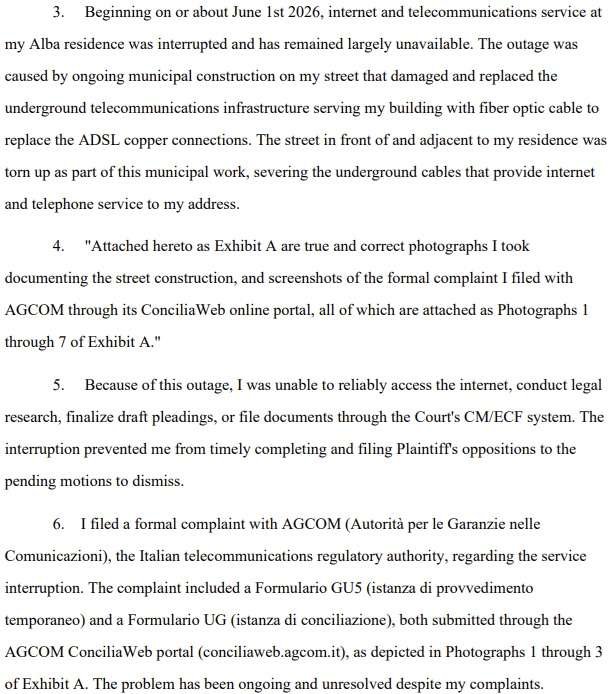
G.P.’s attorney states that the reason he was unable to meet the deadlines, confer with opposing counsel about an extension, or request an extension before now is that he has been residing in Alba, Italy for the last year and construction on his street has interrupted his “internet and telecommunications service” since about June 1, 2026. G.P.’s counsel does not suggest that he has been unable to access any source of internet during the last month, nor would such a claim be credible. Indeed, he has filed several briefs or other documents since the interruption at his residence began.
Although the Court is not yet persuaded that G.P.’s counsel has demonstrated diligence or good cause for his tardy request to extend the deadlines, denying his request would amount to terminating sanctions because the motions to dismiss at issue are dispositive. The Court is disinclined to impose such a sanction at this time.
Instead, Defendants Meta, Arevalo, and Jimenez are DIRECTED to notify the Court no later than July 6, 2026, whether they will stipulate to—or intend to oppose—G.P.’s requested extension and whether they request a commensurate extension of their reply deadline.
And the parties have indeed stipulated to the extensions.
My view: If you want to spend June in lovely Alba, Italy, “famous for its white truffle and wine production” and “the White Truffle Capital of the World,” you absolutely should! But if you also want to practice law during that month, you need to have a Plan B for any Internet outages you might be facing.
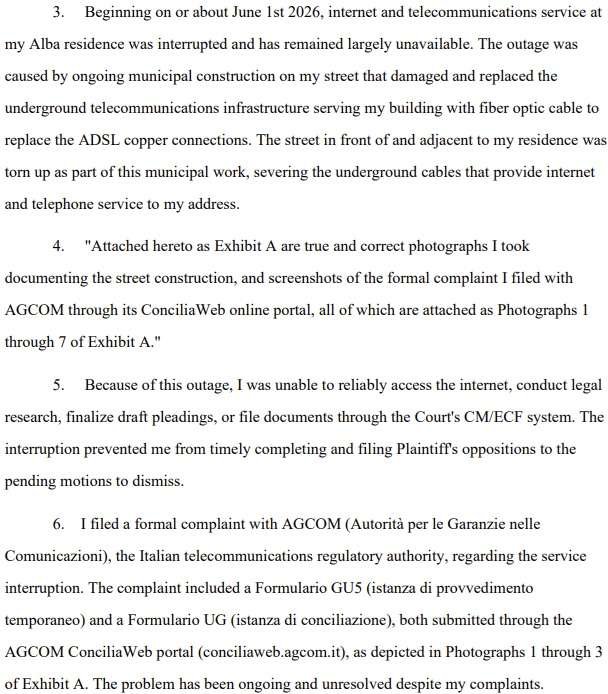
Here’s an excerpt of the lawyer’s argument:
By the way, here’s a summary of Meta’s view of the case, from its motion to dismiss:
Plaintiff G.P.’s claims stem from allegedly unlawfully recorded dashcam footage of Plaintiff looking at her phone for “approximately twenty (20) seconds” while driving a rental car and eventually running off the road. Plaintiff has sued, among others, the “host” of the car who allegedly recorded the footage and posted it online. Plaintiff’s original Complaint acknowledged that Section 230 of the Communications Decency Act would likely preclude any damages claim against Meta, asserted no substantive wrongdoing by Meta, and sought only equitable relief. The First Amended Complaint (“FAC”)—filed only after Meta moved to dismiss—attempts to circumvent that concession by grafting an implausible federal Wiretap Act theory onto the facts. But this new claim against Meta fails across the board.
First, Plaintiff’s FAC does not, and cannot, allege that the dashcam footage that Meta allegedly “amplified” on Facebook and Instagram included any communication at all for purposes of her claim: Plaintiff was alone in her car and not speaking to anyone. The federal Wiretap Act, accordingly, does not apply. Second, even if the footage included a communication that might be subject to the Wiretap Act (it does not), the FAC does not plausibly allege that Meta “knew or had reason to know” that the footage was obtained illegally, particularly since the FAC acknowledges, for the first time, that Plaintiff was given prior notice that the car was equipped with a dashcam and that she declined the express invitation to unplug it. Because Section 230 would bar any other substantive claim Plaintiff might seek to assert against Meta, the Court should dismiss the FAC with prejudice.
On the face of the two complaints—and the dashcam footage incorporated by reference into the FAC—Plaintiff broke the law and endangered the public; gave a false statement to police about being run off the road; repeated that false statement to the rental “host” who posted the footage; and then falsely asserted in her original Complaint both that “[a]t no point” did she receive any notice that the vehicle “contained any recording device whatsoever” and that the crash resulted from just a “split-second decision” to look at her phone. She seeks to recover a windfall from Meta as a reward for her misconduct, but her sole claim against Meta fails on the merits and should be dismissed at the outset of this litigation.
And here’s G.P.’s framing, from the Complaint:
This is a case about the systematic violation of a woman’s most fundamental right—the right to privacy—and the devastating cascade of consequences that followed when that violation was weaponized for revenge and amplified by internet platforms and media outlets to millions of people worldwide.
In August 2025, G.P., a 37-year-old private citizen, single mother of two children, and healthcare professional, rented a vehicle through Turo’s car-sharing service. Without her knowledge or consent, the vehicle’s host, Defendant Jose Hernandez Arevalo, had installed a hidden interior dashcam that recorded not only video of the road ahead but also audio and video of the vehicle’s interior—capturing Ms. G.P.’s private conversations, her voice, and her vulnerable moments inside what she reasonably believed was a private space.
When Ms. G.P. was involved in a single-vehicle accident that afternoon, she became the unwitting subject of what would become a global violation of her privacy, her dignity, and her right to control her own image and identity. Defendant Arevalo, acting with calculated malice and motivated by personal revenge, extracted the illegally obtained dashcam footage, edited it to be maximally humiliating, and published it to social media with inflammatory captions designed to publicly shame and “blast” Ms. G.P.
What followed was a cataclysm: The video spread virally across Facebook, Instagram, Reddit, TikTok, and other platforms. It was picked up by mainstream media outlets including Inside Edition and Atlanta Black Star. Millions of strangers worldwide saw Ms. G.P.’s face, heard her panicked voice, learned her identity, and were presented with a false and damaging narrative that she had lied and was reckless.
The consequences for Ms. G.P. have been profound and ongoing: severe emotional trauma, professional damage, public humiliation, social isolation, loss of her fundamental sense of safety and privacy, and the permanent commodification of her image and personal moment of vulnerability.
All of this was accomplished through conduct that violated federal law (the Federal Wiretap Act, 18 U.S.C. § 2511), Washington state law (RCW 9.73.030, the Washington Privacy Act), and the common law of privacy and tort.
Read the full article here
Fact Checker
Verify the accuracy of this article using AI-powered analysis and real-time sources.